Evolutionary nuclear physics names a lens, not a merger of fields
This publication coins the term evolutionary nuclear physics for a specific and limited move: reading a body of nuclear-physics practice through evolutionary theory’s own formal vocabulary — populations, descent, variation among individuals, selection acting on that variation — wherever that vocabulary genuinely fits, and saying so exactly where it stops fitting. It is not a claim that nuclei evolve, compete or have fitness. It is an observation that a sample of atoms is a population, that each atom’s decay is an individual event drawn from that population, and that the statistics governing which atoms transform and when are the same statistics a population geneticist uses to describe which alleles drift to fixation. The mapping earns its keep only if it produces an insight the plain nuclear-physics description does not: here, that insight is that a population of decaying nuclei is more tractable than a single nucleus, in exactly the way a population of organisms is more tractable than a single pedigree, because the noise that swamps an individual trajectory averages into a precise, predictable, testable statement about the group. Where the analogy breaks is announced directly, each time it comes up, rather than left to imply more than the physics supports.
The reason this matters to a publication about evolutionary theory rather than nuclear structure is historical and specific. Charles Darwin’s argument required an Earth old enough for natural selection’s slow accumulation of small advantages to produce the diversity of life actually observed, and nineteenth-century physics — chiefly Lord Kelvin’s calculations of a cooling Earth — offered an age of tens of millions of years, an order of magnitude too short for Darwin’s own comfort. The dispute was not settled by biology. It was settled by discovering, inside the atomic nucleus, a process that could both supply the missing heat Kelvin’s calculation had not accounted for and, independently, serve as a clock precise enough to measure the age directly. What follows is the history and the current practice of that clock: how it was built, how it earned trust, and what its honestly reported error bars now allow evolutionary biology to say about deep time.
Grading the analogy plainly, before it does any work: a population of decaying nuclei and a population of breeding organisms share a formal statistical skeleton — many individuals, an event with a fixed per-individual probability, an aggregate outcome that is far more predictable than any single case — and that shared skeleton is exactly why the exponential decay law and the exponential growth curves of population genetics are, mathematically, close relatives. The analogy stops there. Nuclear decay has no equivalent of selection: every atom of a given isotope has exactly the same decay probability as every other, with no variation among individuals for any process to act on, no inheritance from one decay event to the next, and no direction imposed by an external filter. A decaying nucleus is pure, undirected drift with no selection layered on top of it; calling radioactive decay “evolution” in anything but this narrow statistical sense would misdescribe both fields. The value of the lens is narrower and more useful than that overreach: it is a reminder that population-level statistical certainty and individual-level unpredictability are not in tension, in a nucleus or in a gene pool, and that lesson is what makes the rest of this article’s measurements trustworthy despite each underlying decay event being, individually, entirely random.
A nucleus has no memory, and that is what makes it a clock
The property that makes radioactive decay useful as a clock is not that it happens on a convenient timescale — some isotopes decay in fractions of a second, others over timescales longer than the universe’s age — but that it happens with no memory. An atom of uranium-238 that has existed, undecayed, for four billion years is exactly as likely to decay in the next second as one formed a microsecond ago. There is no wear, no fatigue, no accumulated probability of failure the way there is in a mechanical clock’s escapement or a living organism’s senescence. This absence of memory is what makes decay first-order: the number of decays in a short interval is proportional only to the number of atoms present, not to their age, giving the population as a whole an exponential decline,
where
The theory behind that equation was built by Ernest Rutherford and Frederick Soddy while both worked at McGill University between 1900 and 1903, in a series of papers whose culmination they titled, plainly, the law of radioactive change [20]. Their transformation theory proposed something that chemistry at the time treated as heretical: that a radioactive element was not merely emitting radiation but was physically converting, atom by atom, into a different element entirely, with the rate of conversion following exactly the statistical decline the equation above describes. This was the conceptual break that made a clock possible at all — before Rutherford and Soddy, “radioactivity” was a property; after them, it was a measurable, population-level transformation rate with a fixed constant attached to each parent isotope.
Half-lives do not care about chemistry, with one instructive exception
For a decay constant to serve as a clock across geological settings — inside a cooling magma chamber, buried under kilometers of overburden, exposed to groundwater for a billion years — it has to be genuinely constant regardless of the chemical or physical environment the nucleus sits in. This is, to measured precision, true, and the reason lies in scale: the forces governing nuclear decay (the strong and weak nuclear forces) operate at the scale of the nucleus itself, roughly a hundred thousand times smaller than the electron cloud that determines chemical bonding, pressure response and temperature response. Chemistry simply does not reach the nucleus.
There is one well-documented exception, and it proves the rule rather than undermining it. Electron-capture decay — in which a nucleus absorbs one of its own atom’s inner-shell electrons rather than emitting a particle — depends on the density of electrons actually present at the nucleus, which chemical bonding can modestly change. Beryllium-7, which decays by electron capture, has had its half-life measured as shortened by 0.83 percent when the atom is encapsulated inside a carbon-60 fullerene cage, which compresses the electron cloud around the nucleus and slightly raises electron density there [9]. That is a real, reproducible, sub-one-percent chemical effect — and it is confined to the small class of light, electron-capture nuclides. None of the alpha- and beta-decay systems that carry the geological clocks this article describes — uranium, thorium, rubidium, samarium, potassium — decay by electron capture, and none show a chemical or pressure effect at a level that would disturb a geochronological age. The existence of one measurable, well-characterized exception is what lets geochronologists state the general rule with confidence rather than as an untested assumption.
Rutherford put a number on a rock before geology believed the number
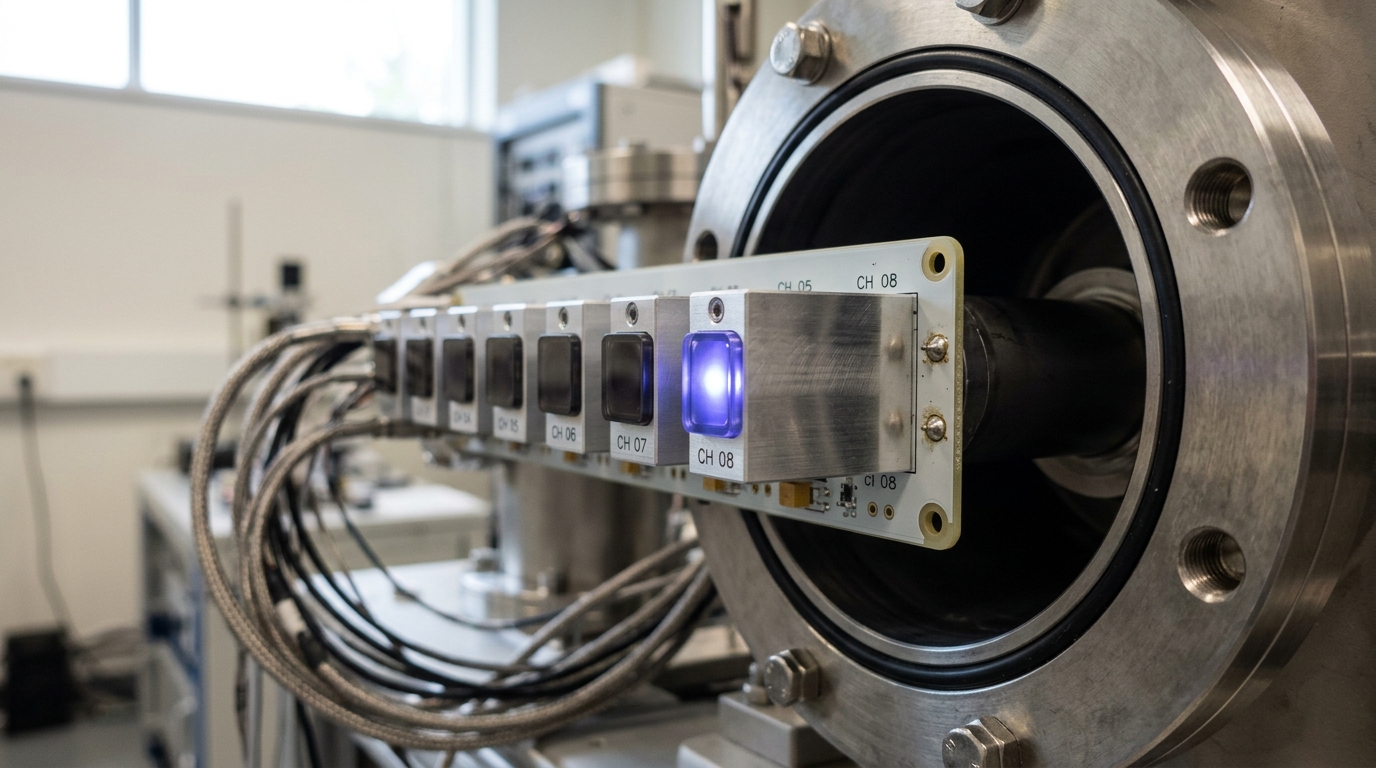
Rutherford was the first to turn the new transformation theory into an actual age. Knowing the rate at which radium produces helium through alpha decay, and able to measure the helium trapped in a radioactive mineral, he calculated an age for a rock in his possession of roughly forty million years by around 1905 [16] — a number that, on its own, was still well within the range Kelvin’s thermal calculations allowed, but the method behind it was the more important result. Rutherford understood immediately that radioactivity solved Kelvin’s other problem as well: Kelvin’s cooling-Earth calculation assumed no internal heat source beyond residual formation heat, and radioactive decay in the Earth’s interior supplied exactly the continuous heat source Kelvin’s model lacked.
The moment is preserved in an anecdote Rutherford told often enough that it survives in multiple biographical accounts: lecturing at the Royal Institution in 1904 with Kelvin in the audience, Rutherford recalled seeing “the old boy” appear to be asleep as he approached the part of his talk where he would point out that Kelvin’s estimate depended on no new source of heat being discovered — and that radium was exactly such a source. Kelvin, in the story, opened one eye and glared, and Rutherford reported diplomatically saying that Kelvin himself had allowed for such a possibility, at which “the old boy beamed upon me” [16]. Whatever the precise theatrics, the substantive point survived the encounter: within a decade, thermal arguments for a short Earth had lost their physical foundation, and the door was open for a nuclear method to replace them rather than merely supplement them.
Boltwood’s uranium-lead ages outran the physics available to defend them
Bertram Boltwood, working independently in the United States, took the transformation theory a step further by recognizing that lead was the final, stable product of uranium’s long decay chain, and that the ratio of lead to uranium remaining in a mineral should therefore record the time since that mineral crystallized. In 1907 he published ages for twenty-six mineral samples calculated on exactly this principle [2]. His initial reported ages, using the decay-rate figures available at the time, ranged from about ninety-two million to five hundred seventy million years; once later workers recalculated the same samples with improved decay constants, the range for the same twenty-six specimens widened considerably, to roughly four hundred ten million years at the low end and about two point two billion years at the high end [16]. That widening on recalculation is itself an early instance of a pattern this article returns to repeatedly: a radiometric age is only as good as the decay constant it is built on, and the honest response to a better-measured constant is to revise the age openly, not to treat the revision as a scandal.
Arthur Holmes took up Boltwood’s method as a career rather than a single paper. His 1913 book, argued forcefully that radioactive methods were superior in principle to the geological and thermal methods then in use, and used them to place the oldest Archean rocks he examined at roughly one point six billion years old [3]. Holmes met sustained resistance from geologists who, decades after Kelvin’s physical arguments had been undercut, still treated Kelvin’s short chronology as the safer default, and his championing of continental drift alongside his radiometric work made him doubly unfashionable among more conservative peers of his generation [4]. By 1927 his published estimates for the Earth’s age had widened to a range of about one point six to three billion years, reflecting both better data and Holmes’s own caution about extrapolating from a still-small sample of dated minerals to the planet as a whole. Holmes kept refining the method regardless, and by the mid-1940s, using new measurements of uranium isotope abundances made by Alfred Nier, he and, independently, Fritz Houtermans arrived at an age for the Earth of about four thousand five hundred million years, plus or minus roughly one hundred million — a value strikingly close to the one that would eventually be confirmed by an entirely different method a decade later [4]. The convergence of two independent approaches — Holmes and Houtermans reasoning from lead-isotope evolution in terrestrial ores, Patterson about to reason from meteorites — on the same number before either could check the other is itself a form of the cross-validation this article treats as the toolkit’s defining virtue, arrived at a decade before the toolkit existed in its modern form.
Patterson needed a rock that had never touched a human hand
The value that finally closed the argument came from meteorites rather than terrestrial rock, for a reason built into the method itself: dating a terrestrial mineral by uranium-lead ratios only gives the age of that mineral’s crystallization, not the age of the planet, because the Earth’s crust has been endlessly recycled. What is needed instead is a sample of the solar system’s original, unfractionated lead — lead that has sat, isolated from any uranium to keep enriching it, since the solar system’s formation — measured against the same primordial lead as it now appears, enriched by billions of years of decay, inside meteorites that do contain uranium. Clair Patterson assembled exactly this comparison using the iron meteorite Canyon Diablo, whose troilite phase contains essentially no uranium and so preserves primordial lead untouched, alongside several stony meteorites whose lead has been progressively enriched by their own uranium decay since formation. Plotting these on a single isochron, Patterson reported an age for the solar system, and by extension the Earth, of four point five five billion years, with an uncertainty of plus or minus seventy million years [1].
Reaching that number took Patterson through a problem as large as the physics itself: industrial lead, mostly from leaded gasoline, had by the 1950s contaminated laboratories, reagents and even the open ocean so thoroughly that Patterson’s own early measurements were swamped by contamination he eventually traced to sources as mundane as the dust on his own hair and clothing [5]. His response was to build what is recognized as one of the first dedicated clean rooms in analytical chemistry — filtered air, acid-washed apparatus, distilled reagents, a discipline of contamination control that geochronology labs still practice today, refined rather than replaced. The fight against lead contamination that made Patterson’s own number trustworthy also, later in his career, made him the leading scientific voice against leaded gasoline itself, but the clean-lab methodology he built to get one meteorite isochron right is the more durable legacy for this article’s purposes: it is the direct ancestor of the clean-lab digestion hoods every modern U-Pb laboratory still uses.

Two decay chains in one mineral is a built-in lie detector
Uranium’s usefulness as a clock is doubled by an accident of nuclear structure: natural uranium consists of two isotopes, uranium-238 and uranium-235, which decay through separate chains to two different stable lead isotopes, lead-206 and lead-207 respectively, at two different, independently measured rates. Uranium-238’s half-life is about four point four seven billion years and uranium-235’s is about seven hundred four million years, values fixed by direct laboratory counting experiments [6] and formally adopted as the field’s working convention shortly after [7]. Because both chains run inside the same mineral grain simultaneously, from the same crystallization event, a single zircon crystal reports two ages that must agree if nothing has disturbed the system since:
where
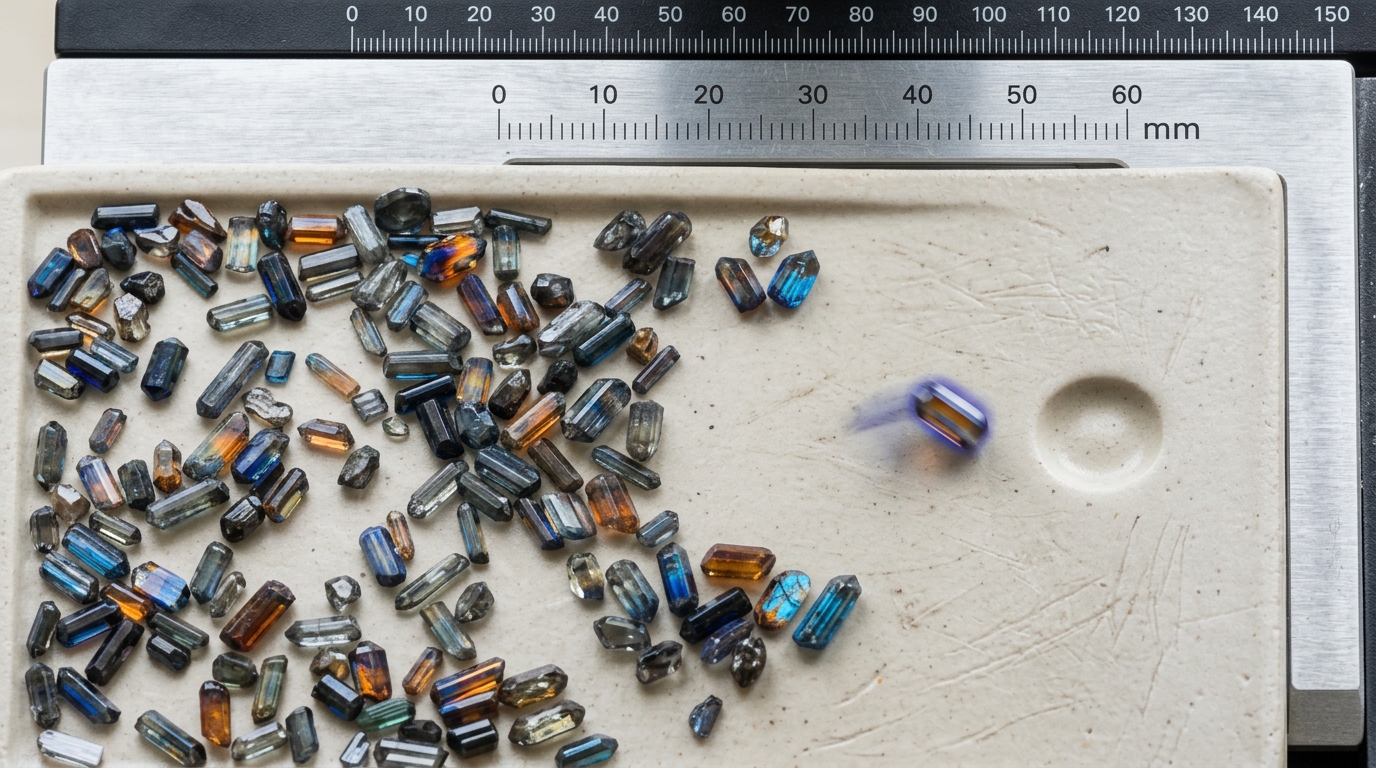
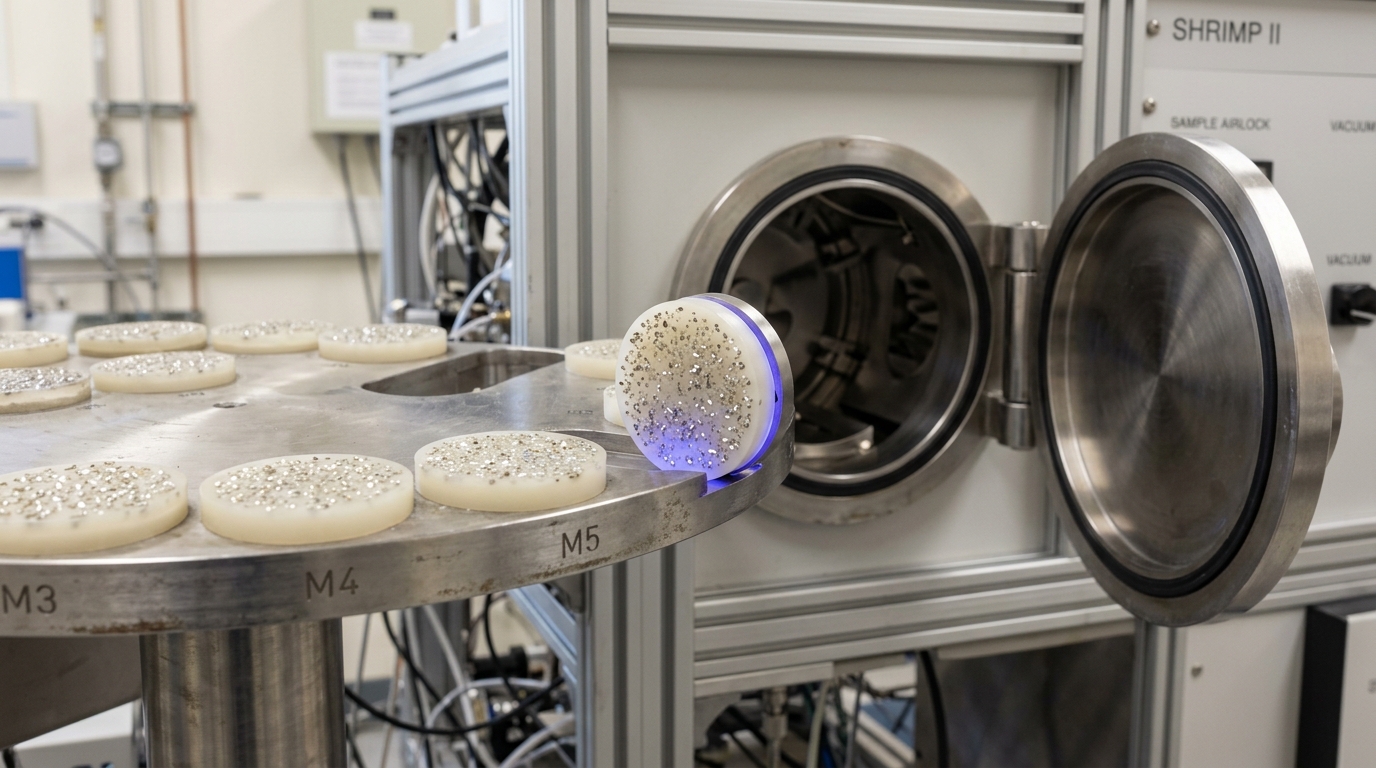
Zircon is the mineral of choice for this method because it incorporates uranium readily during crystallization while almost entirely excluding lead, and because it resists chemical alteration and retains its accumulated lead up to temperatures around nine hundred degrees Celsius [17]. Picking the right individual grains under a polarizing microscope, then digesting and analyzing them either by ion microprobe (SHRIMP) or by isotope-dilution thermal-ionization mass spectrometry after a chemical-abrasion pretreatment that strips away radiation-damaged, lead-leaky domains, now routinely achieves precisions in the range of a tenth of a percent to one percent on the resulting age [17], with the isotope-dilution route depending directly on tracer solutions whose own composition has been calibrated against the International System of Units by the EARTHTIME initiative specifically so that ages measured in different laboratories, on different instruments, in different countries, can be compared without a hidden systematic offset [8].
A disturbed argon spectrum confesses itself
Potassium-argon dating exploits the decay of potassium-40 to argon-40, a noble gas that a mineral retains once it cools below its closure temperature but that a partial reheating event can partially expel. The argon-argon variant improves on the classic method by irradiating the sample with neutrons first, converting a known fraction of potassium-39 into argon-39, so that a single mineral grain’s potassium and argon content can both be read from argon isotope ratios alone, avoiding the need to split the sample for separate potassium and argon measurements. The technique’s real diagnostic power, though, comes from heating the sample in a sequence of increasing temperature steps rather than melting it all at once. Gas released at each step is measured separately and converted to an apparent age; a grain that cooled once, undisturbed since, releases gas of the same age at every step, forming a flat plateau across a run of consecutive steps, while a grain that was later partially reheated or that lost argon unevenly releases gas of varying apparent ages at different steps, producing a staircase or saddle-shaped spectrum instead of a plateau [19].
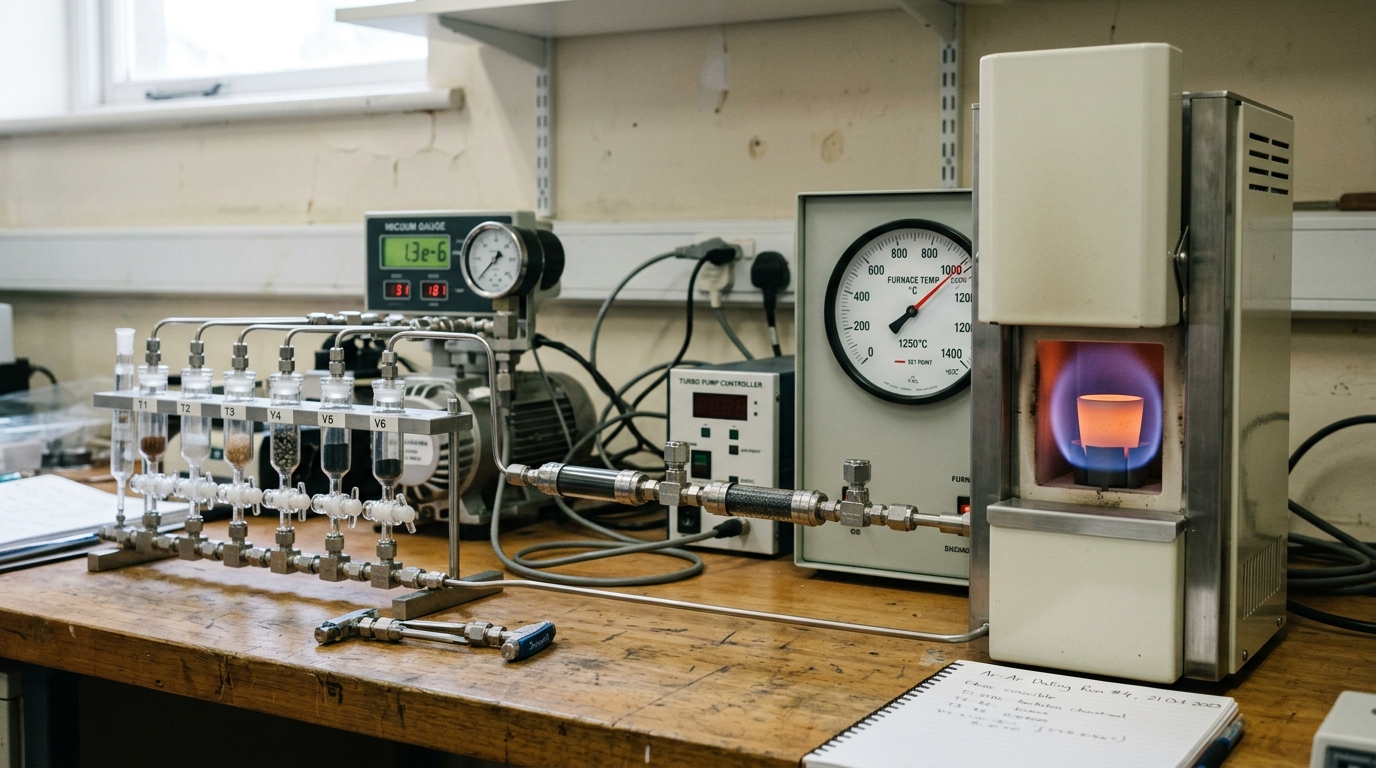
The absence of a plateau is not a failure of the method; it is the method succeeding at a different task, telling the analyst precisely that the sample’s thermal history is more complicated than a single cooling event and, often, roughly when the disturbance occurred, from which steps depart from the others and by how much. A geochronologist reporting an argon-argon age from a disturbed sample without a plateau, or without stating why a partial-plateau age was used instead, is doing the analysis wrong; a geochronologist reporting a clean plateau across the great majority of the gas released, and stating the temperature range it spans, has given the reader the means to judge the age’s reliability directly from the data rather than from reputation.
An isochron’s intercept answers a question you didn’t have to ask
The uranium-lead and argon-argon methods both need to know, or be able to ignore, how much daughter isotope was already present when the mineral formed. The isochron method, used most often with the rubidium-strontium and samarium-neodymium systems, solves this by measuring several minerals from the same rock, each of which crystallized from the same well-mixed magma at the same time and so began with the same strontium or neodymium isotopic composition, but which incorporated different amounts of the radioactive parent isotope depending on their individual chemistry. Plotting each mineral’s present-day ratio of radiogenic daughter to stable reference isotope against its ratio of parent to reference isotope produces a straight line whose slope gives the age and whose intercept gives the initial composition directly:
where
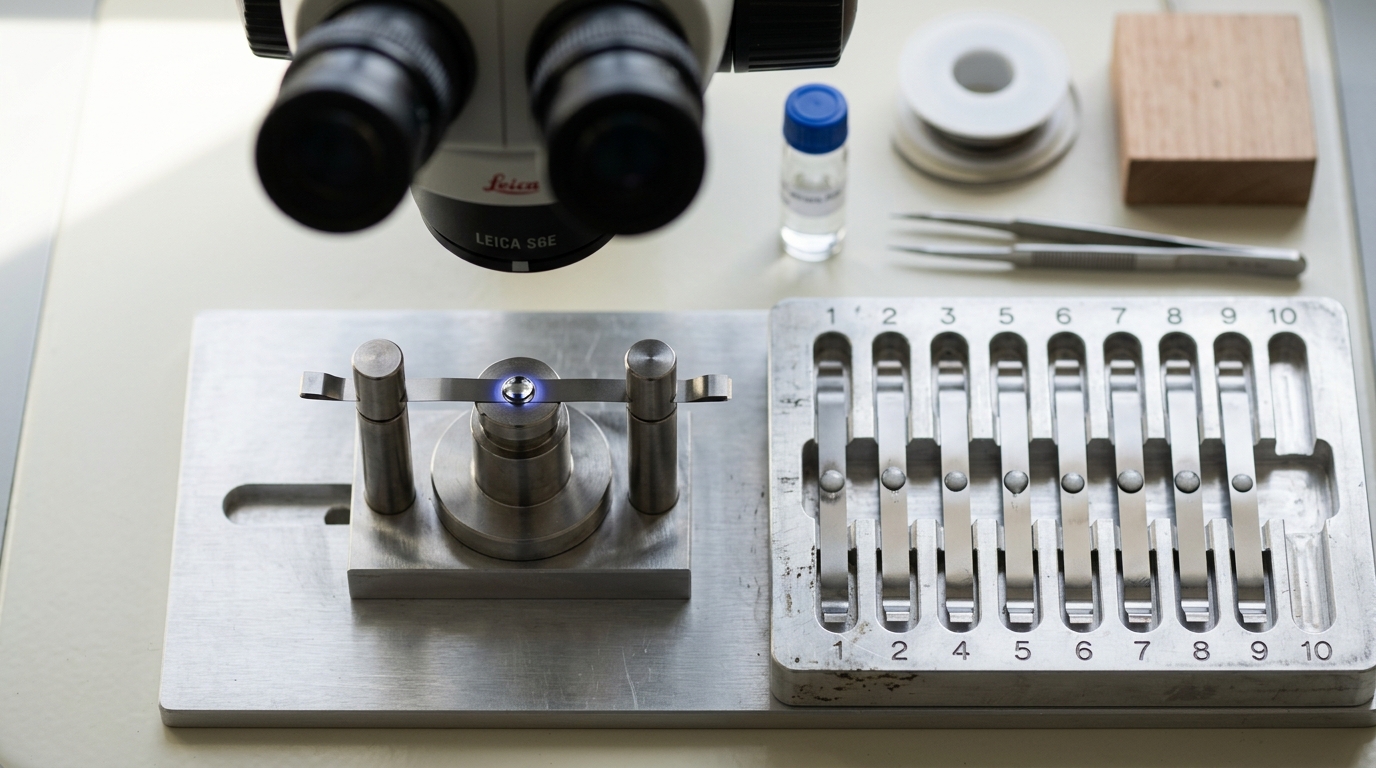
Closure temperature and discordance, across every one of these methods, are understood physical parameters rather than embarrassments to be hidden. Each mineral-isotope system has a characteristic temperature below which it stops losing its accumulated daughter product to diffusion; a rock that cooled slowly through several such temperatures in sequence, in several different minerals, can be dated at each stage of its cooling history rather than producing one contradictory number. A discordant age is data, correctly interpreted, about a second event in a mineral’s history, not a failure of the first measurement.
The rocks evolution actually leans on are dated to the century, geologically speaking
Evolutionary biology does not need radiometric dating to reach into the recent past; it needs the reverse, a method that reaches far enough back and, just as importantly, is honest about how tightly it can pin the intervals that matter most to the fossil record. Radiocarbon dating, useful only out to about fifty thousand years because carbon-14’s roughly five-thousand-seven-hundred-thirty-year half-life renders it undetectable beyond a few tens of thousands of years, plays essentially no role in dating the deep evolutionary record and should not be confused with the uranium, argon and isochron systems described above, whose half-lives run from hundreds of millions to tens of billions of years and whose entire purpose is reaching the other end of the timescale.
The current International Chronostratigraphic Chart places the base of the Cambrian period, and with it the geologically abrupt appearance of most modern animal body plans in the fossil record, at five hundred thirty-eight point eight million years ago, an age itself derived from radiometric dating of ash beds bracketing the boundary [15]. The Cretaceous-Paleogene boundary — the extinction that ended the non-avian dinosaurs — has been dated using argon-argon analysis of the Chicxulub impact melt rock and of ash layers bracketing the boundary directly, with the impact and the boundary shown to be synchronous to within thirty-two thousand years of each other, a precision that ties the impact to the extinction horizon at a resolution close to a hundred-thousandth of the total age involved [13]. The same paper places the boundary itself at sixty-six point zero four three million years, plus or minus forty-three thousand years [16].
The end-Permian mass extinction, the most severe in the fossil record, has received comparably fine treatment. High-precision zircon dating of ash beds within the Siberian Traps lava pile and within the extinction interval itself places the extinction’s onset at two hundred fifty-one point nine four one million years ago and its completion at two hundred fifty-one point eight eight million years ago, a duration of at most about sixty-one thousand years, with the onset of the associated Siberian Traps volcanism dated to two hundred fifty-two point two four million years ago — establishing synchrony between the extinction and the volcanism at roughly four hundredths of a percent precision relative to the ages involved [14]. These are not order-of-magnitude estimates; they are ages known to a precision finer than the duration of many named geological stages, achieved by exactly the two-chain, plateau-checked, isochron-verified toolkit described above.
What critics get right and what they get wrong is a question of measurement
Creation-adjacent criticism of radiometric dating most often targets one of two claims: that decay constants have been shown to vary, undermining every age built on their assumed constancy, or that discordant ages show the method fails whenever it is checked closely. Both claims describe real phenomena inaccurately.
On decay-constant variation: one research group reported an apparent small, periodic modulation in measured decay rates correlated with the Earth’s distance from the Sun, of order a few tenths of a percent [10]. An independent, high-precision counting experiment specifically designed to test the same claim found no such correlation at a comparable sensitivity [11], and the broader counting-physics community has not accepted the original claim as establishing a real solar effect on decay rates; most analyses attribute the reported modulation to seasonal instrumental or environmental artifacts in the original counting setups rather than to new nuclear physics. More decisively, an entirely independent and far older check exists: the Oklo natural fission reactor in Gabon, a uranium deposit that ran as a self-sustaining nuclear reactor roughly two billion years ago, has its isotopic products preserved in the surrounding rock today, and their abundances constrain how much the relevant nuclear decay and reaction rates could have varied over that entire two-billion-year interval to bounds many orders of magnitude tighter than would be needed to move any radiometric age reported in this article by a meaningful amount [12]. A claim that decay rates vary enough to compress the geologic timescale by a factor of a million or more, as some young-Earth proposals require, is not merely unconfirmed; it is directly excluded by evidence from a natural reactor billions of years old, independent of any laboratory measurement made since.
On discordance: as this article has shown at length, a discordant uranium-lead age or a disturbed argon-argon spectrum is not a method failing silently. It is the method’s built-in cross-check succeeding, loudly, at flagging exactly the samples whose simple age would otherwise be untrustworthy — which is why geochronologists report discordant results at all, rather than discarding them, and why the fraction of analyzed grains that are discarded as too discordant to use is itself reported as part of a study’s methodology. A criticism that treats the existence of discordant data as evidence against the method mistakes the method’s diagnostic apparatus for a malfunction.
The maturation of interlaboratory calibration is the quieter, more consequential half of this story. The EARTHTIME initiative’s standardization of isotope tracer solutions to a common, SI-traceable composition means that a zircon age measured in one laboratory can now be compared directly against one measured in another without either lab’s local calibration quietly shifting the comparison [8] — the kind of unglamorous metrological housekeeping that turns a collection of individually careful measurements into a single, internally consistent global record.
Darwin needed time he could not measure; nuclear metrology measured it for him
Darwin’s argument for natural selection required an Earth old enough for the process to work, and he had no way to measure that age himself; he could only note that Kelvin’s physics, if correct, posed a serious problem for his theory and hope that the physics was incomplete. It was. The completion came not from biology but from inside the atomic nucleus: a decay process random at the level of any single atom but statistically exact at the level of a population, discovered by Rutherford and Soddy, turned into a contested age estimate by Boltwood and Holmes against a hostile geological establishment, and finally pinned to four point five five billion years, with an honestly stated uncertainty of plus or minus seventy million years, by Patterson’s meteoritic isochron and the clean-lab discipline he built to defend it. A century of refinement since — two independent decay chains checking each other inside a single zircon, argon spectra that confess their own disturbance, isochrons that solve for their own initial conditions, and tracer solutions calibrated across the world’s laboratories to the same physical standard — has turned that single number into a dense, cross-validated timescale that dates the Cambrian explosion, the end-Permian extinction and the Cretaceous-Paleogene boundary to fractions of a percent, with the error budget disclosed at every step rather than concealed. Evolutionary biology did not build this clock and does not maintain it. It simply inherited, from a century of nuclear metrology answering a question of its own, far more time than it needs, with error bars comfortably narrower than the arguments that depend on them — the deepest working collaboration in science between the very small and the very old.