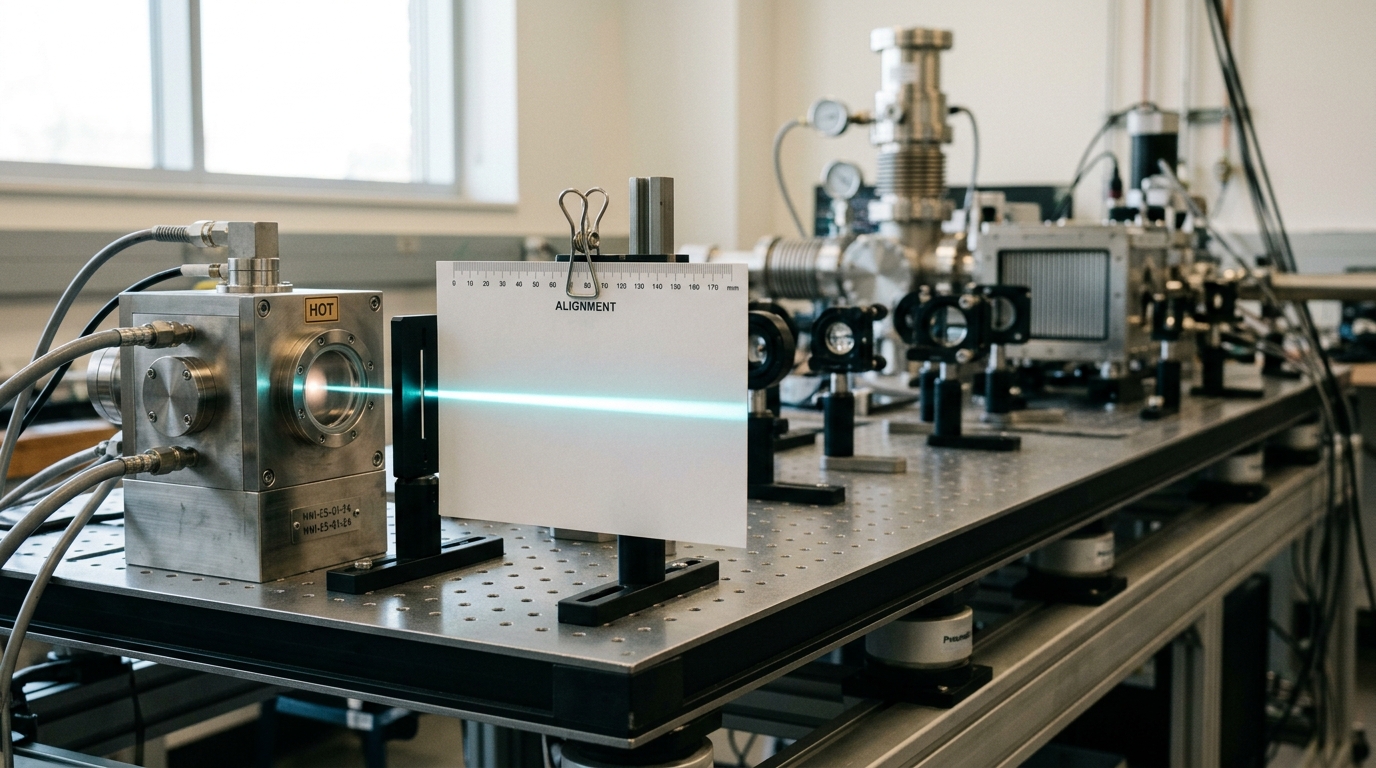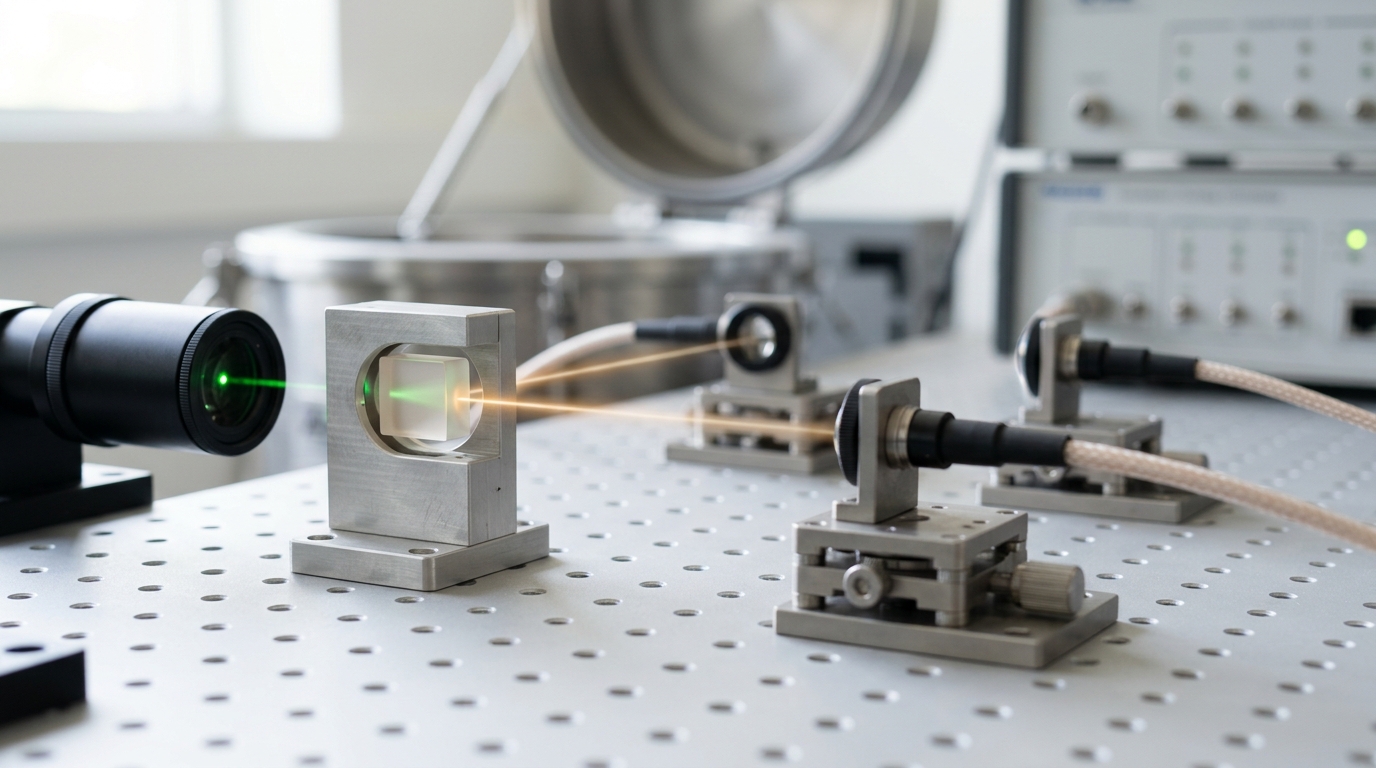
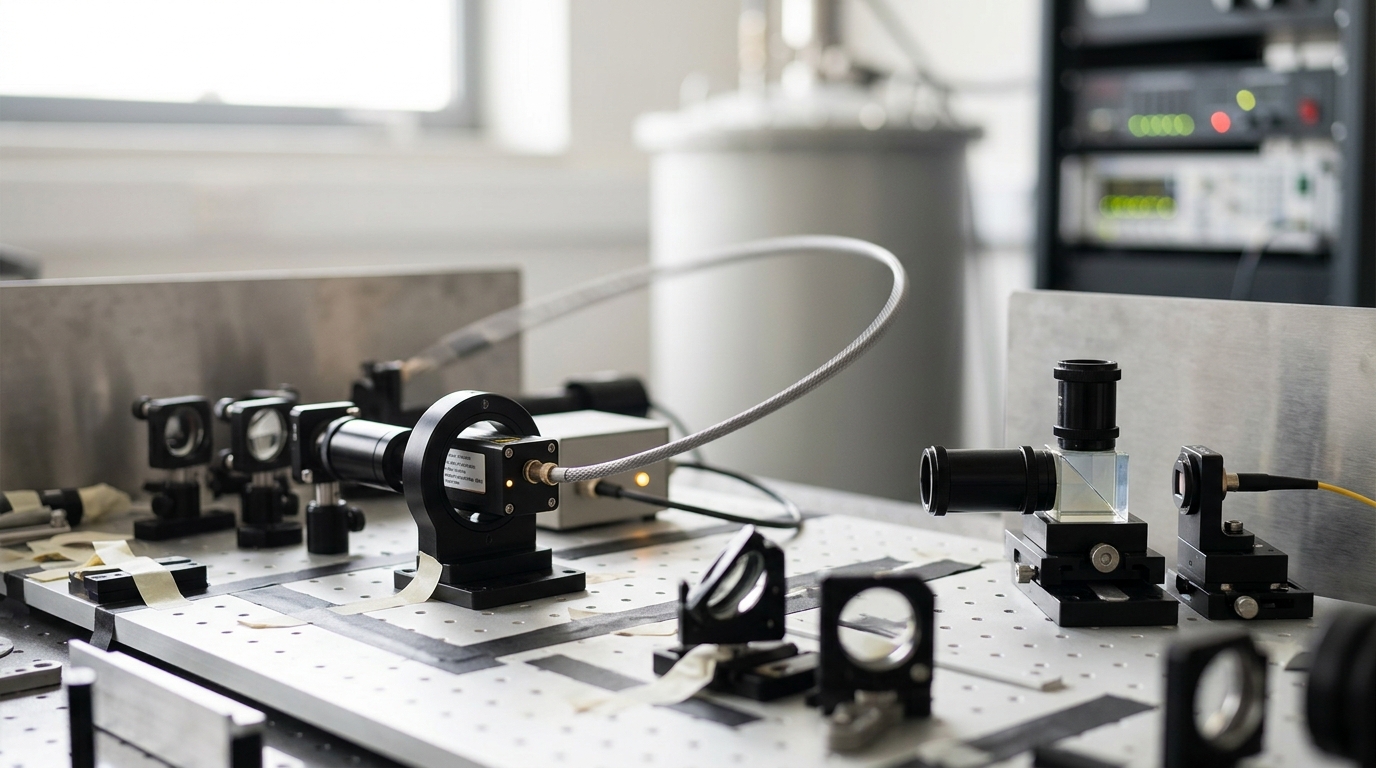
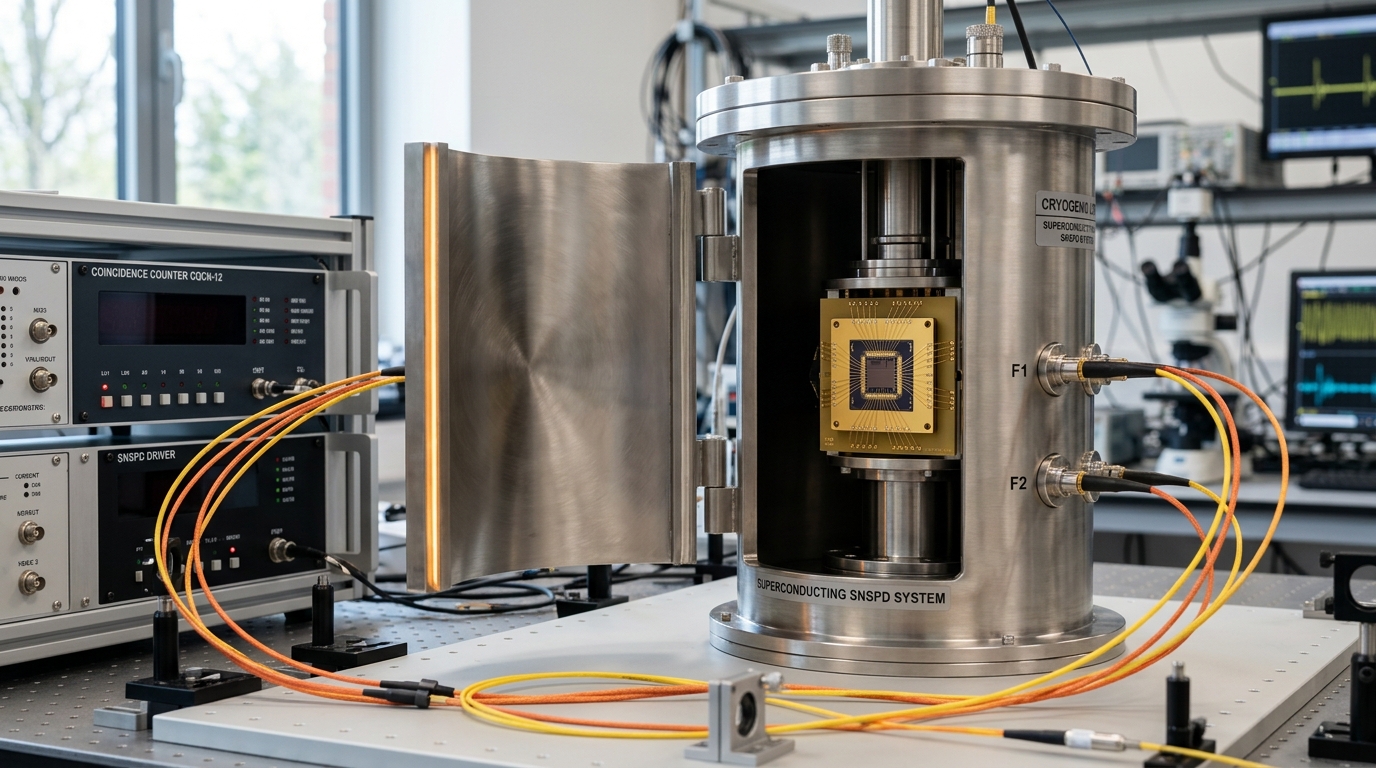
Every working physicist who runs a Bell-test bench agrees, before the run starts, exactly what the coincidence counter will report. They do not agree on what happened between the crystal that produced the photon pair and the detector that clicked. That gap — universal agreement on outcomes, sharp disagreement on mechanism — is the entire subject of quantum foundations, and it is worth being precise about its shape before comparing the candidates that try to fill it.
This article is a comparison, not an argument for a winner. It sets four interpretive families — Copenhagen, Everettian many-worlds, de Broglie-Bohm pilot-wave theory, and objective-collapse models such as GRW — side by side on the dimensions that actually separate them: how each treats the wavefunction, what each says happens during measurement, how each handles contextuality, and, critically, whether each makes an experimentally distinguishable prediction anywhere. Fact, interpretation, analysis, and open question are kept in separate lanes throughout, because the single most common failure in popular writing on this subject is quietly promoting an interpretive preference to the status of an experimental result.
What is actually settled, and what is not
Start with the settled part, because it is smaller than most accounts suggest and it is worth stating precisely. Quantum mechanics gives the Born rule: the probability of a measurement outcome is the squared modulus of a probability amplitude,
for a system in state
What this rules out, precisely, is any theory in which each particle in an entangled pair carries a complete, fixed set of answers to every possible measurement, decided at the moment of creation, combined with the assumption that no influence between the two measurement events can propagate faster than light. It does not rule out non-local hidden-variable theories, which give up the locality assumption instead of the completeness assumption — pilot-wave theory is exactly such a theory, and it survives Bell’s result by design, not by loophole. It also does not, by itself, adjudicate between Copenhagen, many-worlds, and collapse models, because all three already agree with the Bell-violating prediction without needing hidden variables of any kind. The Bell result narrows the field of viable theories; it does not pick among the interpretations that remain viable. Conflating “Bell inequalities are violated” with “many-worlds is confirmed,” or with any single interpretation being confirmed, is a common overreach this article deliberately avoids.
The measurement problem, stated once, precisely
All four interpretations exist to answer one question: the Schrödinger equation is linear and deterministic, so a measuring device coupled to a superposition should itself end up in a superposition of “read outcome A” and “read outcome B” — yet every actual measurement returns one definite outcome. Something in the transition from microscopic superposition to macroscopic definite record is either not fully described by the linear equation, or is being misdescribed by treating “the observer sees one outcome” as a fact about the world rather than a fact relative to something. The four families below are four different diagnoses of that gap.
Copenhagen (in its modern, working-physicist form, distinct from Bohr’s own more austere writings) treats the wavefunction as a bookkeeping device for predicting measurement statistics, not a literal description of an unobserved system. Measurement is a primitive: an interaction with a macroscopic, classically-described apparatus produces one definite outcome, and quantum mechanics does not further explain why that outcome and not another, only its probability. This is the interpretation most working physicists use day to day, largely because it requires no additional postulates about unobserved branches or hidden variables to get useful numbers out of a calculation — but that practical convenience is a fact about physicists’ habits, not a fact that resolves the underlying problem. Critics call this an evasion rather than a solution, since it declares the transition a primitive instead of deriving it.
Everettian many-worlds takes the opposite stance: the Schrödinger equation is the whole story, with no further collapse postulate. When a measuring device interacts with a superposition, the combined system evolves into a superposition of “device recorded A, and an observer-copy who saw A” and “device recorded B, and an observer-copy who saw B.” Each branch is equally real; an observer inside one branch experiences a single definite outcome because that observer is, by construction, only correlated with one branch [7]. This removes the measurement postulate at the cost of an ontology in which every possible outcome of every measurement ever performed actually occurs, somewhere in the universal wavefunction. Its defenders present that as the theory’s virtue — nothing is added to the bare mathematics of quantum mechanics, only subtracted (the collapse postulate). Its critics reply that the theory has not, in fact, been shown to derive the Born rule’s probabilities from the branch structure alone without additional assumptions, and that “probability” is an awkward concept to apply to outcomes that all definitely occur.
De Broglie-Bohm pilot-wave theory keeps the wavefunction as a real physical field, guiding a single, always-definite particle trajectory; the particle has a determinate position at all times, whether or not anyone measures it, and the Born-rule statistics emerge as a statistical distribution over initial positions consistent with a system in “quantum equilibrium” [6]. Measurement is not fundamentally different from any other physical interaction — the apparatus pointer is itself guided by the joint wavefunction of system and apparatus, and it ends up definite because the underlying particles were always definite. The theory is explicitly non-local: the guiding wave for one particle in an entangled pair depends instantaneously on the position of the other, however far away, which is precisely how it reproduces the Bell-violating correlations without violating Bell’s theorem — it gives up locality, not completeness. This non-locality is the standard objection: it sits uneasily, though not in outright logical contradiction, with special relativity, since the theory as usually formulated singles out a preferred simultaneity structure that plays no role in the empirically identical predictions.
Objective-collapse models, of which the Ghirardi-Rimini-Weber (GRW) model is the paradigm
case, take the most direct route: they modify the Schrödinger equation itself, adding a stochastic
term that causes any wavefunction to spontaneously and randomly localize with a small probability
per particle per unit time [5]. For a single particle this collapse rate is negligible on
any timescale of interest. But because the model’s collapse rate scales with the number of
particles in a system, a macroscopic object made of some
Where they agree, and where a real experiment could tell them apart
For essentially every experiment performed to date, all four families agree on the numbers, because the collapse models are tuned to reproduce standard quantum predictions in every regime that has been tested, many-worlds and Copenhagen make identical statistical predictions by construction, and pilot-wave theory is built to be empirically equivalent to standard quantum mechanics for any experiment where the “quantum equilibrium” distribution holds. This equivalence is not an accident or a coincidence to be explained away — it is largely why all four have remained live options for a century’s worth of increasingly precise experiments. The interesting question is where, if anywhere, that equivalence breaks.
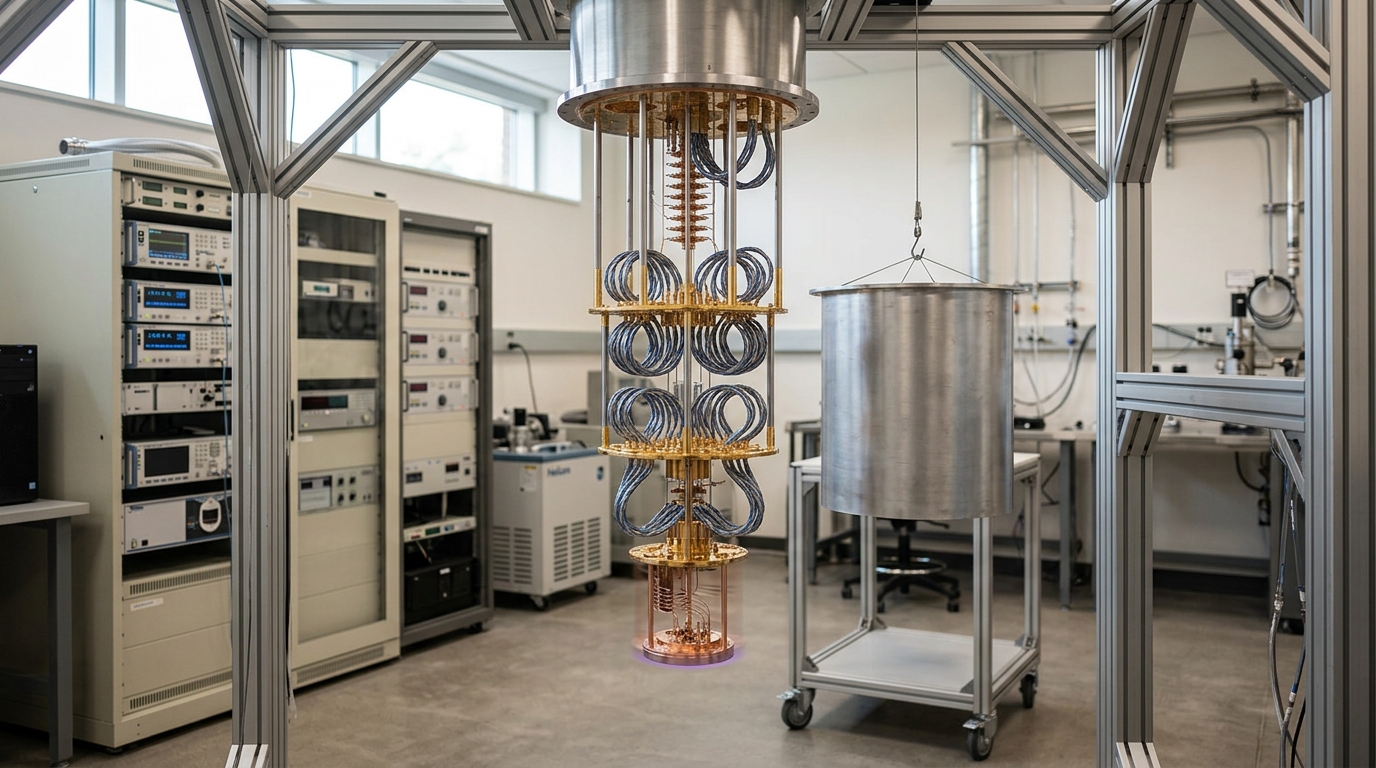
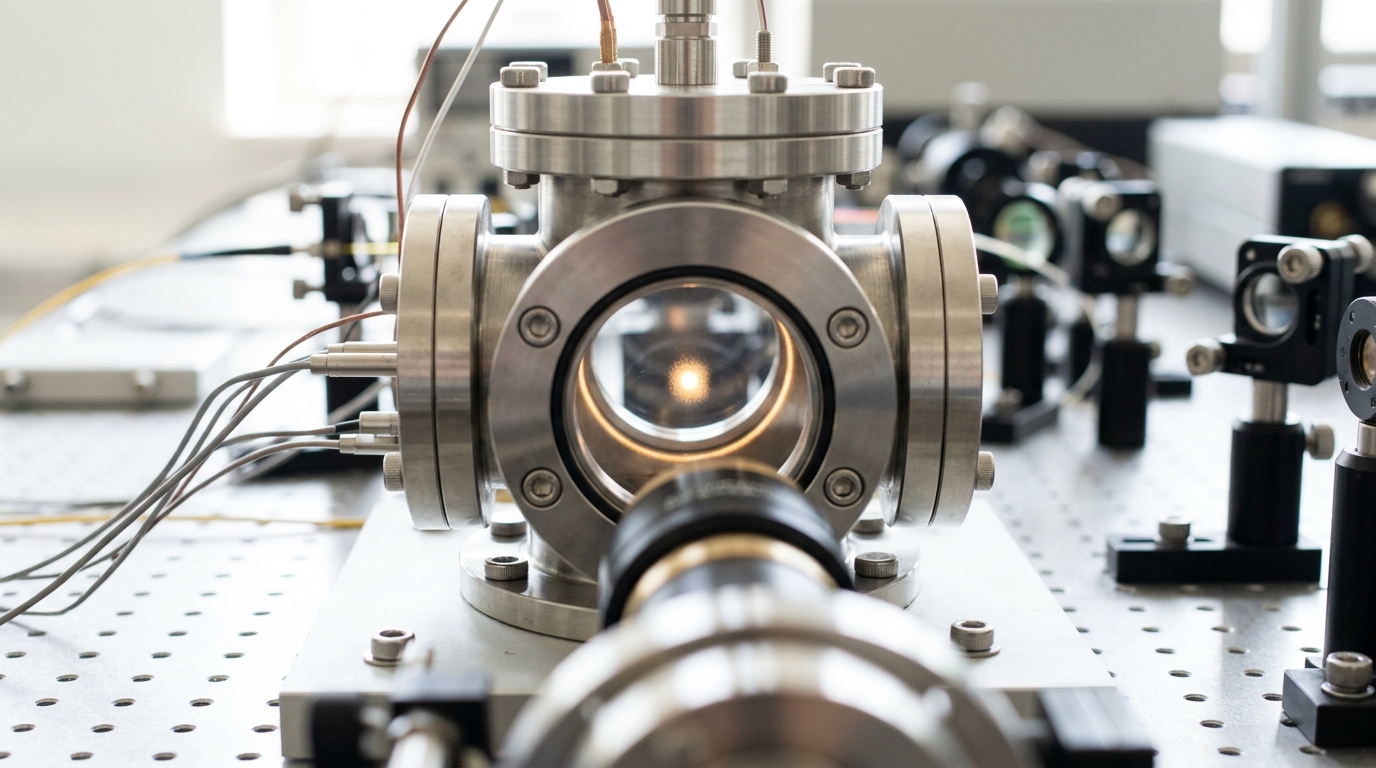
Collapse models give the clearest answer: the added stochastic term predicts a tiny amount of extra heating and decoherence in isolated macroscopic superpositions, growing with the number of particles involved, that standard quantum mechanics (under ordinary environmental decoherence alone) does not predict. Environmental decoherence — a system becoming entangled with, and thereby losing coherence to, an uncontrolled environment — is itself universally agreed physics, extensively reviewed and confirmed as the mechanism by which macroscopic superpositions become practically unobservable even under strictly unitary evolution with no collapse at all [4]. The open experimental question is whether there is additional decoherence beyond what ordinary environmental coupling explains, of the kind collapse models predict, in an isolated system shielded as well as current technology allows. Optically levitated nanoparticle experiments and gravitational-wave detectors, among other precision platforms, have been used to place upper bounds on the collapse parameters of GRW-type models, and a substantial part of the originally proposed parameter space is now experimentally excluded — the models are not falsified, but they are cornered into an ever-smaller range of parameters, and further improvements in isolation and measurement precision continue to close the space [8]. This is squarely in fact-not-interpretation territory: whether a given collapse-model parameter range survives is an empirical question with a definite present-day answer, even though the broader interpretive question — is there a real physical collapse at all — is not settled by ruling out one parameter range.
Many-worlds and pilot-wave theory, by contrast, have no analogous proposed departure from standard quantum predictions under any experiment yet devised; both are explicitly constructed to be empirically indistinguishable from standard quantum mechanics in every accessible regime, which is a strength for parsimony arguments and a permanent limitation for direct falsification. Some theorists have proposed that a sufficiently well-isolated interference experiment involving an observer’s own memory state could in principle distinguish many-worlds-type branching from genuine collapse, but no such experiment is currently feasible, and it remains a thought experiment rather than a a running program. This is worth stating plainly as a scenario rather than a prediction: it has no timeline, depends on isolation and control of an observer-scale quantum system that is many orders of magnitude beyond current capability, and its disconfirmation condition — that no detectable difference ever appears no matter how well isolated the system becomes — is unfalsifiable in practice, which is itself the standard objection raised against treating many-worlds as a scientific theory in Karl Popper’s narrow sense, as opposed to a metaphysically economical reading of an otherwise-agreed formalism.
Contextuality: a second, independent no-go result
Bell’s theorem is about correlations between spatially separated systems. A second and logically independent family of results, stemming from the Kochen-Specker theorem, shows that even a single system, measured through different but “compatible” observables in different orders, cannot be given a consistent assignment of pre-existing values to all its observables at once — the outcome of one measurement depends on which other, compatible measurement is performed alongside it, a property called contextuality. This was originally a mathematical no-go theorem about sufficiently high-dimensional quantum systems, difficult to test directly, but subsequent work found simpler “non-contextuality inequalities” that are directly measurable, and these have been violated experimentally with sequential measurements on single photonic qutrits, matching the quantum prediction and excluding non-contextual hidden-variable models even after correcting for experimental imperfection [10].
Contextuality is where the four interpretations again mostly agree on the physics and diverge on the story. Copenhagen treats it as simply confirming that quantum observables do not have pre-measurement values at all — there is nothing to be contextual about until a measurement context is specified, so the result is unsurprising by construction. Many-worlds treats it similarly: only the relative, branch-indexed outcome is meaningful, and no observable has a single absolute pre-existing value across branches to be contextual or not. Pilot-wave theory is the interesting case, because its particles do have definite pre-existing positions at all times — but the theory is explicitly, famously contextual: the outcome an apparatus reports for a given “observable” depends on the full experimental arrangement used to measure it, not on some pre-existing value intrinsic to the particle alone, which is exactly how the theory evades being a non-contextual hidden-variable model of the kind Kochen-Specker rules out. Collapse models inherit whatever contextuality standard quantum mechanics already has in the regime before an actual collapse event intervenes. No interpretation here is challenged by the contextuality results in a way that favors one over another; the results instead jointly close off an entire class of simpler alternatives — hidden-variable theories that assign fixed, context-independent values to all observables — that none of the four families under comparison ever proposed in the first place.
Wigner’s friend, and what a “strong” version rules out
A more recent line of experiment revisits Eugene Wigner’s old thought experiment: an observer (“the friend”) inside a sealed lab makes a measurement, and a second observer (Wigner) outside treats the entire lab, friend included, as a single quantum system still in superposition until Wigner himself measures it. Standard quantum mechanics allows this only if the friend’s own “the measurement already happened, I saw one outcome” experience is not treated as an absolute fact about the world, but as relative to Wigner’s own measurement — precisely the kind of relational move many-worlds and, in a different way, Copenhagen already make peace with, and pilot-wave and collapse theories resist, since both posit a genuinely definite outcome for the friend independent of what Wigner later does. An extended, “strong” version of this thought experiment has now been run as an actual entangled-photon experiment, proving a theorem that at least one of three assumptions must fail: that measurement outcomes are absolute rather than observer-relative, that no influence propagates outside an event’s future light cone, and that experimenters can freely choose their measurement settings [9]. This is a genuine, additional experimental constraint beyond Bell’s theorem — it is logically independent and strictly stronger under its own assumptions — but it is also, like Bell’s theorem, a result about which combination of assumptions must be abandoned, not a verdict on which interpretation is correct: Copenhagen and many-worlds each already reject the “absoluteness of observed events” assumption in their own distinct ways, and both remain consistent with the result, while a fully deterministic non-local theory such as pilot-wave mechanics accommodates it by giving up locality, which it had already given up to satisfy Bell.
What is fact, what is interpretation, and what is still open
To collect the article’s central distinctions in one place: it is a fact, checked to high statistical confidence in loophole-free experiments, that entangled-photon and entangled-spin correlations violate Bell’s inequality and match the quantum prediction [2, 3]. It is a fact that single-system contextuality inequalities are also violated, ruling out non-contextual hidden-variable models [10]. It is a fact that environmental decoherence, on its own, explains why macroscopic superpositions are never observed in practice, entirely within standard unitary quantum mechanics and without invoking any interpretation’s account of measurement [4]. It is an interpretive claim, not a further experimental fact, that these results favor many-worlds, or Copenhagen, or pilot-wave theory, since all three already predicted the same numbers before the experiments ran. It is an open empirical question, with a narrowing but not yet closed answer, whether objective-collapse dynamics of the GRW type exist at some still-untested parameter range, and current levitated-nanoparticle and precision-metrology bounds continue to shrink, without yet eliminating, the space where such a model could be true [8]. And it is a matter of ongoing, genuine disagreement among physicists working in foundations — not a settled question awaiting a popular-science answer — which of Copenhagen, many-worlds, and pilot-wave theory should be preferred among the empirically equivalent options, a disagreement that turns on parsimony, determinism, locality, and what counts as an acceptable primitive in a physical theory, not on any experiment run to date.
A reasonable forecast, stated as a scenario rather than a prediction: over the next decade, levitated-nanoparticle and optomechanical experiments will likely push the excluded region of collapse-model parameter space further, and it is plausible — though not guaranteed, since it depends on technical progress in isolation and readout precision that has repeatedly outpaced or lagged projections in this field before — that the simplest GRW-type models with parameters chosen to explain the classical world without fine-tuning will be either confirmed or excluded outright within that window. The observable indicator to watch is the reported upper bound on the model’s collapse rate parameter in successive levitated-optomechanics papers; the disconfirmation condition for the “GRW will be excluded soon” scenario is a bound that stalls at its current order of magnitude for several more years running, which would instead suggest the remaining parameter space is harder to close than currently projected. No comparable near-term experimental test exists for choosing among Copenhagen, many-worlds, and pilot-wave theory, and none is currently proposed that does not depend on capabilities far beyond present reach; that disagreement should be expected to remain a live, unresolved one within physics for the foreseeable future, and treated as such.