Two inventions, one popular conflation
Ask most people what made the integrated circuit possible, and the answer, if they have one at all, tends to name a single hero and a single moment. The actual history has two distinct inventions, a year apart, solving two different problems — and popular accounts routinely credit only one, or blur the two together.
What Jack Kilby actually did
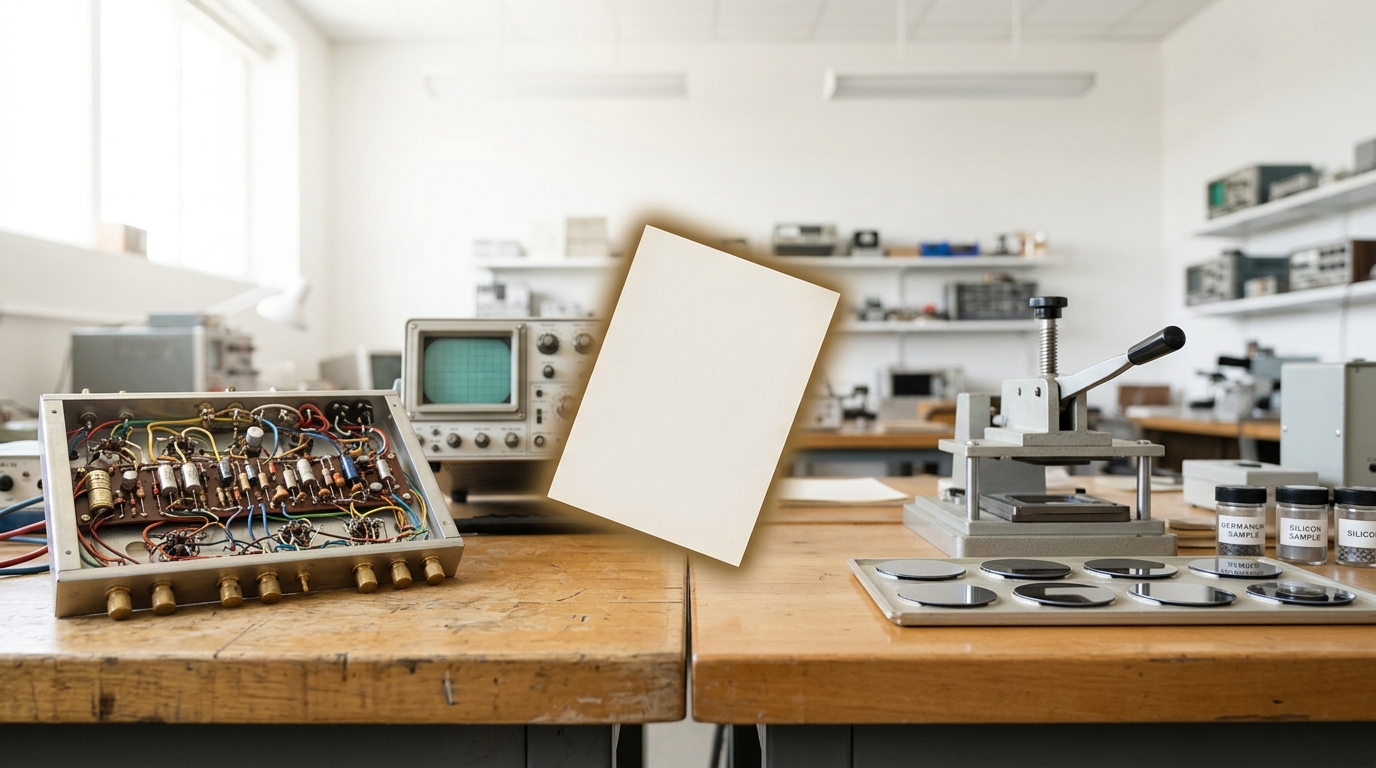
In 1958, Jack Kilby at Texas Instruments demonstrated the first working integrated circuit — proving, for the first time, that multiple electronic components could be built onto a single piece of semiconductor material rather than wired together from separate discrete parts [1]. Kilby’s device used germanium, and the components were connected with fine wires by hand. It was a genuine, world-first proof of concept: the integrated circuit concept was real and it worked.

What Robert Noyce actually did, a year later
Kilby’s device, hand-wired and built one at a time, could not be mass-produced economically. In 1959, Robert Noyce at Fairchild Semiconductor — one of the Fairchild Eight covered in this cohort’s companion briefing — invented the planar process: a technique for manufacturing integrated circuits on silicon using a flat, repeatable, photographically masked process that could, for the first time, be reliably reproduced at scale [2]. This was a manufacturing invention, not a conceptual one — it did not prove the integrated circuit could work, since Kilby had already done that; it proved the integrated circuit could be built identically, over and over, cheaply enough to become a commercial product.
Why conflating the two matters
Crediting “the invention of the integrated circuit” to a single person or a single moment obscures a pattern this cohort has documented repeatedly across the modern industry: a conceptual breakthrough and a manufacturing breakthrough are separate achievements, and the manufacturing breakthrough is frequently the one that actually determines whether a technology reshapes an industry. This cohort’s foundry-track briefings make the same point about TSMC’s 1987 founding — the pure-play foundry model was a manufacturing and business-model innovation layered on top of already-existing chip-design capability, not a new circuit concept [3].
Why this distinction is worth carrying into every other briefing in this cohort
Every company profiled elsewhere in this cohort sits somewhere on this same spectrum: some, like the AI-chip startups in this cohort’s Track D, are primarily conceptual and architectural innovators; others, like TSMC or the equipment makers in this cohort’s Track E, are primarily manufacturing innovators making an already-proven concept reproducible at scale. Kilby and Noyce are the clearest, earliest illustration of why both kinds of innovation matter, and why history too often remembers only the first kind [4].
Why Kilby is more often remembered than Noyce, and why that’s backward
Kilby’s 1958 demonstration has the cleaner, more tellable story — a single dramatic proof that a new kind of device could exist at all, the kind of narrative popular science writing gravitates toward naturally. Noyce’s planar process is a harder story to tell well: it is about manufacturing repeatability, photographic masking, and yield, none of which lends itself to a single dramatic demonstration moment the way Kilby’s device does. That asymmetry in how tellable each story is has shaped popular memory more than the two inventions’ actual relative importance to the industry that followed — by most measures used throughout this cohort’s own coverage, Noyce’s manufacturing innovation is the one that actually determined whether integrated circuits became a mass-market technology at all.
A closing correction worth repeating
Kilby later shared a Nobel Prize in Physics for his contribution; Noyce, who died in 1990, was never awarded one, since Nobel Prizes are not given posthumously. That historical accident of timing — not a judgment about the relative importance of the two contributions — is part of why Kilby’s name persists more prominently in popular accounts than Noyce’s does, despite the planar process arguably having the larger downstream industrial impact of the two — a small historical injustice worth correcting every time the story gets retold.
What this correction is not asking a reader to conclude
None of this is an argument that Kilby’s contribution was somehow lesser, or that his Nobel Prize was undeserved. Both things can be true at once: Kilby’s demonstration was a genuine, world-first proof that the integrated-circuit concept worked at all, and Noyce’s planar process was the separate, later innovation that determined whether that concept could ever leave the laboratory bench. The correction this briefing argues for is narrower and more precise than “credit the other guy instead” — it is simply that popular history should credit both inventions accurately, for the specific and different problems each one actually solved, rather than collapsing two separate 1958 and 1959 achievements into one simplified, single-inventor origin story.