Six benches, six different bundles
Ask six laboratories whether their newest model is open, and six will say yes. That is not useful information. A release is a bundle of separately grantable permissions over separately releasable artefacts — weights, inference code, training code, training data, and the evaluation and post-training recipe — and the label “open” says nothing on its own about which of those actually shipped, or under what terms. The Open Source Initiative puts the asymmetry plainly: weights alone do not include the training code, the training dataset, or comprehensive data transparency, so a weights-only release “only provides a glimpse into the final state of the model” [14]. That is the right frame in the abstract. This article does not restate it in the abstract; it applies it to six named releases that between them account for most of what a developer actually downloads in 2026: Meta’s Llama, Mistral AI’s models, DeepSeek’s, Alibaba’s Qwen, Google’s Gemma, and the Allen Institute for AI’s OLMo.
Read the license text and the model cards side by side, rather than the announcement blog posts, and a pattern appears that a glance at any single release would miss. “Open” currently spans at least three genuinely different commitments — a permissive license with no field-of-use or scale restriction, a permissive license paired with an incomplete artefact set, and a small number of cases where the license itself changed regime within the past year. None of the six families has sat still. What follows takes each on its own terms, quotes the operative clause rather than a paraphrase of it, and states plainly which artefacts left the building. The comparison that survives contact with the primary documents is not a ranking. It is six different answers to a small number of separable questions: what license governs the weights, does that license restrict fields of use or classes of user, and what — beyond the weights — was actually published.
Llama: a broad grant, one hard line, one small tax
Meta’s current release is governed by the Llama 4 Community License Agreement, in force since the Llama 4 models shipped in April 2025 [1]. The grant itself is wide: a “non-exclusive, worldwide, non-transferable and royalty-free limited license under Meta’s intellectual property or other rights owned by Meta embodied in the Llama Materials to use, reproduce, distribute, copy, create derivative works of, and make modifications to the Llama Materials” [1]. Read alone, that sentence would place Llama close to a standard permissive license. Two further clauses move it away from one.
The first is a scale threshold. The license states that “if, on the Llama 4 version release date, the monthly active users of the products or services made available by or for Licensee, or Licensee’s affiliates, is greater than 700 million monthly active users in the preceding calendar month, you must request a license from Meta” [1]. Meta may grant or withhold that separate license at its own discretion; the agreement does not commit Meta to approve it. For the overwhelming majority of licensees this clause never binds — but it is a discriminatory clause in the specific technical sense the software definitions use: it singles out a class of licensee, defined by size, and requires them to negotiate terms the rest of the field does not need. It also means that whether Llama is “open” for a given company is a question with a company-specific answer.
The second is a naming and attribution obligation that travels with every derivative. Distributors must “prominently display ‘Built with Llama’” [1], and separately, “if you use the Llama Materials or any outputs or results of the Llama Materials to create, train, fine tune, or otherwise improve an AI model, which is distributed or made available, you shall also include ‘Llama’ at the beginning of any such AI model name” [1]. Neither obligation is onerous to comply with, but both are conditions a plain Apache or MIT grant does not impose, and both bind the derivative, not just the original download.
One piece of context belongs here because it changes how the Llama license should be read going forward, not backward: Llama 4 remains, as of this writing, the newest Llama release under this license. In April 2026, Meta’s Superintelligence Labs shipped Muse Spark, its first frontier model built outside the Llama line, as a fully closed system with no weights released at all — a genuine departure from the open-release pattern Llama had set since 2023. That closure did not hold. On 10 August 2026 Meta released Muse Glimmer, a 30-billion-parameter model distilled from Muse Spark, “released under a highly permissive Apache 2.0 license,” with the company’s Superintelligence chief stating that open weights for Muse Spark itself would follow [17]. The practical upshot is that Meta currently has two live open-weight license regimes running in the same building — the Llama 4 Community License on Llama 4, and plain Apache 2.0 on the newer Muse line — which is itself a small instance of this article’s larger point: a company’s licensing posture is not a fixed trait, and asking “is Meta open” without naming a specific release no longer has a stable answer.
Mistral: two licenses under one name, and a third category with no weights at all
Mistral AI’s licensing history runs in the opposite direction from Meta’s, from more restrictive to less. When Mistral released Codestral in May 2024, it shipped under the newly written Mistral AI Non-Production License. That license defines a “Non-Production Environment” as “any setting, use case, or application of the Mistral Models or Derivatives that expressly excludes live, real-world conditions, commercial operations, revenue-generating activities, or direct interactions with or impacts on end users,” and its core restriction states plainly that a licensee “shall not supply the Mistral Models or Derivatives in the course of a commercial activity, whether in return for payment or free of charge, in any medium or form, including but not limited to through a hosted or managed service (e.g. SaaS, cloud instances, etc.), or behind a software layer” [2]. That is a field-of-use restriction of the strictest kind available: not a cap on scale, as with Llama or Qwen, but a blanket prohibition on any commercial use whatsoever without a separate, discretionary agreement from Mistral.
That was 2024. By December 2025, Mistral’s posture had reversed for its mainline releases. Announcing the Mistral 3 family — Mistral Large 3 and the Ministral 3 series across three parameter sizes — the company stated without qualification that “all models are released under the Apache 2.0 license” [3], a standard OSI-approved permissive license with no field-of-use or scale restriction of any kind.
The current picture is therefore not simply “Mistral switched licenses.” It is a genuine mix, but not the same mix the MNPL era produced. Most currently shipping Mistral sizes, including the flagship-scale Large 3, are Apache 2.0. A separate top-tier “premier” line — Magistral Medium, at the time of writing — is not released as weights under any license at all; it is offered exclusively through Mistral’s own metered API, which is a stricter posture than any license text, since no license permission is even at issue when there is no artefact to license. The practical spread across one company’s current catalogue therefore covers three distinct positions: unrestricted open weights, no weights, and — for models still carrying the 2024-era MNPL such as some Codestral builds still in circulation — weights available but commercial use categorically excluded pending a separate agreement.
DeepSeek: from a use-restricted custom license to plain MIT
DeepSeek’s earliest releases did not ship under MIT, despite that now being the association most engineers hold in mind. The DeepSeek License Agreement, version 1.0, dated 23 October 2023, granted a “perpetual, worldwide, non-exclusive, no-charge, royalty-free, irrevocable copyright license to reproduce, prepare, publicly display, publicly perform, sublicense, and distribute” the model and related materials, but conditioned that grant on a set of use restrictions listed in an Attachment A, including prohibitions on military applications, harm to minors, and content whose purpose is verifiably false information intended to harm others, together with a requirement that any distributor “include as an enforceable provision” those same restrictions in downstream agreements with their own recipients, all governed by PRC law with Hangzhou courts holding exclusive jurisdiction [4]. Structurally, that combination — a broad grant plus enforceable, contractually propagated use restrictions — closely parallels Meta’s and Google’s field-of-use clauses, even though it comes from a different jurisdiction and a company with a very different public reputation for openness.
The license changed with the model line. DeepSeek-R1’s own model card states without qualification: “This code repository and the model weights are licensed under the MIT License. DeepSeek-R1 series support commercial use, allow for any modifications and derivative works, including, but not limited to, distillation for training other LLMs” [5]. That is a clean, complete move to a standard OSI-approved permissive license, with no field-of-use restriction and no scale threshold — a stricter grant to the public than either Llama’s or (pre-2025) Mistral’s. Every DeepSeek flagship released since, through the V3.1 and V3.2 line, has kept that MIT license on both code and weights.
What did not change is the artefact set beyond the weights. Alongside the 671-billion-parameter, 37-billion-activated mixture-of-experts DeepSeek-V3, trained on 14.8 trillion tokens, DeepSeek published a technical report describing the architecture — multi-head latent attention and an auxiliary-loss-free load-balancing strategy among its stated innovations — and the reported training compute of 2.788 million H800 GPU hours [6]. A technical report is real disclosure and it is not the same artefact as the training data or the training code. It tells a reader what was done; it does not hand them what they would need to redo it. DeepSeek’s release is therefore best described precisely: weights and inference code under an unrestricted permissive license, plus a public paper, with no training data and no training pipeline released.
Qwen: Apache 2.0 above a line that Alibaba has since erased
Alibaba’s Qwen family illustrates the scale-threshold pattern from a different angle than Llama’s, because the threshold applied to only part of the family and has since been removed for current releases. The Tongyi Qianwen License Agreement, which governed Qwen and Qwen2 at the 72-billion-parameter size, states in its commercial-use clause: “If you are commercially using the Materials, and your product or service has more than 100 million monthly active users, You shall request a license from Us” [7]. Smaller sizes in the same generation — 7B, 14B, and others — shipped under plain Apache 2.0 even while the flagship 72B size sat behind that threshold, so within a single Qwen generation, the license a developer received depended on which checkpoint they downloaded.
That split no longer exists in the current generation. Qwen3, released in 2025 across dense and mixture-of-experts architectures spanning roughly 0.6 to 235 billion parameters, ships every public size — including the largest, Qwen3-235B-A22B — under plain Apache 2.0; the model’s own Hugging Face card lists the license simply as apache-2.0, with no accompanying use-scale agreement [8]. The accompanying Qwen3 technical report documents an integrated “thinking” and “non-thinking” mode and an expansion of supported languages from 29 to 119 [9], but — exactly as with DeepSeek — the report is a description of the training process, not the data or code needed to reproduce it. Qwen’s current release therefore sits in the same artefact category as DeepSeek’s: unrestricted permissive weights and code, plus a paper, without training data or training pipeline code. The Open Source Initiative’s own test for a stronger claim is specific — “sufficiently detailed information about the data used to train the system so that a skilled person can build a substantially equivalent system” [15] — and a technical report, however detailed, is not written to clear that bar; it is written to explain results to peers, not to hand over a reproduction recipe.
Gemma: the license itself changed brands within the family
Google’s Gemma line makes the point that a brand name is not a stable proxy for a license more starkly than any other family here, because both the old and the new regime are current at the same time, attached to different sizes. Gemma 1 through 3 shipped under the Gemma Terms of Use, which grant that “you may use, reproduce, modify, Distribute, perform or display any of the Gemma Services only in accordance with the terms of this Agreement” [10] — a grant already narrower in form than a license, since it is framed as conditional throughout rather than as an unconditional permission with listed exceptions. The agreement incorporates by reference “the restricted uses set forth in the Gemma Prohibited Use Policy at ai.google.dev/gemma/prohibited_use_policy (‘Prohibited Use Policy’), which is hereby incorporated by reference into this Agreement” [10] — meaning the actual scope of permitted use is defined by a second document Google can revise without reissuing the license itself. The agreement further states that “Google reserves the right to restrict (remotely or otherwise) usage of any of the Gemma Services that Google reasonably believes are in violation of this Agreement” [10], a residual control right no plain permissive license grants the licensor, and requires that any distributor “include the use restrictions referenced in Section 3.2 as an enforceable provision in any agreement… governing the use and/or distribution of Gemma or Model Derivatives” [10], propagating the restriction through every fork.
In April 2026, that regime changed for the newest size. Announcing Gemma 4 across four model sizes up to 31 billion dense parameters, Google’s own open-source blog stated that “the industry-standard Apache license broadens the horizon for Gemma 4’s applicability and usefulness, providing well-understood terms for modification, reuse, and further development” [11] — dropping the Prohibited Use Policy incorporation, the remote-restriction clause, and the downstream flow-through requirement that had defined the Gemma Terms of Use since Gemma 1. The result, current as of this article, is that “Gemma” no longer names one license. Gemma 1 through 3 weights already downloaded and deployed remain governed by the older, more conditional terms; Gemma 4 is governed by plain Apache 2.0. A developer who standardized on “Gemma” as shorthand for a specific set of obligations was, within one release cycle, wrong about which obligations applied to the newest download carrying that name.
OLMo: the release that treats the other five as a floor, not a target
Every family above ships weights and, in most cases, inference code, under some license. None of them, on its own weights-and-code release, gives an outside party what they would need to rebuild the model from scratch or audit what went into training it. AI2’s OLMo line is the one release among the six built specifically to close that gap, and its most recent generation, Olmo 3, states the ambition directly: the goal, per AI2’s own announcement, is “the entire model flow and full traceability back to training data,” meaning “every stage, checkpoint, dataset, and dependency required to create and modify it” [12].
Released in November 2025 at 7-billion and 32-billion parameter scales, with an update in December 2025, Olmo 3 ships under Apache 2.0 across the family, with no field-of-use or scale restriction [12]. What sets the release apart is not the license — Qwen3, current Mistral, and DeepSeek all match Apache 2.0’s permissiveness — but the artefact list attached to it. AI2 published the pretraining and mid-training corpora themselves (Dolma 3 at roughly 9.3 trillion tokens, plus the Dolma 3 Mix, Dolmino, and Dolci datasets used at later training stages), stating explicitly that “we’re making every training and fine-tuning dataset available for download without any license restrictions” [12]. Alongside the data, AI2 released the training and post-training code itself — named tools including Olmo-core, Open Instruct, datamap-rs, duplodocus, OLMES, and decon — plus checkpoints at multiple stages of training rather than only the finished model [12]. That combination is the same one the prior OLMo 2 generation established and that its own paper opens by naming directly: “we present OLMo 2, the next generation of our fully open language models” [13].
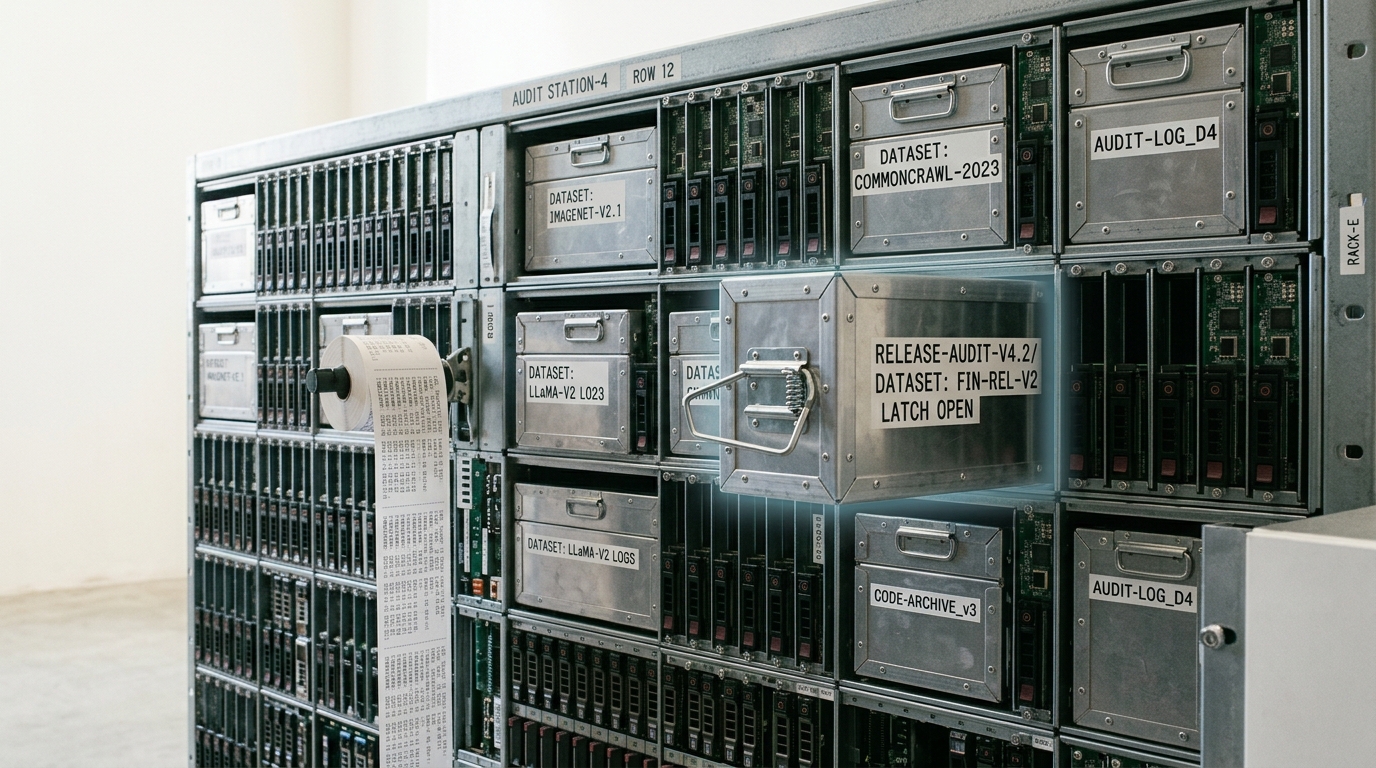
This is also the one release among the six that clears the Open Source Initiative’s own bar for open source AI rather than open weights. That definition requires three components under OSI-approved terms together: data information sufficient for a skilled person to build a substantially equivalent system, the complete source code used to train and run the system, and the model parameters themselves [15]. Llama, Gemma, DeepSeek, Mistral, and Qwen each supply parameters and, typically, running code; none currently supplies training data or a complete training-code release. OLMo supplies all three. It is worth being precise about what that comparison does and does not establish: it does not mean OLMo is the most capable model here — it is not, by any public benchmark, the frontier system among the six — and it does not mean the other five made an indefensible choice. It means that, on the specific and narrow question of whether an outside party can rebuild what was trained rather than only run what was shipped, five of the six families withhold the ingredients and one does not.
What is actually released, station by station
Collecting the six side by side rather than one at a time makes the shape of the comparison clearer than any single family’s page does. On license permissiveness alone, four of the six current flagship releases — DeepSeek, current Mistral, Qwen3, and OLMo — now sit at the same point: plain Apache 2.0 or plain MIT, with no field-of-use restriction and no user-scale threshold. Llama sits apart, with both a scale threshold and a naming obligation attached to a broad grant. Gemma currently straddles both positions depending on which generation a developer downloads. On artefact completeness, the picture regroups differently: five of the six — Llama, Mistral, DeepSeek, Qwen, and Gemma — release weights and, typically, inference code, several of them accompanied by a technical report describing what was done; none of the five releases the training data or the training pipeline itself. OLMo alone releases weights, data, code, and logs together.
Those two axes do not move together, and treating them as one variable is the single most common error in casual comparisons of these releases. A model can be maximally permissive on license terms and still withhold everything needed to audit or reproduce it — DeepSeek and Qwen3 are exactly that combination, MIT- or Apache-licensed weights with a paper standing in for the training pipeline. A model can be released under a license with real restrictions and still be, on that specific license’s own terms, broadly usable by nearly every actual licensee — Llama’s 700-million-user threshold binds essentially no one who is not already a large platform operator. And a model can rank last on capability benchmarks among frontier-adjacent releases while ranking first, unambiguously, on the reproducibility question — OLMo’s position exactly. None of these are contradictions. They are what happens when a single English word is asked to describe outcomes on three separate axes: what you are legally permitted to do, what you were actually given, and how good the resulting model is at any given task.
Why there is no single “most open” ranking
It is tempting, having laid the six out, to compress them into one ordered list. That temptation should be resisted, and not as a matter of politeness — different legitimate methodologies, applied to the same six releases, produce different orderings, which is itself evidence that no single ranking is being measured.
Apply the Open Source Initiative’s pass/fail definition, which requires data information, complete code, and parameters together under OSI-approved terms [15], and only OLMo passes; the other five fail identically, regardless of how permissive their weight license is, because none currently publishes training data or a full training pipeline. Apply instead a simpler commercial-deployability test — can a mid-sized company self-host this model in a product without asking anyone’s permission — and DeepSeek, current Mistral, Qwen3, and OLMo tie for first, Llama sits below them because of its scale clause, and Gemma’s answer depends on which generation is downloaded. Apply a graded, multi-tier framework instead of a pass/fail one — the Linux Foundation’s Model Openness Framework explicitly builds “a three-tiered ranked classification system that rates machine learning models based on their completeness and openness” rather than a single cutoff [16] — and several of the middle families that fail the OSI’s strict test still separate cleanly from each other by how much of the recipe, evaluation setup, and documentation they disclose alongside the weights, rather than collapsing into one undifferentiated “not fully open” bucket.
Three different, defensible methodologies; three different orderings of the same six releases. The reason is structural, not a matter of one methodology being sloppier than another: license text answers a legal question about permission, artefact completeness answers an empirical question about what was actually handed over, and neither of those answers what a model can do or how good it is at doing it. A publication, or a procurement team, that reports “the most open model is X” without stating which of those questions X won is not summarizing the evidence — it is discarding the part of the evidence that would let a reader disagree.
Predictions, with disconfirmation conditions
These are forecasts, clearly separated from the sourced comparison above. Horizon: 12 August 2029. They assume no major jurisdiction bans open-weight release of frontier-adjacent models and no single capability discontinuity that redraws the field.
One. Plain OSI-approved permissive terms (Apache 2.0 or MIT) will keep displacing custom, use-restricted licenses for mid-scale open-weight releases, following the path DeepSeek, Qwen, and most of Mistral’s catalogue have already taken, while genuinely frontier-scale flagship models increasingly skip a weights release entirely rather than shipping under a restrictive custom license — Mistral’s Magistral Medium and Meta’s initial Muse Spark launch are the current instances of that pattern. Disconfirmed if newly announced frontier-scale open-weight flagships in 2029 are more commonly released under custom, use-restricted licenses than under OSI-approved permissive terms.
Two. The gap between “license is permissive” and “artefacts are complete” will persist rather than close, because publishing training data and a training pipeline is a separate, more expensive, and more legally exposed decision than choosing a license text, and most laboratories will keep making the cheaper choice. Disconfirmed if a majority of major 2029 flagship releases include training data or data documentation sufficient to meet the OSI’s substantially-equivalent-reproduction bar [15].
Three. Within-brand regime changes of the kind Gemma and DeepSeek have already undergone — the same product name spanning a restrictive license on one generation and a permissive one on the next — will keep recurring, so a brand name will remain an unreliable predictor of a specific weight file’s license without checking that release’s own license text. Disconfirmed if the companies discussed here each converge on one license text they do not revise across subsequent releases through 2029.
Four. Fully open releases in OLMo’s sense — weights, data, code, and logs together under OSI-approved terms — will remain a minority of releases by count, produced chiefly by research-oriented organizations rather than the largest commercial laboratories, while becoming close to a requirement for work that claims scientific reproducibility. Disconfirmed if a majority of the six organizations discussed here publish training data and a complete training pipeline alongside a subsequent flagship release before the horizon date.
The question that replaces the label
None of the six laboratories compared here is lying when it calls its release open. Each is describing one real thing accurately and letting the word do more work than it can bear. Llama’s grant really is broad below 700 million users. Mistral’s Apache-licensed sizes really do carry no restriction at all, even as its premier tier carries none of the weights. DeepSeek’s and Qwen’s current licenses really are as permissive as software licensing gets, even though neither hands over what would be needed to retrain from scratch. Gemma really did just remove its most restrictive clauses, on one size, this year. OLMo really does publish the whole pipeline, and is not, on that account alone, the strongest model of the six.
The question “is it open” invites exactly one bit of information and six confident yes answers. The questions that replace it — which license, on this specific release, quoted rather than summarized; does that license restrict fields of use or classes of user; and what, beyond the weights, actually left the building — invite six different, checkable answers, and those answers are what a developer, a procurement team, or a researcher actually needs before they build on top of any of them.