Two lineages, one convergence
Robotics does not have one history; it has two, and for most of the twentieth century they barely spoke to each other. One tradition built machines that acted precisely without understanding anything about what they were doing — arms that repeated a taught motion regardless of what was actually in front of them. The other built machines that reasoned carefully about a model of the world but could barely act in it at all — programs that planned genuinely novel sequences of moves inside a simplified room of blocks and ramps, then stalled the moment the room got messy. Embodied AI, as the field is now named, is the record of these two lineages colliding: perception, planning and learning being slowly forced to answer to a physical body, and bodies slowly being given enough sensing and computation to carry out a plan rather than merely a motion.
This article follows that record from its first verifiable milestone — a patented programmable arm installed on an automobile assembly line in 1961 — to the vision-language-action models now trained on demonstrations gathered across dozens of different robot bodies. It is a history, not a forecast; every claim below is attached to a primary account, a peer-reviewed paper, a standards body or an archival record, and dates and attributions are stated as narrowly as the sources allow. Where a claim comes from a company describing its own system rather than an independent measurement, that distinction is kept explicit, because it matters for how much weight the claim can bear.
Two threads run through the whole account and are worth naming before the story starts. The first is that every real advance in this field has had to solve a data or a reliability problem specific to acting on matter, not merely a modelling problem specific to intelligence in the abstract. The second is that the field’s dominant paradigm has been overturned completely at least twice — from symbolic planning to reactive control in the 1980s, and from hand-engineered perception to learned, data-driven policies from the mid-2010s onward — and both resets were forced by the same discovery: whatever had been built worked only inside the specific, simplified conditions it had been built for.
A machine that could be taught, not designed, for the job
The industrial robot’s founding document is a patent, not a paper. George Devol filed “Programmed Article Transfer” with the United States Patent Office on 10 December 1954; it was granted as US Patent 2,988,237 on 13 June 1961, and it describes a transfer device controlled by a program stored on a magnetic drum rather than by cams or linkages built for one task [1]. The patent’s own language states the ambition plainly: a “universal, automatic article transfer machine” that could be taught a sequence of motions once, by guiding it through them, and would then repeat that sequence indefinitely [1]. That single idea — separate the mechanism from the task by storing the task as data rather than as shape — is the design principle every programmable robot since has inherited, including the ones discussed at the end of this article.
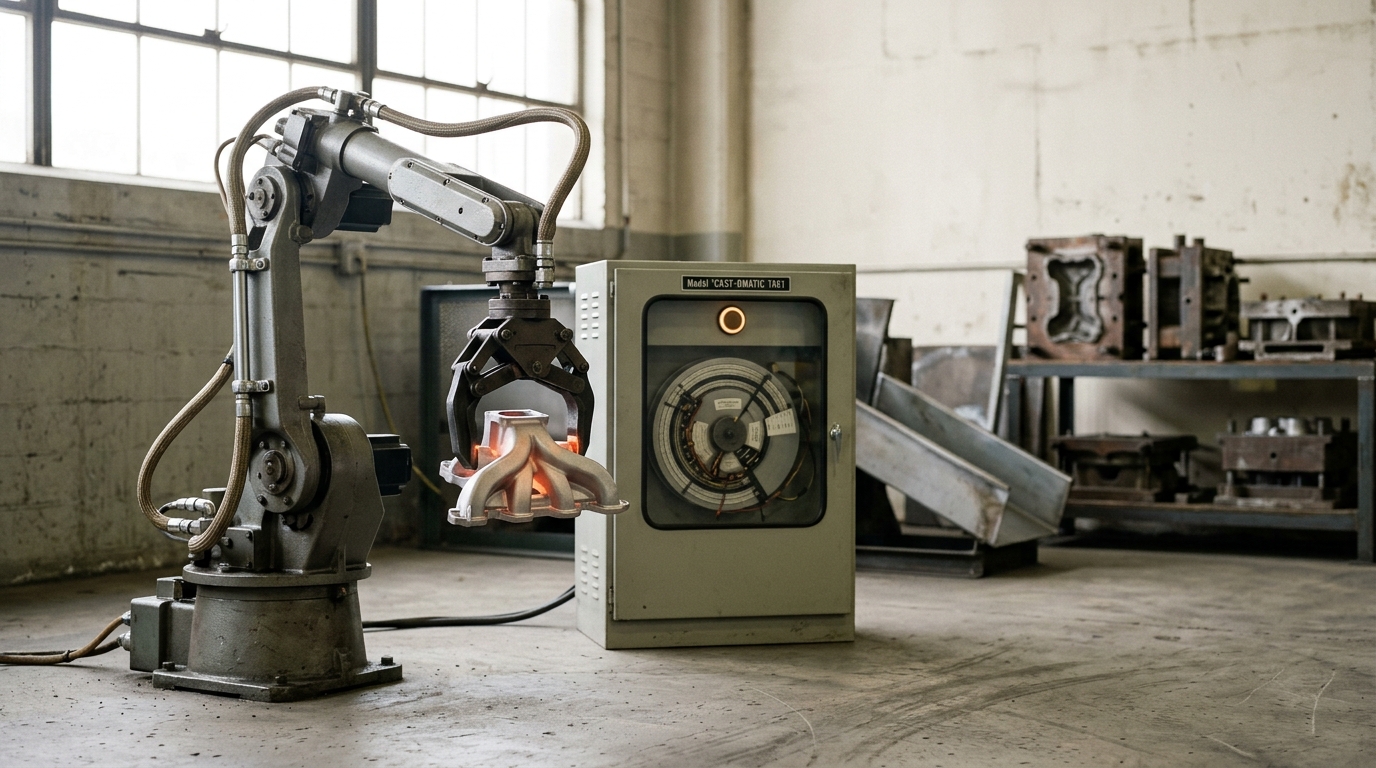
Devol met Joseph Engelberger in 1956, and together they founded Unimation, the first company built solely to manufacture robots [2]. Their first machine, Unimate, went to work in 1961 at a General Motors plant, lifting hot castings from a die-casting machine and stacking them — a job that was hot, heavy and dangerous for a person to do by hand, and repetitive enough that a taught trajectory could handle it without ever perceiving the part [3, 2]. The museum record of that first machine describes it, in the plainest terms available, as designed to “perform repetitive, arduous and hazardous tasks” in place of a person [3]. It had no camera, no model of the room, and no representation of the part beyond a taught sequence of positions; its intelligence, such as it was, lived entirely in the specificity of what it had already been shown.
This is fixed automation’s whole case, and its whole limit, made visible in one machine. It worked because die-casting is repetitive: the part arrives in the same place, in the same orientation, on the same schedule, every cycle. Extending the same machine to a task where the part’s position or identity varied required either a fixture engineered to force the variation back out before the robot ever touched it, or a human standing where the robot could not go. For roughly two more decades, industrial robotics scaled mostly by proliferating that same machine into more of the tasks a fixture could tame — welding, spraying, palletizing, spot assembly — rather than by attacking the tasks a fixture could not.
The blocks-world lesson
While Unimate’s descendants were spreading across body shops, a separate and much smaller project at the Stanford Research Institute was attempting something categorically different: a robot that reasoned about its own actions rather than merely executing a taught one. Development ran from 1966 to 1972, led first by Charles Rosen and then by Nils Nilsson, Bertram Raphael and Peter Hart, and the machine came to be known as Shakey, for the way its television-camera-and-rangefinder head visibly shuddered as it moved across the floor [5]. Shakey lived in a set of rooms furnished with painted blocks and a low wedge-shaped ramp, tethered by radio link to a mainframe that ran its vision routines and its planner, since none of that computation could yet fit on the robot itself [4].
The planner was STRIPS — the Stanford Research Institute Problem Solver — and it is the part of the project with the longest afterlife. STRIPS represented the state of the world as a set of logical statements and represented each available action as a precondition and an effect on that set, then searched over sequences of actions to find one that reached a stated goal [6]. On 7 October 1969, told to push a box off a platform it could not directly reach, Shakey inferred that it first needed to be on the platform itself, found the ramp, pushed the ramp up against the platform, and drove up it — a demonstration still cited as an early instance of a machine composing a plan that no one had handed it directly, purely by reasoning over the represented consequences of its own possible actions [5, 6].
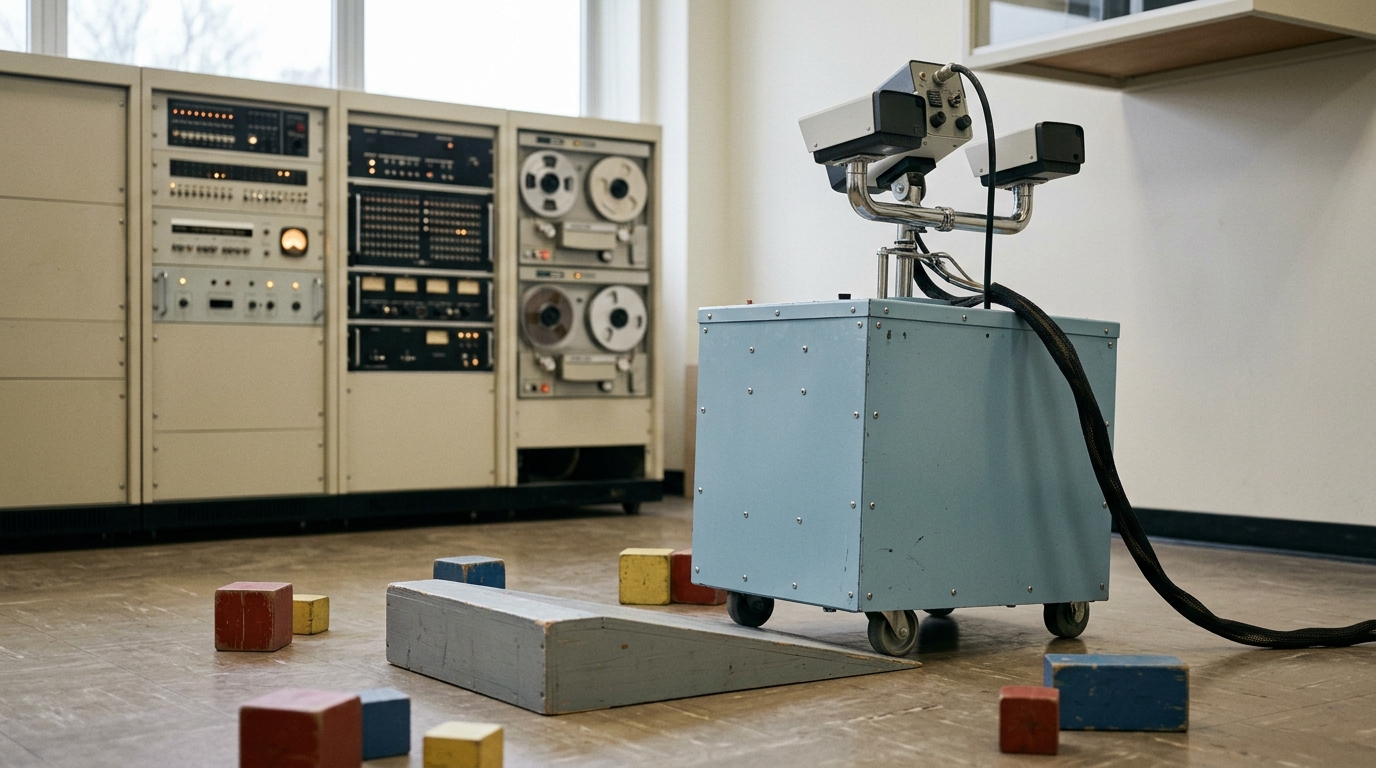
That same demonstration is also the clearest illustration of the project’s boundary, and the technical note documenting the finished system is candid about where the boundary sat: reasoning of this kind depended on a world reduced to a small number of objects the vision system had been built to recognize, often painted for contrast and placed on a bare floor, so that the state STRIPS reasoned over was a small, enumerable, symbolic thing rather than an open-ended scene [6]. Extend the same machinery to an ordinary room — variable lighting, occlusion, objects with no clean edges, uncertainty about whether an attempted action had actually succeeded — and both the vision system and the planner’s clean logical state broke down long before the reasoning itself did. The room of blocks was not a simplified version of the real world so much as a genuinely different world that happened to resemble it; the label that stuck, “blocks world,” became shorthand within the field for exactly that gap. Closing the gap — rather than reasoning ever more cleverly inside it — became the next generation’s problem.
Putting the world back in the loop
Rodney Brooks’ answer, developed at MIT through the mid-1980s, inverted the Shakey architecture rather than extending it. His 1986 paper described a “layered control system” built from independent, asynchronous modules, each a comparatively simple finite-state machine wired close to sensors and actuators; higher layers could suppress or override the outputs of lower ones, but a lower layer kept working even if a higher one were removed or had not yet finished computing, because none of the layers depended on a single shared symbolic model of the world to function at all [7]. He named the approach subsumption architecture, and the change it proposed was structural rather than incremental: there was no central planner building a model of the room, and no single point where the whole system could stall waiting for perception to finish updating that model. Behaviors like obstacle avoidance ran continuously and directly on raw sensor readings, underneath whatever higher-level behavior was also running.
Brooks made the underlying argument explicit a few years later, in a paper whose title states the thesis outright: an elephant plainly displays intelligent, adaptive behavior in a complicated physical world without anything resembling STRIPS-style symbolic planning, so symbolic representation could not be a precondition for intelligent action — only one route to a narrow kind of it, purchased at the cost of needing a world simple enough to represent completely [8]. His preferred formulation was that the world is its own best model, to be consulted again at every instant rather than captured once, stored, and reasoned over in the abstract — a conclusion that followed directly from watching how badly the stored-model approach degraded the moment it left the room it had been built for [8].
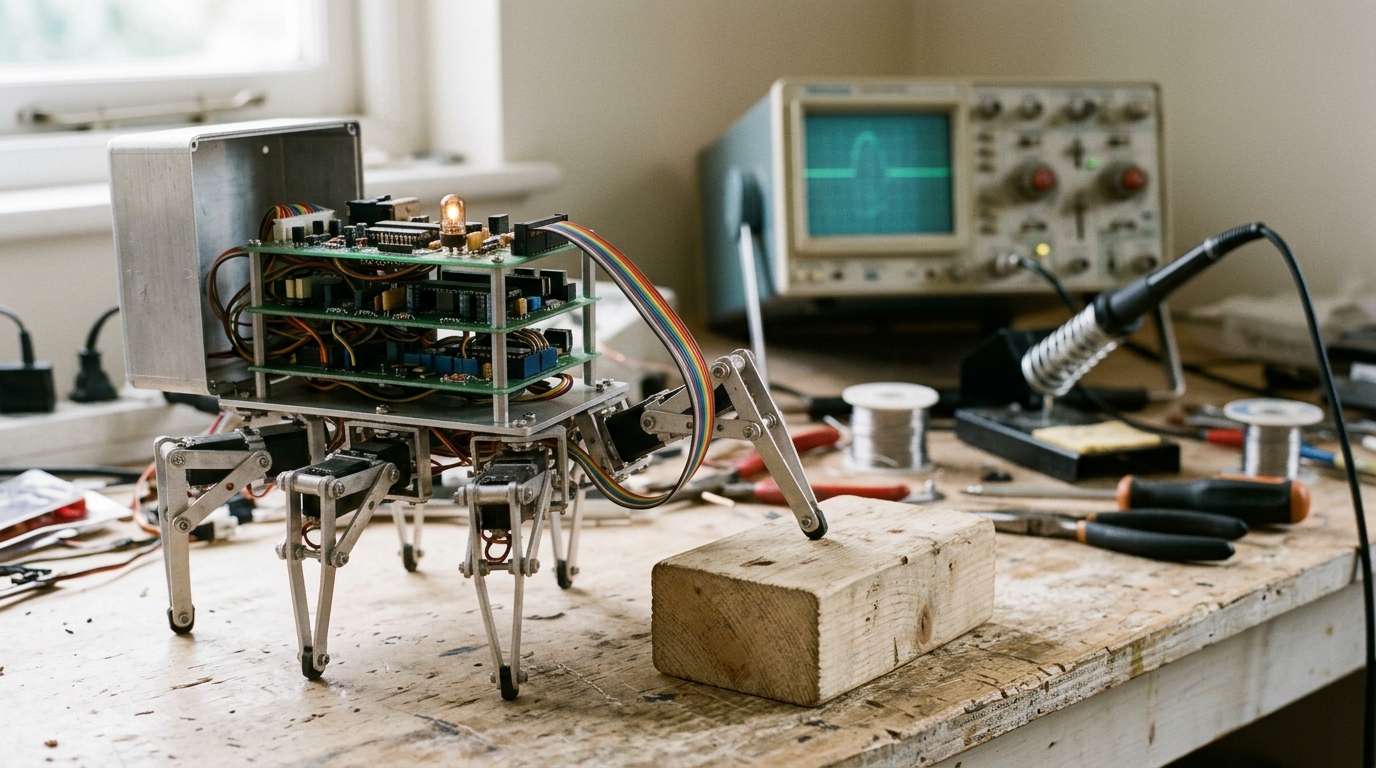
Robots built on this principle through the late 1980s and early 1990s — walking and navigating machines with no central map of their surroundings — were slower to plan anything elaborate and considerably more robust to a world that refused to hold still while they thought. Neither tradition simply won the argument. What behavior-based robotics established, durably, is that a fast reactive layer belongs somewhere underneath any working embodied system, a lesson later inherited wholesale by the multi-layer software stacks built for autonomous driving, where reaction and deliberation run concurrently rather than one waiting on the other.
A fatality, and the standard it helped force
The same decade that produced subsumption architecture also produced industrial robotics’ first recorded workplace fatality. On 25 January 1979, Robert Williams, an employee at a Ford Motor Company casting plant in Flat Rock, Michigan, climbed into the storage rack of a one-ton robotic parts-retrieval system after it began running slowly; the machine’s arm struck him in the head and killed him instantly, and the resulting lawsuit produced what was then the largest personal-injury verdict in Michigan’s history [20]. The case is documented as the first fatality attributed to a robot in a workplace setting, and the jury’s finding turned specifically on the absence of alarms or an automatic shutdown that would have stopped the machine the moment a person entered its working envelope [20].
Industrial robots of that generation had no way to detect that a person was present; safety, where it existed at all, was a matter of fencing the whole machine off and hoping the fence held. Formal, internationally agreed safety engineering for the class of machine Devol had patented took over a decade longer to arrive as a single standard: ISO published the first edition of ISO 10218, covering the safety of manipulating industrial robots, in 1992, and a working group of robotics, engineering and safety specialists then rebuilt it from 2001 onward into the two-part ISO 10218-1 and ISO 10218-2 standard published in 2011, which remains the direct ancestor of the safety requirements now written into collaborative robots designed to share space with people rather than be fenced away from them [16]. The standard did not make a robot understand that a person was nearby; it made the absence of that understanding something a designer was required to engineer around, rather than something a factory was left to assume away.
The desert forces a different kind of reliability
By the early 2000s, the harder half of “acting in the world” had migrated from a factory floor to an open road, and the Defense Advanced Research Projects Agency restructured the problem as a prize competition rather than a research grant. The first Grand Challenge, run on 13 March 2004 over a roughly 142-mile course from Barstow, California toward Primm, Nevada, ended with no finishers at all: the best-performing vehicle covered only about 7.5 miles before it beached itself on an embankment in a hairpin turn and spun its wheels until the tires melted, and the million-dollar prize went unclaimed [11].
The arithmetic behind that result is worth making explicit, because it explains why the next eighteen months mattered more than the raw distance suggests. If a course of length
Over a 142-mile course, even a per-mile reliability of 99 percent yields a finishing probability under 25 percent, and the 2004 fleet did not come close to that bar. This is illustrative arithmetic rather than a number drawn from any cited study, but it frames what changed by October 2005: Stanford’s Stanley, built by a team led by Sebastian Thrun and documented in a paper with 29 co-authors, completed a desert course of comparable length in 6 hours 53 minutes, using a probabilistic software stack — machine-learned terrain classification, laser- and vision-based obstacle detection, and adaptive speed control — rather than a faster version of the 2004 approach [9]. The qualitative change between the two years was not speed. It was a roughly order-of-magnitude reduction in the rate of the errors that had stranded the 2004 fleet in the desert.
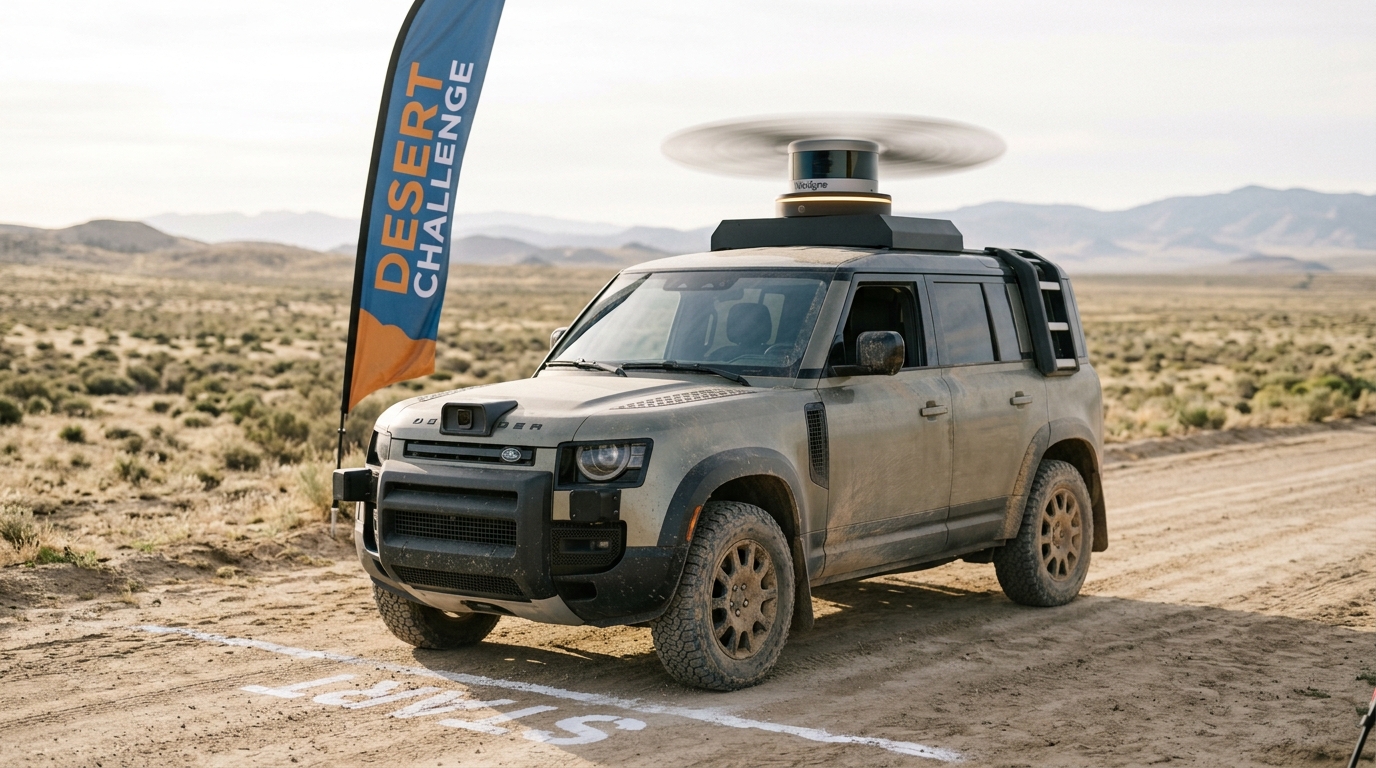
DARPA moved the problem again in 2007, from an empty desert to an urban road network with moving traffic, stop signs and other autonomous vehicles to negotiate around. Carnegie Mellon’s Boss won the Urban Challenge, and the paper describing it, with Chris Urmson as lead author among more than thirty contributors, documents a three-layer planning system — mission, behavioral and motion planning — sitting on top of the same kind of multi-sensor fusion Stanley had used, now applied to interacting with other vehicles rather than avoiding static desert terrain [10]. That layered mission-behavior-motion structure, and the underlying practice of fusing lidar, radar and camera data into a single probabilistic model of nearby traffic, is the direct software lineage the self-driving industry still runs today, decades and several corporate generations removed from the competition that produced it.
Two decades on, the field has largely stopped asking whether an autonomous vehicle can complete a course and started asking how many miles of ordinary driving would be needed to demonstrate that it is safe enough for public roads. A RAND Corporation analysis published in 2016 found that autonomous vehicles would need to be driven hundreds of millions of miles, and in some cases hundreds of billions of miles, to establish reliability with statistical confidence comparable to human driving; at the time, the most any developer had accumulated was roughly 1.3 million miles, and the report concluded that road testing alone could not close a gap that size, making simulation and structured scenario testing a permanent part of the validation process rather than a stopgap measure [17]. The 2004 desert established that the underlying problem was tractable at all; the 2016 finding established that proving it had been solved would be its own separate and much larger problem.
Perception stops being the bottleneck
For most of the period covered so far, a robot’s camera was its weakest link: hand-engineered feature detectors were brittle, and small changes in lighting, clutter or viewpoint could defeat them outright. The wave of convolutional neural network results that reshaped image classification in the early 2010s reached robotics with a lag, because a classifier trained on labeled photographs does not by itself tell an arm how to move — but by the middle of the decade, laboratories had begun building the large, purpose-collected interaction datasets that closing that gap actually required.
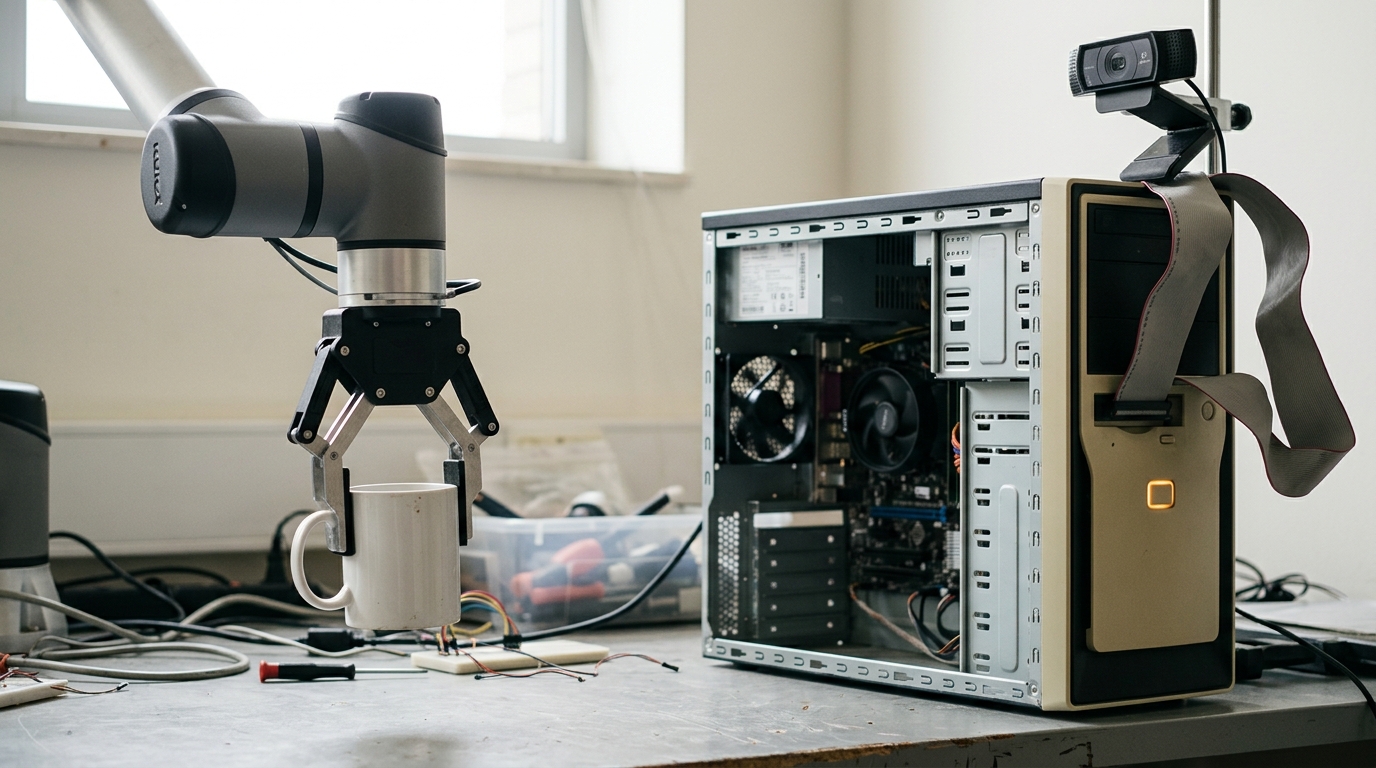
The clearest published example is a 2016 study from a team including Sergey Levine that trained a large convolutional network to predict, from a single uncalibrated monocular camera image, whether a given gripper motion would result in a successful grasp. The network was trained on more than 800,000 real grasp attempts, gathered over two months using between six and fourteen robot arms running in parallel, and the resulting continuous visual-servoing policy could correct its own approach in response to what the camera saw rather than executing one pre-planned motion end to end [12]. What made this different from earlier vision-guided grasping work was less the network architecture than the method: instead of hand-engineering features or fitting a physical model of contact, the system learned the mapping from raw pixels to successful motion directly from a dataset large enough to absorb the real variability a hand-built detector never could.
This is also the point at which data collection itself became a first-class engineering problem for robotics, rather than an afterthought to a modelling one. Running six to fourteen physical arms continuously for two months to gather 800,000 attempts is a logistics operation, not an experiment run by one student over an afternoon, and every subsequent large robot-learning effort inherited that same underlying constraint: unlike a language model, a robot policy cannot be trained on trajectories that already exist somewhere on the internet, because a record of joint torques and gripper states has to be produced by physically moving an actual machine through an actual task.
From one robot’s data to every robot’s data
The late 2010s and early 2020s response to that constraint was to industrialize demonstration collection itself, first within a single laboratory and then across many at once. Google’s RT-1, described in a 2022 paper, was trained by imitation on 130,000 episodes covering more than 700 tasks, collected over 17 months using a fleet of 13 robots, and the paper’s central claim was that a single high-capacity transformer policy, trained on that scale of task-agnostic real-world data, generalized better than the narrower single-task policies that had preceded it [13]. The following year, RT-2 changed what the network was built from rather than how the data was collected: it started from a vision-language model already trained on internet-scale image-and-text data, represented robot actions as another kind of output token alongside words, and fine-tuned the combination on robot demonstrations, reporting that this let the resulting policy follow instructions involving objects and concepts that had never appeared in its robot-specific training data [14]. That architecture — a large pretrained vision-language backbone with an action output grafted onto it — is what the field now calls a vision-language-action, or VLA, model, and it is the direct architectural ancestor of the systems described as the field’s current frontier.
The year after that, a consortium of robotics laboratories pooled their separately collected datasets into a single standardized release, Open X-Embodiment: recordings from 22 different robot embodiments across 21 institutions, spanning 527 distinct skills over more than 160,000 tasks, released together with a model, RT-X, trained across all of it at once [15]. The point of the exercise was to test whether experience gathered on one robot’s body could transfer to a differently shaped one — whether “robot data” could be pooled the way image and text data already had been — and the collaboration reported positive transfer across embodiments as a result [15]. That is a substantially different wager than anything earlier in this history: Unimate’s intelligence lived in one taught trajectory built for one machine, Shakey’s lived in one hand-built symbolic model of one room, and RT-X is explicitly a bet that a single learned policy can be shared across bodies that were never designed to be interchangeable.
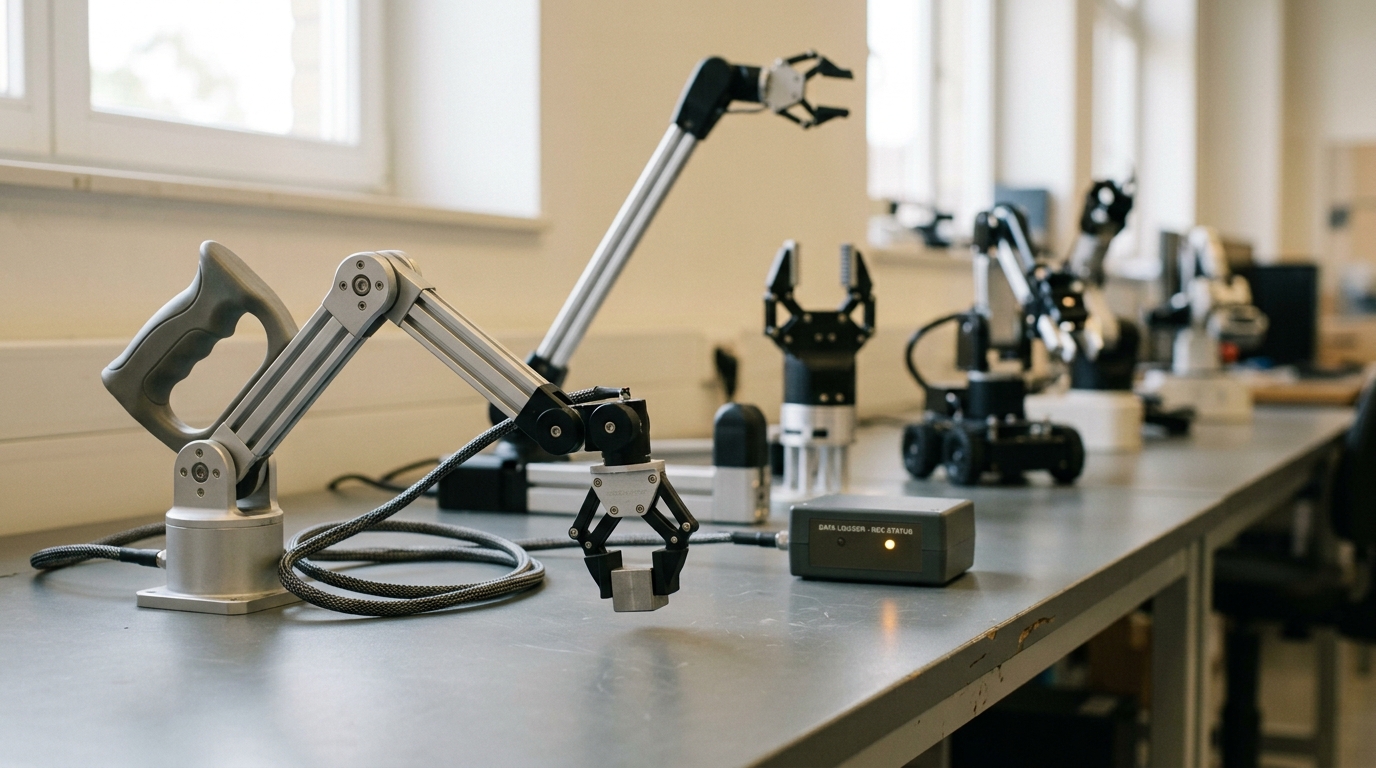
The current frontier, as of the most recently published work in this lineage, consists of VLA models built specifically to generalize across tasks and embodiments rather than being fine-tuned to one robot in one room. Physical Intelligence describes its pi-zero model, trained on a mixture the company characterizes as more than 10,000 hours of robot interaction data spanning seven robot configurations, as capable of multi-stage household tasks including laundry folding and box assembly [18] — a developer’s own account of its own system, presented here as a claim rather than an independently verified result. Google DeepMind’s Gemini Robotics, built on the Gemini 2.0 language model and reported in 2025, is described by its authors as able to follow open-vocabulary instructions, handle previously unseen environments, and adapt to new robot embodiments after fine-tuning on as few as 100 demonstrations [19] — again a claim from the system’s own developers rather than a result independent evaluators have reproduced. Both systems are direct continuations of RT-2’s core move, start from an internet-pretrained model and then teach it to act, carried forward by roughly two more years of scale in data, model size and the number of laboratories pursuing the same architecture at once.
What the arc actually shows
Read end to end, this history is not a straight line of steadily improving robots. It is two traditions — act without understanding, or understand without much ability to act — running in parallel for three decades, each solving problems the other could not touch, before the tools existed to combine them usefully. Unimate could act with total reliability inside a world it never had to perceive. Shakey could reason about a world it had been allowed to simplify down to blocks and a ramp. Subsumption architecture put fast reaction back underneath deliberate reasoning rather than replacing reasoning outright. The DARPA Challenges forced probabilistic perception and planning to run continuously, in real time, against a world that would not hold still for a plan to finish computing. And the imitation-learning lineage running from the 2016 grasping study through RT-1, RT-2, Open X-Embodiment and today’s vision-language-action models is, underneath its architecture, an attempt to give a learned policy something closer to Unimate’s reliability without Unimate’s requirement that every task be engineered in advance.
None of this is evidence that the combination is finished, or that its remaining problems are small. A 1979 fatality made a formal safety standard possible rather than automatic, and it still took the field over a decade to publish ISO 10218 in response to an already-mature fixed-automation industry; the equivalent standards effort for machines that improvise around people, rather than execute a taught trajectory behind a fence, is comparatively young. What the sourced record supports is narrower than a verdict on the present moment, and more durable: robotics has already survived one complete reset of its dominant paradigm, from symbolic planning to reactive control, and is now most of the way through a second, from hand-engineered perception to learned, cross-embodiment policies. Whatever eventually succeeds today’s vision-language-action models will very likely be judged, as each of its predecessors was in turn, by whether it can act reliably outside the specific room it was built in.