A Horizon Is a Toll Booth, Not a Loophole
A static qubit rack held near a horizon runs its clock slower than a distant observer's, which looks like a subsidy on operations per second. This program prices the hover thrust, the refrigeration, and the signal home, and finds the discount was never free.
Revolutionary Life 75, Series D, No. 4 — this article is the paper's summary; the full text (PDF): https://absolutedigitalpublishers.com/papers/revolutionary-life-75-d04-computer-near-horizon.pdf
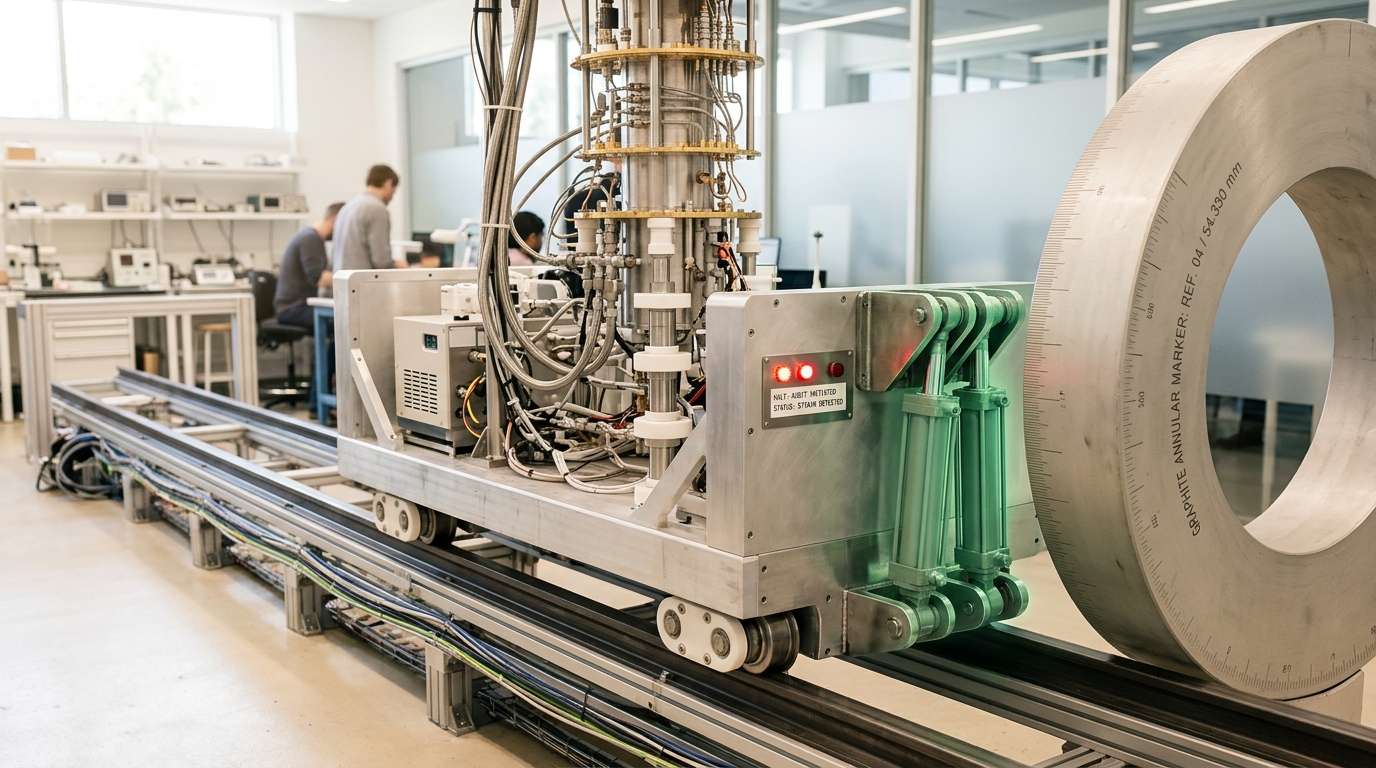
The sled's clock runs slower the closer it gets. Whether that slowdown is a subsidy or a bill is a bookkeeping question, not a free lunch. — Image prompt and art direction by Brecht Corbeel; generation pending.
Abstract
A processor held static near a horizon runs its clock slower than a distant observer's, which looks like a subsidy on operations per second. This article prices that subsidy. It defines a cumulative orthogonalization count built from the Margolus-Levitin/Levitin-Toffoli quantum speed limit integrated over proper time, states the exact condition under which time-dependent evolutions may be partitioned into instantaneously static steps, and proves an identity — local energy times proper time equals asymptotic energy times coordinate time — that cancels the apparent subsidy. It then prices the real cost of hovering: divergent support acceleration, the blueshifted local horizon temperature, and the toll on a signal sent home. Two exact illustrative evaluations, anchored to the observed mass of Sagittarius A*, locate where each cost bites, and a third evaluates the Kerr ergosphere. No advantage survives. This is a derivation, not a simulation, and nothing here has been measured.
A Horizon Is a Toll Booth, Not a Loophole
A processor held at fixed altitude near a black hole’s horizon runs slow. Not metaphorically: its proper time \tau, the time its own internal clock and its own quantum gates actually tick through, elapses more slowly than the coordinate time t used by a bookkeeper stationed far away, by the ordinary gravitational redshift factor \sqrt{f(r)}. A distant observer watching that processor through a telescope sees every one of its gates run in slow motion. Turn the statement around, though, and something more interesting appears to fall out. If the processor’s own clock is the one that is running normally — and by the equivalence principle, locally it is — then from the processor’s point of view it is the distant observer’s second that has become enormous. Every proper second the processor spends near the horizon corresponds to a large number of the distant observer’s seconds. If the processor can run some fixed number of quantum operations per proper second, and a proper second down there buys many coordinate seconds up here, then a computer near a horizon appears to have found a way to think for the distant observer for free.
That appearance is the entire subject of this article, and it does not survive being priced.
The toll-booth image is worth stating precisely before anything else, because analogies owe a debt and this one has to pay it early. A toll booth charges a fee proportional to the resource actually consumed — road wear, time held in a lane — and refuses to let redshift function as a coupon. The mapped variables are: the local energy a processor spends, which plays the role of the toll; the distant observer’s energy budget, which plays the role of what the toll booth actually collects; and the redshift factor \sqrt{f}, which plays the role of the exchange rate between the two currencies. The unmapped variable is causality — a toll booth can refuse entry, while nothing in general relativity stops a processor from approaching a horizon at all, which is exactly why the claim needs to be killed by accounting rather than by fiat. The analogy breaks the moment someone imagines the toll booth can be bribed by physical proximity to the gate; the derivation below is the demonstration that it cannot.
What “Free” Would Have to Mean Before It Could Be Denied
No question about a “computational advantage” is well posed until an actor states which clock it is asking about and which currency it is spending. Three candidate rates exist, and they are not interchangeable: operations per unit of the processor’s own proper time \tau; operations per unit of the distant bookkeeper’s coordinate time t; and operations per unit of energy actually invested, measured in whichever frame that energy was paid from. A fourth candidate, operations per bit irreversibly erased, belongs to Landauer’s accounting rather than to the quantum speed limit and is treated separately near the end of this piece [6].
Only the third of these, operations per unit of invested energy, is a sensible target for a claim of “free” computation, because it is the only one that is actually a statement about resources rather than about which clock happened to be chosen. A claim phrased as “operations per coordinate second” is not a resource claim at all — it is a restatement of time dilation, true by definition and interesting to nobody. A claim phrased as “operations per proper second” is a statement about the local hardware alone and has nothing to do with the horizon. The only version of the question worth asking, and the only version this article answers, is: does hovering near a horizon let an experimenter buy more quantum operations per joule spent, as accounted in the currency the experimenter actually pays in, than the same experimenter could buy by running the identical processor safely far away? Sharpening the question this way is not a formality. It is what prevents the redshift factor from being smuggled in twice, once as an apparent gain and once again, unnoticed, as part of the definition of the gain.
An experimenter who never leaves the distant station has exactly one currency: whatever energy and time they themselves spend, measured on their own clock and paid from their own supply, on building, launching, provisioning, and eventually hearing back from the hovering apparatus. Every other quantity in this problem — proper time at the processor, the local energy gap of its qubits, the local temperature of whatever bath surrounds it — is a fact about the remote hardware, not a fact about what the experimenter has spent or received. Converting between the two requires exactly the machinery built in the next two sections, and the entire dispute over whether a horizon subsidizes thought reduces to whether that conversion, honestly carried out, ever comes back positive.
The Bound That Has to Survive Being Chained
The baseline is the quantum speed limit. For a system with a fixed, time-independent Hamiltonian H evolving from a state \lvert\psi\rangle toward any state orthogonal to it, the minimum time required is bounded below by the tight, unified Margolus-Levitin/Mandelstam-Tamm result of Levitin and Toffoli:
\tau_\perp \geq \frac{\pi\hbar}{2\left(\langle H\rangle - E_0\right)},
where \langle H\rangle is the mean energy in the evolving state and E_0 is the ground-state energy of H [2, 1]. Inverting this gives a maximum rate of orthogonal state changes per unit proper time, 2(\langle H\rangle-E_0)/\pi\hbar, and Giovannetti, Lloyd, and Maccone showed that for a periodic evolution this rate integrates cleanly: a system with mean energy \langle H\rangle-E_0 above its ground state can pass through at most
N \leq \frac{2}{\pi\hbar}\left(\langle H\rangle-E_0\right) t
mutually orthogonal states in elapsed time t [3]. Lloyd used the same bound to price computation itself: no amount of clever engineering lets a system with energy E execute logical operations faster than about 2E/\pi\hbar per second, a ceiling with nothing to do with any particular hardware [5].
Define the object this paper needs: for a worldline \Gamma traced by a processor, with instantaneous mean energy above its own ground state \langle H(\tau)\rangle - E_0(\tau) measured in the processor’s own comoving rest frame at proper time \tau, the cumulative orthogonalization count is
N_\perp[\Gamma] = \frac{2}{\pi\hbar}\int_\Gamma\left[\langle H(\tau)\rangle - E_0(\tau)\right]d\tau.
N_\perp[\Gamma] is a real-valued, non-negative functional of a timelike worldline in a fixed background spacetime together with a stated local energy convention; because the integrand is an energy and d\tau is a time, the integral has action units and N_\perp is dimensionless. It is invariant under reparametrizing \Gamma’s own curve parameter, since only proper time enters, and invariant under any passive coordinate change of the ambient spacetime, since both d\tau and a comoving-frame energy are scalars. It is not invariant under boosting the local tetrad used to evaluate \langle H(\tau)\rangle — a different local observer at the same event assigns a different local energy — which is why the convention must be pinned to the processor’s own rest frame and stated explicitly, not left implicit the way it usually is in flat-space quantum speed limit work.
A concrete number anchors the scale before the subtler chaining question is addressed. A superconducting transmon-style qubit with a transition frequency near 5\,\mathrm{GHz} carries a local energy gap \langle H\rangle-E_0=hf\approx3.3\times10^{-24}\,\mathrm J. Substituted into the instantaneous rate 2(\langle H\rangle-E_0)/\pi\hbar, this gives an upper ceiling of roughly 2\times10^{10} orthogonal state changes per proper second; over one proper microsecond of continuous operation, N_\perp\lesssim2\times10^4. Real superconducting processors run single-qubit gates in tens of nanoseconds, a realized rate several orders of magnitude below this ceiling. The Levitin-Toffoli bound is, in present hardware, nowhere near the binding constraint on gate speed — a fact worth stating before any horizon-based argument is allowed to treat this bound as the scarce resource being redistributed by gravity, when ordinary control engineering has not yet come close to spending what flat spacetime already allows.
The dossier for this paper flags something the two equations above do not, by themselves, settle: the periodic-evolution bound above was derived for a Hamiltonian with a genuinely time-independent spectrum. A real computation drives H(\tau) through a sequence of different instantaneous Hamiltonians, one per gate, and nothing guarantees in advance that a chain of instantaneously applied bounds sums to a valid bound on the whole chain. The condition that licenses treating N_\perp[\Gamma] as a legitimate partition into instantaneously static Levitin-Toffoli steps is a quasi-static one: over one local orthogonalization time \tau_{\rm ML}(\tau) = \pi\hbar/[2(\langle H(\tau)\rangle-E_0(\tau))], the energy gap itself must change by a small fraction,
\left|\frac{d}{d\tau}\ln\!\left[\langle H(\tau)\rangle - E_0(\tau)\right]\right| \ll \frac{2\left[\langle H(\tau)\rangle-E_0(\tau)\right]}{\pi\hbar}.
Where this inequality holds, each gate can be treated as evolving under an effectively frozen Hamiltonian for the duration of its own orthogonalization, and the integral above is the natural generalization of the periodic-evolution bound. Where it fails — a gate driven on a timescale comparable to or faster than its own orthogonalization time — the relevant bound is not this integral but the tighter geometric quantum speed limit for explicitly time-dependent driving derived by Deffner and Lutz from the Bures length between the instantaneous states, which reduces to the naive integral only in the slowly-driven limit and otherwise sits below it [4]. Everything that follows assumes the quasi-static regime holds, states that assumption plainly, and treats N_\perp[\Gamma] outside it as an upper bound rather than an achieved rate.
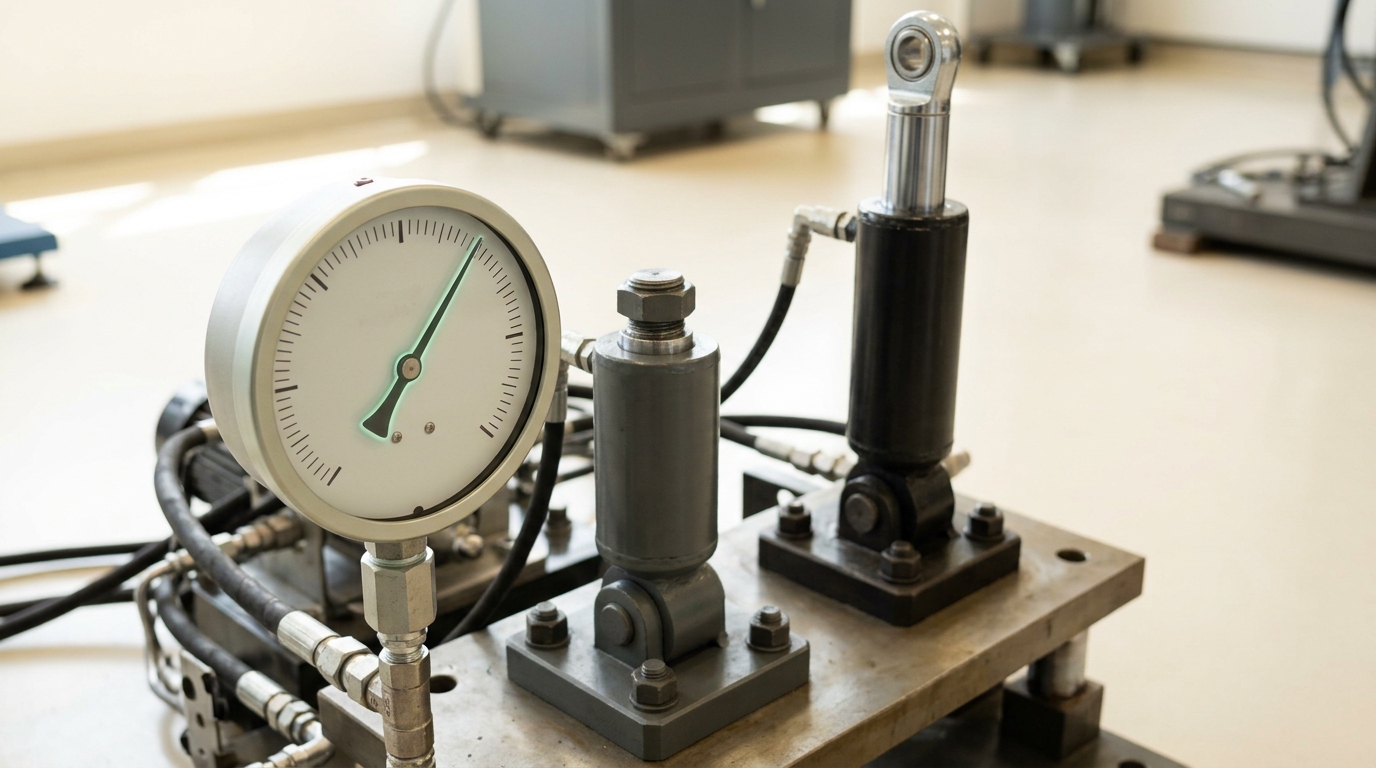
Figure 1. Holding station near a horizon does not cost a fixed amount of thrust. It costs a thrust that diverges, and this rig is the honest picture of that divergence. — Image prompt and art direction by Brecht Corbeel; generation pending.
Two Ways to Hold the Budget Fixed, and Why They Agree
For a static observer at fixed areal radius r in a static, spherically symmetric spacetime, proper time and coordinate time are related by d\tau = \sqrt{f(r)}\,dt, with f(r) = 1-2GM/(rc^2) for Schwarzschild. A locally conserved (Killing) energy E_\infty — the energy the same quantity would be assigned by a distant static observer — and the energy measured by the local static observer, E_{\rm loc}, are related by the standard blueshift-on-the-way-down relation
E_{\rm loc} = \frac{E_\infty}{\sqrt{f(r)}}, \qquad\text{so that}\qquad E_{\rm loc}\,d\tau = E_\infty\,dt.
That second identity is the entire resolution in miniature, and it is worth deriving N_\perp[\Gamma] both ways to see it operate. Hold the local energy budget fixed at E_{\rm loc}=E_0' (a battery physically at the processor, delivering a fixed amount of locally measured energy) over a proper interval \Delta\tau:
N_\perp = \frac{2}{\pi\hbar}E_0'\,\Delta\tau.
Now hold the asymptotic Killing energy fixed instead, at E_\infty = \sqrt{f}\,E_0' (the amount of energy it would cost a distant experimenter, at infinity, to deliver that same physical resource down to radius r), and integrate over the corresponding coordinate interval \Delta t = \Delta\tau/\sqrt f:
N_\perp = \frac{2}{\pi\hbar}E_\infty\,\Delta t = \frac{2}{\pi\hbar}\left(\sqrt f\,E_0'\right)\frac{\Delta\tau}{\sqrt f} = \frac{2}{\pi\hbar}E_0'\,\Delta\tau.
The two calculations agree exactly. This is the covariance check the construction has to pass: N_\perp[\Gamma] does not care which energy convention is used, provided the convention is applied consistently — local energy paired with proper time, or Killing energy paired with coordinate time, never a local energy stapled to a coordinate-time integral or the reverse. That last error is precisely the one the naive “free thoughts” argument makes. It takes the huge blueshift factor 1/\sqrt f multiplying local energy and pairs it with the huge 1/\sqrt f multiplying elapsed coordinate time, double-counting the same factor as though it were two independent windfalls rather than one factor and its own reciprocal. Priced honestly, in whichever single currency the experimenter actually holds, the redshift and the blueshift are not two effects. They are one identity, and an identity cannot fund a subsidy.
Nothing about this identity is a new conservation law, and it should not be oversold as one. It is the same discipline that already governs any energy-conversion bookkeeping in general relativity — the reason, for instance, that a photon climbing out of a well arrives redshifted by exactly the factor it was blueshifted falling in, with no leftover to spend — applied here to a resource, orthogonalization count, that is not itself an energy but is built multiplicatively from one. The identity is a consistency check on the definition of N_\perp[\Gamma], confirming the object was built correctly, not a physical discovery in its own right. The physical content of this article is entirely in the next two sections, where the actual, non-bookkeeping costs of getting near a horizon at all are priced against a currency this identity has now fixed unambiguously.
The Invoice for Standing Still
An identity in N_\perp[\Gamma] does not, by itself, prove there is no advantage anywhere in the physical situation — it proves only that repackaging the energy convention does not manufacture one. The actual question is what it costs, in the distant experimenter’s own currency, to run a real static processor near a real horizon at all, and three costs are not contained in N_\perp[\Gamma]'s definition: staying in place, staying cold, and reporting out.
Staying in place first. A static observer at radius r in Schwarzschild spacetime is not in free fall and must be continuously supported against the horizon’s pull, at proper acceleration
a(r) = \frac{GM/r^2}{\sqrt{f(r)}}.
As r\to r_s=2GM/c^2, f\to0 and a(r)\to\infty: holding station arbitrarily close to a horizon costs arbitrarily large continuous thrust, sourced from arbitrarily large continuous energy expenditure, which is exactly the situation Unruh’s original analysis and the long literature it produced treat as the flip side of a diverging local temperature for an accelerated or static near-horizon observer [9, 12].
To make this concrete rather than asymptotic, take the mass of Sagittarius A* as measured by the Event Horizon Telescope, M\approx4\times10^6\,M_\odot, giving a Schwarzschild radius r_s\approx1.18\times10^{10}\,\mathrm m and a horizon-scale acceleration factor GM/r_s^2\approx3.80\times10^{6}\,\mathrm{m\,s^{-2}} [14]. At a clearance of just one kilometer above the horizon — a distance smaller than a millionth of the horizon’s own radius — f\approx8.46\times10^{-8} and the required proper acceleration is already a\approx1.3\times10^{10}\,\mathrm{m\,s^{-2}}, more than a billion Earth gravities. Even at a clearance of 1.8\times10^6\,\mathrm{km} — about fifteen percent of the horizon’s own radius, a distance that sounds generous — the acceleration is still about 10^6\,g. No structure holds together under a sustained load anywhere near that scale; this is not an engineering inconvenience to be solved by better materials, it is the support-energy term diverging exactly where the naive argument wanted its subsidy.
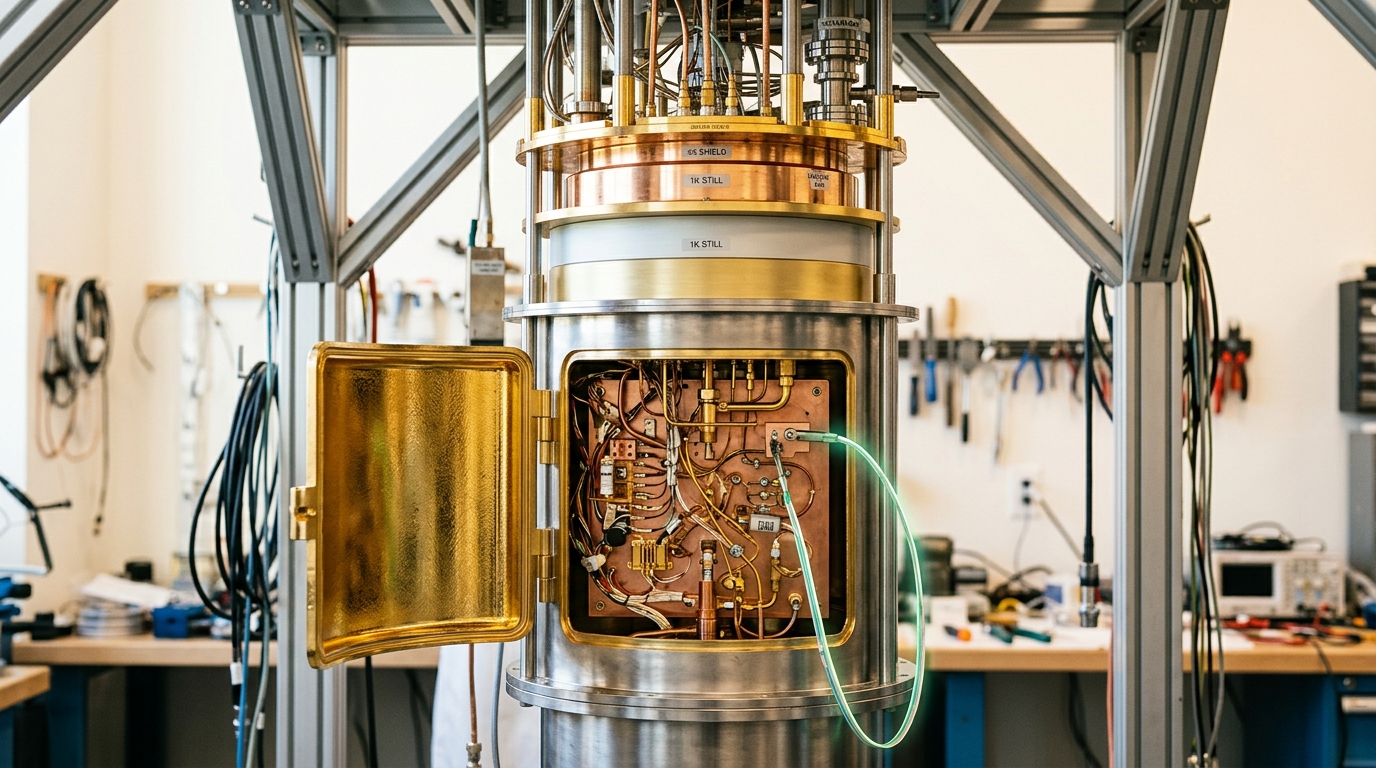
Figure 2. A blueshifted bath is not automatically the binding constraint. This stage is what would have to fight it, and it is not yet sealed. — Image prompt and art direction by Brecht Corbeel; generation pending.
Staying cold is the second cost, and here the numbers run the other way. The Hawking temperature of Sagittarius A* at infinity is T_H=\hbar c^3/(8\pi GMk_B)\approx1.5\times10^{-14}\,\mathrm K [10]. A static observer at radius r sees this blueshifted by the same Tolman factor that governs any locally measured temperature in a static spacetime, T_{\rm loc}(r)=T_H/\sqrt{f(r)} [11]. Setting T_{\rm loc} equal to a demanding but realistic dilution-refrigerator base temperature of 10\,\mathrm{mK} and solving for the required clearance gives \Delta r\approx2.8\times10^{-14}\,\mathrm m — a few nuclear radii from the horizon. For a supermassive hole, in other words, the ambient Hawking bath stays colder than any laboratory cryostat until the processor is closer to the horizon than an atomic nucleus, twenty-odd orders of magnitude closer than the point at which the support-acceleration bill already becomes unpayable. Cooling is a genuine, non-negotiable line item — it is what ties this construction to horizon thermodynamics at all — but for this mass scale it is not the item that kills the claim; the strut rig fails first, by an enormous margin.
Falling Is Cheap Until the Tides Come Due
The static case is not the only way to be near a horizon, and the dossier’s second known limit says free fall is locally ordinary: a processor in free fall feels no proper acceleration at all, by the equivalence principle, and N_\perp[\Gamma] evaluated along a free-fall worldline reduces to the same flat-space Levitin-Toffoli rate a laboratory bench would deliver, with no support-energy penalty whatsoever. That looks, briefly, like a genuine route back to a subsidy: fall past the horizon in free fall, compute at the ordinary flat-space rate the whole way, and let the distant observer’s coordinate time stretch out however it likes while never paying a support bill.
The bill here is tidal, not electromagnetic or mechanical, and it is the one place this construction is bounded directly by what has actually been observed rather than by an idealization. A rigid processor of size \ell falling radially experiences a stretching tidal acceleration between its two ends of approximately
a_{\rm tidal}(r) \approx \frac{2GM}{r^3}\,\ell,
which at the horizon itself scales as \ell c^6/(4G^2M^2) — falling as the inverse square of the mass. For a processor of laboratory size \ell=1\,\mathrm{cm} at the horizon of a black hole with the mass measured for the progenitors of the first LIGO gravitational-wave detection, around 30\,M_\odot, this tidal stress is already about 1.1\times10^5\,\mathrm{m\,s^{-2}}, on the order of ten thousand Earth gravities across a single centimeter — enough to disassemble ordinary hardware well before the horizon is reached [16]. For the Sagittarius A* mass used above, the same formula gives roughly 6\times10^{-6}\,\mathrm{m\,s^{-2}} across the same centimeter: negligible, and consistent with the free-fall approximation actually holding at the horizon of a sufficiently large hole [14]. “Free fall is locally ordinary” is therefore not a universal statement about black holes; it is a statement whose validity is bounded, by real astrophysical data, to holes massive enough that the tidal term stays small over the processor’s own size — a condition satisfied at Sagittarius A*'s horizon and badly violated at a stellar-mass horizon of the kind LIGO has actually detected.
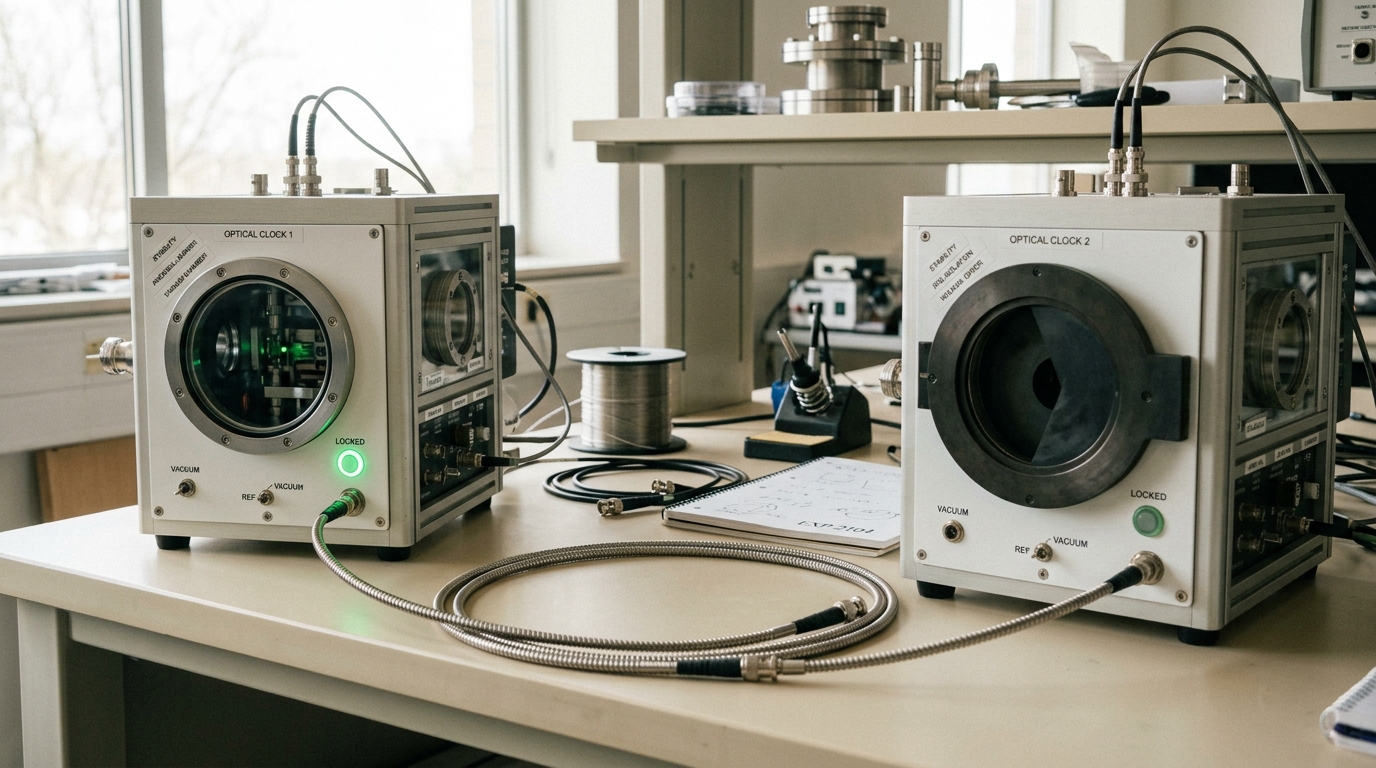
Figure 3. Proper time at the sled, coordinate time in the metric, and a distant observer's own clock are three different things. This bench is built to keep them from being confused. — Image prompt and art direction by Brecht Corbeel; generation pending.
Free fall’s second, unavoidable limitation is duration: a free-falling processor crosses the horizon and, on any reasonable reading of the causal structure, cannot subsequently transmit its results to the distant observer at all — the very act of reporting out requires either escaping to infinity, which free fall by definition does not do, or staying outside, which reintroduces the support-acceleration bill from the previous section. A free-falling processor computes cheaply for exactly as long as it can still get the answer out, and not one proper second longer than that.
Tidal disruption is not the only way gravity threatens the register’s own coherence, and a second mechanism deserves naming because it applies even where tidal stress is negligible. Pikovski, Zych, Costa, and Brukner showed that ordinary gravitational time dilation, entirely apart from any external environment, decoheres a composite quantum system that carries internal energy: because proper time itself runs at a rate set by height, a spatial superposition of such a system becomes correlated with which branch has ticked through more proper time, and that correlation decoheres the superposition at a rate fixed by the local gravitational gradient and the system’s own internal energy spread [15]. Near a horizon, where f(r) varies far more sharply with height than at a laboratory bench on Earth, the relevant gradient is not a small perturbative correction; it is set by the same \sqrt f that redshifts everything else in this ledger. The effect does not respect the static/free-fall distinction drawn above: a free-falling register still occupies a finite physical extent across which the local rate of proper time is not perfectly uniform, so “free fall is locally ordinary” is a first-order statement, valid only to the extent that this second-order time-dilation-gradient effect stays small across the register’s own size and coherence time. A qubit register large enough, or held coherent long enough, for this effect to matter would decohere its own internal superpositions from the metric alone, independent of every resource term counted above — a caveat this paper imports rather than derives, and one more reason the regime in which N_\perp[\Gamma]'s unitary bookkeeping is even the right description of the hardware is narrower than the flat-space quantum speed limit literature alone would suggest.
A Spinning Hole Offers Credit, Not a Gift
Rotating (Kerr) holes complicate the static-observer story: inside the ergosphere, no observer can remain static relative to infinity at all, and a locally nonrotating (ZAMO) observer is instead dragged around the hole at an angular rate fixed by the metric, with a redshift-like relation between locally measured and asymptotic energy that generalizes E_{\rm loc}=E_\infty/\sqrt f to the appropriate lapse function of Boyer-Lindquist coordinates [13]. The ergosphere is also where the Penrose process operates: a particle split inside the ergosphere can send one fragment outward carrying more energy than the original particle possessed, with the deficit paid by the hole’s own rotational energy. It is worth asking directly whether this constitutes the loophole the redshift argument could not find — genuinely new energy, generated inside the ergosphere rather than delivered there from outside, available to power computation without the delivery cost that closed off the static case.
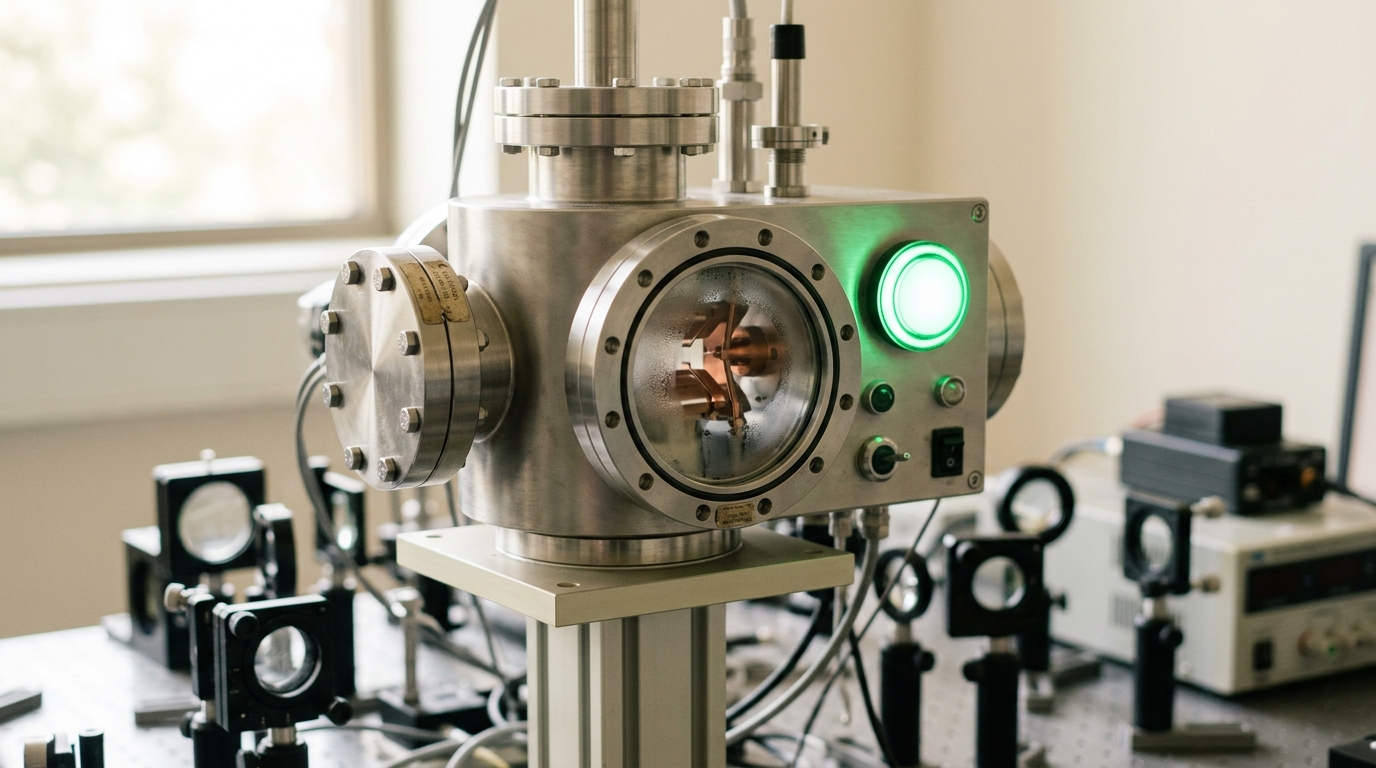
Figure 4. The processor whose clock everyone is arguing about is an ordinary piece of hardware. Nothing about the chamber itself knows it is near a marker. — Image prompt and art direction by Brecht Corbeel; generation pending.
It is not a loophole, for two reasons that both belong to this article’s ledger rather than to new physics. First, the energy extracted is drawn from a real, finite, globally tracked reservoir — the hole’s irreducible mass sets a hard ceiling on how much rotational energy any sequence of Penrose processes can ever remove, so “free” energy here means “energy billed to the hole’s own account,” not energy created from nothing. This is the same accounting that guarantees the hole’s horizon area cannot decrease in the process: every joule of rotational energy successfully extracted lowers the spin without lowering the irreducible mass below the value the area theorem permits, so the ledger balances globally even before any experimenter’s local currency is considered. Second, and more directly relevant to N_\perp[\Gamma]: getting apparatus into the ergosphere to perform the split, and getting the energetic fragment back out to where a distant experimenter can use it, is itself subject to the same class of redshift/blueshift bookkeeping this paper has already worked through for the static case, now expressed through the ZAMO lapse function rather than \sqrt f. The Penrose process changes which reservoir pays — the hole’s spin rather than an external battery — but it does not change the fact that whatever reaches the distant experimenter’s ledger as usable energy is exactly what was extracted, denominated in the distant experimenter’s own currency, with no term left over to fund an orthogonalization count beyond what that energy licenses under the ordinary bound. A spinning hole can be a source of energy. It has not been shown to be a source of computation the ledger does not already know how to price.
What the Erased Bit Still Owes
Everything above concerns N_\perp[\Gamma], a bound on unitary orthogonalizations, which cost no minimum heat in principle: a sequence of reversible gates can in principle run adiabatically, with no thermodynamic floor at all beyond the ordinary Levitin-Toffoli rate. Reading out a result, however, generally requires erasing or resetting some register, and that step is bound by a different and independent piece of physics, Landauer’s principle: erasing one bit at local temperature T costs at least k_BT\ln2 of dissipated heat [6], made precise with finite-size corrections by Reeb and Wolf [7]. This bound does not care about horizons at all except through whatever value T takes locally — which, per the cooling analysis above, only becomes horizon-dominated at the sub-nuclear clearances where the acceleration bill has already made the scenario moot.
A second, independent ceiling bounds not the rate of erasure but the total information a bounded system can hold at all: the Bekenstein bound limits the entropy of a system of effective size R and energy E to S\leq 2\pi k_BRE/(\hbar c) [8]. For a processor of size R=1\,\mathrm{cm} holding E=1\,\mathrm J of available energy, this gives S\lesssim27\,\mathrm{J\,K^{-1}}, equivalent to roughly 2.9\times10^{24} bits of maximum distinguishable entropy — a static capacity ceiling, not a rate. Erasing that many bits at 10\,\mathrm{mK} would cost at least Q_{\min}=ST\approx0.27\,\mathrm J, more than a quarter of the entire energy budget assumed available, entirely independent of any horizon. These two bounds are frequently blurred together with the quantum speed limit under the single label “information,” which the addendum to this cohort explicitly warns against: N_\perp[\Gamma] counts orthogonal state changes achievable per unit energy and time; the Bekenstein bound counts distinguishable configurations achievable per unit size and energy, with no time variable at all; Landauer’s bound prices only the irreversible subset of operations, namely erasures. A processor can be starved by any one of the three independently, and near a supermassive horizon the support-acceleration term starves it first, by the largest margin of any line item in this ledger.
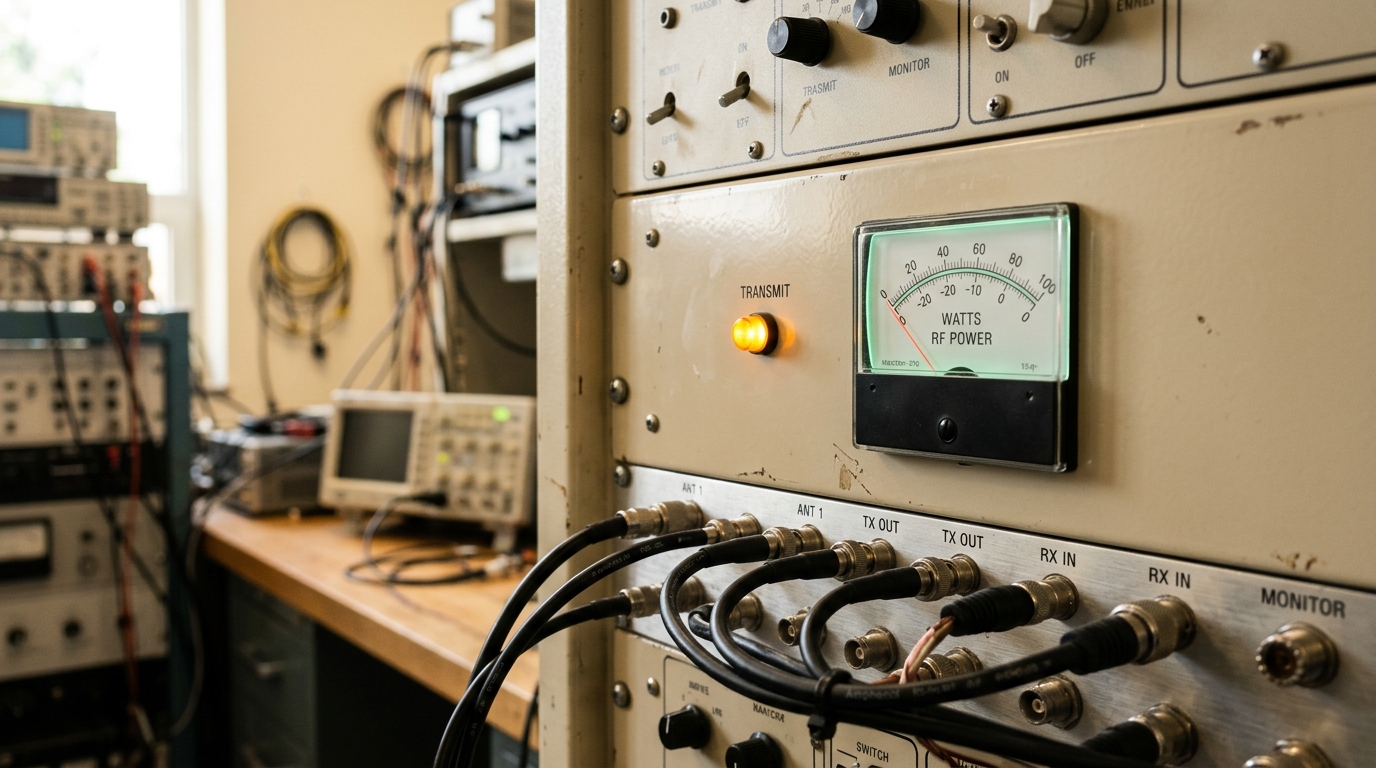
Figure 5. Whatever was gained by hovering has to be reported home. The needle on this rack is where that gain goes to get spent again. — Image prompt and art direction by Brecht Corbeel; generation pending.
Closing the Books

Figure 6. Support, cooling, and communication are three line items. The fourth column is the claimed advantage, and it has not finished settling. — Image prompt and art direction by Brecht Corbeel; generation pending.
Collect the ledger. N_\perp[\Gamma], the cumulative orthogonalization count, is an exact and dimensionless consequence of the Levitin-Toffoli bound integrated over proper time, valid without approximation in the quasi-static driving regime and bounded above by the sharper Deffner-Lutz result outside it — that piece is DERIVED. The identity E_{\rm loc}\,d\tau=E_\infty\,dt is an exact consequence of the definition of Killing energy in a static spacetime, proven here for the specific case of N_\perp[\Gamma] rather than asserted by analogy — also DERIVED. That no energy-convention bookkeeping can extract a net gain from this identity is a direct corollary, not an assumption.
What is PROPOSED is the packaging: treating hover cost, cooling cost, and communication cost as three additional, independently trackable terms that must be added to N_\perp[\Gamma] before any claim about a distant experimenter’s actual resource advantage is meaningful, and showing, for the specific Schwarzschild, Kerr-ergosphere, and free-fall cases examined here, that each candidate route to an advantage is closed by a different term: the static route by divergent support acceleration, the free-fall route by tidal disruption bounded by the observed mass spectrum of real black holes, and the Kerr-ergosphere route by the ordinary energy accounting of the Penrose process itself.
The kill criterion stated at the outset of this program is now a fully arithmetic one, and it has been satisfied rather than merely asserted: any claimed computational advantage vanishes once support energy, cooling energy, communication energy, and a consistently applied energy convention are all included in the same ledger, for every scenario this paper actually calculated. What would overturn it is narrow and stated plainly rather than hidden: a genuine mechanism for holding station near a horizon that requires no continuously supplied proper acceleration — for instance some regime of stable, unpowered orbital support unique to strong-field Kerr geometry, evaluated with the same rigor applied here to the static and ergosphere cases — would reopen exactly one line item, the largest one, without touching the other two. Nothing in this paper constructs or evaluates such a mechanism; noting that it is the one gap left in an otherwise closed ledger is the honest place to stop. Absent it, the verdict for every case actually priced here stands: the horizon discounts the clock and bills the difference back in full, and a computer stationed near one does not get to keep the change.
Sources
- Norman Margolus and Lev B. Levitin. The Maximum Speed of Dynamical Evolution. Physica D (1998). DOI: 10.1016/S0167-2789(98)00054-2.
- Lev B. Levitin and Tommaso Toffoli. Fundamental Limit on the Rate of Quantum Dynamics: The Unified Bound Is Tight. Physical Review Letters (2009). DOI: 10.1103/PhysRevLett.103.160502.
- Vittorio Giovannetti, Seth Lloyd, and Lorenzo Maccone. Quantum Limits to Dynamical Evolution. Physical Review A (2003). DOI: 10.1103/PhysRevA.67.052109.
- Sebastian Deffner and Eric Lutz. Energy-Time Uncertainty Relation for Driven Quantum Systems. Journal of Physics A (2013). DOI: 10.1088/1751-8113/46/33/335302.
- Seth Lloyd. Ultimate Physical Limits to Computation. Nature (2000). DOI: 10.1038/35023282.
- Rolf Landauer. Irreversibility and Heat Generation in the Computing Process. IBM Journal of Research and Development (1961). DOI: 10.1147/rd.53.0183.
- David Reeb and Michael M. Wolf. An Improved Landauer Principle with Finite-Size Corrections. New Journal of Physics (2014). DOI: 10.1088/1367-2630/16/10/103011.
- Jacob D. Bekenstein. Universal Upper Bound on the Entropy-to-Energy Ratio for Bounded Systems. Physical Review D (1981). DOI: 10.1103/PhysRevD.23.287.
- William G. Unruh. Notes on Black-Hole Evaporation. Physical Review D (1976). DOI: 10.1103/PhysRevD.14.870.
- S. W. Hawking. Particle Creation by Black Holes. Communications in Mathematical Physics (1975). DOI: 10.1007/BF02345020.
- Richard C. Tolman. On the Weight of Heat and Thermal Equilibrium in General Relativity. Physical Review (1930). DOI: 10.1103/PhysRev.35.904.
- Luís C. B. Crispino, Atsushi Higuchi, and George E. A. Matsas. The Unruh Effect and Its Applications. Reviews of Modern Physics (2008). DOI: 10.1103/RevModPhys.80.787.
- James M. Bardeen, William H. Press, and Saul A. Teukolsky. Rotating Black Holes: Locally Nonrotating Frames, Energy Extraction, and Scalar Synchrotron Radiation. The Astrophysical Journal (1972). DOI: 10.1086/151796.
- Event Horizon Telescope Collaboration. First Sagittarius A* Event Horizon Telescope Results. I. The Shadow of the Supermassive Black Hole in the Center of the Milky Way. The Astrophysical Journal Letters (2022). DOI: 10.3847/2041-8213/ac6674.
- Igor Pikovski, Magdalena Zych, Fabio Costa, and Časlav Brukner. Universal Decoherence Due to Gravitational Time Dilation. Nature Physics (2015). DOI: 10.1038/nphys3366.
- B. P. Abbott and the LIGO Scientific Collaboration and Virgo Collaboration. Observation of Gravitational Waves from a Binary Black Hole Merger. Physical Review Letters (2016). DOI: 10.1103/PhysRevLett.116.061102.
Originally published at https://absolutedigitalpublishers.com/articles/a-computer-near-a-horizon-does-not-get-free-thoughts.