The Fish the Map Predicted
Shubin and Daeschler did not stumble on Tiktaalik roseae. They matched a fossil-record gap to a geological map, targeted one Devonian floodplain, and found a mosaic animal there — not a missing link, but one branch on a much larger bush.
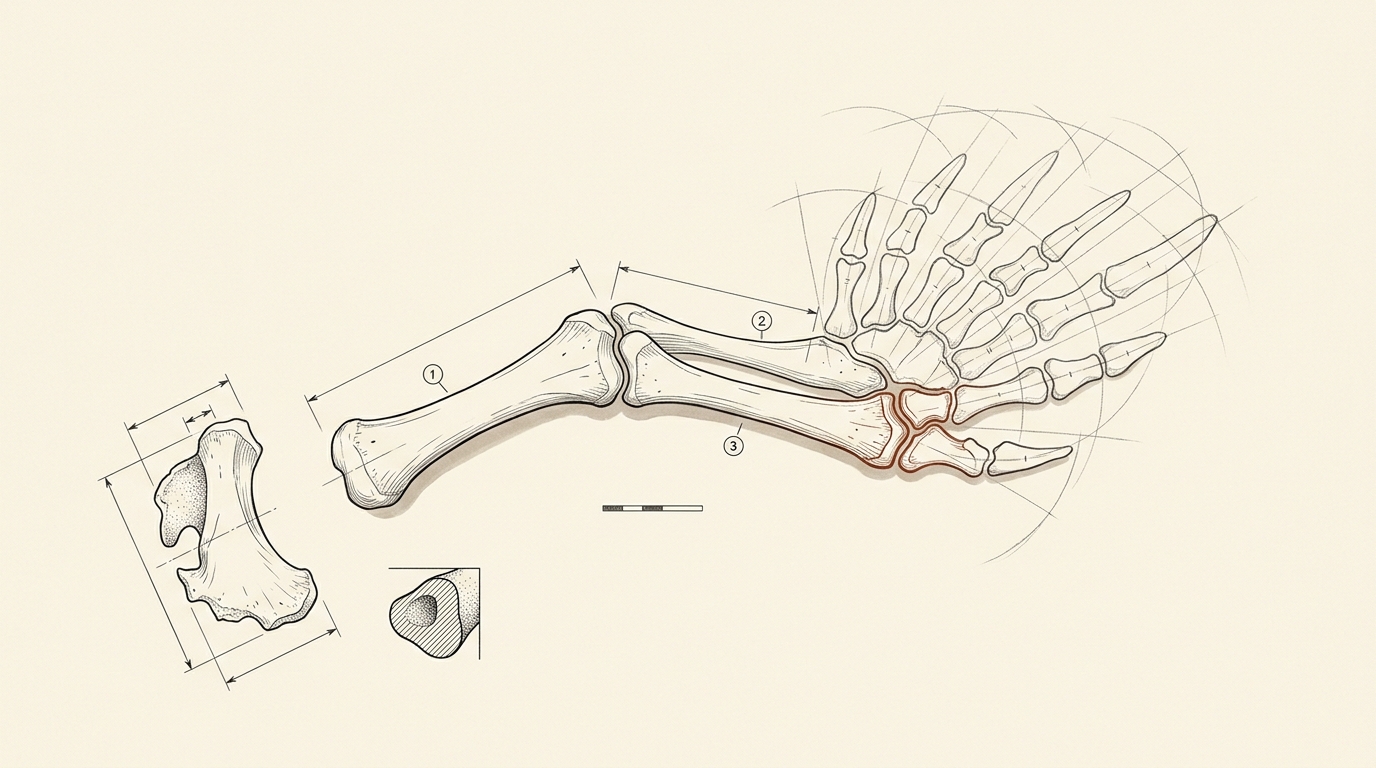
Tiktaalik's fin carried a shortened humerus, an ulna and a radius, and then — where a fish fin simply fans into rays — a small array of distal bones whose joints let the fin flex the way a wrist flexes, without yet being a wrist [@shubin-daeschler-jenkins-2006-fin]. — Image prompt and art direction by Brecht Corbeel; generation pending.
Abstract
In 2004, on the fourth field season of a search built entirely from a stratigraphic prediction, Neil Shubin and Ted Daeschler's team found Tiktaalik roseae on Ellesmere Island in rock chosen for its age and its environment rather than for any prior fossil clue. This article follows that prediction from the gap it was built to fill, through the mosaic anatomy the animal actually turned out to have — a fin with a wrist-like joint array, a skull still wired for underwater breathing, a shoulder girdle detached from the skull, a pelvis nearly as large as the shoulder girdle it once trailed far behind — and into two later findings, a more complete Quebec fin and a set of Polish trackways older than the animals meant to precede it, that complicate the simple story in a way that strengthens rather than weakens the underlying science. The argument throughout is that the transition these fossils document is a bush of contemporaneous experiments, not a ladder with Tiktaalik as a rung.
The prediction came first, the fossil second
By the early 2000s the fossil record of the transition from lobe-finned fish to four-limbed land vertebrates had two firmly dated brackets and a conspicuous silence between them. On the fish side sat Panderichthys, a flat-skulled, robust-finned tetrapodomorph fish usually placed at around 380 million years old. On the tetrapod side sat Acanthostega, an unmistakably four-limbed animal from Greenland usually placed at around 365 million years old — and one that, even as a card-carrying tetrapod, still breathed in part through fish-like internal gills housed behind an open opercular chamber, a condition established from well-preserved gill-arch material [8]. Between the two brackets lay roughly fifteen million years in which almost nothing about the transition was known firsthand. When a new animal finally filled part of that gap in 2006, Per Ahlberg and Jennifer Clack described its effect on the record in exactly those terms: it “substantially narrows the gap in the fossil record of the fish-tetrapod transition” [7].
What makes the discovery worth telling as more than a fossil-of-the-week is how the animal was found. Neil Shubin, of the University of Chicago, and Ted Daeschler, of the Academy of Natural Sciences of Drexel University, did not survey randomly and get lucky. They reasoned from the shape of the gap to the kind of rock that ought to hold its filling, then went looking for that specific rock. Explaining the choice at the time, Daeschler put the logic in one sentence: “We knew that the rocks on Ellesmere Island offered a glimpse into the right time period and were formed in the right kinds of environments to provide the potential for finding fossils documenting this important evolutionary transition” [10]. Two conditions had to be satisfied together, not separately — age and environment — and it is that conjunction that turns a hunch into something closer to a test with a real chance of failing.
The age condition pointed at rock roughly 375 million years old, squarely inside the Panderichthys–Acanthostega gap. The environment condition pointed away from the marine strata that dominate most well-collected Devonian outcrops and toward nonmarine, fluvial floodplain deposits — the shallow, plant-choked stream systems where an animal caught between water and land would plausibly have been living, dying, and getting buried in the first place. Daeschler was explicit that this was the operative hypothesis, not merely a date window: “This kind of shallow stream system seems to be the place where many features of land-living animals first arose” [10]. Ellesmere Island, in what is now Nunavut, carries exactly that combination in its Fram Formation: an Upper Devonian, Frasnian-aged sequence of siltstone and sandstone laid down by braided river systems at a time when the North American craton straddled the equator [1]. The Geological Survey of Canada had mapped the formation decades earlier for entirely different purposes; nobody had prospected it for vertebrate fossils, because nobody had a specific reason to expect a payoff large enough to justify an Arctic expedition on what would otherwise have been a hunch.
The expedition took four summer field seasons before it justified itself [10]. Fragmentary material recovered on an early trip was tantalizing enough that the team kept returning, and in 2004 — the fourth season — a site later catalogued as locality NV2K17, in a remote valley more than six hundred miles north of the Arctic Circle, produced multiple partial skulls in close articulation with their fins still attached [1, 10]. Shubin’s own account of the moment of recognition, given afterward, has the specificity of a real memory rather than a tidied-up anecdote: “I looked over at a wall; there was a Tiktaalik snout looking out of the cliff at me. I couldn’t believe my eyes. I knew the rest of the skeleton was behind it” [11]. The animal was named Tiktaalik roseae and described the following year [1]. Shubin’s own summary of what four field seasons had bought was characteristically blunt: “Tiktaalik blurs the boundary between fish and land animals… This animal is both fish and tetrapod; we jokingly call it a fishapod” [10].
That word, fishapod, is doing real work and is worth pausing on before turning to the anatomy itself. It does not mean “a fish partway through becoming a tetrapod,” as though the animal were caught mid-transformation like a single frame lifted from a flip-book. It means an animal that is, simultaneously and without contradiction, fully committed to fish anatomy in some of its systems and fully committed to tetrapod-style anatomy in others, because different parts of a body can face different selective pressures at the same time and evolution has no obligation to upgrade a whole organism on one shared schedule. What the geological prediction bought access to was that mosaic. What the mosaic actually looks like, system by system, is the rest of this article.
A fin that already had a wrist inside it
Two papers, back to back in the same April 2006 issue of Nature, described Tiktaalik from two angles. Daeschler, Shubin, and Jenkins covered the whole animal and its place in tetrapod body-plan evolution [1]; Shubin, Daeschler, and Jenkins gave the pectoral fin an entire paper of its own [2]. A fin earning its own paper is itself a signal about what the describing team judged too consequential to fold into a general description.
The fin’s proximal skeleton is unremarkable by tetrapod standards, in the sense that fish considerably older than Tiktaalik already had something like it: a single stout bone occupying the position a humerus would later occupy, followed by a pair of bones occupying the positions a radius and ulna would later occupy. That arrangement is not the novelty here. The novelty sits past it, at what would eventually become the wrist. Rather than the simple fringe of parallel rays that finishes off a typical fish fin, Tiktaalik’s fin carries what the describing paper calls “an expanded array of distal endochondral bones and synovial joints” whose pattern “is similar to the distal limb pattern of basal tetrapods” [2]. Synovial joints — fluid-cushioned, load-bearing joints of the kind a wrist or an ankle needs in order to bend under weight without grinding itself apart — are a defining tetrapod feature. Finding a cluster of them doing something recognizably wrist-like, inside a structure that is in every other respect still a fin, with fin rays and fish-type scales fully intact, is precisely the anatomical signature a mosaic prediction calls for and a simple ladder story quietly erases.
The same paper does not stop at counting bones; it tests what the arrangement could actually do. It reports that the fin was capable of a range of postures, “including a limb-like substrate-supported stance in which the shoulder and elbow were flexed and the distal skeleton extended” [2]. Read plainly, that is a fish that could, at least on occasion, plant its fin against a solid surface and push, the way a later animal plants a forefoot — while that same fin kept doing everything a fin ordinarily does in open water, because it had not stopped being a fin in order to gain the capability. The two facts sit together without tension only if you drop the assumption that “fin” and “limb” are two stops on one line rather than overlapping toolkits that a single structure can carry at once.
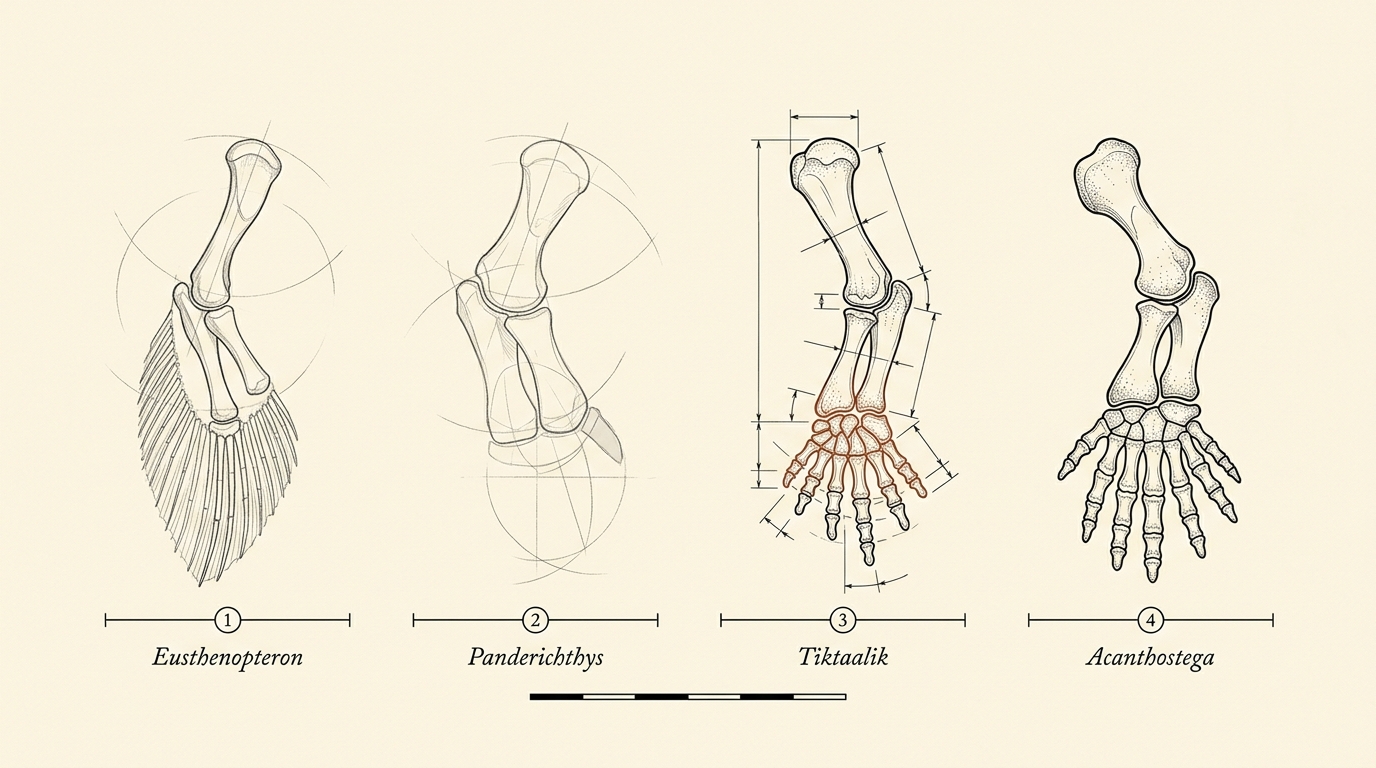
Figure 1. Set at one scale, the same three proximal bones persist across tens of millions of years while the fin's far end is what actually changes, gaining joints one form at a time rather than crossing from fin to limb in a single step [@daeschler-shubin-jenkins-2006; @shubin-daeschler-jenkins-2006-fin]. — Image prompt and art direction by Brecht Corbeel; generation pending.
Set beside its neighbors at one scale, as the plate does, the pattern reads as accumulation rather than transformation. Eusthenopteron, an earlier and more conventionally fish-like tetrapodomorph, carries the same three proximal bones attached to an unremarkable fringe of rays. Panderichthys carries the same three bones in a flatter, more robust arrangement. Tiktaalik adds the distal joint array described above on top of that shared base. Acanthostega, on the far side of the gap, carries a broad hand with far more digits than any later tetrapod would keep — a point taken up later in this article. None of this is a claim that one genus produced the next in a straight genetic line; arranging fossils by anatomical grade rather than by inferred ancestry is exactly how a comparative plate avoids implying that. What it does show is the wrist-type joint array evolving as one addition among several, on its own schedule, rather than as the final step of a single transformation completing itself in one motion.
A skull still wired for breathing underwater
The internal skull skeleton — the braincase, the palate, and the branchial arches that in a fish support the gills — received its own dedicated description two years later, once enough three-dimensionally preserved material had been prepared to make the internal anatomy legible [3]. Its authors report a mixture rather than a verdict: the braincase “retains primitive features” while sharing “derived tetrapod characteristics such as a large basal articulation and flat, horizontally oriented entopterygoid” — and, in the single most diagnostic bone of the set, the hyomandibula is described as “short” and “straight,” showing “morphology intermediate between primitive fish and tetrapods” [3].
The hyomandibula is worth explaining, because its job changes completely across this transition and Tiktaalik’s version is caught between the two jobs rather than having finished either one. In a typical fish it is a strut that helps suspend the jaw and braces the bony gill cover, flexing with every gill-pumping breath. In a tetrapod, the same bone — by then renamed the stapes — has abandoned respiration and jaw support altogether and been repurposed as a sound-transmitting ossicle inside the middle ear. Tiktaalik’s hyomandibula is shortened and straightened relative to a typical fish condition without having become a dedicated hearing bone: an intermediate documented directly in the fossil itself, not inferred from something else nearby [3]. The animal’s original description places a related theme at the level of the skull roof and dermal skeleton: a flattened, broadened skull and reduced dermal gill-cover bones removed one of the fixed connections that, in a fish, ties the head rigidly to the body — a change taken up in the next section [1].
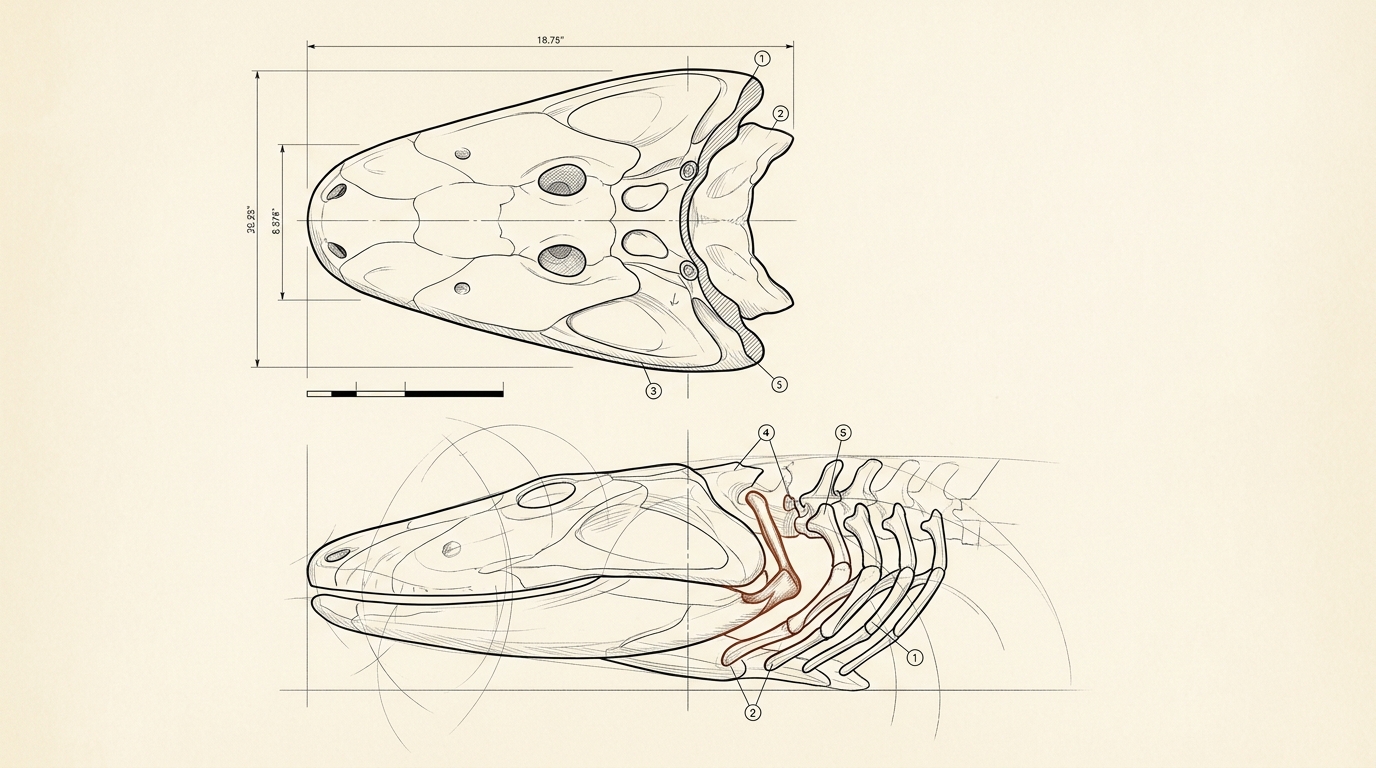
Figure 2. The skull roof reads flat and broad from above, and the gill-arch skeleton behind the jaw still reads as a fish's — but the hyomandibula, the bone a fish braces its gill cover on, is short and straight, already closer to the tetrapod condition than the fish one [@downs-daeschler-shubin-2008]. — Image prompt and art direction by Brecht Corbeel; generation pending.
That the internal breathing skeleton was still doing recognizably fish-type work matters for what comes later in this article, because it is tempting to assume the fish-to-tetrapod transition proceeds breathing-first — gills give way to lungs, and everything else follows from there. Acanthostega, an unambiguous four-limbed tetrapod some ten to fifteen million years further along, undercuts that assumption directly. Coates and Clack’s description of its well-preserved gill-arch material shows Acanthostega retained fish-like internal gills housed in an open opercular chamber, evidence the authors read as aquatic respiration persisting well after limbs, digits, and a mobile neck were already in place [8]. Breathing and limb-bearing did not arrive as a bundled package. They are separate systems that happened to finish changing on different schedules, which is exactly what a mosaic model predicts and a single-track transformation cannot easily accommodate.
The shoulder let go of the skull before the fin let go of the water
Most of a fish’s shoulder girdle is not, mechanically speaking, a free-standing structure. It is sutured to the back of the skull through the same dermal and opercular bones that brace the gill cover, which means the head and the trunk function as one rigid unit: turn the body, and the head turns with it, because no joint exists between them to do otherwise. Tiktaalik’s original description places the loss of that connection among its most consequential changes — reduced, mobile-neck-permitting dermal and opercular elements that, together with a genuinely differentiated neck region, let the head move independently of the shoulders for the first time in this lineage [1].
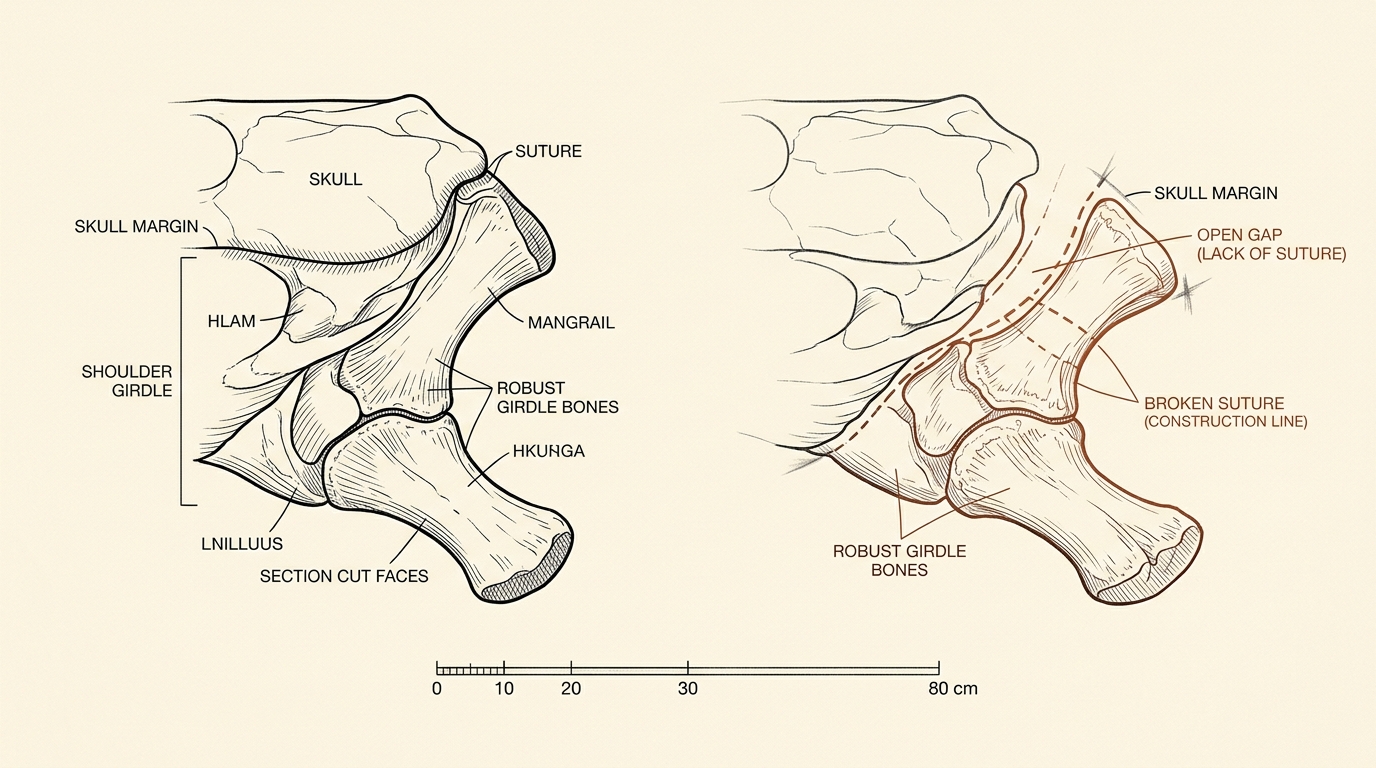
Figure 3. In most fish the shoulder girdle is sutured directly to the back of the skull; in Tiktaalik it is not, and that missing suture is what let the head turn on a neck instead of the whole body turning with it [@daeschler-shubin-jenkins-2006]. — Image prompt and art direction by Brecht Corbeel; generation pending.
It is difficult to overstate how much downstream behavior a single missing suture makes available. An animal whose head cannot turn independently of its trunk can only look at, or strike at, whatever its whole body is already aimed toward; feeding becomes a matter of aiming the entire animal at prey, which is a fish’s ordinary solution and a perfectly good one in open water. An animal with a mobile neck can hold its body still and swing its head — toward something at the water’s edge, along a bank, into a gap between obstacles — without committing the rest of itself to the movement first. That capability has an obvious payoff in exactly the marginal, structurally cluttered floodplain habitat the geological prediction was built around, well before it has any payoff on dry land at all.
The same description reports the ribs as broadened and overlapping relative to typical fish ribs of the period, a change usually read as bracing for a trunk no longer fully supported by water’s buoyancy [1]. Notice what is not claimed alongside it: nothing about the scales, which stayed a fish’s scales, or the fin rays, which stayed fin rays, or the gills, addressed in the previous section, which stayed functionally close to a fish’s gills. Four systems — feeding-related neck mobility, trunk bracing, breathing, and fin-joint architecture — were each partway toward a tetrapod condition, on four evidently uncoordinated schedules, in one living animal that never stopped being, for most practical purposes, a fish that swam for a living.
The hind fin started doing a tetrapod’s job while still a fin
New material recovered from the same Ellesmere Island locality and described in 2014 extended the mosaic to the back half of the animal [4]. The headline measurement is a simple comparison that nonetheless overturns an assumption: in the best-preserved specimen the pelvic girdle measures about 65 millimetres in craniocaudal length against a pectoral girdle of about 70 millimetres — nearly matching proportions, “roughly the same rostrocaudal length as the cleithrum/scapulocoracoid block” — where a more typical finned tetrapodomorph such as Eusthenopteron carries a pelvis only about a twentieth of its body length [4]. A structure that in most fish is a minor anchor point had, in Tiktaalik, grown to rival the shoulder girdle in size.
Size was not the only change reported. The paper describes the acetabulum, the hip socket, as “a deeply concave socket” oriented so that it “would have faced more laterally than that of fish but less than tetrapods” — an intermediate joint geometry rather than a fish-type or tetrapod-type socket outright — and the iliac blade as “a broad and flat planar surface,” more robust than in other finned tetrapodomorphs even though it still lacks the sacral rib attachment that anchors a true tetrapod pelvis to its vertebral column [4]. The paired pelvis also carries flat, elongate pubes, and its acetabular rim is finished with a robust lip of bone rather than the unreinforced edge a fish pelvis gets by with — a socket built, structurally, to take a load a fish hip is never asked to bear [4]. The authors read the whole package as evidence against a once-standard assumption they call the “front wheel drive” hypothesis — the idea that fish-to-tetrapod locomotion was pectoral-limb-led throughout the aquatic phase, with the hind end becoming a serious propulsive and load-bearing partner only once the animal was on land — arguing instead for capabilities including “paddling, station holding, and walking” well before any of that happened out of water [4].
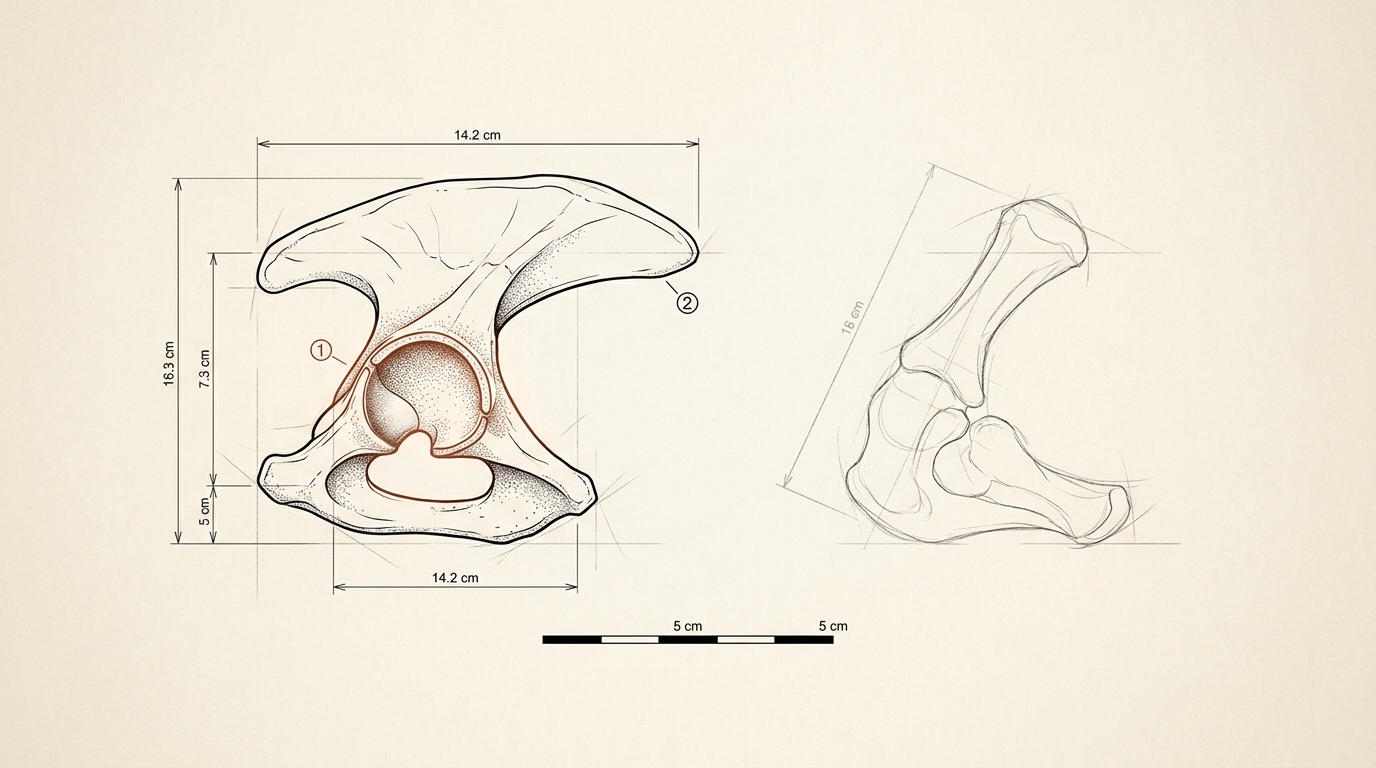
Figure 4. Drawn at the same scale as its own shoulder girdle, Tiktaalik's pelvis is not the small brace a fish carries — its craniocaudal length nearly matches the shoulder girdle's, and its hip socket is a deep, laterally facing cup rather than a shallow fish acetabulum [@shubin-daeschler-jenkins-2014-pelvis]. — Image prompt and art direction by Brecht Corbeel; generation pending.
Coverage of the paper at the time reached for the obvious mechanical shorthand: “a shift occurred from ‘front-wheel drive’ locomotion in fish to more of a ‘four-wheel drive’ in tetrapods,” with Tiktaalik’s own pelvis “nearly identical in size to its shoulder girdle, a tetrapod-like characteristic” [12]. Daeschler’s own characterization of the find was that the pelvis was “very different from anything that we knew of in the lineage leading up to limbed vertebrates,” suggesting the animal used its hind fin “in a way that’s more suggestive of the way a limb gets used,” while Shubin speculated it may have paddled with the enlarged fin, or used it to push against a substrate, drawing a loose comparison to how living African lungfish use their own hind fins today [12]. The point that survives independently of any one reconstructed gait is the sequencing: whatever “four-wheel drive” locomotion eventually became, on this evidence it did not begin as a response to gravity on land. It began underwater, in a fish, being worked out fin by fin before there was any land requirement waiting to be answered.
A more complete fin turned up one node closer to the line
Nothing in the preceding sections requires Tiktaalik to be uniquely important, and the first serious complication to the popular retelling makes that explicit. In 2020, a team led by Richard Cloutier described a remarkably complete, 1.57-metre articulated specimen of Elpistostege watsoni, collected a decade earlier from the Frasnian-aged Escuminac Formation in Quebec [6]. High-energy computed tomography of the specimen’s pectoral fin found four proximodistal rows of radials, two of which include branched carpal-like elements, and two further distal rows organized clearly enough to be called digits and putative digits — a fin skeleton carrying identifiable digit precursors while its owner’s fin remained, externally, an entirely ordinary-looking finned appendage covered in scales and lepidotrichia [6].
That is the same mosaic signature described in the sections above — tetrapod-grade skeletal organization embedded inside an externally fish-type structure — pushed one further step toward the tetrapod condition, in the one structure, the hand, that Tiktaalik’s own fossils do not preserve articulated finely enough to settle. It also unsettles the tidy version of the story in a specific way. Earlier phylogenetic analyses had generally placed Elpistostege as Tiktaalik’s close relative within a wider group of elpistostegid fish; the 2020 redescription instead recovered it as sister to all limbed vertebrates — positioned, in that analysis, crownward of Tiktaalik and closer to the tetrapod lineage [6]. If that placement holds, Tiktaalik is not uniquely “the” transitional form connecting fish to land. It is a superbly documented relative sitting at least one branch further from the tetrapod crown than an animal whose best specimen sat unprepared in a collection for years before anyone read what its fin actually contained. The describing team’s own conclusion states the reversal plainly: the vertebrate hand, on their reading, “arose primarily from a skeletal pattern buried within the fairly typical aquatic pectoral fin of elpistostegalians” [6] — the hand as a pre-existing fish pattern uncovered, not a novelty invented once anything came ashore.
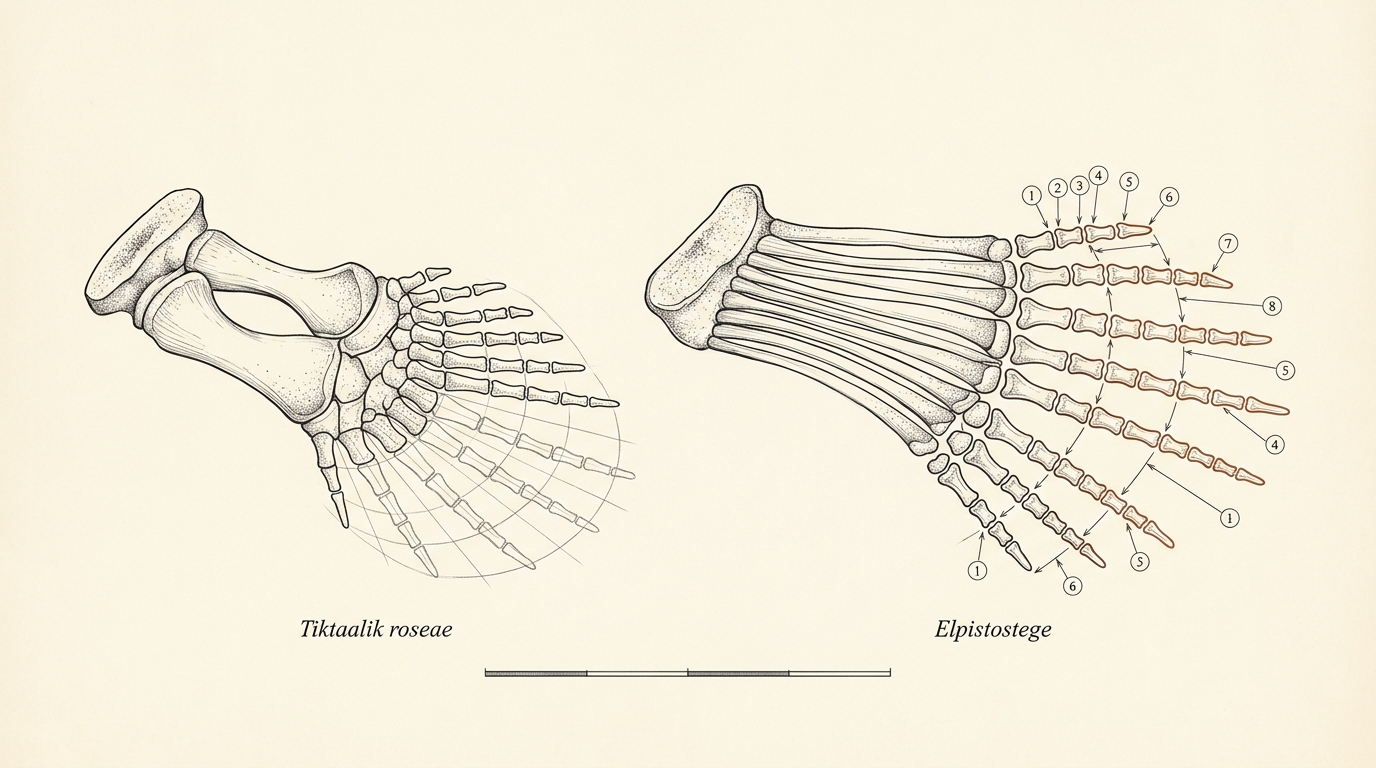
Figure 5. A more complete Quebec specimen described in 2020 shows four rows of radials ending in two rows organised enough to be called digit-like — a fin skeleton that some analyses place closer to the tetrapod hand than Tiktaalik's own [@cloutier-2020-elpistostege]. — Image prompt and art direction by Brecht Corbeel; generation pending.
None of this embarrasses the original prediction, which was built on a time-and-environment window rather than on any single genus, and a mosaic anatomy inside that window is exactly what the prediction called for regardless of which fossil happened to preserve it best or first. What it does is puncture the “missing link” reading before the article’s harder complication arrives. If two separately named, separately described animals from two different Devonian localities both carry hand-like or wrist-like structure buried inside an ordinary fin, worked out on parallel and only loosely synchronized timelines, then what the fossil record is documenting is more than one lineage solving a shared problem at roughly the same time — a spread of related experiments, not one filament running dependably from fin to foot.
Something was already walking before the intermediates existed
The complication that matters most for how this whole subject should be framed does not come from a body fossil at all. In 2010, Grzegorz Niedźwiedzki and colleagues described tetrapod trackways — ten complete trackways plus numerous isolated manus and pes prints — from the Zachełmie quarry in Poland’s Holy Cross Mountains, preserved in the Wojciechowice Formation and documenting what the authors interpret as semi-terrestrial and underwater walking, resting, and swimming behavior by a genuinely limbed animal [5]. That formation is a dolomite sequence the describing paper interprets as deposited in a transitional lacustrine-to-marginal-marine setting on a broad, shallow carbonate platform — a shoreline environment, not the freshwater floodplain the Ellesmere Island prediction had targeted [5]. Dated by conodont biostratigraphy to the early Eifelian stage of the Middle Devonian, the tracks come out at roughly 390 million years old — a figure the describing paper puts at about eighteen million years older than the earliest known tetrapod body fossils, and about ten million years earlier than the oldest known elpistostegid body fossils [5].
Do the arithmetic and the problem is immediate. Ten million years before roughly 390 million years ago lands at approximately 380 million years ago — squarely Panderichthys’s age, not Tiktaalik’s 375 or Elpistostege’s Frasnian window. An animal capable of pressing distinct, digited footprints into a tidal or lake-margin surface was already walking before any of the fossils conventionally arranged as intermediate stages toward that gait — Panderichthys, Tiktaalik, Elpistostege — had appeared in the rock record at all.
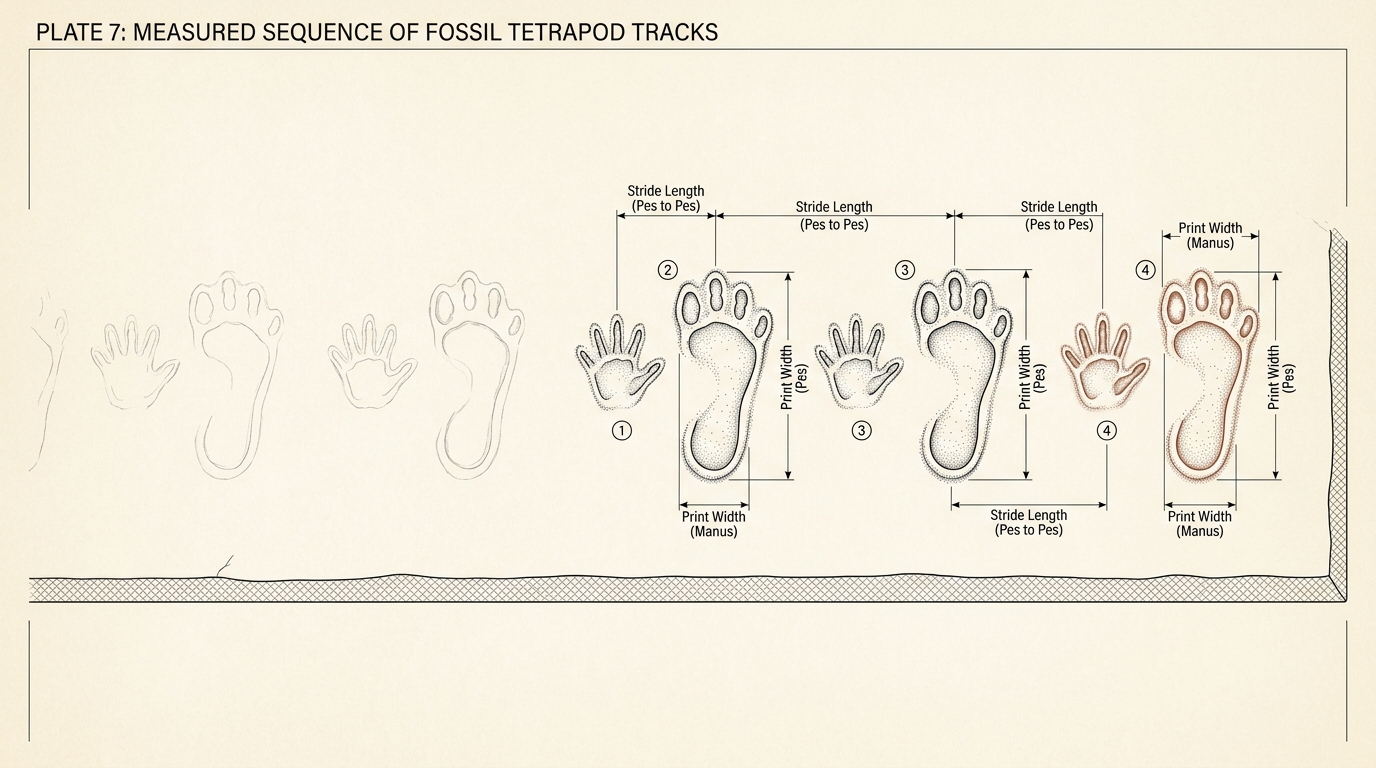
Figure 6. These prints date to roughly 390 million years ago, some ten million years before the oldest known elpistostegid body fossils — meaning whatever made them cannot be a descendant of Tiktaalik's lineage at all [@niedzwiedzki-2010-zachelmie]. — Image prompt and art direction by Brecht Corbeel; generation pending.
There is exactly one way to hold this fact and the earlier sections together without contradiction, and it is the way the discipline actually holds it: none of the well-known “intermediate” fossils can be the trackmaker’s ancestor, because every one of them is younger than the trackway. At best they are its cousins — descendants, along with the actual trackmaker’s own lineage, of a still-earlier common ancestor that had, by 390 million years ago, already given rise to at least one branch capable of a walking gait, while other branches from that same ancestor spent the following ten to fifteen million years still working out fin joints, pelvic proportions, and neck mobility in the water, each on a branch-specific timetable of its own. Treated as a single ladder with the well-known named fossils as its rungs, the trackways are a contradiction: older evidence of a supposedly later capability. Treated as a bush — an actual phylogenetic tree with many branches alive at once, almost all of them now extinct, only one line among them actually ancestral to any living tetrapod — the finding stops being a contradiction and becomes close to an expectation. A bush predicts that a capability like walking should evolve more than once, in more than one lineage, at more than one time, and that the fossil record will hand back an essentially arbitrary sample of that redundancy rather than a single clean sequence. Zachełmie is what that prediction, taken seriously, looks like once it is confirmed by a find nobody was specifically searching for.
What a confirmed prediction is worth in a historical science
Pull the pieces together and the achievement being described is narrower, and more interesting, than “scientists found the missing link.” Shubin and Daeschler did not predict an animal. They predicted a location defined by two independently checkable variables — a rock age and a depositional environment — derived from a gap in an existing dataset, then spent four field seasons finding out whether the prediction paid off [10, 1]. It did, and what came out of the ground was not a single missing puzzle piece but a mosaic animal whose separate systems — fin joints, cranial and gill architecture, neck mobility, pelvic proportions — each sat at a different point along the fish-to-tetrapod spectrum, confirming that the transition was a matter of many quasi-independent changes rather than one coordinated upgrade arriving all at once.
Two later findings sharpened rather than undermined that picture, and both arrived from directions the original team was not specifically looking in. A more complete Quebec specimen showed that hand-like structure was being worked out in a contemporary fin elsewhere on roughly the same timeline [6], and a set of Polish trackways ten to eighteen million years older than any of the well-known body fossils showed that a walking gait had already evolved on some branch of the tree before the famous “intermediate” genera existed to be anyone’s ancestor [5]. Both results would be awkward for a ladder model, in which each named fossil is supposed to sit on the direct line between the last one and the next. Neither is awkward for a bush model, in which named fossils are cousins sampled more or less at random from a once-much-larger set of contemporaneous experiments, most of which left no other trace at all. Acanthostega’s own limbs make the same point from a different angle: rather than settling early on the five digits every later tetrapod keeps, its forelimbs and its paddle-like, anteriorly torsioned hindlimbs were both octodactylous, carrying eight digits each, with the eventual standardization on five happening independently in different lineages rather than being fixed from the start [9]. The same description finds Acanthostega retaining a rhachitomous vertebral column with a primitive atlas-axis complex and tail fin rays, and places it as sister group to Ichthyostega and all more advanced tetrapods rather than as their direct forerunner [9]. Even the “successful” branches did not converge on a single blueprint on their first attempt, and the best-known early tetrapod is itself a mosaic sitting beside the lineage it is usually drawn leading into, not on top of it.
What would overturn this reading is worth stating plainly, because a historical science earns its claims by saying what would break them. The bush interpretation predicts that further Devonian trackway or body-fossil finds should keep turning up out of the tidy fish-to-tetrapod order — older walking evidence, younger fish-grade anatomy, contemporaneous taxa at different stages of the same systems — rather than slotting neatly between Panderichthys and Acanthostega. A ladder interpretation would be restored if that pattern stopped: if the Zachełmie dating were revised sharply younger under further scrutiny, if no other pre-Frasnian trackway or body fossil ever turned up despite continued search, and if subsequent phylogenetic work converged on Tiktaalik or a close kin as a literal, unbranched ancestor of all later tetrapods rather than one cousin among several. Nothing in the record assembled here shows that. Every new find over the fifteen years since Tiktaalik’s description — the 2010 trackways, the 2014 pelvis, the 2020 Elpistostege redescription — has added another branch rather than straightening the line, which is itself a testable pattern and, so far, the one this evidence keeps confirming.
What makes the original prediction worth returning to, given all of that, is that it demonstrates something about evolutionary biology’s status as a historical science that is easy to state and unusually rare to demonstrate this cleanly: a theory built from comparative anatomy and stratigraphy generated a specific, falsifiable, geographically actionable claim — dig here, in rock of this age and this environment, and you should find an animal with this kind of anatomy — and the claim survived contact with a shovel. That the mosaic which turned up was more tangled than a straight line, and that later finds tangled it further rather than resolving it, is not a failure of the method. It is what a successful prediction about a genuinely branching history should look like once enough of the branches start turning up.
Sources
- Edward B. Daeschler, Neil H. Shubin, and Farish A. Jenkins Jr.. A Devonian tetrapod-like fish and the evolution of the tetrapod body plan. Nature (2006). DOI: 10.1038/nature04639.
- Neil H. Shubin, Edward B. Daeschler, and Farish A. Jenkins Jr.. The pectoral fin of Tiktaalik roseae and the origin of the tetrapod limb. Nature (2006). DOI: 10.1038/nature04637.
- Jason P. Downs, Edward B. Daeschler, Farish A. Jenkins Jr., and Neil H. Shubin. The cranial endoskeleton of Tiktaalik roseae. Nature (2008). DOI: 10.1038/nature07189.
- Neil H. Shubin, Edward B. Daeschler, and Farish A. Jenkins Jr.. Pelvic girdle and fin of Tiktaalik roseae. Proceedings of the National Academy of Sciences (2014). DOI: 10.1073/pnas.1322559111.
- Grzegorz Niedźwiedzki, Piotr Szrek, Katarzyna Narkiewicz, Marek Narkiewicz, and Per E. Ahlberg. Tetrapod trackways from the early Middle Devonian period of Poland. Nature (2010). DOI: 10.1038/nature08623.
- Richard Cloutier, Alice M. Clement, Michael S. Y. Lee, Roxanne Noël, Isabelle Béchard, Vincent Roy, and John A. Long. Elpistostege and the origin of the vertebrate hand. Nature (2020). DOI: 10.1038/s41586-020-2100-8.
- Per E. Ahlberg and Jennifer A. Clack. Palaeontology: a firm step from water to land. Nature (2006). DOI: 10.1038/440747a.
- M. I. Coates and J. A. Clack. Fish-like gills and breathing in the earliest known tetrapod. Nature (1991). DOI: 10.1038/352234a0.
- M. I. Coates. The Devonian tetrapod Acanthostega gunnari Jarvik: postcranial anatomy, basal tetrapod interrelationships and patterns of skeletal evolution. Earth and Environmental Science Transactions of The Royal Society of Edinburgh (1996). DOI: 10.1017/S0263593300006787.
- Academy of Natural Sciences of Drexel University. New Arctic fossils fill evolutionary gap between fish and limbed animals. EurekAlert! (2006).
- Nature News. The fish that crawled out of the water. Nature (2006).
- ScienceDaily. Discovery of new Tiktaalik roseae fossils reveals key link in evolution of hind limbs. ScienceDaily (2014).
Originally published at https://absolutedigitalpublishers.com/articles/tiktaalik-the-fossil-found-because-evolution-said-where-to-dig.