The Peacock Problem: Darwin's Second Theory and Its Hard Tests
An ornament that costs its owner survival needed a theory natural selection could not supply. Darwin wrote one in 1871. It took a century to be taken seriously, and the experiments built to test it still disagree with each other.
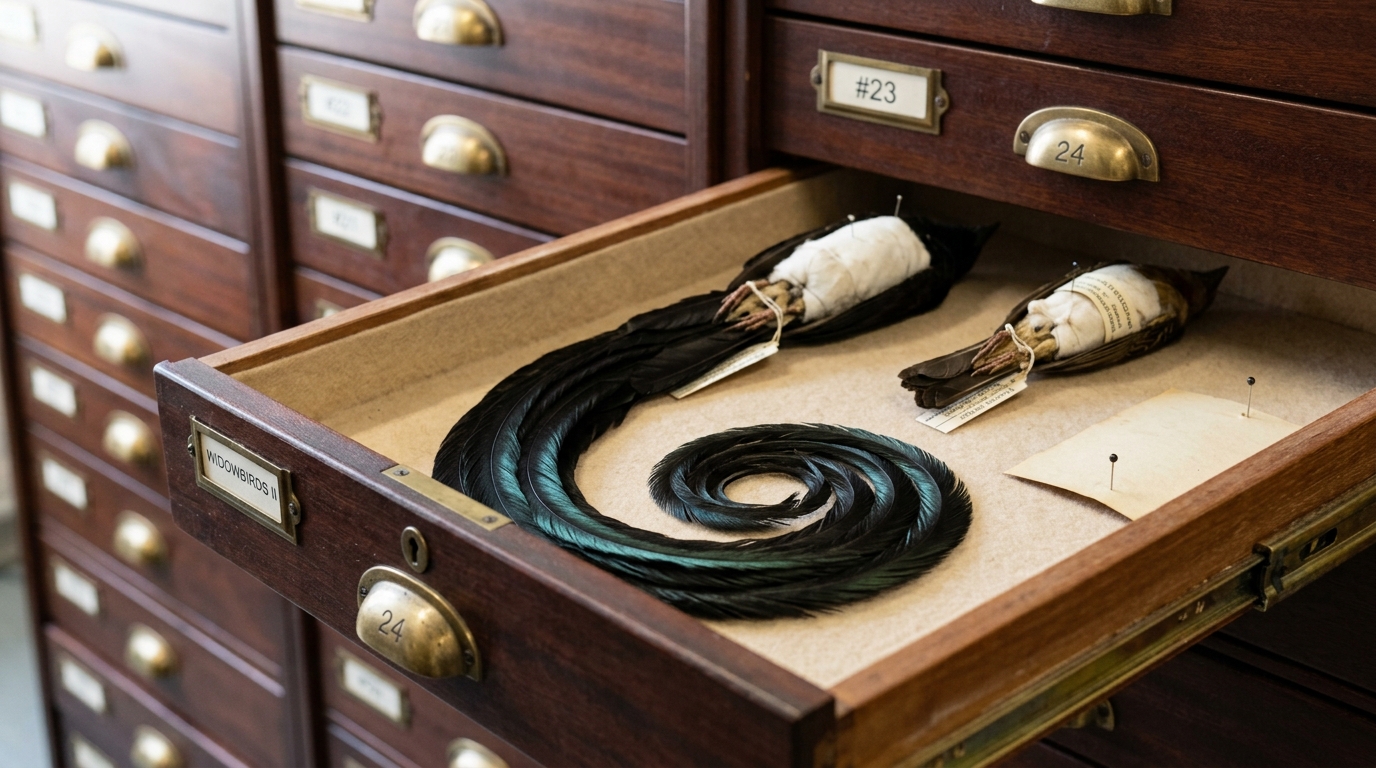
One drawer holds the whole argument: a tail this long costs something to grow and something to fly with, so whatever keeps it in the population has to be paying a separate bill from survival. — Image prompt and art direction by Brecht Corbeel; generation pending.
Abstract
In 1860 Darwin told Asa Gray that the sight of a peacock's tail feather made him sick, because natural selection could not explain an ornament that should get its bearer killed. His answer, published in 1871, was a second selective force running on preference rather than survival, and it was rejected or ignored by most working biologists for roughly a century. This article follows the theory from Darwin's own ambivalence and Alfred Russel Wallace's dissent, through Fisher's 1930 runaway model and Zahavi's 1975 handicap principle, to the experiments that finally made sexual selection testable: Andersson's 1982 widowbird tail manipulations, Petrie's peahen and eyespot experiments, and a 2008 study of a second peafowl population that found no such preference at all. The dispute that follows is reported as what it is — open, technical, and unresolved — alongside the more recent argument that arbitrary beauty may not need an adaptive excuse in the first place.
A feather that made its own discoverer sick
In April 1860, five months after publishing On the Origin of Species, Darwin wrote to the American botanist Asa Gray with a confession that has embarrassed tidier accounts of his theory ever since: “The sight of a feather in a peacock’s tail, whenever I gaze at it, makes me sick!” [1]. The letter is catalogued by the Darwin Correspondence Project as letter no. 2743, dated 3 April 1860, and the sentence is not a joke at his own expense. Natural selection explains traits that improve survival or reproduction through function — sharper eyes, better camouflage, stronger jaws. A train of iridescent feathers a metre long, grown fresh every year at metabolic cost, heavy enough to slow flight and gaudy enough to draw a predator’s eye, is the opposite of that. If natural selection were the only engine of adaptation, the peacock’s tail should not exist, and Darwin knew it well enough to say so in a private letter before he had any public answer.
The answer took eleven years. In The Descent of Man, and Selection in Relation to Sex (1871), Darwin proposed that a second selective force operates alongside natural selection, one he named sexual selection and defined as acting through exactly two means: “the law of battle” among males for access to females, and “choice exerted by the female” among competing suitors [2]. The first mechanism was easy for his contemporaries to accept, because combat looks like ordinary struggle wearing different clothes — antlers, tusks, and size differences between the sexes all fit comfortably inside a survival-of-the-fittest framework once fitness is redefined as fighting ability. The second mechanism was not easy to accept, and its difficulty is the whole reason this article exists. Darwin was proposing that female animals — mostly birds, in his examples — possessed what he called, without embarrassment, “a taste for the beautiful,” and that this taste, exercised generation after generation, could build ornaments with no survival value at all [2]. As Richard Prum’s 2012 review of this history stresses, Darwin’s aesthetic language was not loose Victorian colour; he meant literally that many secondary sexual ornaments are “entirely arbitrary,” successful because they are preferred and not because they signal anything else about the bearer [14].
That claim found its sharpest critic in the co-discoverer of natural selection itself. Alfred Russel Wallace spent much of the 1860s through the 1880s arguing that Darwin had it backwards: dull female coloration, Wallace held, was itself an adaptation for concealment during nesting, and the male ornaments Darwin attributed to female taste were better explained as by-products of male vigour correlated with health and survival ability, not as objects of aesthetic preference at all. Prum’s account quotes Wallace’s own summary of the position directly: “if there is (as I maintain) such a correlation [between ornament and health, vigour, and the ability to survive], then sexual selection, for which there is little or no evidence, becomes needless, because natural selection… will itself produce all the results” [14]. The irony Prum draws out of this exchange is worth stating plainly, because it reorganises everything that follows in this article: Wallace never denied that female preference existed. What he denied was that preference could track anything other than a male’s underlying quality — which means Wallace, not Darwin, is the intellectual ancestor of every “good genes” and honest-signal theory that would later claim to rescue Darwin’s idea. The nineteenth-century debate was won, decisively, by Wallace. It took a further century for anyone to seriously revisit Darwin’s own, stranger, arbitrary version.
Wallace was the most effective critic, but he was not the only source of Victorian resistance, and Darwin’s own text shows him arguing against a wider current of doubt that female birds possessed any aesthetic capacity worth the name. Discussing the ornamental tail spots of a male hummingbird, Darwin quotes the Duke of Argyll’s own objection directly — “What explanation does the law of natural selection give of such specific varieties as these?” — and records his own answer without softening it: “He answers, ‘none whatever;’ and I quite agree with him” [14]. That is Darwin conceding, in his own book, that natural selection has nothing to say about the specific form certain ornaments take, which is exactly the gap he built sexual selection to fill. Elsewhere he pressed the aesthetic claim to its most contested extreme, writing of the Argus pheasant that “the most refined beauty may serve as a sexual charm, and for no other purpose,” and that the male’s beauty and the female’s capacity to appreciate it “advanced together” through many generations of exercised preference [14]. Prum’s assessment of how this landed is blunt: the explicitly aesthetic core of Darwin’s proposal was “highly controversial at the time,” and criticism of it was swift enough, and broad enough, that sexual selection by mate choice was very nearly abandoned as a serious research topic for the century that followed [14].
Fisher showed an arbitrary taste can run away under its own power
The first mathematically serious attempt to rescue Darwin’s arbitrary version came from Ronald Fisher in 1930, and it is worth reading in Fisher’s own words before it gets summarised into a diagram, because summaries tend to erase how odd the mechanism actually is. Fisher wrote that a display trait shaped this way “owes nothing to natural selection, which may even have turned against it, but it still increases in splendour and perfection, and the importance attached to it by the opposite sex still increases, so long as it retains a balance of advantage” [3]. The logic, stripped to its skeleton, starts from something almost trivial: if some females in a population have a genetically heritable preference for slightly longer tails, and some males have genetically heritable slightly longer tails, then over generations the two traits become statistically coupled, because daughters of choosy mothers disproportionately inherit both the choosiness and the genes of the long-tailed males their mothers chose. Once that coupling exists, a male with a longer-than-average tail is preferred not only because tail length itself is attractive in the abstract, but because he is statistically more likely to sire sons who will themselves be preferred by the next generation of choosy daughters. Preference and trait begin to drag each other upward, and the process can continue after the trait has become a net cost to survival, restrained only by the point at which that survival cost finally outweighs the mating advantage.
Russell Lande’s 1981 paper gave this verbal logic its standard quantitative-genetic form, modelling the joint evolution of a female preference trait and a male display trait under stabilising natural selection on the display and showed that, “despite stabilizing natural selection on males, various types of mating preferences may create a runaway process in which the outcome of phenotypic evolution depends critically on the genetic variation parameters and initial conditions of a population” [4]. One compact way to see why sits in the coupling itself. Let (\bar t) be the population mean of a male display trait and (\bar p) the population mean of the corresponding female preference; write (\beta_t) and (\beta_p) for the direct selection gradients acting on each (natural selection pulling (\beta_t) downward, since the ornament is costly), (h_t^2) and (h_p^2) for their heritabilities, and (B) for the genetic covariance that non-random mating builds between the two traits. The standard Lande-Fisher formalisation of one generation’s change is then a coupled pair:
\begin{aligned} \Delta \bar{t} &= h_t^{2}\,\beta_t + B\,\beta_p \\ \Delta \bar{p} &= B\,\beta_t + h_p^{2}\,\beta_p \end{aligned}
Read the first line on its own and the trait looks stable: natural selection ((\beta_t)) pulls the ornament back down every generation. But the second term, (B,\beta_p), imports a push from the preference side through the genetic covariance the mating system itself has created. When (B) is large enough relative to the stabilising pull of (\beta_t), the two equations no longer settle to a fixed point; they feed each other, and (\bar t) and (\bar p) escalate together until some external limit — a wing that can no longer lift the tail, a display that finally costs more than it wins — brings the pair to a halt. Nothing in the equations names where that limit falls. That absence of an internal stopping rule is the entire content of “runaway”: once the covariance term dominates, the direction is set and the magnitude is set by biomechanics, not by the selective logic that started the process.
This is also why the mechanism is sometimes described, a little loosely, as selection for “sexy sons”: a female who mates with an attractive male gains no direct benefit for herself, and on the handicap account she may not even be choosing a healthier mate, but her sons inherit his attractiveness and will themselves be preferred by the next generation of choosy females, which is enough on its own to make the choice adaptive for her in strictly genetic terms. Lande’s model makes a further point that is easy to lose in the algebra: the outcome is not guaranteed to be dramatic escalation in every population. Depending on the genetic variances and the population’s starting position, the same coupled system can instead drift along a line of neutral equilibria, producing “rapid evolution” through the interaction of natural selection, sexual selection and genetic drift without any runaway divergence at all [4]. The mathematics behind Fisher’s verbal sketch does not predict that every population subject to mate choice will develop an ever more extreme ornament; it predicts a family of possible outcomes whose direction depends on details — heritabilities, the sign and size of the genetic covariance, where a population happens to start — that differ from species to species and are rarely known with any precision in the wild.
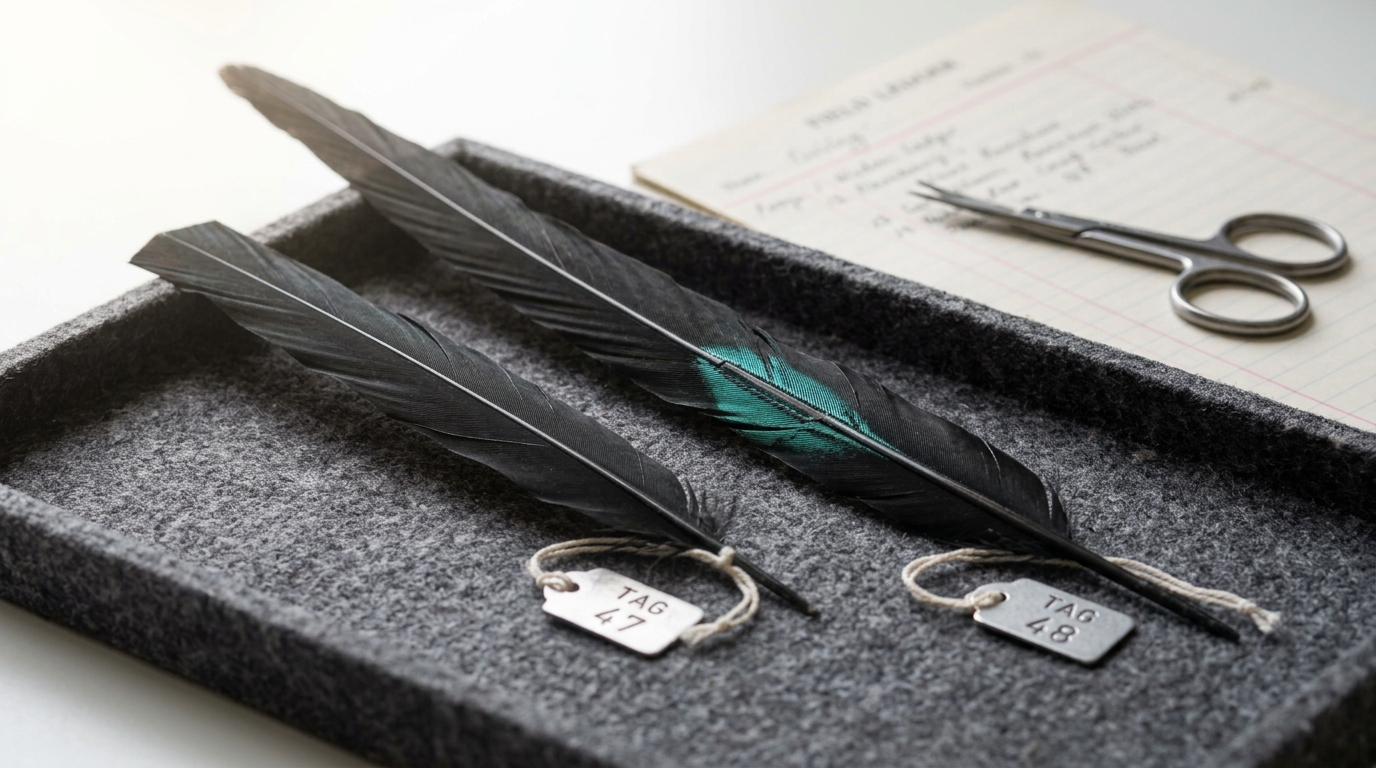
Figure 1. Fisher's point in one tray: nothing inside the mechanism marks a place to stop. A slightly longer tail is preferred because it is slightly more preferred, and that loop has no natural ceiling of its own. — Image prompt and art direction by Brecht Corbeel; generation pending.
Zahavi’s handicap sounded like nonsense for fifteen years, then Grafen made it algebra
Fisher’s runaway explains how an arbitrary preference can escalate once it exists, but it does not explain why a female should ever prefer a trait that tells her nothing true about the male carrying it. In 1975 the Israeli biologist Amotz Zahavi proposed a different answer that inverted the usual intuition about cost: rather than preference creating cost as an unfortunate side effect, cost itself is what makes preference worth having. Zahavi argued that secondary sexual characters function as handicaps, and that “characters develop through mate preference confer handicaps on the selected individuals in their survival,” precisely because that cost is what makes the ornament a reliable indicator of quality — a weak or diseased male cannot afford to carry a maximally expensive tail, so only the genuinely superior can display one without dying [5]. On this account the peacock’s train is not an arbitrary Fisherian escalation at all; it is a costly, hard-to-fake advertisement, closer to a job applicant submitting an expensive, verifiable credential than to a fashion that simply caught on.
The idea was not received as an insight. It was received, for roughly the next decade and a half, as an error. John Maynard Smith, one of the most influential theoretical biologists of the period, published a direct rebuttal the following year arguing that Zahavi’s verbal model could not be made to work within standard population-genetic logic — a handicap that reduces survival should simply be selected against, full stop, unless some additional mechanism were doing work that Zahavi had not specified [6]. Zahavi’s proposal sat for years afterward without a rigorous formal defence, treated by much of the field as an appealing but mathematically unsupported paradox.
The rescue came from game theory rather than from population genetics as such. Alan Grafen’s 1990 paper, “Biological signals as handicaps,” built an evolutionarily stable strategy model of signalling between individuals with partly conflicting interests and proved, under stated conditions, that a costly signal can be a stable equilibrium precisely when the marginal cost of increasing the signal is lower for a genuinely high-quality individual than for a low-quality one [7]. That single clause is the difference between Zahavi’s original intuition and a working model: it is not the absolute cost of the tail that has to correlate with quality, it is the cost at the margin — how much harder one more centimetre of train is on a sick bird than on a healthy one. Grafen showed that when that condition holds, cheating does not pay, because a low-quality male attempting to fake a high-quality signal would pay a steeper marginal price than the signal is worth to him, while a genuinely high-quality male pays less at the margin than the mating benefit he receives. The mathematics converted what had looked like special pleading into an ordinary equilibrium result, and the handicap principle moved, over the following years, from a rejected curiosity into one of the two dominant explanatory frameworks in the field — the other being the Fisherian runaway it had originally been proposed to replace. Grafen’s own paper situates the result deliberately outside biology as well as inside it, treating the handicap principle as one instance of a broader class of costly-signalling problems and drawing explicit parallels to signalling models developed independently in economics, where the same logic — that a credential is only informative if it is cheaper for the genuinely qualified to obtain — governs why job applicants, borrowers and firms send costly signals of quality that words alone could not credibly convey [7]. That an evolutionary biologist and economists working on entirely different problems converged on the same equilibrium condition is part of why the 1990 paper, rather than Zahavi’s original 1975 proposal, is usually credited as the moment the handicap principle became a formal theory rather than an appealing story.
The conceptual line separating the two mechanisms is worth holding onto with some precision, because popular treatments routinely blur it. In pure Fisherian runaway, the ornament need carry no information whatsoever about the male’s underlying quality; its only job is to be what females currently prefer, and the preference itself is arbitrary at its origin. In the handicap framework, the ornament is a signal in the technical sense: its size or vibrancy is causally tied to something true about the signaller — health, parasite load, foraging skill — and female preference for it is favoured by natural selection because acting on the signal improves the chooser’s own reproductive outcome, not merely her sons’ future attractiveness. Both mechanisms can in principle operate on the same trait at once, and separating their contributions in any real species has turned out to be exactly the technical fight the rest of this article follows.
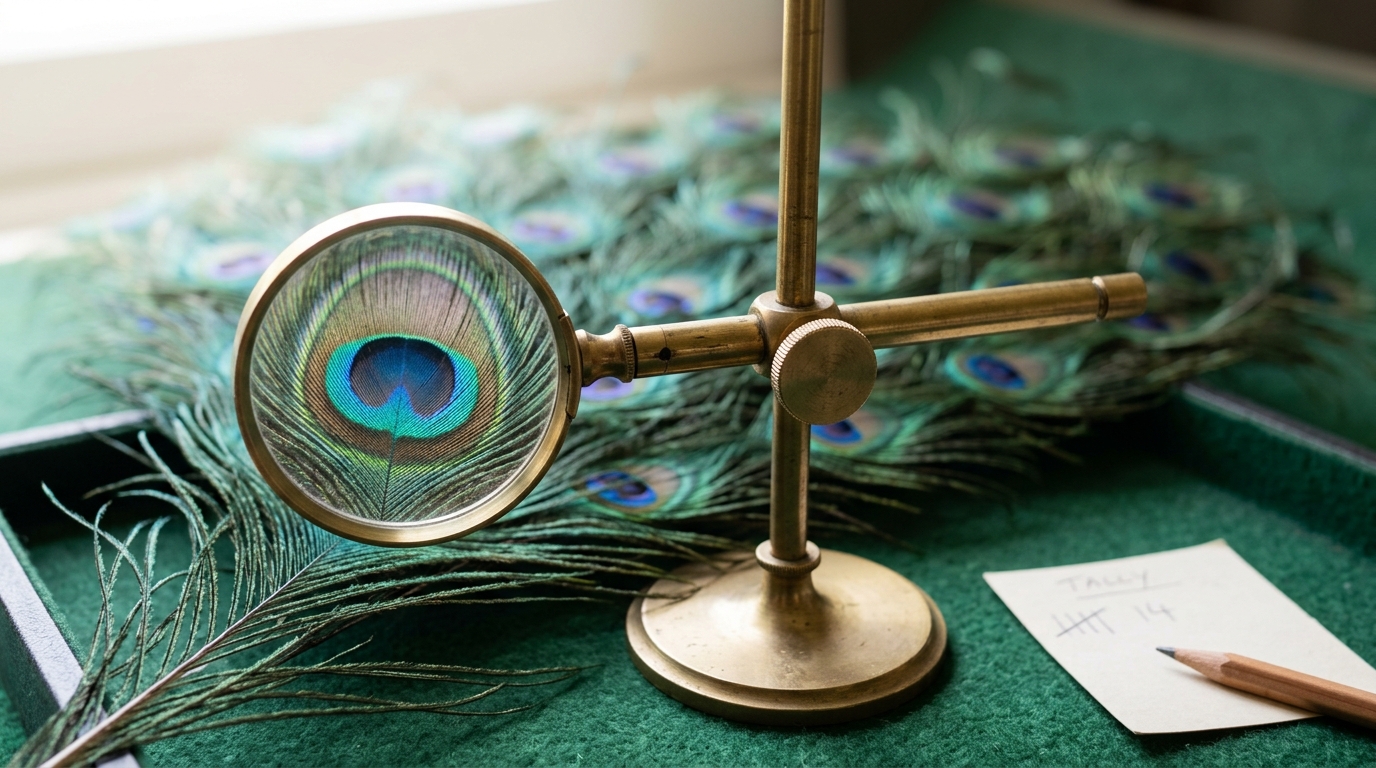
Figure 2. The handicap principle asks a narrower question than "is it beautiful": is the display's cost legible enough that a cheap fake could not fake it? Grafen's 1990 model is the proof that an honest answer can be evolutionarily stable. — Image prompt and art direction by Brecht Corbeel; generation pending.
A widowbird with a glued-on tail turned sexual selection into an experimental science
For more than a century after 1871, sexual selection by female choice remained almost entirely a theoretical proposition, argued from correlation and plausibility rather than from manipulation. That changed in 1982, when Malte Andersson published an experiment on the long-tailed widowbird (Euplectes progne), a Kenyan grassland weaverbird in which males display tails averaging 49.6 centimetres against inconspicuous, short-tailed females [8]. Andersson worked with thirty-six territorial males on the Kinangop Plateau, sorted into nine matched groups of four birds each, chosen so that all four members of a group began with similar tail length and territory quality. Within each group of four, he randomly assigned one of four treatments: tails cut to about fourteen centimetres (shortened), tails elongated by gluing on the clippings from a shortened bird’s tail to add roughly twenty-five centimetres on average (elongated), and two controls — one whose tail was cut and immediately reglued to its original length, and one left uncut and merely ringed — that between them established the manipulation itself, rather than the length change, was not driving any result [8].
The outcome tracked the manipulation, not the bird. Before treatment, mating success — measured as the number of active nests on each male’s territory — did not differ significantly between the groups that would go on to receive different treatments. After treatment, males with elongated tails attracted significantly more new nests than males with shortened tails, and the four treatment categories fell in a clear, statistically significant increasing trend from shortened through the two controls to elongated (P = 0.03 by a Pitman randomisation test built for the design, with the elongated-versus-shortened and elongated-versus-control comparisons each significant at P < 0.05) [8]. Andersson had anticipated the obvious alternative explanation — that tail length affects male-male competition for territories rather than female preference directly — and tested for it: territory tenure did not differ across treatments (P > 0.6), and rates of aggressive intrusion did not differ significantly either (P > 0.1), while flight-display rates if anything moved in the wrong direction to explain the result [8]. The paper’s own conclusion is appropriately careful rather than triumphant: the results “support Darwin’s hypothesis that certain male ornaments are favoured by female mate choice, and probably evolved through it” [8]. It was the first field experiment to manipulate a sexual ornament directly and show that female behaviour, not male competitive ability, tracked the manipulation.
Six years later, Anders Møller extended the same experimental logic to a monogamous species, the barn swallow, where sexual selection theory predicted weaker ornamentation because males contribute directly to raising young rather than only supplying genes. Møller found that males with experimentally elongated outer tail streamers obtained mates earlier in the season than males with shortened streamers, achieved higher reproductive output within that breeding season, and were more often sought by females for extra-pair copulations outside their own pair bond [11]. Together, Andersson’s polygynous widowbirds and Møller’s monogamous swallows demonstrated that female preference for an experimentally manipulated ornament was not a peculiarity of one mating system; it replicated across two very different social structures using the same basic cut-and-extend logic.
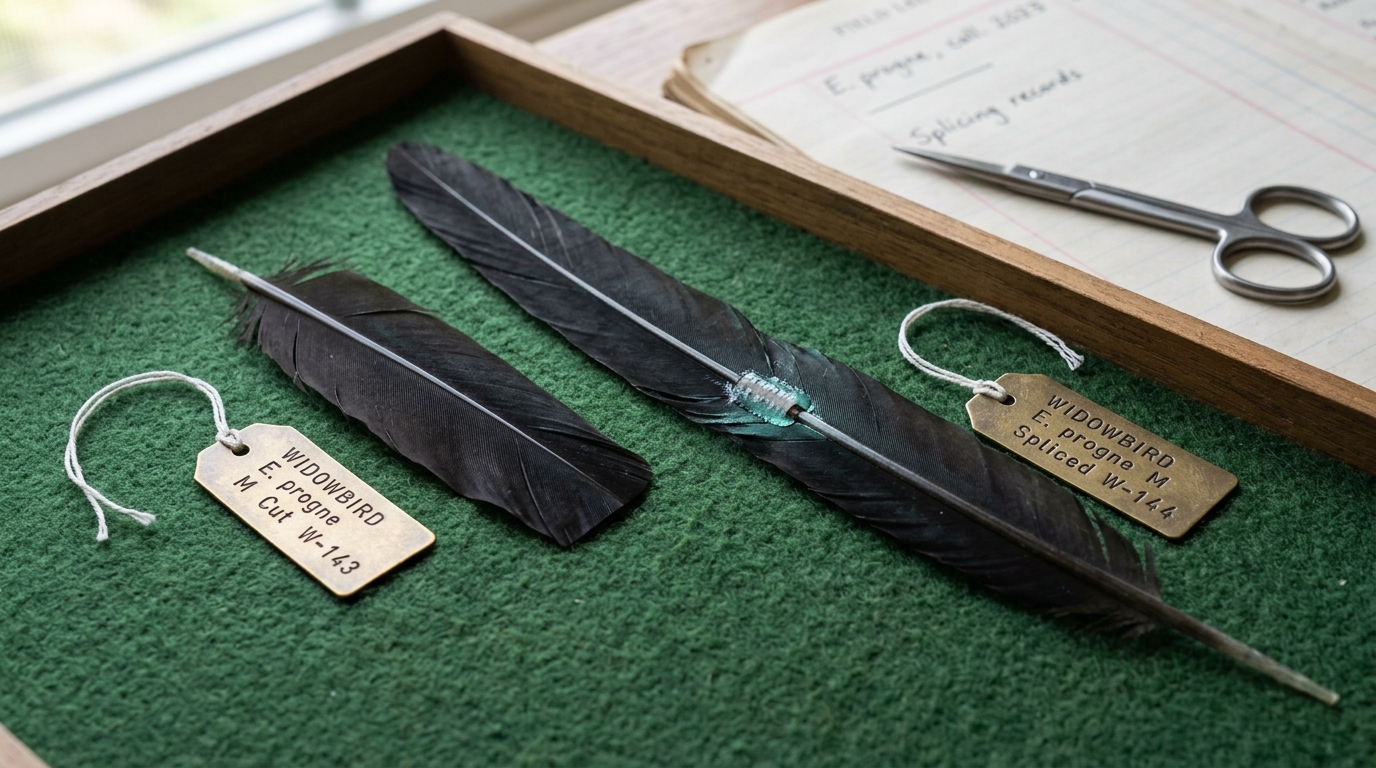
Figure 3. This is the actual manipulation behind the 1982 result: nine matched groups of four males, tails cut and glued to three lengths, territories mapped, and new nests counted for a month afterward. — Image prompt and art direction by Brecht Corbeel; generation pending.
Eyespots predicted whether a peacock’s chicks lived
The widowbird and swallow experiments established that a manipulated ornament changes female behaviour. They did not, on their own, establish that the ornament tracks any real difference in male quality, which is the specific empirical claim the handicap framework requires. Marion Petrie and colleagues took that question to the Indian peafowl (Pavo cristatus), the species behind Darwin’s own queasiness. In 1991, Petrie, Halliday and Sanders reported that at a lek where females could inspect several displaying males before choosing, mating success tracked the number of eyespots (“ocelli”) in a male’s train, with chosen males almost invariably carrying trains with more eyespots than the males a given female had passed over [9].
Correlation between train quality and mating success does not by itself show that the train communicates anything true, so Petrie followed with a controlled breeding experiment published in Nature in 1994. Females were assigned to males at random rather than allowed to choose, removing female preference from the outcome entirely, and all resulting offspring were then reared under identical conditions, removing differential maternal investment as an explanation [10]. Under those controls, offspring sired by peacocks carrying more elaborate trains — more eyespots — grew faster and survived better than offspring of males with less elaborate trains, even though no chick’s rearing environment depended on its father’s ornament in any way [10]. That is close to the cleanest available field evidence for the specific mechanism Zahavi proposed and Grafen formalised: the ornament predicted a real difference in offspring viability that could not be explained by the ornament itself changing how the offspring were treated.

Figure 4. Petrie's causal claim, on paper: chicks fathered by males with more eyespots in their train grew faster and survived better under identical rearing, with mothers assigned to fathers at random. — Image prompt and art direction by Brecht Corbeel; generation pending.
A second population found no such preference, and neither side has conceded
The result that would make this a settled textbook case is precisely the result the literature does not have. In 2008, Mariko Takahashi and colleagues published a study of a feral, free-ranging population of Indian peafowl established in Japan, observed over seven years, in which they measured train length, eyespot number, and a fluctuating-asymmetry index of train symmetry against actual mating records rather than staged choice trials [12]. They found no correlation between any of those train characteristics and male mating success: neither longer trains, more numerous eyespots, nor more symmetrical arrangements predicted which males females chose, a result the authors state directly contradicts the earlier Petrie findings [12]. What did predict success in the Japanese population was a display behaviour — the frequency and duration of a wing-shaking “shivering” display performed during courtship — rather than any static feature of the train itself [12].
Petrie’s group did not let the contradiction stand unanswered. Adeline Loyau, Marion Petrie, Michel Saint Jalme and Gabriele Sorci published a reply in the same journal the same year, titled, pointedly, “Do peahens not prefer peacocks with more elaborate trains?” [13]. A dispute conducted this way — original result, independent non-replication in a second population, a direct published reply from the original authors, and no retraction or concession from either side — is not evidence that one team did bad science. It is what a live, unresolved empirical disagreement in field biology actually looks like, and reporting it as though Petrie’s 1994 result or Takahashi’s 2008 non-replication has settled the question would misstate the current state of the literature in either direction. Both papers remain standing. The honest description is that female preference for train elaboration in peafowl has been shown to operate strongly in at least one population and studied population-year, and shown to be absent or undetectable in at least one other, and no consensus account of why the two populations differ — history of the founder population, local predation regime, sample and methodology, or something about the trait’s condition-dependence varying by environment — has been established well enough to cite as fact.
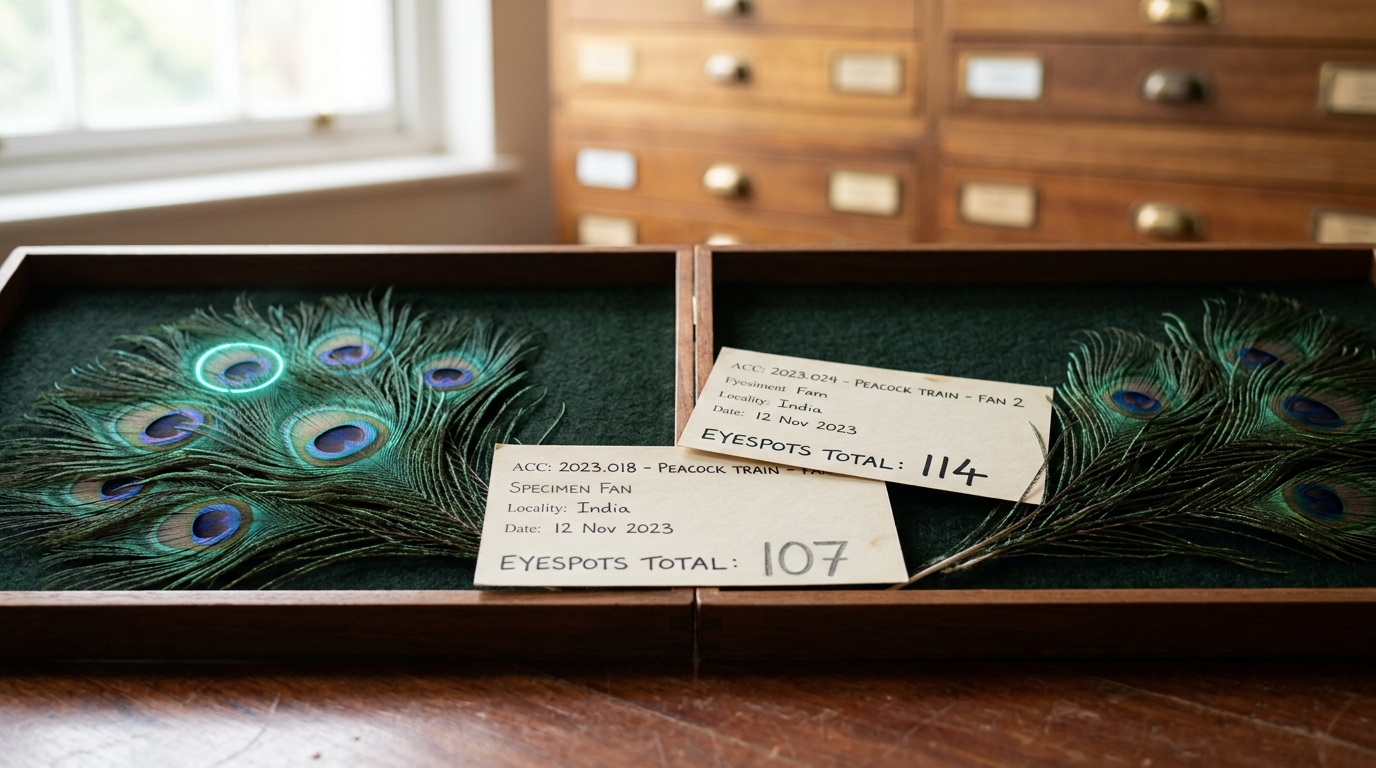
Figure 5. A 2008 study of a second, feral peafowl population in Japan found no preference for train length, symmetry or eyespot number at all, and Petrie's group published a same-year reply disputing the reading. The disagreement has not been resolved by either side conceding. — Image prompt and art direction by Brecht Corbeel; generation pending.
Prum argues arbitrary beauty may be the default, not the exception
Nearly all of the theory discussed so far, including the handicap framework built to challenge Fisher, treats an arbitrary, non-informative ornament as the case requiring the unusual explanation — something evolutionary biology should expect to find rarely, if a more parsimonious honest-signal story is available instead. In a 2012 paper in Philosophical Transactions of the Royal Society B, the ornithologist Richard Prum argued that this default is itself a historical accident rather than a scientific conclusion. Prum’s claim is that mainstream sexual selection research since the 1970s has been built, largely without acknowledgment, on Wallace’s original anti-aesthetic position rather than Darwin’s — treating any confirmed instance of arbitrary, non-adaptive preference as an anomaly to be explained away rather than as the null expectation the underlying Lande-Fisher mathematics actually supports [14]. Prum makes the historical connection explicit and slightly uncomfortable for the handicap tradition specifically: Zahavi’s own 1975 paper states that Wallace “dismissed altogether the theory of sexual selection by mate preference,” yet a few pages later Zahavi writes that “sexual selection is effective because it improves the ability of the selecting sex to detect quality in the selected sex” — a sentence, Prum points out, “entirely consistent with Wallace’s” own proposal that mate choice tracks correlated vigour rather than arbitrary beauty [14]. The handicap principle, on this reading, is Wallace’s idea rediscovered under a new name, not a modernisation of Darwin’s.
Prum’s own positive proposal treats aesthetic evolution as arising from the coevolution of a display trait with the sensory and cognitive systems that evaluate it, where evaluation itself is what matters, independent of whether the trait being evaluated encodes any information about the signaller at all [14]. A courtship song can be preferred purely because of how a receiver’s existing perceptual system processes it — no different in kind, on this argument, from how flower colour attracts pollinators without the flower’s redness being an honest signal of nectar quality. Structural, angle-dependent iridescence of exactly the kind found in a peacock eyespot is a natural candidate for this mechanism: the colour is a physical consequence of how light interferes off the barb’s microstructure, not a pigment whose production cost anything, and a receiver’s preference for a more intense flash carries no logical requirement that the flash be honestly correlated with the bearer’s condition.

Figure 6. Prum's argument for a rival mechanism: the eyespot's colour is a structural accident of how the barb's surface bends light, not a receipt for anything the bird spent. An arbitrary preference for that accident needs no honesty at all to evolve. — Image prompt and art direction by Brecht Corbeel; generation pending.
The reply: a null model still has to say when it applies
Prum’s argument did not go unanswered either, and the shape of the pushback matters for how much weight the sensory-evaluation framework should carry. Reviewing Prum’s book-length treatment of the same argument for the journal Evolution, the behavioural ecologists Gail Patricelli, Eileen Hebets and Tamra Mendelson credited Prum with “engaging descriptions of the natural world” while directly disputing his central historical and empirical framing, arguing that he “misrepresent[s]” how contemporary sexual selection researchers actually treat competing mechanisms [15]. Their core technical objection is that Prum poses his Fisherian, purely aesthetic model and the field’s honest-signal, “good genes” models as mutually exclusive alternatives competing for the same explanatory territory, when the working consensus among researchers who actually run these experiments is that both mechanisms operate, often on the same trait in the same species, in proportions that have to be measured case by case rather than assumed from a philosophical starting position [15]. On this view, Prum is right that arbitrary aesthetic evolution deserves to be treated as a live, testable possibility rather than dismissed by default — a corrective this article’s earlier sections suggest was overdue — but wrong to present it as the single correct null model displacing signal-cost explanations wherever the two have not been carefully distinguished by data.
Three mechanisms, unevenly supported, coexisting by species
The honest summary of a century and a half of work on Darwin’s second theory is not a single winning mechanism. It is three mechanisms — combat, which was never seriously disputed; Fisherian runaway on an arbitrary or coevolved preference; and Zahavian, Grafen-formalised honest signalling — that are neither mutually exclusive nor equally well supported in every species where someone has looked. The long-tailed widowbird experiment shows female choice tracking a manipulated ornament cleanly, without settling whether the preference is arbitrary or quality-tracking. The barn swallow experiment extends the same choice result to a monogamous system. Petrie’s controlled peafowl breeding experiment is among the strongest field demonstrations available anywhere that an ornament can predict real offspring viability, exactly as the handicap principle requires — in the specific population and years she studied. Takahashi’s Japanese peafowl population shows that the same species, observed differently, can show no such preference at all, and the dispute between that finding and Petrie’s remains open in the technical literature rather than resolved by either side’s argument alone. Prum’s sensory-evaluation framework is a serious, mathematically grounded challenge to treating honest signalling as biology’s default explanation, and it has drawn a serious, specific rebuttal rather than a simple refutation.
None of this uncertainty licenses the conclusion that sexual selection is unsupported or that the question is unanswerable; the widowbird and swallow manipulations alone rule out the possibility that female behaviour is indifferent to these ornaments. What the evidence does not currently support is a single confident story about why any particular ornament, in any particular species, evolved the way it did — arbitrary preference, honest cost, sensory bias, or some combination whose relative weight differs by lineage and even by population within a lineage. Darwin was made queasy by a feather because he could see, more clearly than most of his contemporaries would allow for a century afterward, that a single tidy mechanism was not going to be enough to explain it. On the current state of the evidence, he was right to be uneasy, and the discomfort has never fully resolved — it has simply moved from a private letter to a set of peer-reviewed disagreements that are still, as of this writing, being argued out in the same journals that first tried to settle them.
Sources
- Charles Darwin. Letter no. 2743 — Darwin to Asa Gray, 3 April 1860. Darwin Correspondence Project, University of Cambridge (1860).
- Charles Darwin. The Descent of Man, and Selection in Relation to Sex. John Murray (Project Gutenberg edition) (1871).
- Ronald A. Fisher. The Genetical Theory of Natural Selection. Clarendon Press (Internet Archive digitisation) (1930).
- Russell Lande. Models of speciation by sexual selection on polygenic traits. Proceedings of the National Academy of Sciences (1981). DOI: 10.1073/pnas.78.6.3721.
- Amotz Zahavi. Mate selection — a selection for a handicap. Journal of Theoretical Biology (1975). DOI: 10.1016/0022-5193(75)90111-3.
- John Maynard Smith. Sexual selection and the handicap principle. Journal of Theoretical Biology (1976). DOI: 10.1016/S0022-5193(76)80016-1.
- Alan Grafen. Biological signals as handicaps. Journal of Theoretical Biology (1990). DOI: 10.1016/S0022-5193(05)80088-8.
- Malte Andersson. Female choice selects for extreme tail length in a widowbird. Nature (1982). DOI: 10.1038/299818a0.
- Marion Petrie, Tim Halliday, Carolyn Sanders. Peahens prefer peacocks with elaborate trains. Animal Behaviour (1991). DOI: 10.1016/S0003-3472(05)80484-1.
- Marion Petrie. Improved growth and survival of offspring of peacocks with more elaborate trains. Nature (1994). DOI: 10.1038/371598a0.
- Anders Pape Møller. Female choice selects for male sexual tail ornaments in the monogamous swallow. Nature (1988). DOI: 10.1038/332640a0.
- Mariko Takahashi, Hiroyuki Arita, Mariko Hiraiwa-Hasegawa, Toshikazu Hasegawa. Peahens do not prefer peacocks with more elaborate trains. Animal Behaviour (2008). DOI: 10.1016/j.anbehav.2007.10.004.
- Adeline Loyau, Marion Petrie, Michel Saint Jalme, Gabriele Sorci. Do peahens not prefer peacocks with more elaborate trains?. Animal Behaviour (2008). DOI: 10.1016/j.anbehav.2008.07.021.
- Richard O. Prum. Aesthetic evolution by mate choice: Darwin's really dangerous idea. Philosophical Transactions of the Royal Society B (2012). DOI: 10.1098/rstb.2011.0285.
- Gail L. Patricelli, Eileen A. Hebets, Tamra C. Mendelson. Book review of Prum, R.O., The Evolution of Beauty. Evolution (2019). DOI: 10.1111/evo.13629.
Originally published at https://absolutedigitalpublishers.com/articles/the-peacock-problem-darwins-second-theory-and-its-hard-tests.