Materials Discovery and Degradation in 2035: Scenarios, Signals, and Falsifiable Predictions
Autonomous labs, generative crystal models, and solid-state cells are all racing toward the same decade. Here is what would have to be true for each one to matter, and what would prove it wrong.
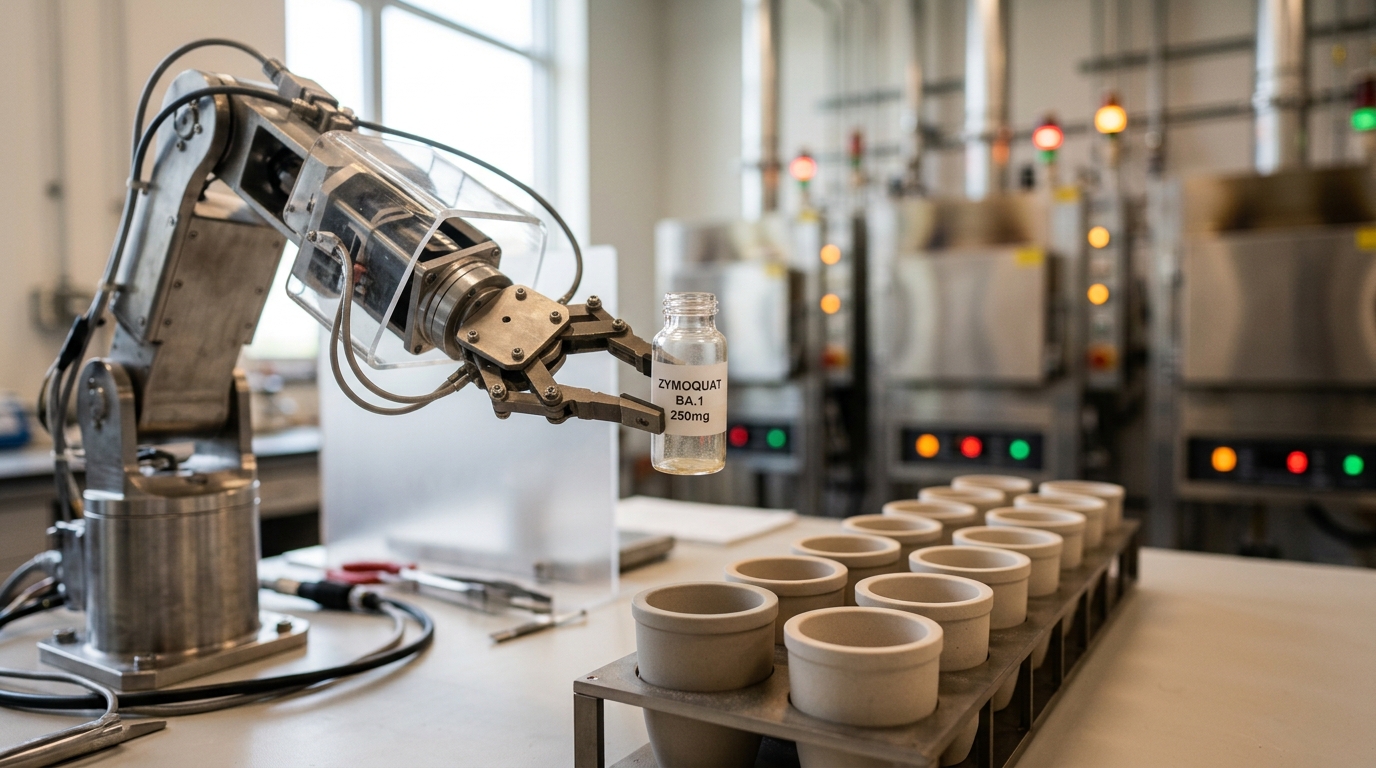
An autonomous synthesis line mid-run: the arm has not yet released the vial, and the furnace queue behind it is still half full. — Image prompt and art direction by Brecht Corbeel; generation pending.
Abstract
Materials science is in the middle of three overlapping bets: that autonomous laboratories can close the loop between prediction and synthesis, that solid-state batteries can leave the pilot line for the factory floor, and that generative models can shrink the gap between a stable crystal on a screen and a powder in a vial. Each bet has produced a headline result and a serious rebuttal in the same eighteen months. This article separates the verified facts from the vendor claims, builds one explicit scenario per bet with a stated horizon and assumptions, and names the observable indicator and the disconfirmation condition that would tell a reader, well before 2035, which way each one actually broke.
Three bets are running at once in materials science right now, and all three have a headline result and a serious rebuttal sitting inside the same eighteen-month window. That combination — genuine progress and genuine pushback, simultaneously, on the same claim — is unusual, and it is the reason this article treats 2035 as a set of falsifiable scenarios rather than a forecast. A forecast picks a winner. A falsifiable scenario states what would have to be true, names what you would see along the way, and says explicitly what result would prove it wrong. That is the format used below for each of the three bets: autonomous laboratories, solid-state batteries, and computational discovery closing the gap between a stable prediction and a synthesizable material.
The fact pattern, first
Start with what is actually established, separated from what vendors and press releases have claimed on top of it.
Fact: in November 2023, a Berkeley-led team published a description of “A-Lab,” a system combining a large language model trained on synthesis literature, an active-learning planner, and robotic furnaces, reporting that it had synthesized 41 target compounds out of 58 attempts over 17 days of autonomous operation [1]. That is a real, peer-reviewed, operational result: a closed loop that proposed a recipe, executed it robotically, and characterized the product without a human choosing each next step.
Fact, and a correction on top of the first fact: a subsequent critique argued that several of the “novel” compounds the paper reported were already present in the Inorganic Crystal Structure Database, undercutting the claim of novelty, and Nature issued an author correction in early 2026 in which the original authors acknowledged that “new” had meant new to the prediction platform’s search space, not new to science [2] [3]. Both facts are true simultaneously: the automation loop functioned, and the novelty claim built on top of it was overstated and has now been formally walked back. Readers who only saw the 2023 headline, and readers who only saw the 2025–26 controversy, each have half the picture.
Fact: DeepMind’s GNoME model, published the same month as the A-Lab paper, reported 2.2 million candidate stable crystal structures, an order-of-magnitude expansion of the previously known space of computationally stable inorganic compounds [4]. Analysis, not fact: independent commentary has pointed out that “stable on the convex hull” is a thermodynamic screening criterion, not a synthesis instruction, and that the fraction of GNoME’s candidates judged synthesizable by structural criteria is a small minority of the stable set, with an even smaller fraction passing stricter existence-probability filters [5] [10]. The synthesizability gap is not a rounding error at the edge of the field; on the numbers reported in that follow-up work, it discards the large majority of the headline count.
Fact: the Materials Genome Initiative, launched in the United States in 2011 to accelerate exactly this kind of computation-to-synthesis pipeline, is now well past its tenth anniversary, and its own program leadership describes the second decade’s central open problem as closing the gap between prediction and fabrication — the same gap the GNoME critique names [7]. That is a decade-plus of institutional attention on a problem that is still, by its own architects’ account, unsolved.
Fact: corrosion — the slow, unglamorous half of “materials discovery and degradation” — was estimated by the NACE International IMPACT study at roughly 2.5 trillion US dollars in annual global economic cost, with 15 to 35 percent of that judged preventable through existing best practice already known and simply not applied [6]. Discovery gets the headlines; degradation is where most of the money actually is, and the gap there is organizational and economic, not scientific.
Fact: solid-state battery manufacturers are targeting commercial-scale cell production in the 2027–2030 window — SK On has stated a 2029 commercialization target, and industry analysis describes 2026 as the year mass production began “taking off” at pilot scale, while still describing full automotive-volume manufacturing as unresolved [8] [9].
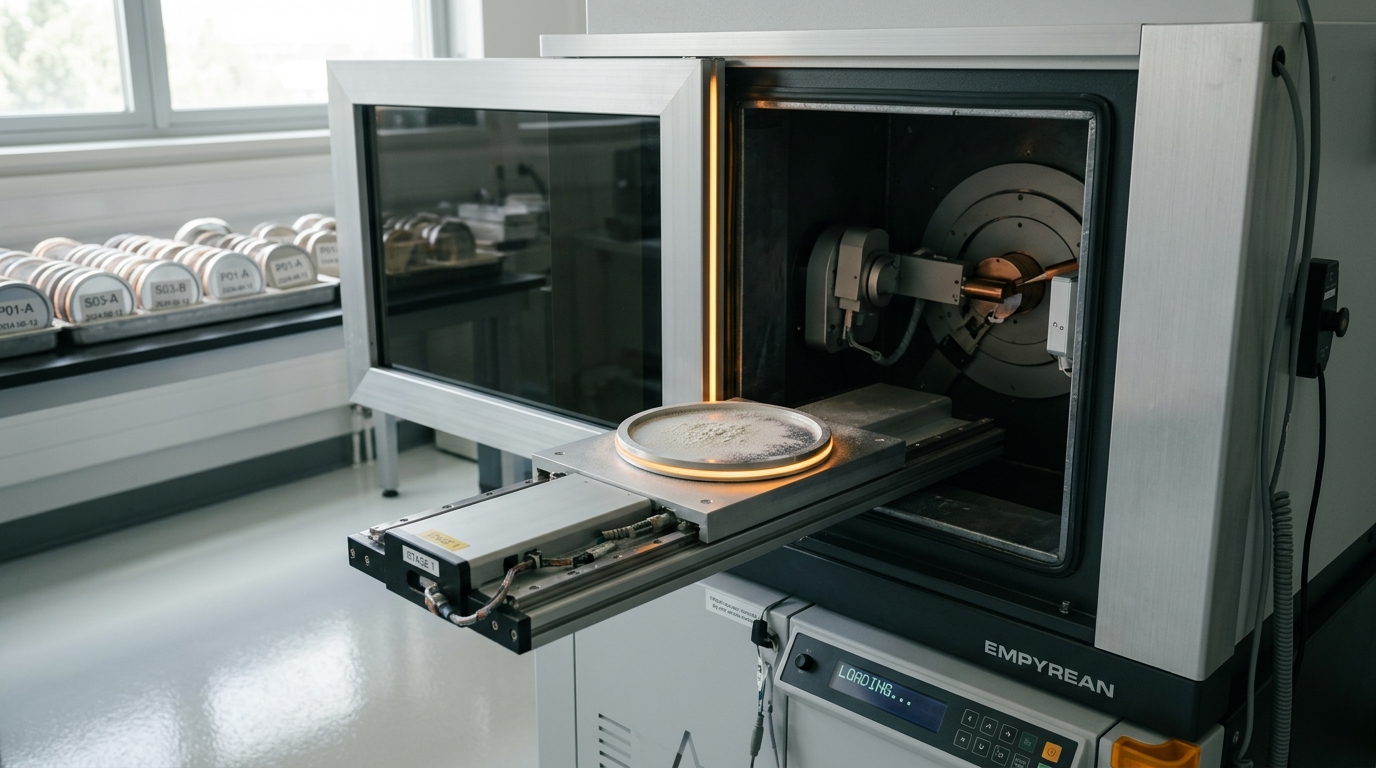
Figure 1. A synthesized powder enters the diffractometer for the step that decides whether the autonomous lab actually made anything new. — Image prompt and art direction by Brecht Corbeel; generation pending.
With that fact base established, three scenarios follow, each built the same way: horizon, assumptions, observable indicators, and a disconfirmer.
Scenario one: the autonomous laboratory reaches industrial adoption
Horizon: by 2035, at least one material discovered end-to-end by an autonomous synthesis loop — proposed, synthesized, and characterized with no human choosing the specific recipe — is in commercial production at a scale beyond a single customer’s pilot order.
Assumptions this scenario requires: first, that the novelty-verification problem exposed by the A-Lab correction gets solved as an engineering discipline, not just debated as a controversy — meaning independent, database-cross-checked novelty confirmation becomes a standard step in any autonomous-discovery pipeline, the way a null-result control is standard in a wet-lab assay. Second, that active-learning synthesis planners generalize past the inorganic oxide chemistry where they have been demonstrated so far, into polymers, alloys, or battery materials with more degrees of synthetic freedom. Third, that the economics clear: an autonomous line has to beat a skilled human team on cost-per-validated-candidate, not just on candidates-per-day.
Observable indicators between now and then: a published autonomous-discovery result that survives independent replication and cross-database novelty checking within twelve months of publication, rather than requiring a two-year correction cycle as the 2023–2026 case did; at least one materials company, not a national lab, running a closed discovery loop as a production tool and disclosing it in a manner an analyst can verify (patent filings naming the tool, or a supply agreement); and a second, independent autonomous lab — not the Berkeley group — publishing a comparable closed-loop result in a different materials class.
Disconfirmation condition: if, by 2035, every published “autonomous discovery” result still requires a post-publication correction or independent challenge to establish what was actually novel — as happened with A-Lab — and no material whose discovery pathway was substantially autonomous has entered production beyond a demonstrator, the scenario is falsified. The mechanism would not have failed at the level of robotics or planning software; it would have failed at the harder, less glamorous level of verification, which is exactly where the first real test case stumbled.
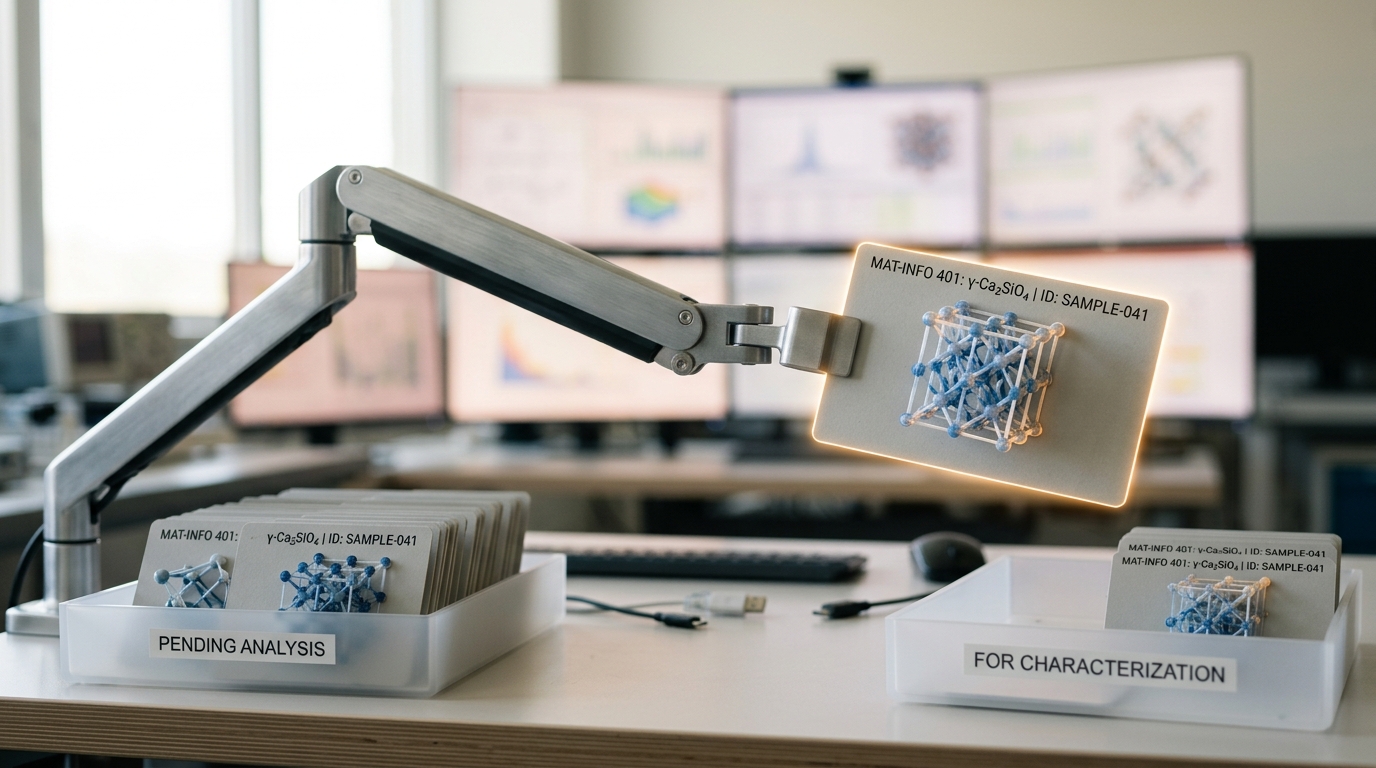
Figure 2. A screening queue of computationally stable candidates, most still unflagged, one card mid-drag toward the synthesis shortlist. — Image prompt and art direction by Brecht Corbeel; generation pending.
Scenario two: solid-state batteries reach automotive-scale commercial production
Horizon: by 2035, solid-state cells account for a non-trivial share — call it low double-digit percent — of new electric-vehicle battery capacity shipped, not merely announced or piloted.
Assumptions: manufacturers solve the interfacial contact and dendrite-suppression problems at the pressures and volumes required for gigafactory-scale roll-to-roll assembly, not just at cell-level demonstrations; the cost per kilowatt-hour falls enough to compete with the liquid-electrolyte lithium-ion cells that will themselves keep improving over the same decade, meaning solid-state has to beat a moving target, not a frozen one; and at least one of the two currently announced 2027–2029 commercialization timelines — Toyota/Idemitsu or SK On — actually holds, since a further multi-year slip in the anchor programs would itself be diagnostic of a harder-than-stated manufacturing problem [8] [9].
A brief, explicit note on vendor claims here: SK On’s 2029 target and Toyota’s earlier stated dates are vendor assertions, not independent verifications of manufacturing readiness. CATL’s chairman has separately characterized the industry’s actual technology-readiness position as roughly “level four of nine,” which is a notably more cautious internal industry assessment than any single company’s public roadmap — and where experts disagree this openly about readiness level, the honest move is to report the disagreement, not average it into a single number.
Observable indicators: a solid-state cell shipping in a production vehicle (not a demonstration fleet) with published, third-party-verified cycle life and energy density; a cost curve showing solid-state cells crossing below 100 US dollars per kilowatt-hour at pack level, tracked by an independent analyst firm rather than company press materials; and no further slip of the current 2027–2029 anchor timelines past 2031.
Disconfirmation condition: if by 2035 solid-state cells remain confined to pilot lines, luxury low-volume trims, or non-automotive niches (medical implants, aerospace), while the anchor 2027–2029 commercialization dates have each slipped by three or more years, the scenario is falsified — and the mechanism will most likely be the unglamorous one manufacturing engineers already flag: interfacial contact loss under the pressure cycling of a real drivetrain, not a fundamental chemistry limit.
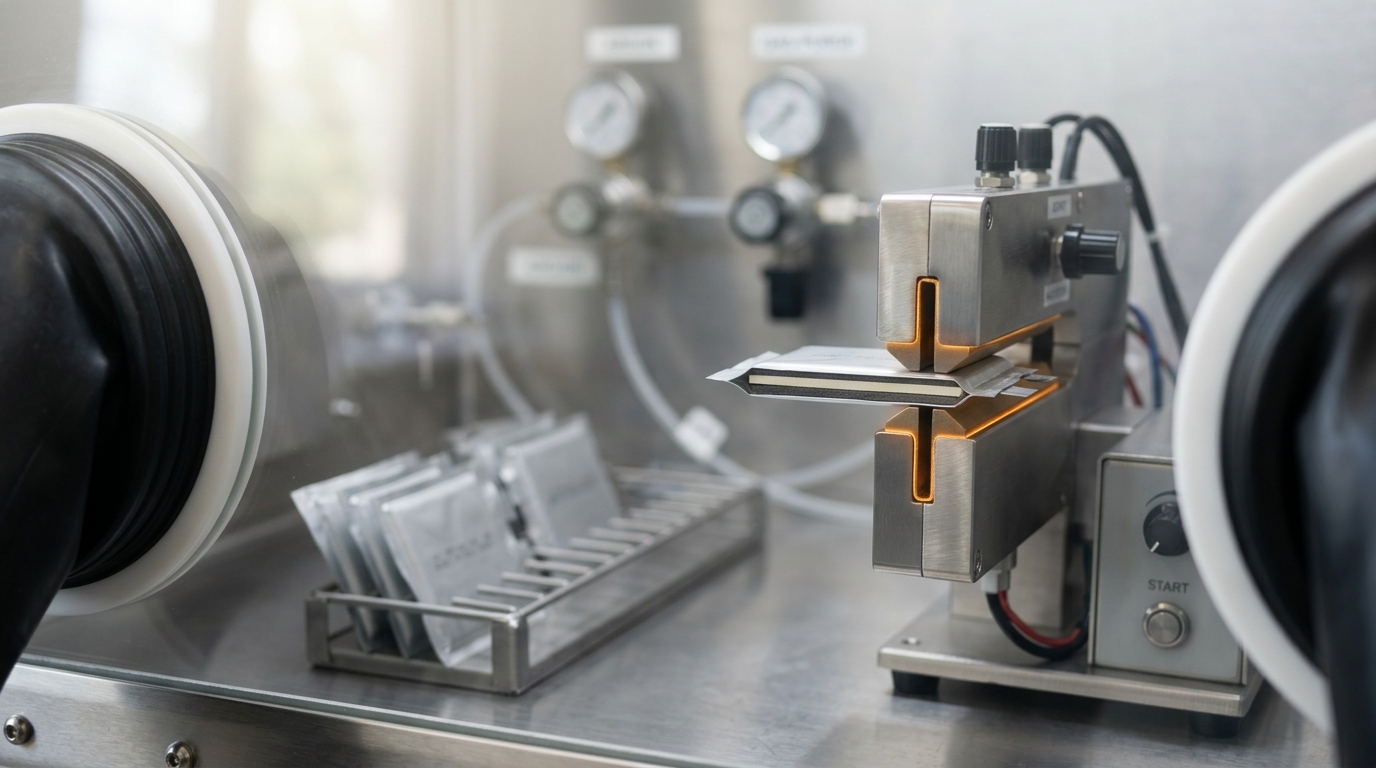
Figure 3. A solid-state pouch cell mid-assembly inside an inert-atmosphere glovebox, the pressing step still incomplete. — Image prompt and art direction by Brecht Corbeel; generation pending.
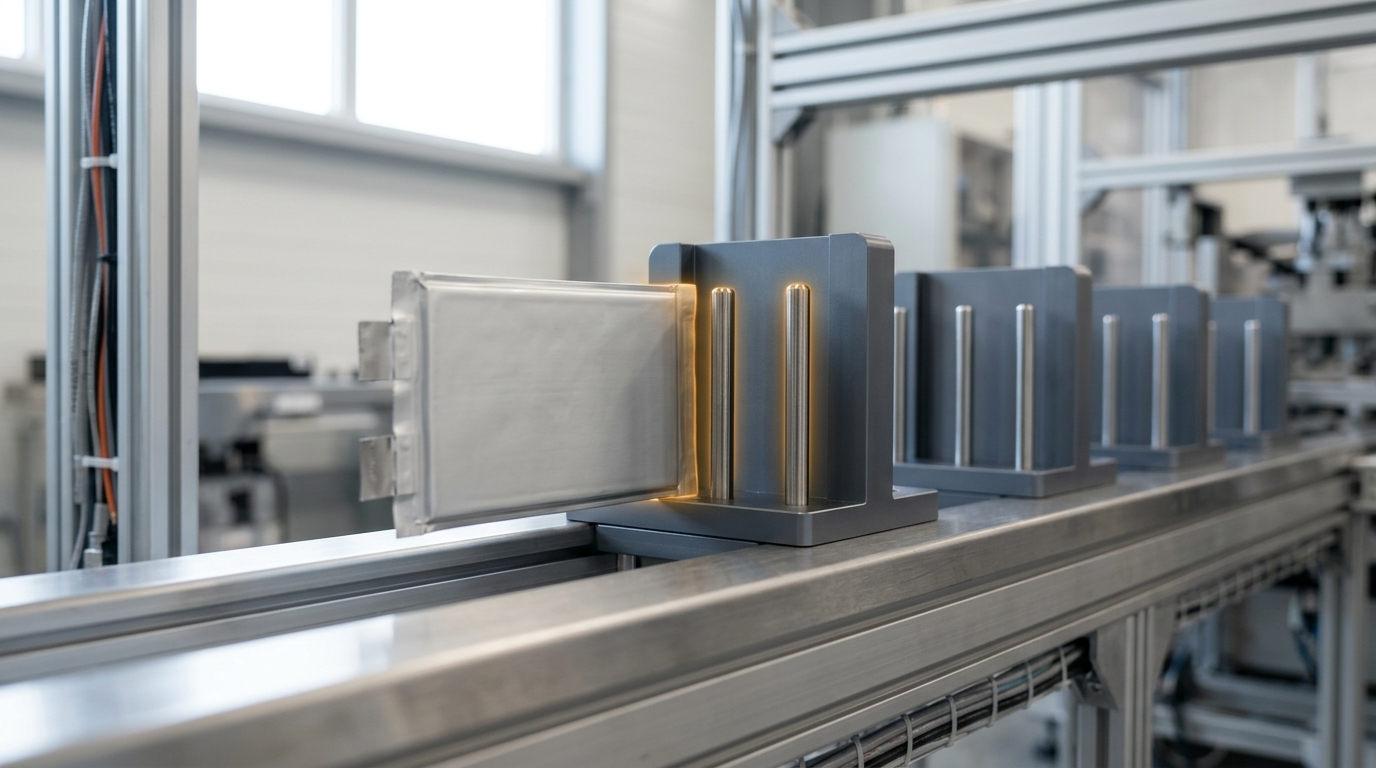
Figure 4. A pilot line's stacking station, one cell still gliding into place on the conveyor — the gap between a lab cell and a factory cell. — Image prompt and art direction by Brecht Corbeel; generation pending.
Scenario three: computational discovery closes the synthesizability gap
Horizon: by 2035, a majority — not a small minority — of structures a leading generative or screening model flags as “high-priority candidate” are confirmed synthesizable on first or second attempt, closing most of the gap the 2024–2025 GNoME critiques identified.
Assumptions: synthesizability prediction becomes a first-class model output rather than a post-hoc filter bolted onto a stability screen — meaning models are trained jointly on thermodynamic stability and on historical synthesis-attempt outcomes, including failures, which requires materials science to start systematically publishing negative synthesis results the way it currently does not. This is worth stating plainly as an analysis point: the synthesizability gap is partly a data problem, not only a modeling problem, because failed syntheses are rarely reported and therefore rarely trainable on.
If a screening model reports a stability margin against decomposition,
\Delta E_{\text{hull}} = E(\text{compound}) - E_{\text{convex hull}}(\text{composition})
then a small positive \Delta E_{\text{hull}} has historically been treated as a proxy for “worth attempting to synthesize.” The 2024–2025 critique’s core point is that this proxy is weak: a large share of low-\Delta E_{\text{hull}} candidates in the GNoME set failed independent synthesizability screens once structural and existence-probability criteria were applied on top of the energy criterion alone [5] [10]. Closing the gap means replacing that single-variable proxy with a jointly trained, multi-criterion one — an analysis claim about what the fix would have to look like, not a report that anyone has yet built it at scale.
Observable indicators: a published benchmark, ideally maintained as a standing leaderboard the way image-classification benchmarks are, that tracks confirmed-synthesizable rate against a large candidate pool over time, showing the rate climbing year over year rather than staying flat; a materials-discovery paper reporting attempted-but-failed syntheses as a named, citable dataset rather than omitting them; and at least one industrial materials group publicly attributing a shipped product to a computational-first pipeline with a synthesizability hit rate disclosed alongside the discovery claim.
Disconfirmation condition: if by 2035 the confirmed-synthesizable fraction of top-ranked computational candidates remains in the same low-double-digit-percent range reported in 2024–2025 analyses, despite larger training sets and more compute, the scenario is falsified — and that outcome would say something specific: that the gap is not a scale problem solvable by bigger models, but a data or physics problem (missing kinetic and metastability information that thermodynamic stability alone cannot supply).
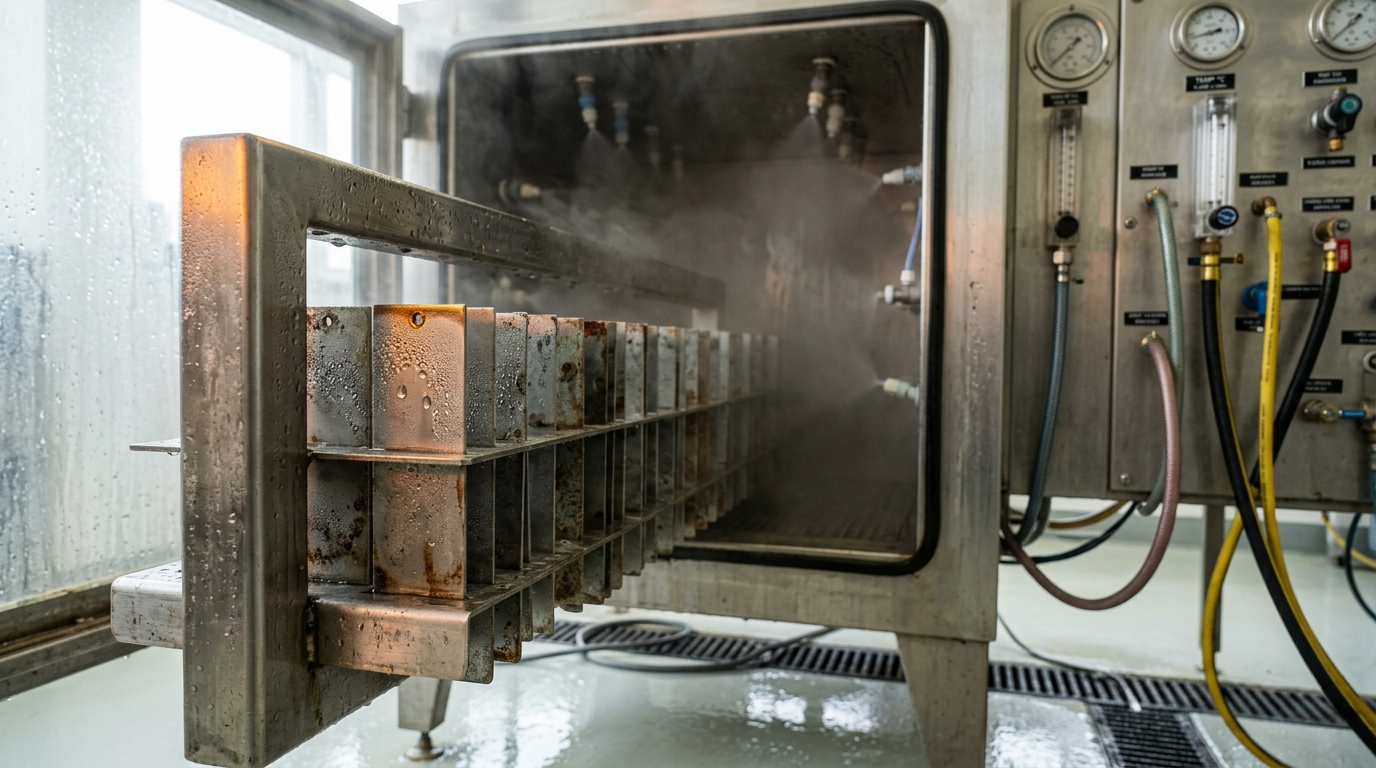
Figure 5. Coupons pulled from a salt-fog chamber mid-cycle, still wet, before the corrosion has been read and scored. — Image prompt and art direction by Brecht Corbeel; generation pending.
Where degradation fits, and why it is the quieter half of the decade
Everything above is about making new materials. The other half of the assignment’s mandate — degradation — gets less attention precisely because it produces fewer demo-able headlines, even though the NACE IMPACT figure of roughly 2.5 trillion dollars a year in corrosion cost alone [6] dwarfs any plausible near-term revenue from novel-material discovery. The realistic 2035 scenario here is not a breakthrough but a diffusion story: accelerated-degradation testing (salt-fog chambers, autoclave coupon cycling, electrochemical impedance monitoring) increasingly feeding the same active-learning infrastructure built for discovery, so that a material’s predicted failure mode becomes part of the same screening pass as its predicted stability, rather than a separate downstream qualification step done years later. The falsifiable version: by 2035, do materials characterization pipelines routinely report a joint stability-plus-degradation score at the discovery stage, or does degradation testing remain a separate, later-stage qualification silo the way it is today? If it is still silo’d, the “materials genome” vision has succeeded at prediction and failed at the systems-integration problem that would have made prediction actually change how materials get qualified for use.
Structure-property relations beyond the headline chemistries
The three scenarios above are framed around inorganic crystals and battery cells because that is where the loudest 2023–2026 claims and rebuttals happened, but the underlying question — does a computed or screened structure-property relation actually survive contact with a real synthesis and a real service environment — applies just as sharply to semiconductors, polymers, and metamaterials, and it is worth being explicit about how the same three-part test (fact, assumption, disconfirmer) transfers.
In semiconductors, the analogous bet is whether machine-learned interatomic potentials and defect-prediction models shrink the multi-year gap between a proposed wide-bandgap or two-dimensional material and a foundry-qualified process. The fact is that computational defect and dopant screening has already shortened some materials-selection cycles in research settings; the assumption a 2035 success story requires is that those same models can predict yield-limiting defect populations at the parts-per-billion densities a real fab cares about, not just the qualitative defect types visible in a small research boule. The disconfirmer is concrete: if by 2035 no computationally-screened semiconductor material has entered a qualified foundry process design kit without years of conventional trial-and-error defect engineering layered on top, the “computation shortens the loop” claim has failed for this materials class even if it succeeded for oxide powders.
Polymers present almost the opposite problem from crystalline inorganics: the property that matters most — long-term degradation under UV, heat, and mechanical cycling — is precisely the one current generative and screening models are worst at predicting, because it depends on chain entanglement, crystallinity fraction, and additive migration over years, not on a single computable ground-state energy. A falsifiable polymer-specific scenario for 2035: does at least one computationally-designed polymer formulation reach commercial use with a predicted accelerated-aging profile that later matches its measured field-service degradation within a stated tolerance, published as a named case study? If every commercially successful “AI-designed” polymer by 2035 still required a conventional multi-year accelerated-aging qualification campaign indistinguishable from pre-2020 practice, the prediction pipeline will have generated candidates faster without actually shortening qualification — a real but much smaller win than the headlines around generative polymer design currently imply.
Metamaterials are the class where the discovery and degradation problems fold into each other most tightly, because a metamaterial’s function usually depends on a precise, small-scale geometric lattice rather than on bulk composition alone, which means manufacturing tolerance and in-service degradation of that geometry — creep, fatigue cracking at lattice nodes, corrosion at high-surface-area strut surfaces — determines whether the computed property ever shows up outside a lab sample. The honest 2035 marker here is narrower than a market-share number: has any additively-manufactured metamaterial part carrying a designed mechanical or acoustic property survived a real qualification standard (aerospace fatigue testing, for instance) with performance matching its as-designed lattice model, at a batch scale beyond single hand-built coupons? A “no” by 2035 would indicate the gap is not computational design fidelity but manufacturing-process repeatability at the lattice-node scale — a distinct, and arguably harder, problem than the chemistry-only synthesizability gap discussed above.
What would make a reader revise this article
Each scenario above names its own disconfirmer, but the single fastest tell across all three is the same: watch whether the next major discovery claim in this field is accompanied, at first publication, by an independent replication attempt and an explicit novelty check against existing databases — or whether that check only happens two years later, after press coverage, in the form of a correction. The A-Lab case is not an indictment of autonomous synthesis; the robotic loop worked as engineered. It is a demonstration that the field’s verification culture, at the point these predictions were made, had not caught up to its automation culture. Whether that changes is the most concrete, checkable signal this whole set of 2035 scenarios comes down to.
Sources
- Nathan J. Szymanski, Bernardus Rendy, Yuxing Fei, et al.. An autonomous laboratory for the accelerated synthesis of inorganic materials. Nature (2023). DOI: 10.1038/s41586-023-06734-w.
- Nathan J. Szymanski, Bernardus Rendy, Yuxing Fei, et al.. Author Correction: An autonomous laboratory for the accelerated synthesis of inorganic materials. Nature (2026). DOI: 10.1038/s41586-025-09992-y.
- Chemistry World editorial staff. New analysis raises doubts over autonomous lab's materials discoveries. Chemistry World (2025).
- Amil Merchant, Simon Batzner, Samuel S. Schoenholz, et al.. Scaling deep learning for materials discovery. Nature (2023). DOI: 10.1038/s41586-023-06735-9.
- Register editorial staff. Boffins deem Google DeepMind's material discoveries shallow. The Register (2024).
- NACE International (now AMPP). International Measures of Prevention, Application, and Economics of Corrosion Technologies (IMPACT). NACE International (2016).
- James Warren, interviewed by American Ceramic Society staff. Materials Genome Initiative 10 years later: An interview with James Warren. American Ceramic Society Bulletin (2021).
- BatteryTech Online editorial staff. SK On accelerates solid-state EV battery timeline, targets 2029 commercialization. BatteryTech Online (2026).
- IDTechEx analyst staff. Solid-State Battery Commercialization: Mass Production Taking Off. IDTechEx (2026).
- Materials informatics research group (arXiv preprint). Bridging Theory and Experiment in Materials Discovery: Machine-Learning-Assisted Prediction of Synthesizable Structures. arXiv (2025).
Originally published at https://absolutedigitalpublishers.com/articles/materials-discovery-and-degradation-in-2035-scenarios-signals-and-falsifiable-predictions.