How Writing, Archives, and Information Revolutions Actually Work
From clay accounting tokens to checksummed digital records: the documented mechanics of how marks became writing, how the press mechanized copying, and how modern archives prove a file has not been altered.
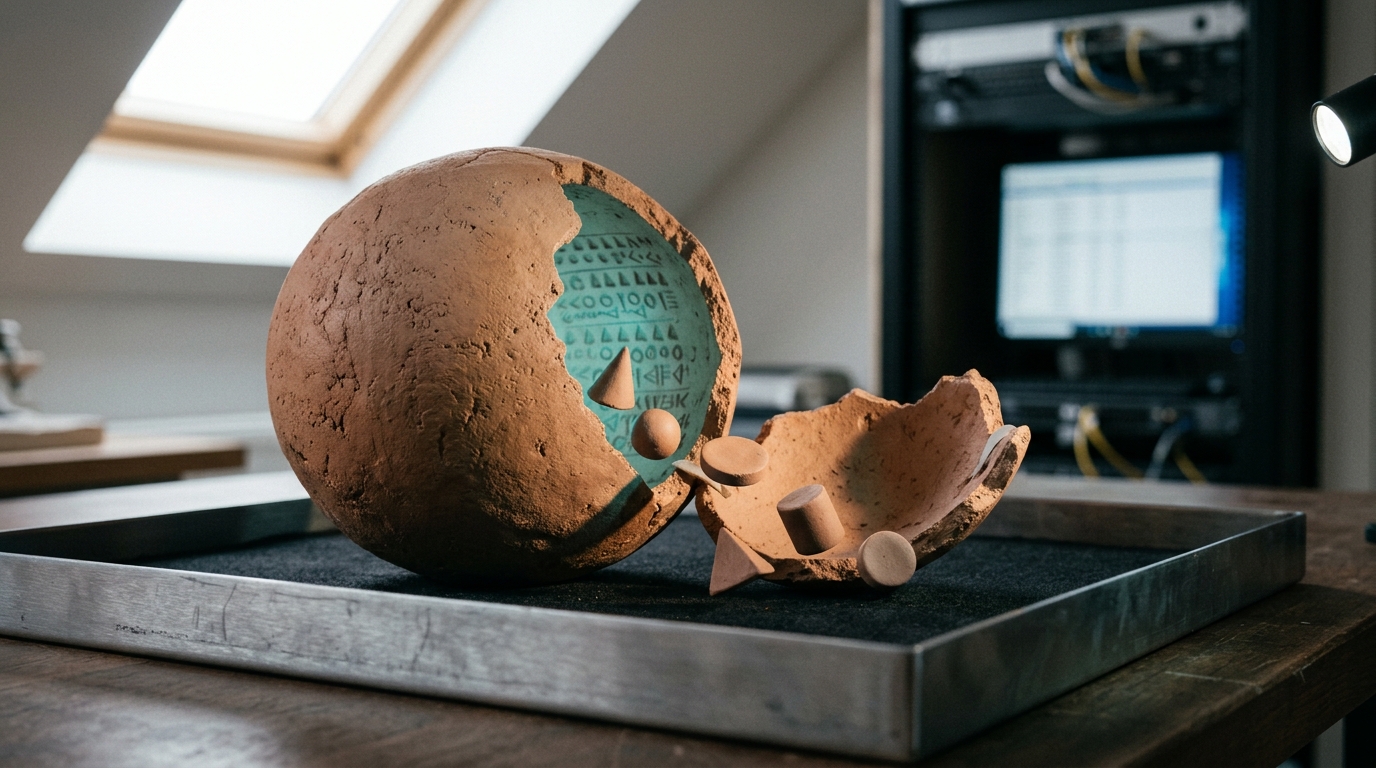
Where the write-blocking rack behind it will later verify a digital record's unaltered state, this cracked clay envelope is the oldest surviving evidence of the same impulse: proving what was recorded matches what was inside. — Image prompt and art direction by Brecht Corbeel; generation pending.
Abstract
Three documented mechanisms, read in sequence: the archaeological record showing three-dimensional clay tokens converted into two-dimensional impressed and then incised signs at the origin of cuneiform; the specific mechanical innovations — type metal alloy, adjustable mold, oil-based ink, screw press — that let Gutenberg's workshop reproduce a page thousands of times without redrawing it; and the cryptographic hash functions and preservation-metadata standards a modern digital archive runs today to prove a record has not been silently altered since it was captured. Fact, vendor claim, and forward-looking analysis are kept explicitly separate throughout.
What this briefing separates
Three claims get run together constantly: that writing was “invented” by someone, that Gutenberg “invented” printing, and that a modern archive can “prove” a document is authentic. Each claim is more specific and more interesting than the popular version. This briefing walks through the documented mechanics of all three, marking fact, inference, and open question separately rather than smoothing them into one triumphant line from clay to cloud.
How proto-writing actually developed from accounting tokens
The archaeological sequence is unusually well documented for something this old. Across the ancient Near East, small geometrically shaped clay tokens — cones, spheres, discs, cylinders — were used from roughly the eighth millennium BCE to represent quantities of specific goods: a cone for a small measure of grain, a sphere for a larger measure, a disc for an animal [1]. This is fact, not reconstruction from silence: excavated tokens survive by the thousands, recovered from Neolithic and early urban sites throughout the region [2].
The mechanism that turns counting tokens into writing is the documented part, and it did not happen in one step. Administrators in early Mesopotamian city-states began sealing sets of tokens inside hollow clay balls — envelopes — to record a transaction in a form that could not be quietly altered after the fact. But a sealed envelope has an obvious problem: nobody can check its contents without destroying it. The solution was to press each token into the envelope’s wet outer surface before sealing it inside, leaving an impressed record of exactly what was enclosed. As one archival account of the sequence puts it, reducing three-dimensional tokens to two-dimensional impressed signs “proved revolutionary: it was the invention of writing” [1].
The next step is the one usually skipped in popular retellings, and it is the most important one mechanically: once the impressions on the outside of an envelope told you everything the tokens inside told you, the tokens themselves became redundant. Envelopes flattened into solid tablets. Scribes stopped pressing physical tokens into clay and began imitating their shapes directly with a stylus, then abstracting those shapes further into the wedge-formed marks known as cuneiform. Proto-cuneiform tablets from the Uruk period, roughly 3200 to 3000 BCE, preserve this transition directly — some of the earliest examples are literally accounting records, tallies of rations and labor rather than narrative or ritual text [2].
Two things follow from this sequence that are easy to miss. First, writing did not begin as a way to record language — early proto-cuneiform signs represent quantities and commodities, not spoken words, and the representation of full spoken grammar in cuneiform came later. Second, the entire innovation is a solution to a bureaucratic verification problem: how do you let a third party check that a sealed record matches its contents without breaking the seal. That is not an incidental detail of the origin of writing. It is the origin of writing, and it is the same problem this briefing’s third section addresses with sixty-four-character hash strings instead of clay impressions.
What is inference rather than settled fact: the precise number of centuries the token-to-tablet transition took at any one site, and whether the same sequence occurred independently or diffused from a single point of origin, remain active questions in the specialist literature. The broad mechanism — three-dimensional token, to impressed two-dimensional sign, to abstracted incised sign — is well supported by the stratified archaeological record and is not seriously contested.
How Gutenberg’s press actually mechanized text reproduction
By the time movable type reached Europe, block printing and even earlier movable-type systems already existed elsewhere in the world; movable type is documented in China centuries before Gutenberg’s workshop. What Gutenberg’s operation in Mainz, around 1440, actually contributed was not the concept of reusable type but a specific, replicable manufacturing chain that made mass production of Latin-alphabet text economically viable [3].
That chain had four separate mechanical components, and it is worth separating them because “the printing press” as a phrase collapses all four into one object:
- An adjustable hand mould for casting type. This is the actual bottleneck Gutenberg solved. A punch was cut for each letterform, driven into a softer metal to make a matrix, and the matrix was locked into an adjustable mould so that a caster could produce large numbers of identical, interchangeable sorts of one letter quickly. Without this, “movable type” just means hand-carved blocks that are no faster to make than a woodblock.
- A type-metal alloy suited to casting. A lead-tin-antimony alloy castable at practical temperatures, durable enough for repeated impressions, and precise enough to hold a sharp letterform, replacing the wood or ceramic types of earlier systems that wore down or warped.
- An oil-based printing ink. Water-based inks used in earlier block printing did not adhere well to metal type; an oil-based ink was needed to transfer cleanly from a metal face to paper.
- A press mechanism adapted from an existing screw press. Gutenberg’s press mechanism was built on the model of presses already used for wine and paper production — a long handle turning a heavy wooden screw to bring a platen down onto paper laid over inked, set type with even, repeatable pressure [3].
The result is not a single invention but an assembled production system, and that is the actual historical claim worth making: the press mechanized reproduction, not composition. A compositor still set each letter by hand into a composing stick, one sort at a time — the labor of assembling a page did not disappear. What disappeared was the labor of re-drawing or re-carving each copy of the page. Once a forme of set type was locked and inked, the same press could stamp an arbitrary number of near-identical impressions limited only by wear on the type and the operator’s stamina.
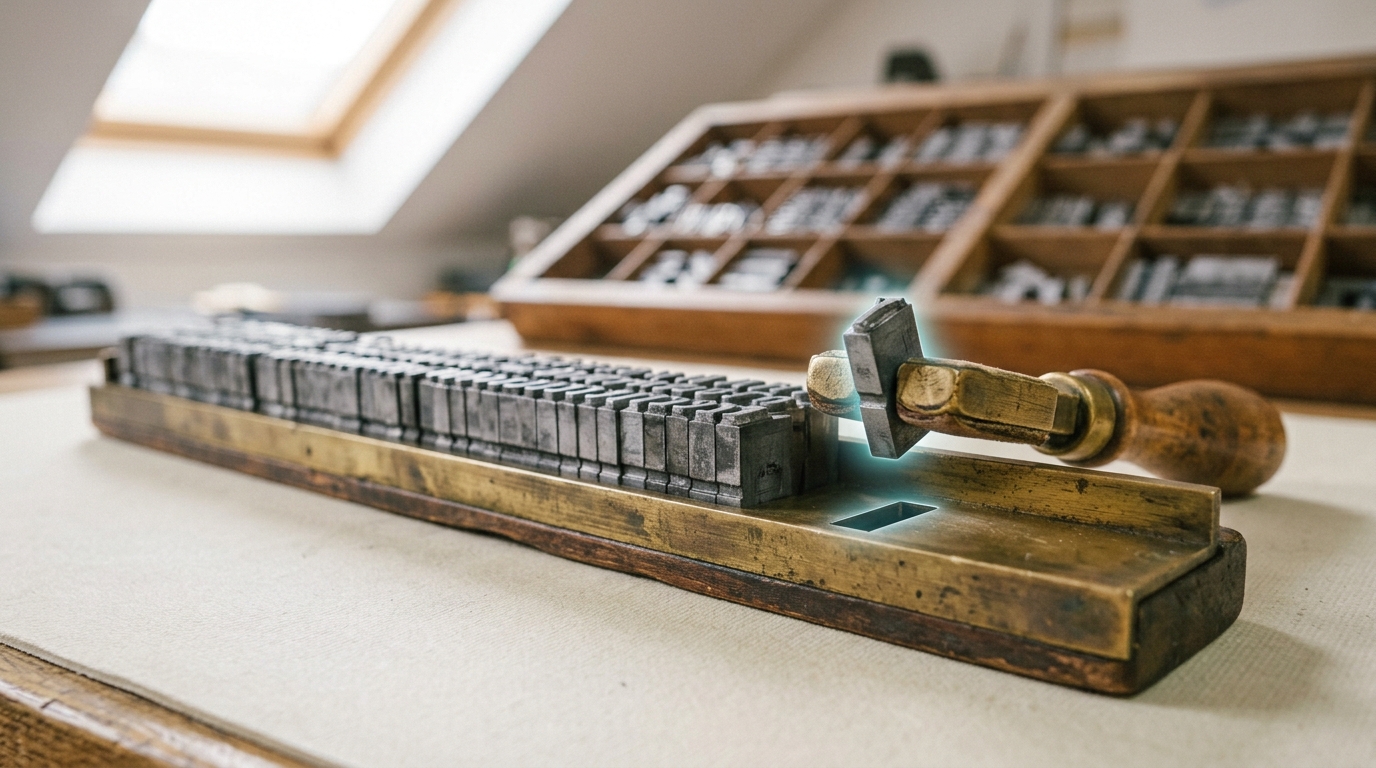
Figure 1. Gutenberg's actual mechanization was not the letterform but the casting process behind it: an adjustable mold that could recast any letter, identical, as many times as a page required. — Image prompt and art direction by Brecht Corbeel; generation pending.
This is why the workshop’s 1455 Bible, the first complete surviving book printed from movable type in the West, matters as a systems claim rather than a single-object claim: it demonstrates the whole chain working end to end at production scale [3]. It is also worth stating plainly what is analysis rather than settled fact here: characterizing this as a “revolution” is a historian’s interpretive framing, not a measurement — the diffusion of printing across Europe over the following decades, and its effects on literacy rates, religious schism, and vernacular publishing, are separate, still-debated causal questions that this briefing does not attempt to adjudicate.
How modern digital archives actually verify a record’s authenticity
The clay envelope’s problem — prove the contents match what was recorded, without a trusted witness present at the moment of checking — is exactly the problem a modern digital archive faces with a file that might be copied, transmitted, or stored for decades. The mechanism that solves it today is a cryptographic hash function, and it is worth being precise about what it actually proves, because it is routinely oversold.
A cryptographic hash function such as SHA-256, standardized by the U.S. National Institute of Standards and Technology in FIPS 180-4, takes an input of arbitrary length — a document, an image file, an entire disk image — and produces a fixed-length digest, 256 bits for SHA-256, such that changing even one bit of the input changes the digest unpredictably [4]. An archive computes and stores this digest at the moment a record is captured. Any later re-computation that produces the same digest is evidence the bytes have not changed since that moment; a different digest is proof they have.
This is the fact, and it is a narrower fact than it is often presented as. A matching checksum does not verify that a document’s content is true, that its author is who they claim, or that it was captured correctly in the first place — it verifies only bit-for-bit fixity against a specific prior snapshot. Authenticity in the fuller archival sense requires a second layer: recorded metadata about who created a digital object, what has been done to it since, and by what agent or process. The PREMIS data dictionary (PREservation Metadata: Implementation Strategies), maintained by the Library of Congress, is the standard most digital repositories use for this layer. It organizes preservation metadata around four entities — Object, Event, Agent, and Rights — so that every action taken on a digital object (a format migration, a fixity check, a copy to new storage media) is logged against the object, the actor responsible, and the time it occurred [5].
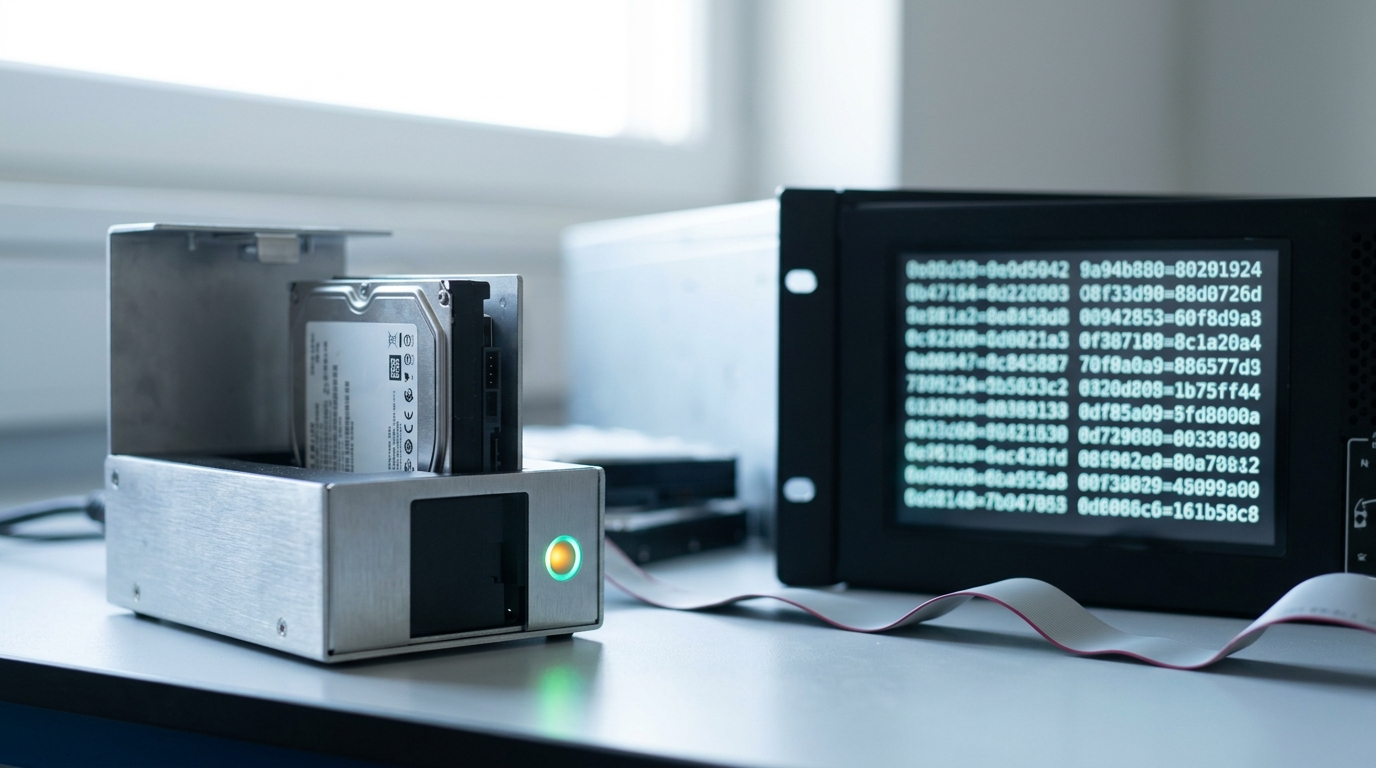
Figure 2. A checksum does not prove what a record says is true; it proves only that the bytes captured on one date are the same bytes being read on another. That distinction is the whole discipline. — Image prompt and art direction by Brecht Corbeel; generation pending.
Put together, a modern archive’s authenticity claim is a chain, not a single check: a hash fixes the bytes at each recorded instant, and PREMIS-style event metadata fixes the sequence of custody and transformation between instants. Break either link and the chain of evidence weakens — a hash with no provenance record proves a file is unchanged since an unknown, unattributed moment; a provenance record with no hash proves a documented history of an object that might itself have already been altered before the record began. This is analysis, not something either standard states about itself: the two mechanisms are complementary specifically because each covers what the other does not.
A scenario worth naming explicitly, with its own disconfirmation condition: it is plausible that hash-based fixity checking becomes standard practice even for small personal and institutional archives over the next decade, given falling storage costs and the availability of free tooling that already implements FIPS-validated algorithms. The observable indicator would be broader adoption of automated fixity-checking in mainstream backup and archival software outside specialist library and museum systems. The condition that would disconfirm it: if such checking remains confined to institutional repositories with dedicated preservation staff, because the failure mode of not checking (silent bit rot, undetected tampering) is invisible until a fixity failure is actually looked for — which is itself the same reason cuneiform’s impressed envelopes and Gutenberg’s identical cast sorts were needed in the first place: verification infrastructure only gets built once its absence has already caused a documented failure.
Reading the sequence as one mechanism, not three inventions
None of these three cases is a story about a lone inventor solving a problem from nothing. Token-based accounting existed for millennia before anyone impressed a token into an envelope wall; movable type and screw presses each existed separately before Gutenberg’s workshop combined them into one production chain; hash functions and structured metadata standards are each older than their combination into a working preservation pipeline. In every case, the actual mechanism is an assembly of existing components solving a specific verification or reproduction bottleneck, documented in the surviving record rather than reconstructed from a founding-genius narrative. That is the pattern worth taking from this briefing more than any one date.
Sources
- Denise Schmandt-Besserat. From Accounting to Writing. University of Texas at Austin (2023).
- Department of Ancient Near Eastern Art, The Metropolitan Museum of Art. The Origins of Writing. The Metropolitan Museum of Art (2004).
- Wikipedia contributors. Printing press. Wikimedia Foundation (2026).
- National Institute of Standards and Technology. FIPS 180-4: Secure Hash Standard (SHS). NIST (2015). DOI: 10.6028/NIST.FIPS.180-4.
- Wikipedia contributors. Preservation Metadata: Implementation Strategies (PREMIS). Wikimedia Foundation / Library of Congress (2026).
Originally published at https://absolutedigitalpublishers.com/articles/how-writing-archives-and-information-revolutions-actually-works.