How Quantum Foundations and Measurement Actually Work
A compact mechanics walkthrough of collapse, decoherence, Bell tests and contextuality — and a precise account of what each one does and does not settle.
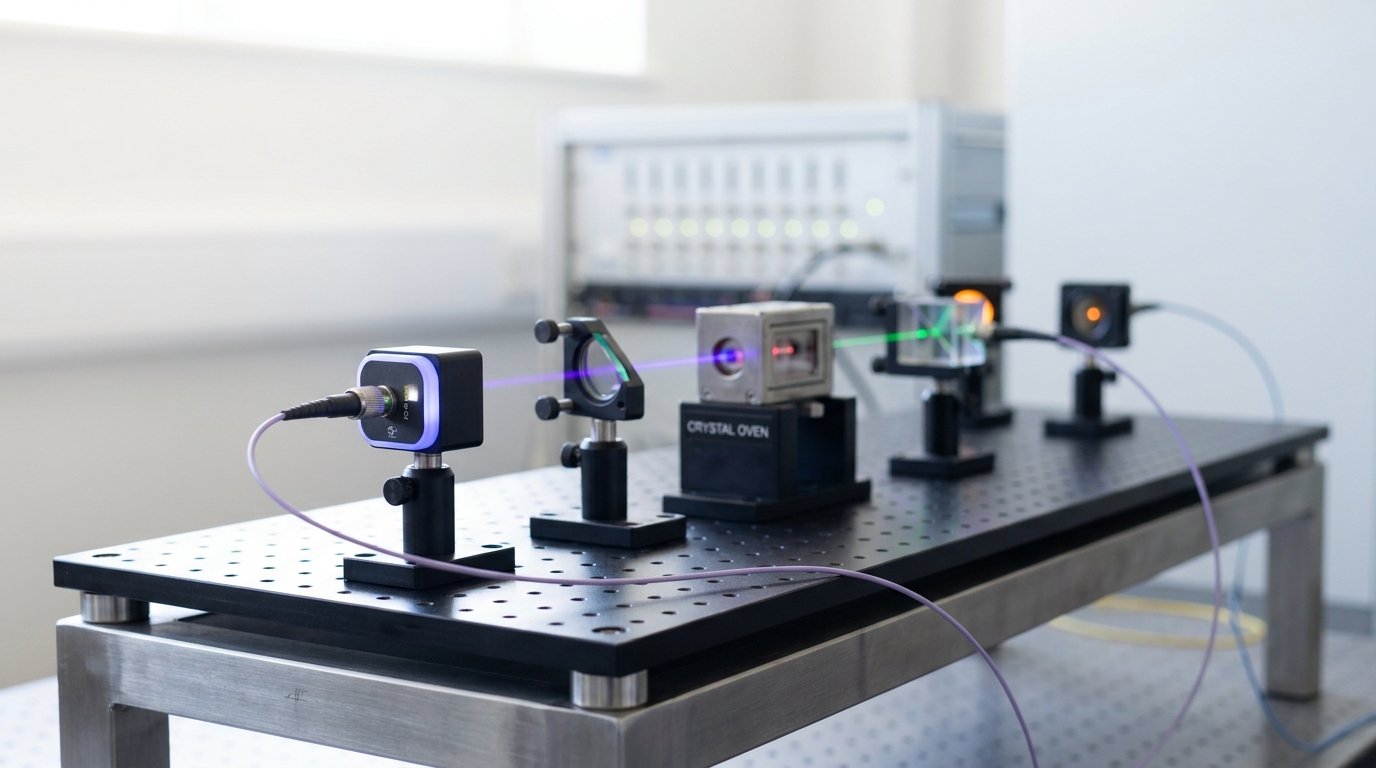
A Bell test does not observe an outcome forming; it counts coincidence clicks and checks whether their statistics can be reproduced by any theory obeying locality and realism together. — Image prompt and art direction by Brecht Corbeel; generation pending.
Abstract
This briefing separates three things that get run together in popular accounts of quantum mechanics: measurement (the physical process by which a superposition stops interfering), nonlocality (what a loophole-free Bell test rules out about local hidden variables), and interpretation (which remains genuinely unsettled). It walks through decoherence as the mechanism that suppresses interference without alone explaining a definite outcome, reports the two Bell experiments that closed the detection and locality loopholes simultaneously, and explains contextuality as an experimentally falsifiable constraint on any hidden-variable account, independent of locality.
Three separate claims get run together whenever “quantum weirdness” comes up: that measurement does something physically definite, that entanglement is spooky at a distance, and that quantum mechanics forces you to give up common-sense assumptions about reality. Only some of that is settled science; the rest is live interpretive dispute dressed as fact. This briefing keeps the three apart and reports, for each, what the actual experiments show.
What a measurement physically does
A quantum state in superposition carries relative phases between its components, and those phases are what produce interference — the double-slit fringes, the oscillating populations of a qubit. Measurement, in the everyday sense of “a detector clicks and now the system has a definite outcome,” requires that those phases stop mattering. The mechanism for that is decoherence: the measured system unavoidably becomes entangled with a much larger environment — stray photons, phonons in a substrate, the electromagnetic modes of a shielding can — and once the joint system-environment state is traced back down to the system alone, the interference terms are suppressed at a rate set by how strongly and how many environmental degrees of freedom couple in [5].
\rho_S(t) = \mathrm{Tr}_E\big[U(t)\,\rho_S(0)\otimes\rho_E(0)\,U^\dagger(t)\big]
This reduced density matrix \rho_S(t) is what an observer restricted to the system alone can predict with; as t grows, its off-diagonal terms in a preferred (“einselected”) basis decay toward zero, and the state comes to look like a classical mixture of definite outcomes with fixed probabilities [5]. That is a fact, derived from unitary quantum mechanics plus a specification of the environment, and it is well tested — it is precisely the effect engineers fight when they build a qubit, and the reason a dilution refrigerator’s coldest stage is wrapped in magnetic shielding and isolated by successive thermal stages, each one suppressing another channel of environmental coupling.
What decoherence does not by itself supply is a reason any one outcome, rather than the whole decohered ensemble, is realized on a given run. That step — why this click and not the other — is exactly where interpretations of quantum mechanics diverge: a collapse postulate, a many-worlds branching, a pilot-wave trajectory, or a QBist update of an agent’s beliefs, all reproduce the same decohered statistics and are not distinguished by any of these experiments. Treating decoherence as having “solved” measurement is a common vendor-style overclaim in popular writing; the peer-reviewed literature is explicit that it explains the suppression of interference and the emergence of an effectively classical, definite-looking ensemble, not the selection of a single realized outcome [5].
What a Bell test actually rules out
Separately from measurement, there is the question of whether quantum correlations between distant, entangled particles could be reproduced by some underlying local hidden-variable theory — one in which each particle carries predetermined answers to every possible measurement, unaffected by anything done to its distant partner. Bell’s theorem shows that any such theory obeys an inequality that quantum mechanics predicts will be violated for suitably chosen measurement settings. For decades, experimental violations of that inequality still admitted loopholes: a detection loophole (too many photons went uncounted to trust the sample was representative) and a locality/setting loophole (measurement choices and outcomes were not spacelike separated, leaving room for a hidden causal signal).
In 2015, two independent groups closed both loopholes simultaneously in a single experiment for the first time. One used electron spins in nitrogen-vacancy centers in diamond, 1.3 kilometres apart, entangled via photon exchange and read out with near-unit efficiency, and reported a statistically significant violation with no unclosed loophole [3]. The other used entangled photon pairs with high-efficiency superconducting detectors and fast, independent random setting choices, reporting a violation inconsistent with local realism at a significance corresponding to roughly 3.74 × 10⁻³¹ probability under the local-realist null hypothesis [4]. Alain Aspect, John Clauser, and Anton Zeilinger were awarded the 2022 Nobel Prize in Physics specifically “for experiments with entangled photons, establishing the violation of Bell inequalities and pioneering quantum information science” — recognition of the decades-long experimental program these two 2015 results capped [1].
What this rules out, precisely, is any theory that is simultaneously local (no faster-than-light influence) and realist in Bell’s specific sense (every measurement outcome is predetermined independent of which measurement is performed). It does not by itself pick an interpretation of quantum mechanics, does not license the popular claim that “information travels faster than light,” and does not resolve whether nature is best described as fundamentally random, many-branched, or guided by nonlocal hidden variables (a loophole Bell tests do not close, since Bohmian mechanics is explicitly nonlocal and remains consistent with these results). Zeilinger’s own Nobel lecture frames the result as ruling out local realism while explicitly leaving interpretation open, and as founding a research program — quantum information science — that treats entanglement as a resource rather than a puzzle to be resolved first [2].
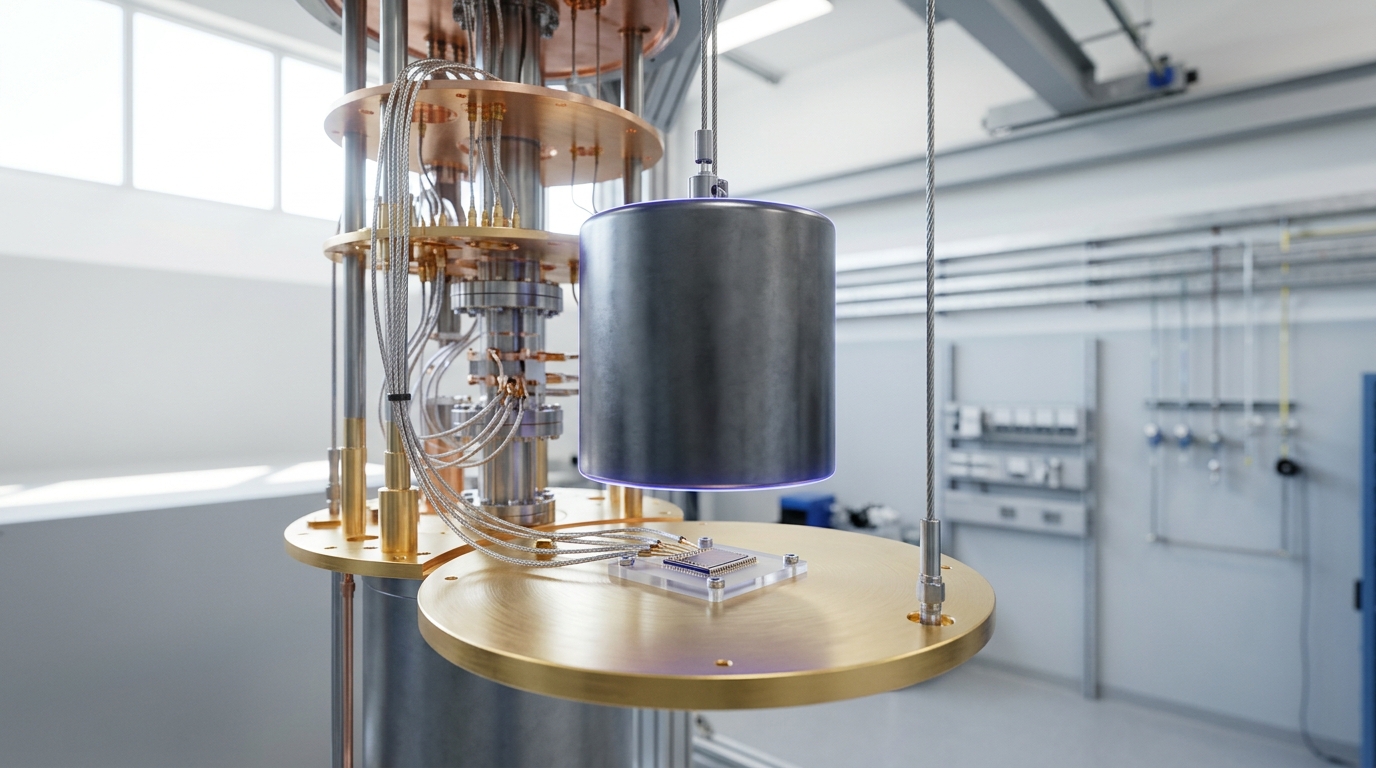
Figure 1. Decoherence is entanglement with the environment; the cryostat's stages exist to slow exactly that leakage, not to stop it outright. — Image prompt and art direction by Brecht Corbeel; generation pending.
Contextuality: a different, non-local question
Contextuality is often folded into the same conversation as Bell nonlocality, but it is a distinct property and does not require two separated particles at all. The Kochen-Specker theorem shows that for quantum systems with a Hilbert space of dimension three or higher, no assignment of predetermined values to all possible measurement outcomes can be consistent with quantum mechanics’ predictions if that assignment is required to be non-contextual — that is, if a measurement’s assigned value cannot depend on which other compatible measurements happen to be performed alongside it. This is a statement about a single system, not about locality between two systems.
Kirchmair and colleagues gave a state-independent experimental demonstration of this using a pair of trapped calcium ions, implementing a Peres-Mermin square of correlated measurements whose results cannot be reproduced by any non-contextual hidden-variable assignment, for any input state, closing the “special state” loophole that limited earlier tests [6]. The practical upshot: contextuality is falsifiable in the same operational sense a Bell inequality is — a specific inequality, a specific measurement protocol, a specific statistical bound — and it has been falsified for non-contextual hidden variables, independent of any claim about distant correlations or measurement collapse.
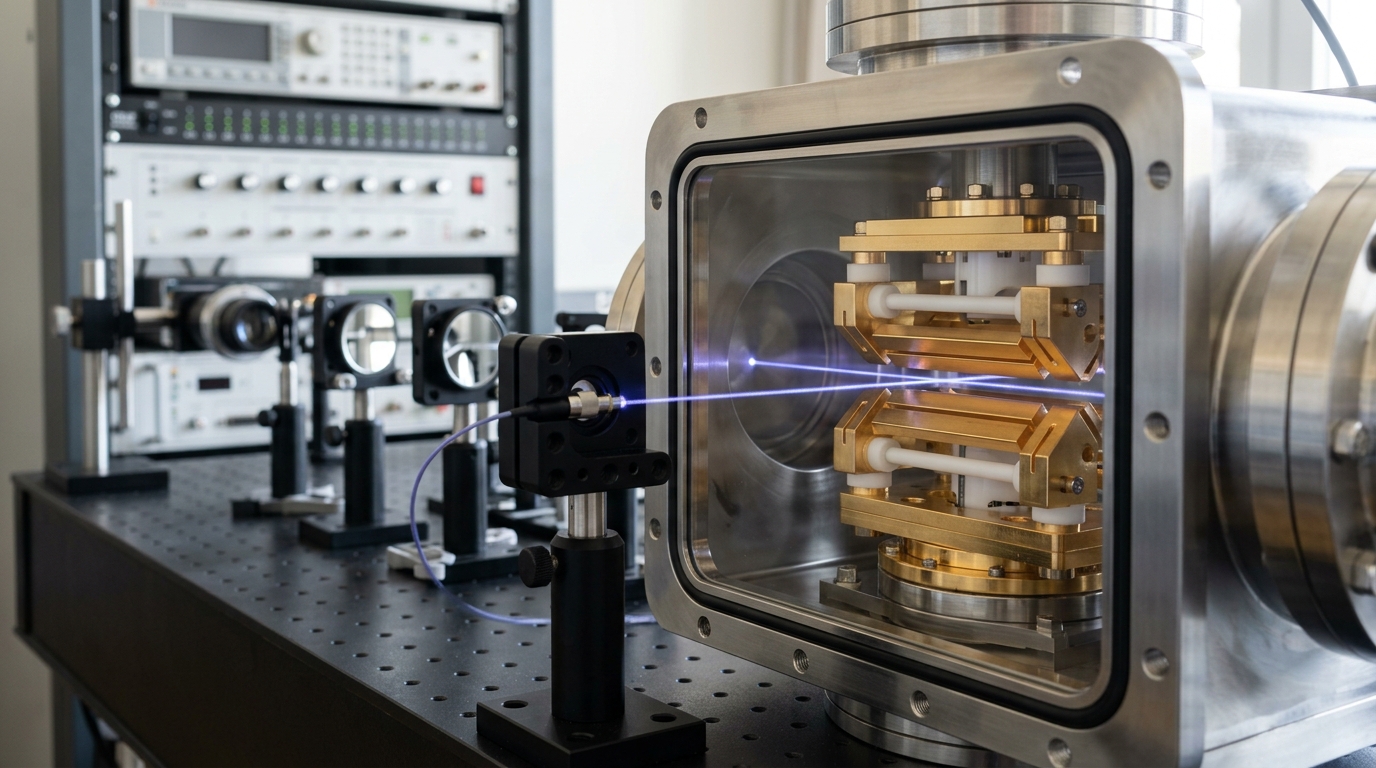
Figure 2. Contextuality experiments do not test locality at all; they test whether a single system's own measurement outcomes can be assigned values in advance, independent of which compatible measurement is chosen alongside it. — Image prompt and art direction by Brecht Corbeel; generation pending.
Keeping the claims separate
Fact, tested and replicated: decoherence suppresses interference at a rate derivable from system-environment coupling [5]; loophole-free Bell tests rule out local hidden-variable theories [3, 4]; state-independent contextuality tests rule out non-contextual hidden-variable theories for single systems [6]. Vendor-style overclaim to watch for: any framing that treats these results as having selected one interpretation of quantum mechanics, or as showing signals travel faster than light — neither follows. Analysis: the honest description of where physics stands is that the statistics of quantum measurement are unambiguously established and increasingly precisely bounded, while the ontology — what is “really” happening on a single run — remains an open, empirically underdetermined question among several internally consistent interpretations. Scenario, not prediction: if a future experiment found a loophole-free violation of a Bell-type inequality that also falsified quantum mechanics’ own numerical predictions, that would be a genuinely new discovery rather than a resolution of interpretation; no such result exists, and the disconfirmation condition for the current consensus is exactly a reproducible deviation from quantum mechanics’ predicted correlations at the loophole-free level already demonstrated [3, 4].
Sources
- The Royal Swedish Academy of Sciences. The Nobel Prize in Physics 2022: Scientific Background. Nobel Prize Outreach (2022).
- Anton Zeilinger. Nobel Lecture: Quantum Entanglement — from Fundamentals to Quantum Technology. Nobel Prize Outreach (2022).
- B. Hensen, H. Bernien, A. E. Dréau, et al.. Loophole-free Bell inequality violation using electron spins separated by 1.3 kilometres. Nature (2015). DOI: 10.1038/nature15759.
- M. Giustina, M. A. M. Versteegh, S. Wengerowsky, et al.. Significant-Loophole-Free Test of Bell's Theorem with Entangled Photons. Physical Review Letters (2015). DOI: 10.1103/PhysRevLett.115.250401.
- Wojciech H. Zurek. Decoherence, einselection, and the quantum origins of the classical. Reviews of Modern Physics (2003). DOI: 10.1103/RevModPhys.75.715.
- G. Kirchmair, F. Zähringer, R. Gerritsma, et al.. State-independent experimental test of quantum contextuality. Nature (2009). DOI: 10.1038/nature08172.
Originally published at https://absolutedigitalpublishers.com/articles/how-quantum-foundations-and-measurement-actually-works.