How Planetary Science and Exploration Actually Work
Planets are not photographed into understanding. Their interiors, air, and surfaces are inferred from tracking signals, seismic ring-down, and reflected light, and their history is read from grams of matter carried home in a sealed capsule.
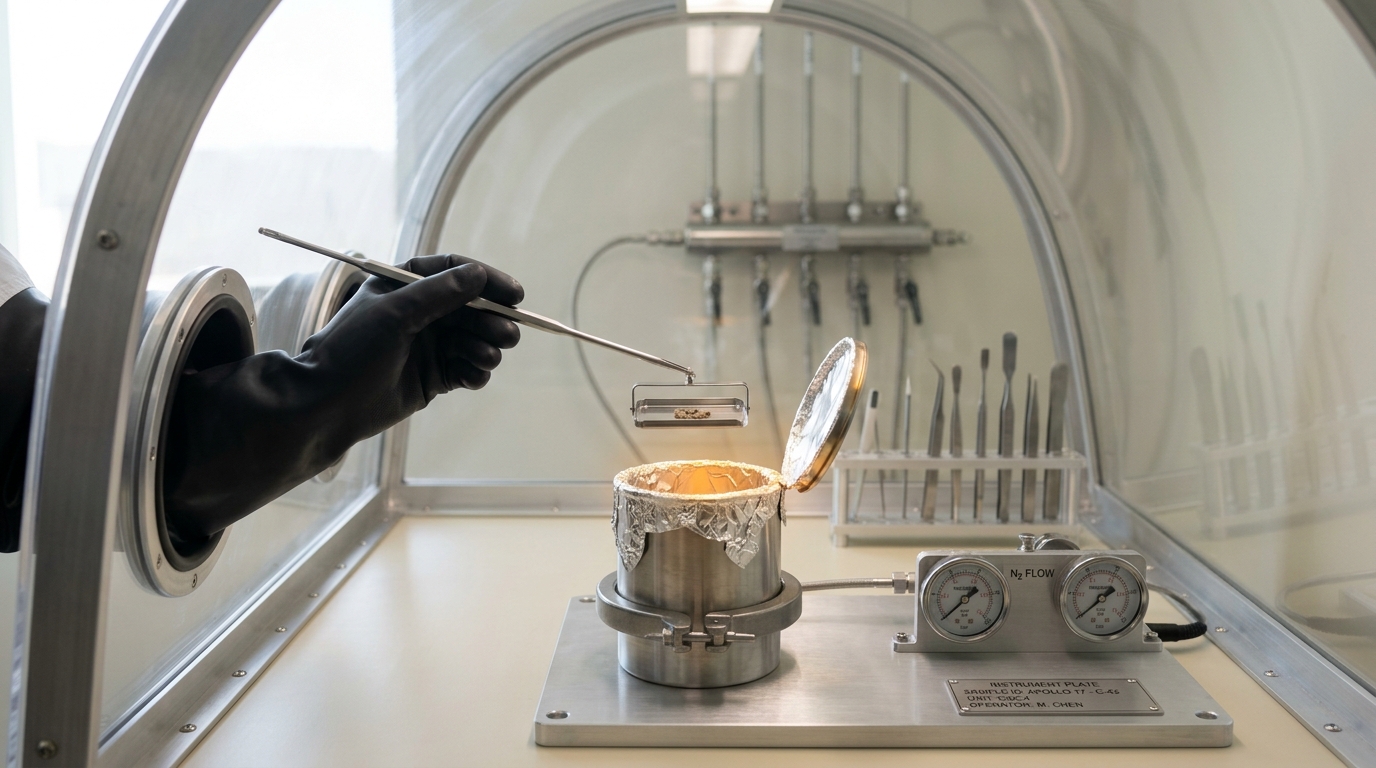
A returned sample is not examined until it has been transferred, still sealed, into a nitrogen atmosphere built to keep Earth's air and water away from it. — Image prompt and art direction by Brecht Corbeel; generation pending.
Abstract
This is the opening piece in a series on planetary science and exploration, and it builds the field from its actual measurement mechanics rather than its imagery. It explains how a planet's interior is inferred from two independent channels — the gravity field measured by radio tracking and the seismic wavefield measured by a single Mars seismometer — and why each gives a different, partial constraint on density and structure. It works through how orbiting and flyby instruments measure atmospheric composition without ever touching the air, using transmission and emission spectroscopy governed by ordinary radiative transfer. It then follows a sample-return mission end to end, from an asteroid's non-gravitational drift to a curation glovebox, using OSIRIS-REx as the worked example. Throughout, the piece separates established fact, mission-team claims, methodological analysis, and forward-looking scenario, because planetary science is a field where a strong instrument result and a plausible interpretation are routinely confused with each other.
The instrument stands between the planet and the claim
Planetary science has an image problem, and not the one usually meant by that phrase. The public record of a mission is almost always a picture — a crescent limb, a crater field, a plume against black sky — and pictures make it easy to believe that planets are known the way a landscape is known, by looking. They are not. Every quantitative claim in planetary science — a core radius, a mantle density, a trace-gas abundance, an age since last resurfacing — comes from an instrument reading a signal that is not the planet itself: a radio carrier’s frequency, a seismometer’s displacement, a spectrum’s missing wavelengths, an isotope ratio in a returned grain. This piece, the first in a series on planetary science and exploration, is about that layer: the actual mechanics connecting a raw instrument channel to a stated fact about a world, using three domains — interiors, atmospheres, and sample return — as worked examples.
The organizing discipline throughout is separating four kinds of statement that get blended together in mission coverage. A fact is a measured quantity with stated uncertainty, traceable to a specific instrument and analysis. A mission-team claim is an interpretation the team advances, often correct, but resting on modeling choices that a fact alone does not fix. An analytical inference is this article’s own reasoning about what a method can and cannot support. A scenario is a described possible future, bounded by an explicit horizon and a condition that would disconfirm it. Conflating these is the single most common way planetary results get overstated in secondary coverage, and this article tries not to repeat that error.
How a planet’s interior is actually inferred: two independent channels
No instrument has ever directly sensed the deep interior of a planet. Interiors are inferred, and the two channels that do the inferring — gravity and seismic — are genuinely independent, which is why agreement between them counts as strong evidence rather than a single measurement repeated twice.
Gravity. A planet’s external gravity field is not sensed with a gravimeter sitting on the planet; it is read off the motion of an orbiting or flying-by spacecraft, whose trajectory bends in response to mass distribution beneath it. In practice this means tracking the spacecraft’s radio carrier signal from Earth and measuring its Doppler shift with extreme precision as the spacecraft accelerates and decelerates along its orbit. A denser, non-uniformly distributed interior produces small, characteristic deviations from a simple point-mass orbit, expressed as gravity harmonics (J_2, C_{22}, and higher terms) layered on top of the dominant 1/r^2 term. From those harmonics and the body’s known radius and rotation, one can compute the moment of inertia factor,
\frac{C}{MR^2},
where C is the polar moment of inertia, M the mass, and R the mean radius. A uniform sphere has C/MR^2 = 0.4; a value below that indicates mass concentrated toward the centre — a core. This is exactly the method Cassini’s radio tracking used to constrain Titan’s interior, returning a moment of inertia factor near 0.34 and pointing to incomplete separation of rock from ice rather than a fully differentiated body [6], and it is the same logic Galileo’s gravity measurements applied to Europa, where the data supported a metallic core, rocky mantle, and outer ice–water layer [7]. The method is powerful and also intrinsically limited: gravity alone cannot uniquely fix a full density profile, because different internal arrangements can produce the same low-degree harmonics. Gravity constrains bulk structure; it does not, by itself, resolve boundaries.
Seismic. The second channel is direct wave propagation through the interior, and it requires an instrument sitting on the surface. NASA’s InSight lander placed a seismometer package, SEIS, on Mars in 2018 specifically to record marsquakes and use their travel times to map internal boundaries [3]. A seismic wave that crosses a boundary — crust to mantle, mantle to core — changes speed and partially reflects, and the arrival-time pattern of direct and reflected phases at a single station can be inverted for the depth and sharpness of that boundary. Within its first ten months, InSight had already recorded well over a hundred marsquakes, mostly modest tectonic events with no confirmed impact-induced quake yet identified in that early catalogue [1]. The core detection itself came from a specific type of arrival: seismic energy reflected once off the core–mantle boundary before reaching the surface station, whose travel time — inverted jointly with independent geodetic constraints — put the radius of Mars’s liquid metallic core at 1{,}830 ± 40 km, with an inferred core density (5.7–6.3 g/cm³) high enough to require a substantial fraction of light elements dissolved in the iron–nickel mixture [2].
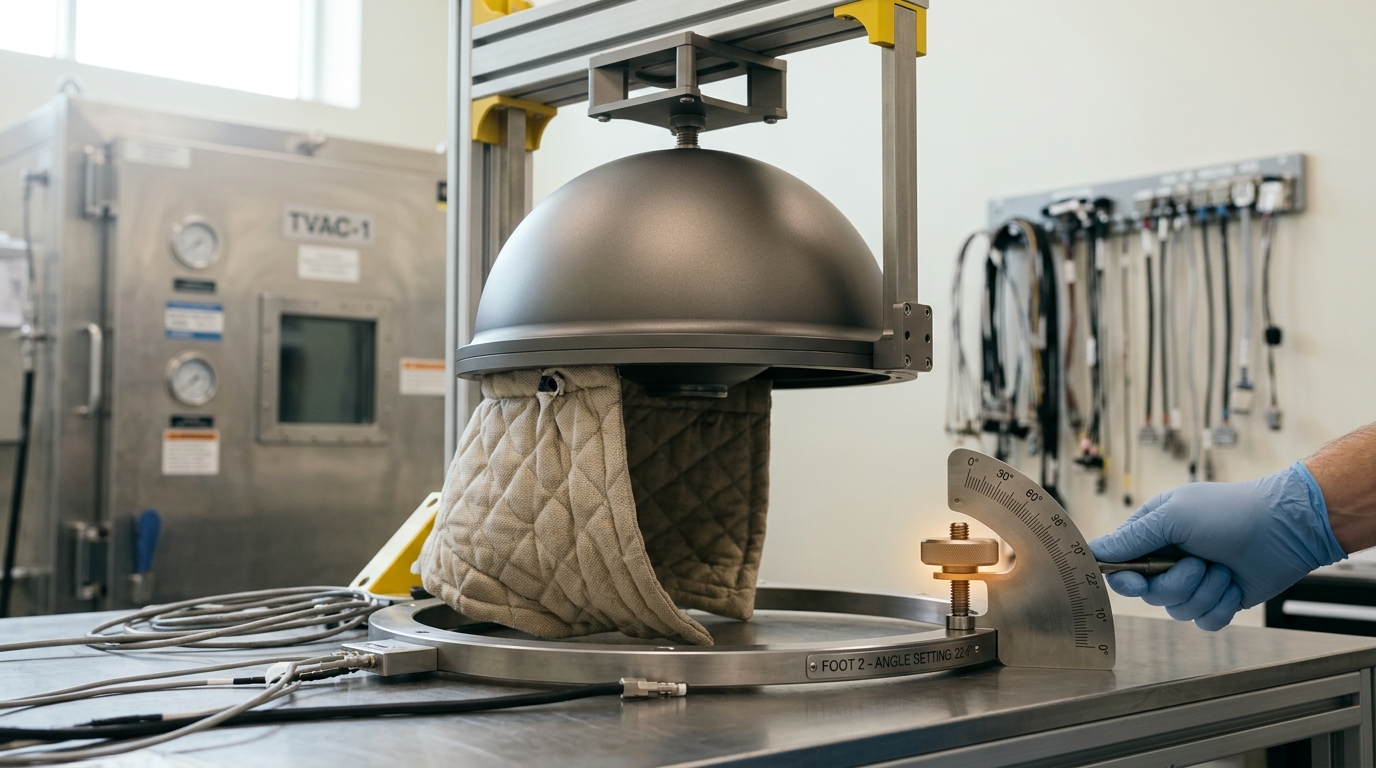
Figure 1. A planetary seismometer must be leveled to a fraction of a degree before it can register ground motion smaller than the width of a hydrogen atom. — Image prompt and art direction by Brecht Corbeel; generation pending.
Two things about the seismic method deserve to be stated as analysis rather than left implicit in the citation. First, a single seismometer, unlike a terrestrial network, cannot triangulate an epicentre the way multiple stations can; distance and depth to a quake are recovered from the internal structure of its own wave arrivals, which makes the interior model and the event catalogue mutually dependent in a way a multi-station network avoids. Second, “detecting the core” is a claim built on a chain — instrument fidelity, phase identification, an assumed velocity model, and a joint inversion with geodetic data — not a single unambiguous ping. The result has held up under independent scrutiny and is treated here as fact, but the chain is worth naming because it is the chain, not a picture of Mars, that produced the number.
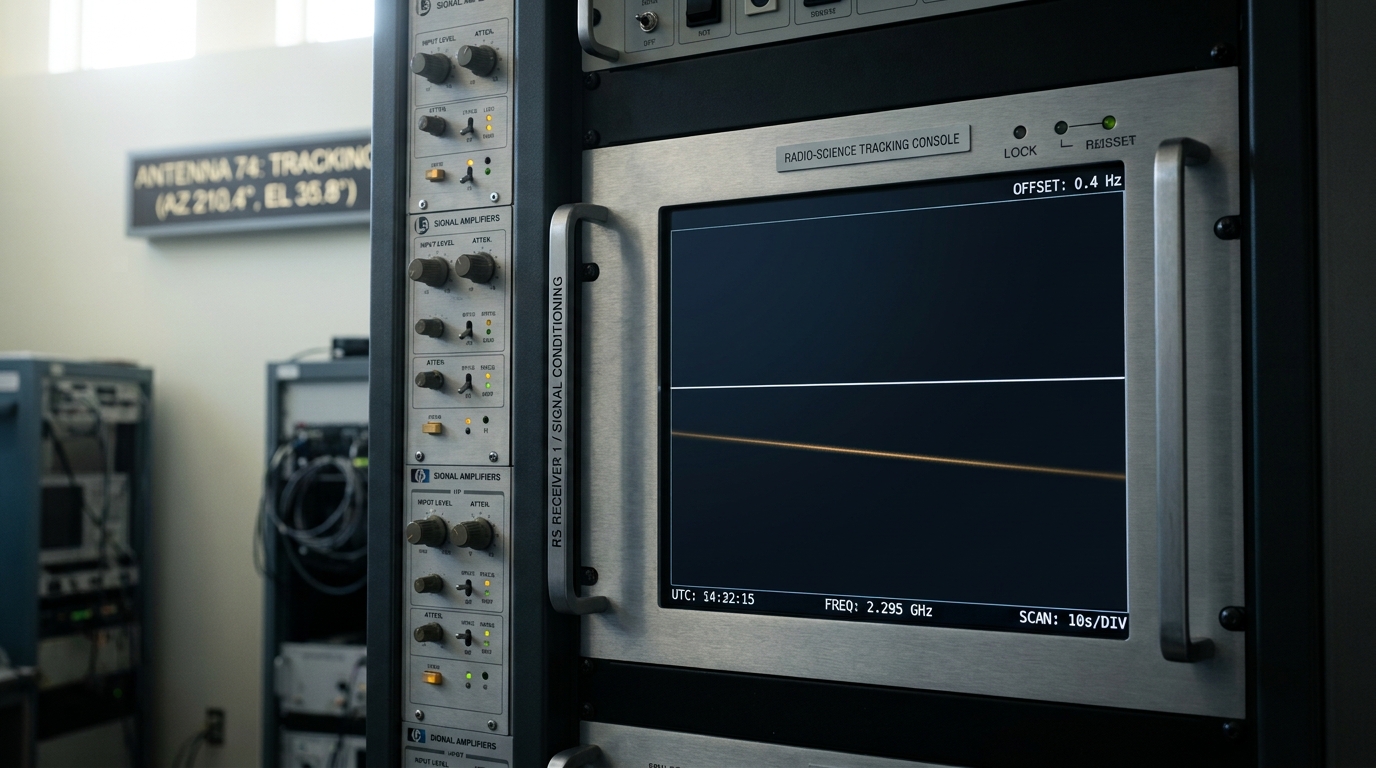
Figure 2. A planet's gravity field is measured not by sensing gravity directly but by timing the Doppler drift of a spacecraft's own radio carrier. — Image prompt and art direction by Brecht Corbeel; generation pending.
Gravity and seismic data are complementary rather than redundant precisely because they are sensitive to different things: gravity to the radial mass distribution averaged over the whole body, seismic to sharp discontinuities and to the actual wave speed of the material the waves cross. A model consistent with both is a materially stronger claim than a model fit to either alone, and this is the actual epistemic structure behind statements like “Mars has a large, low-density, light-element-rich core” — it is not a single instrument’s output, it is an agreement between two independent methods.
How instruments measure a planet’s air without touching it
Atmospheric composition is inferred the same way interiors are — from a signal, not from the substance itself — but the physics is radiative transfer rather than mechanics. The workhorse technique is transmission spectroscopy: as a planet with an atmosphere passes in front of its star (for an exoplanet) or as sunlight grazes a planet’s limb (for a solar-system body observed from orbit), starlight is filtered through the atmosphere’s outer layers before reaching the detector. Each gas absorbs a characteristic set of wavelengths, governed to first approximation by the Beer–Lambert relation,
I(\lambda) = I_0(\lambda)\, e^{-\tau(\lambda)}, \qquad \tau(\lambda) = \int n(z)\,\sigma(\lambda, z)\, dz,
where I_0(\lambda) is the incident spectrum, \tau(\lambda) the wavelength-dependent optical depth, n(z) the number density of an absorbing species at altitude z, and \sigma(\lambda, z) its absorption cross-section, which itself depends on temperature and pressure. The instrument records I(\lambda); the abundance profile n(z) is recovered by inverting this relation against a model atmosphere, which means every composition result carries the assumptions of that model — cloud and haze opacity, temperature structure, and the line-list data used for \sigma(\lambda,z) — bundled in with the raw spectral measurement.
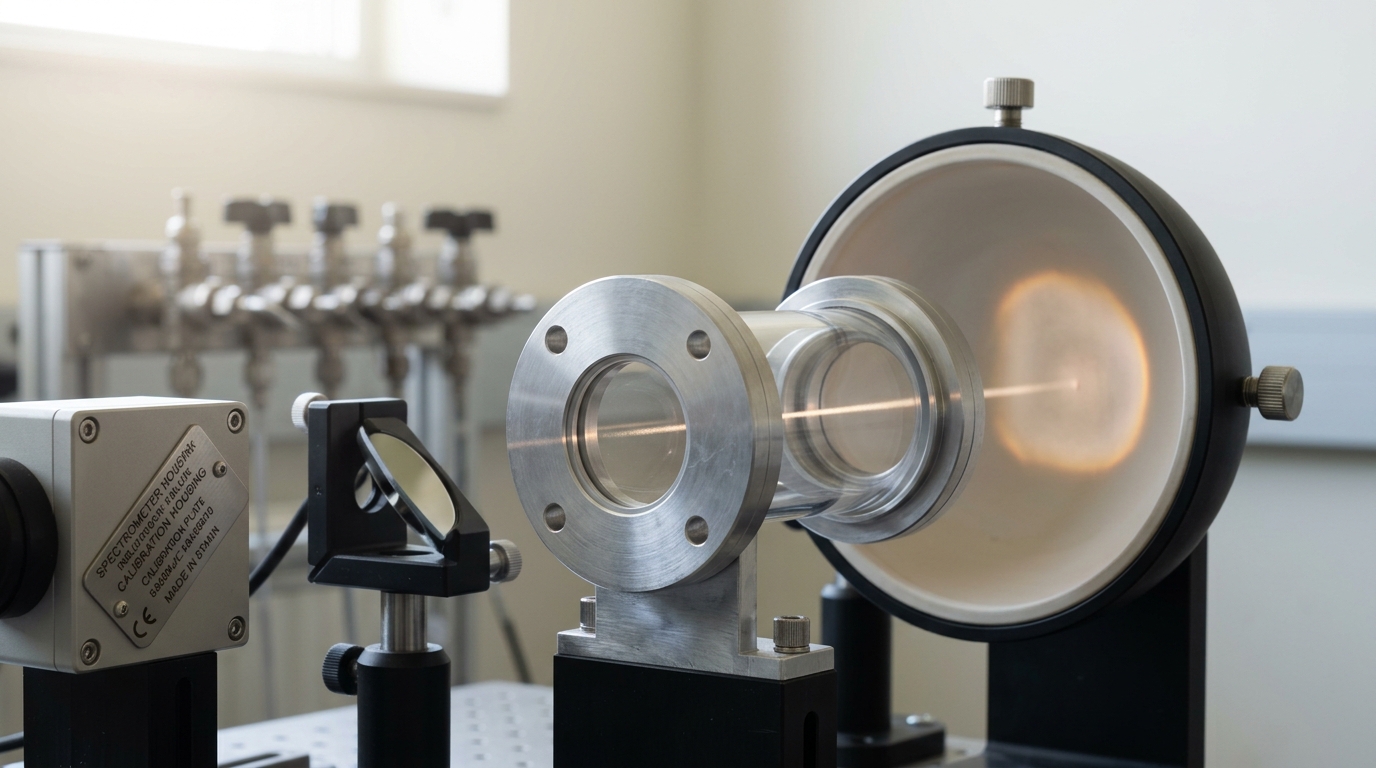
Figure 3. Remote instruments measure atmospheric composition by reading which wavelengths of light a planet's air has already absorbed, not by touching the air itself. — Image prompt and art direction by Brecht Corbeel; generation pending.
This is exactly the method behind the James Webb Space Telescope’s 2022 identification of carbon dioxide in the atmosphere of the hot-Jupiter exoplanet WASP-39b, a clean, high-confidence spectroscopic detection because the CO_2 absorption feature it targeted (near 4.3 microns) was distinctive enough to separate from the confounding effects of other opacity sources in the observed band [8]. CO_2 is scientifically interesting less for its own sake than as a metallicity tracer: heavy-element enrichment in a giant planet’s envelope is diagnostic of how and where it formed, which is the mission-team interpretation layered on top of the raw detection fact. The detection itself — a specific absorption feature present at a specific depth in a specific wavelength band — is the fact. That the feature implies a particular formation history for WASP-39b is an inference riding on a planet-formation model, and it should be read as analysis rather than as an observation of formation directly.
The same physics runs in emission rather than transmission for a planet observed without a convenient transit geometry — an orbiter or flyby instrument measures thermal infrared emitted by the atmosphere itself, and gas-specific emission or absorption features in that thermal spectrum are read the same way. Orbital and flyby spectrometers at Mars, Venus, and the outer planets have built up atmospheric composition and vertical-structure profiles this way for decades; the instrument never samples a single air molecule. It reads light that the air has already touched.
How a sample-return mission actually works, end to end
The most direct way to know what a planetary body is actually made of is to bring a piece of it back and put it in a mass spectrometer on Earth, where laboratory instruments vastly exceed what fits on a spacecraft. NASA’s OSIRIS-REx mission to the near-Earth asteroid Bennu is a complete, well-documented example of what that actually requires, end to end [4, 9].
Approach and characterization. OSIRIS-REx did not simply fly to Bennu and grab a sample. After arriving in December 2018, the spacecraft spent nearly two years in close proximity, mapping the surface in detail to find a site that was both scientifically valuable and mechanically safe — a genuine engineering constraint, because Bennu’s surface turned out to be far rockier and more boulder-strewn than premission models predicted, which forced the mission to select a much smaller, more precisely targeted sampling site than originally planned. This is a fact about how the mission actually proceeded, not incidental colour: sample-return missions spend a large fraction of total mission time on reconnaissance precisely because a single sampling attempt is not casually repeatable against an unpredictable natural surface.
Contact and collection. The sampling event itself, called Touch-And-Go (TAG), lasted a matter of seconds: the spacecraft descended to brief contact, fired a burst of nitrogen gas from its Touch-And-Go Sample Acquisition Mechanism (TAGSAM) to stir up loose regolith, and captured the disturbed material in an annular collector head before immediately backing away. The head design and gas-firing sequence were validated in advance against simulant material in ground testing to characterize how varied regolith particle sizes would behave under the collection gas burst, precisely because there is no way to rehearse contact with the actual asteroid surface [4].
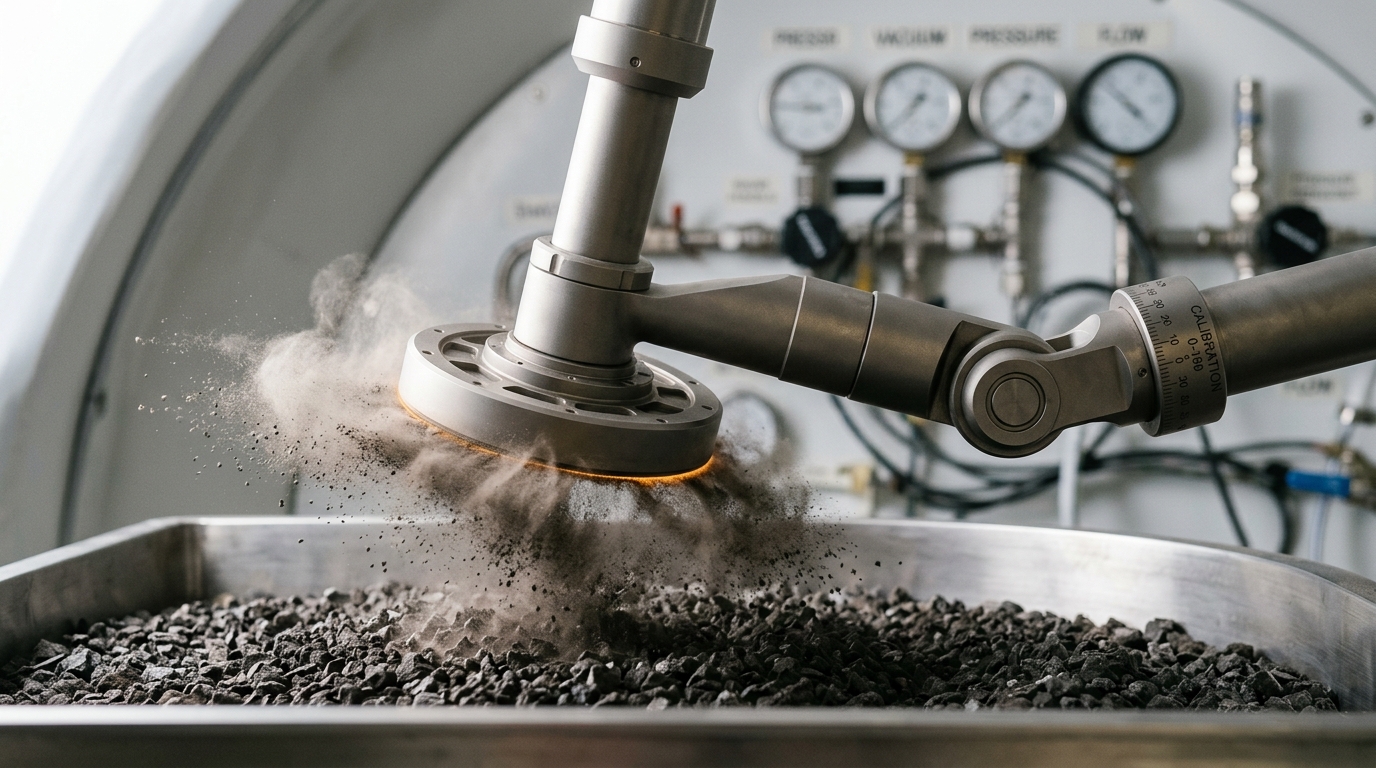
Figure 4. A touch-and-go sampler is proven on Earth first, against simulated regolith, because the real surface only gets one unrehearsed attempt. — Image prompt and art direction by Brecht Corbeel; generation pending.
Contamination control, decided before launch. Because the entire scientific value of a returned sample depends on distinguishing what came from the asteroid from what the mission itself might have introduced, OSIRIS-REx’s hardware contamination budget and control procedures were engineered and documented years before the spacecraft ever reached Bennu, including maintaining spacecraft sampling hardware within strict particulate and biomolecular cleanliness limits and exposing witness plates throughout assembly, launch, and cruise so that any contribution from the mission itself could later be characterized and subtracted from what the returned sample actually shows [5]. This is a methodological point worth stating plainly: a sample-return mission’s contamination control plan is not a housekeeping footnote, it is part of the measurement design, on the same footing as the sensor itself.

Figure 6. A sample-return mission tracks its own contamination before launch, so that what a lab measures afterward can be told apart from what the mission itself carried along. — Image prompt and art direction by Brecht Corbeel; generation pending.
Return and curation. The sample capsule separated from the main spacecraft and re-entered Earth’s atmosphere under parachute in September 2023, landing in the Utah desert, while the main spacecraft itself continued on to a new mission target. Recovery teams transported the still-sealed capsule to a curation facility where it was opened not in ordinary air but inside a nitrogen-purged glovebox, specifically to keep terrestrial oxygen and water vapour from altering or contaminating material that may carry water- and carbon-bearing compounds unlike anything in Earth’s atmosphere [9].
Analysis. Only once material is safely inside a controlled atmosphere is it distributed, in carefully weighed and logged aliquots, to laboratories for the actual chemical, isotopic, and mineralogical work — mass spectrometry for isotope ratios, electron microscopy for mineral texture, and, for many bulk-composition questions, standard petrographic techniques such as thin sections examined under polarized light to identify constituent minerals from their optical properties [4]. This last step is unglamorous compared to a nitrogen-gas sampling burst on an asteroid, but it is where the actual scientific payoff of a years-long, cross-continental mission is finally realized, one polished slice at a time.
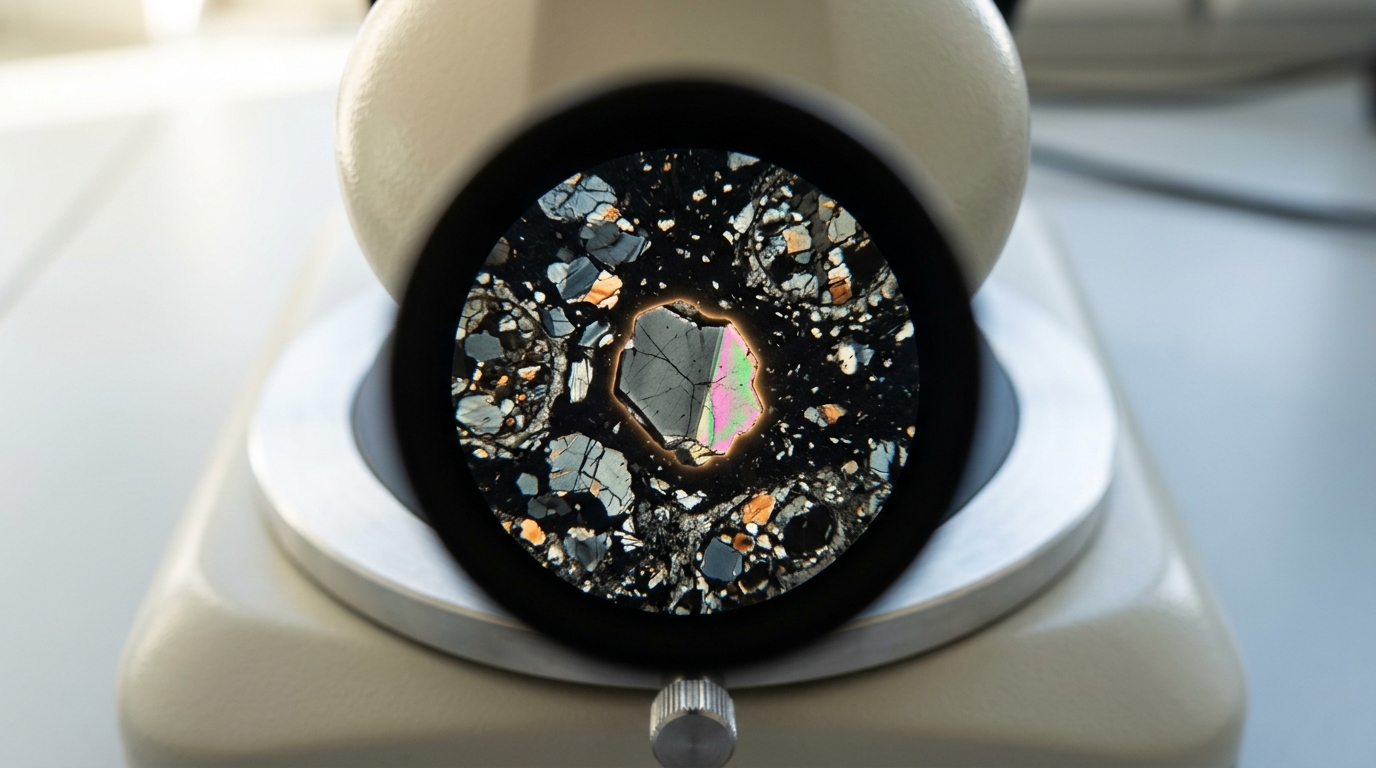
Figure 5. Comparative planetology often comes down to a mineral grain a few hundred microns wide, rotated under polarized light until it reveals what it is. — Image prompt and art direction by Brecht Corbeel; generation pending.
Comparative planetology: what one world’s method tells you about another
None of the three methods above — gravity inversion, atmospheric spectroscopy, sample return — was invented for a single planet, and their real power in practice is comparative. The moment-of-inertia method that constrained Titan’s interior [6] and Europa’s layered structure [7] is the identical mathematics applied to two very different bodies, and the fact that it returns different answers (a incompletely differentiated ice–rock mixture for Titan, a clearly layered metal–rock–ice structure for Europa) is itself informative about their different thermal and accretional histories, not a sign that the method behaves inconsistently. Similarly, transmission spectroscopy applied to WASP-39b’s thick, hot hydrogen-dominated envelope [8] and to a thin, cold, carbon-dioxide-dominated terrestrial atmosphere elsewhere in the solar system uses the same Beer–Lambert physics, but the retrieved abundance profile means something completely different for a planet’s formation history depending on which regime it falls in.
This comparative structure is also where planetary science is most exposed to overreach. A moment-of-inertia value or a single absorption feature constrains a family of interior or atmospheric models; it does not, on its own, select a unique one. Responsible interpretation states the model family and its assumptions alongside the number, and treats a well-fitting model as the current best explanation rather than as a settled fact equivalent to the measurement that constrains it. Where planetary scientists genuinely disagree — for instance, on exactly how much of Titan’s low moment-of-inertia factor reflects incomplete rock–ice separation versus water bound within silicate minerals [6] — that disagreement is a live feature of the field, not a defect to be smoothed over in summary.
What comes next in this series, and what would have to be true
This piece deliberately stopped short of surface geomorphology, small-body dynamics beyond Bennu’s sampling encounter, and detailed instrument physics for imaging spectrometers and mass spectrometers — each is a large enough topic for its own piece in this planetary-science-and-exploration series, and none is covered here in more than a supporting role. As a forward-looking scenario rather than a claim: if upcoming sample-return missions to Mars and to comets follow the OSIRIS-REx pattern — extended reconnaissance, a validated sampling mechanism, a pre-launch contamination budget, and nitrogen-atmosphere curation — over roughly the next decade, comparative planetology should gain several more independently curated, ground-truth reference samples against which remote gravity and spectroscopic methods can be calibrated. The observable indicator to watch for is whether returned-sample compositions systematically confirm or diverge from what orbital spectroscopy of the same body predicted beforehand; a persistent, well-characterized divergence would be the condition that should make the field revisit its current retrieval models rather than treat them as validated. That test has not yet been run at scale, and this article makes no claim about how it will come out.
What can be said now, from the record already in hand, is narrower and more solid: two independent physical channels agree that Mars has a large, light-element-rich core; one high-confidence spectroscopic detection has identified carbon dioxide in a hot Jupiter’s atmosphere from its own light, filtered through that atmosphere and nothing else; and a mission that spent years in transit, months in reconnaissance, seconds in contact, and still more years in laboratories has shown, in full, that returning a planetary sample and trusting what a lab instrument reports from it is now a demonstrated, repeatable engineering procedure, not a one-time feat.
Sources
- W. B. Banerdt et al.. Initial results from the InSight mission on Mars. Nature Geoscience (2020). DOI: 10.1038/s41561-020-0544-y.
- Simon C. Stähler et al.. Seismic detection of the martian core. Science (2021). DOI: 10.1126/science.abi7730.
- Philippe Lognonné et al.. SEIS: InSight's Seismic Experiment for Internal Structure of Mars. Space Science Reviews (2019). DOI: 10.1007/s11214-018-0574-6.
- Dante S. Lauretta et al.. OSIRIS-REx: Sample Return from Asteroid (101955) Bennu. Space Science Reviews (2017). DOI: 10.1007/s11214-017-0405-1.
- Jason P. Dworkin et al.. OSIRIS-REx Contamination Control Strategy and Implementation. Space Science Reviews (2018). DOI: 10.1007/s11214-017-0439-4.
- Luciano Iess et al.. Gravity Field, Shape, and Moment of Inertia of Titan. Science (2010). DOI: 10.1126/science.1182583.
- John D. Anderson et al.. Europa's Differentiated Internal Structure: Inferences from Two Galileo Encounters. Science (1998). DOI: 10.1126/science.276.5316.1236.
- JWST Transiting Exoplanet Community Early Release Science Team. Identification of carbon dioxide in an exoplanet atmosphere. Nature (2023). DOI: 10.1038/s41586-022-05269-w.
- NASA Science Mission Directorate. NASA's OSIRIS-REx Mission to Asteroid Bennu. NASA (2023).
Originally published at https://absolutedigitalpublishers.com/articles/how-planetary-science-and-exploration-actually-works.