How Materials Discovery and Degradation Actually Work
Inside the synthesize-characterize-decide loop of a robotic materials lab, and inside the anode of a battery cell as it quietly loses lithium cycle by cycle.
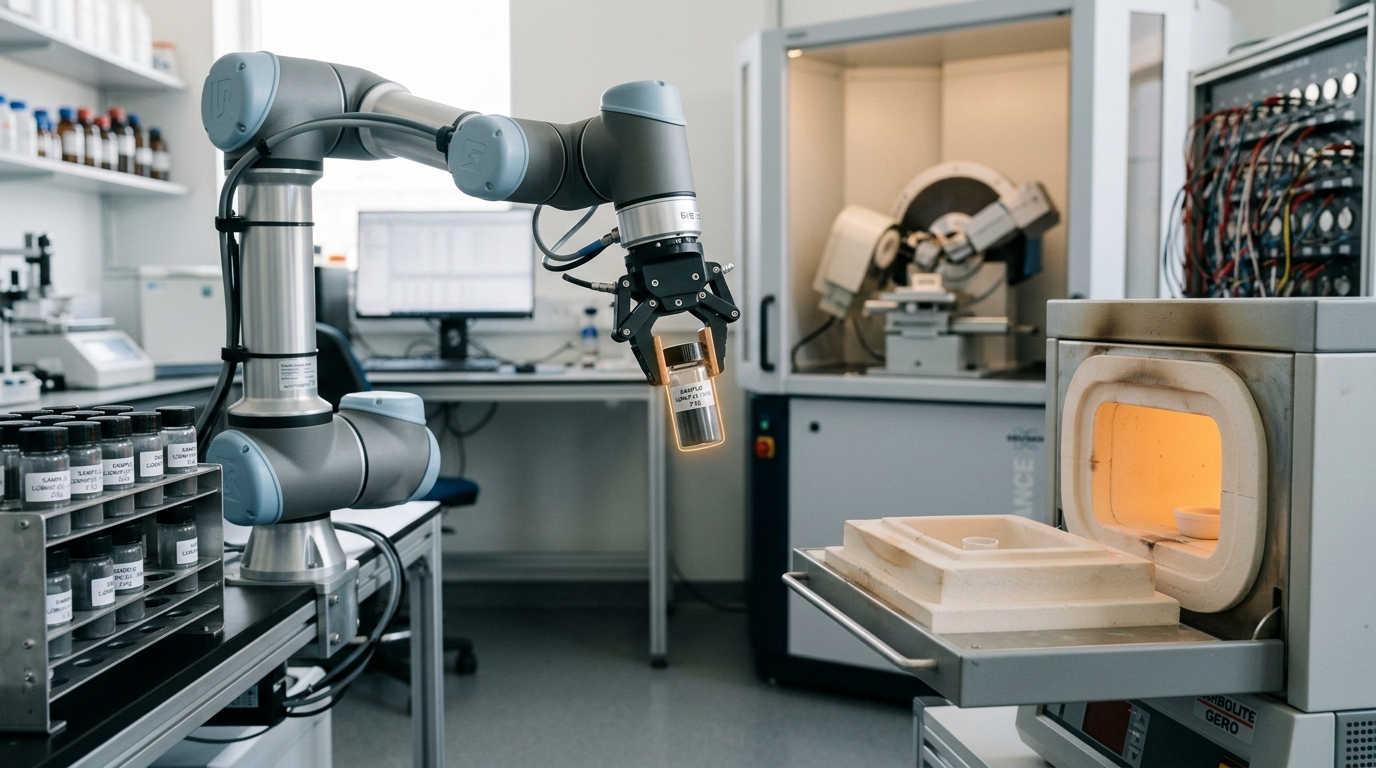
An autonomous lab closes the loop between a computed candidate, a synthesis attempt, and a measurement that tells the system whether the attempt worked. — Image prompt and art direction by Brecht Corbeel; generation pending.
Abstract
An autonomous materials laboratory is not a robot that "does chemistry faster" — it is a closed loop of computed candidates, robotic synthesis, automated characterization, and an active-learning policy that decides the next recipe. This briefing walks that loop mechanistically using the A-Lab platform, unpacks what a structure-property relationship concretely commits a model to, and traces how lithium-ion battery capacity actually erodes through solid-electrolyte-interphase growth and lithium plating. Fact, vendor-style claim, analysis, and prediction are kept separate throughout.
Three machines, one loop
An “autonomous laboratory” is not a single robot; it is a loop wired between components that already existed separately — a computed candidate list, a robotic synthesis rig, an automated characterization instrument, and a decision policy — closed so each output feeds the next without a human in the middle. The clearest published example is A-Lab, a Berkeley/Lawrence Berkeley National Laboratory system that ran seventeen days and attempted solid-state synthesis of 58 computationally predicted inorganic compounds, successfully producing 41 of them with a robotic arm handling powder dosing, mixing, and furnace loading, guided by recipes drawn from text-mined literature and refined between attempts [1].
Fact. The A-Lab loop runs synthesize–characterize–decide: a robotic arm doses and mixes precursor powders into a crucible and loads it into a furnace on a fixed schedule; when the reaction finishes, the product is carried to a powder X-ray diffractometer and its diffraction pattern is compared against the pattern the target structure should produce; an active-learning routine reads the match (or mismatch) and either accepts the product or proposes a modified recipe — a different precursor set, ratio, or temperature — for the next attempt [1]. Nothing about this loop performs chemistry a human couldn’t; it runs the same synthesize-and-check cycle a bench chemist runs, at a pace and volume no bench chemist sustains, with every failed attempt logged in a form the decision policy can use on the next iteration.
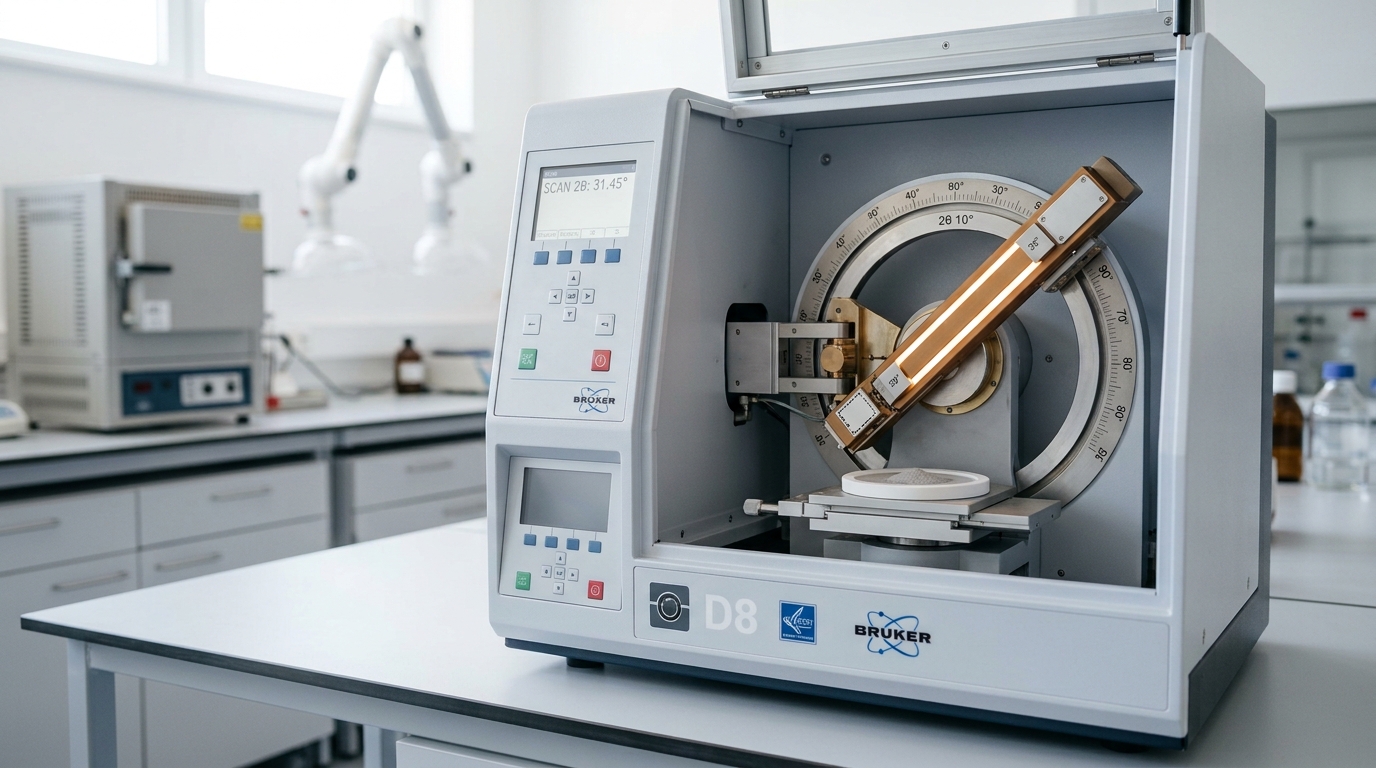
Figure 1. A structure-property relationship is only as good as the structure it is fit to; diffraction is how a lab confirms what actually formed rather than what was intended. — Image prompt and art direction by Brecht Corbeel; generation pending.
Vendor-style overclaim to flag explicitly. Coverage of autonomous labs frequently compresses “41 of 58 target compounds synthesized” into “AI discovers new materials,” which elides two things the paper is explicit about: the 58 targets were themselves computed candidates from an existing database, not novel hypotheses the system originated, and a meaningful fraction of attempts still failed even with active learning correcting between runs [1]. The system accelerates a known synthesis-search problem; it does not remove the uncertainty over whether a predicted compound is kinetically reachable by a given route.
Analysis. The bottleneck is not compute, it’s characterization throughput and interpretation. Diffraction confirms crystal structure but not always phase purity or a target property; a system optimizing against “matches the target diffraction pattern” can converge on the right structure while staying silent on the property the material was wanted for. That gap — structure confirmed, property unmeasured — is where the next section’s problem sits.
What a structure-property relationship actually commits you to
“Structure-property relationship” sounds like a single continuous law connecting atomic arrangement to a bulk property, but as a claim it is a fit — a model trained on structures paired with measured or computed properties, whose scope is exactly the region of that dataset. A 2023 study formalized this by pairing an interpretable deep-learning architecture (attention layers over crystal-graph representations) with property regression across computed-materials databases, to identify which structural motifs the model weights when predicting a property rather than treating it as a black box [5].
Fact. The approach recovers attention weights over local atomic environments — coordination number, bond length distortion, symmetry breaking — and checks them against known descriptors for properties like thermoelectric performance, testing whether the model’s reasoning matches established chemistry rather than reporting only an accuracy number [5].
A structure-property model asserts a functional dependence
P = f(\mathbf{s}; \theta)
where P is the target property, \mathbf{s} is a structural descriptor vector (lattice parameters, coordination, bonding topology), and \theta are parameters fit to a training set \{(\mathbf{s}_i, P_i)\}. The equation is trivial; the content is entirely in what \mathbf{s} includes and what range of \mathbf{s}_i the training set spans. A model fit only on cubic perovskites extrapolates poorly to a layered structure even if the underlying physics is continuous, because f was never asked to fit that region.
Analysis. “Structure-property relationship” is best read as a scoped, falsifiable model rather than a law. A materials-design claim built on one is only as strong as the diversity of structures in the training set and whether the property was measured under conditions matching the intended application. Extending a fit outside its training distribution — a routine temptation in screening papers — is a scenario, not a finding, unless flagged as such.
How a battery cell actually loses capacity
Two distinct mechanisms account for most of the capacity a graphite-anode lithium-ion cell loses in normal use, frequently conflated despite operating on different timescales and physics.
Mechanism one: SEI growth. The first time a graphite anode is charged, electrolyte decomposes at its surface because the electrolyte is not thermodynamically stable at the anode’s low potential; the decomposition products form a solid electrolyte interphase (SEI) — a passivating film thin enough to let lithium ions through but thick enough to block direct electron transfer to the electrolyte. This film is necessary: without it, the electrolyte would keep decomposing indefinitely. The problem is that the SEI is not perfectly static. A modeling review of anode SEI formation describes continued “bottom-up” growth at the SEI–electrolyte interface over the cell’s life, consuming cyclable lithium and electrolyte with each addition, and notes the detailed mechanism remains incompletely resolved because in situ measurement of a few-nanometre buried film is difficult [2].
Diffusion-limited SEI thickening is commonly modeled with a square-root-of-time growth law,
\delta(t) \approx \delta_0 + k\sqrt{t}
where \delta(t) is film thickness, \delta_0 an initial thickness, and k a rate constant set by species diffusivity through the existing film — a direct consequence of assuming the rate-limiting step is diffusion across a film whose own thickness is the barrier [2]. This is a model, not a universal law: the review is explicit that mixed kinetic-and-transport regimes, porous or cracked SEI, and side reactions all produce departures from a clean square-root trend, and reconciling model and experiment remains an open problem [2].

Figure 2. Capacity loss in a lithium-ion cell is not one event but an accumulating film and, under the wrong charging conditions, a deposit of metallic lithium on the anode. — Image prompt and art direction by Brecht Corbeel; generation pending.
Mechanism two: lithium plating. A distinct, faster-acting failure mode triggered specifically by fast or cold charging. Charging drives lithium ions toward the anode faster than they can diffuse through the electrolyte or intercalate into graphite; if the local anode potential is driven below 0 V versus Li/Li⁺, ions are thermodynamically favored to deposit as metallic lithium on the graphite surface rather than intercalate — “plating” instead of charging normally [4]. Plated lithium is worse than SEI growth in three ways: it is largely irreversible (some becomes electrically isolated “dead lithium”), it can grow as dendritic deposits risking a pierced separator, and it reacts with electrolyte to build more SEI on top of itself, compounding the first mechanism [3]. A 2022 paper demonstrated onboard detection of plating onset using differential pressure sensing — tracking cell pressure change per unit charge as a real-time signal, since plating has a measurably different pressure signature than normal intercalation — letting a charge controller back off before plating accumulates, rather than only detecting it after the fact from capacity loss [3].
Analysis. The distinction matters for anyone reading a degradation claim: “capacity fade” as reported by a cycler conflates a slow, largely unavoidable background process (SEI growth, present from cycle one) with an avoidable, condition-triggered one (plating, which a conservative charge rate and temperature range can suppress almost entirely). A fast-charging claim reporting only cycle-life numbers without charge rate and temperature is not verifiable against these two mechanisms separately.
Scenario and prediction
Scenario, not fact. If closed-loop synthesis platforms pair more tightly with in-line electrochemical characterization — not just diffraction, but cycling data within the same loop — a lab could screen for both “does this structure form” and “does it retain capacity” in one campaign, rather than handing candidates to a separate testing group. No published system closes that loop end to end; this is a plausible next architecture, not a demonstrated one.
Prediction. Over the next three to five years, expect more materials papers reporting active-learning-guided synthesis loops for battery candidates specifically, observable via more papers citing onboard degradation-detection methods like differential-pressure sensing as a characterization step rather than only a post-hoc diagnostic. This would be disconfirmed if, by 2030, the dominant characterization step paired with such loops remains ex situ structural analysis alone, with cycling still a separate, non-integrated step.
What this rules out
Neither mechanism here supports claiming a single “materials AI” replaces domain synthesis knowledge, or that degradation is fixable by charge-rate policy alone. SEI growth happens regardless of charge rate; only plating is rate- and temperature-sensitive. A structure-property model is trustworthy only inside the range it was trained on. An autonomous lab’s success rate describes synthesis of pre-selected candidates, not open-ended discovery. Each is a falsifiable claim grounded in the cited studies — not a general endorsement of “AI for materials.”
Sources
- Nathan J. Szymanski, Bernardus Rendy, Yuxing Fei, Rishi E. Kumar, Tanjin He, David Milsted, Matthew J. McDermott, Max Gallant, Ekin Dogus Cubuk, Amil Merchant, Haegyeom Kim, Anubhav Jain, Christopher J. Bartel, Kristin Persson, Yan Zeng, and Gerbrand Ceder. An autonomous laboratory for the accelerated synthesis of inorganic materials. Nature (2023). DOI: 10.1038/s41586-023-06734-w.
- Aiping Wang, Sanket Kadam, Hong Li, Siqi Shi, and Yue Qi. Review on modeling of the anode solid electrolyte interphase (SEI) for lithium-ion batteries. npj Computational Materials (2018). DOI: 10.1038/s41524-018-0064-0.
- Wenxiao Huang, Yusheng Ye, Hao Chen, Rafael A. Vilá, Andrew Xiang, Hongxia Wang, Fang Liu, Zhiao Yu, Jinwei Xu, Zewen Zhang, Rong Xu, Yecun Wu, Lien-Yang Chou, Hansen Wang, Junwei Xu, David Tomas Boyle, Yuzhang Li, and Yi Cui. Onboard early detection and mitigation of lithium plating in fast-charging batteries. Nature Communications (2022). DOI: 10.1038/s41467-022-33486-4.
- Weiyu Li and co-authors. Onset of Lithium Plating in Fast-Charging Li-Ion Batteries. ACS Energy Letters (2025). DOI: 10.1021/acsenergylett.5c00322.
- Tien-Sinh Vu, Minh-Quyet Ha, Duc-Nhat Nguyen, Viet-Cuong Nguyen, Yoshinao Abe, Truyen Tran, and co-authors. Towards understanding structure-property relations in materials with interpretable deep learning. npj Computational Materials (2023). DOI: 10.1038/s41524-023-01163-9.
Originally published at https://absolutedigitalpublishers.com/articles/how-materials-discovery-and-degradation-actually-works.