How Chemical Dynamics and Catalysis Actually Work
A catalyst does not change a reaction's thermodynamics; it opens a different path through it, and operando spectroscopy is how chemists now watch that path being taken in real time.
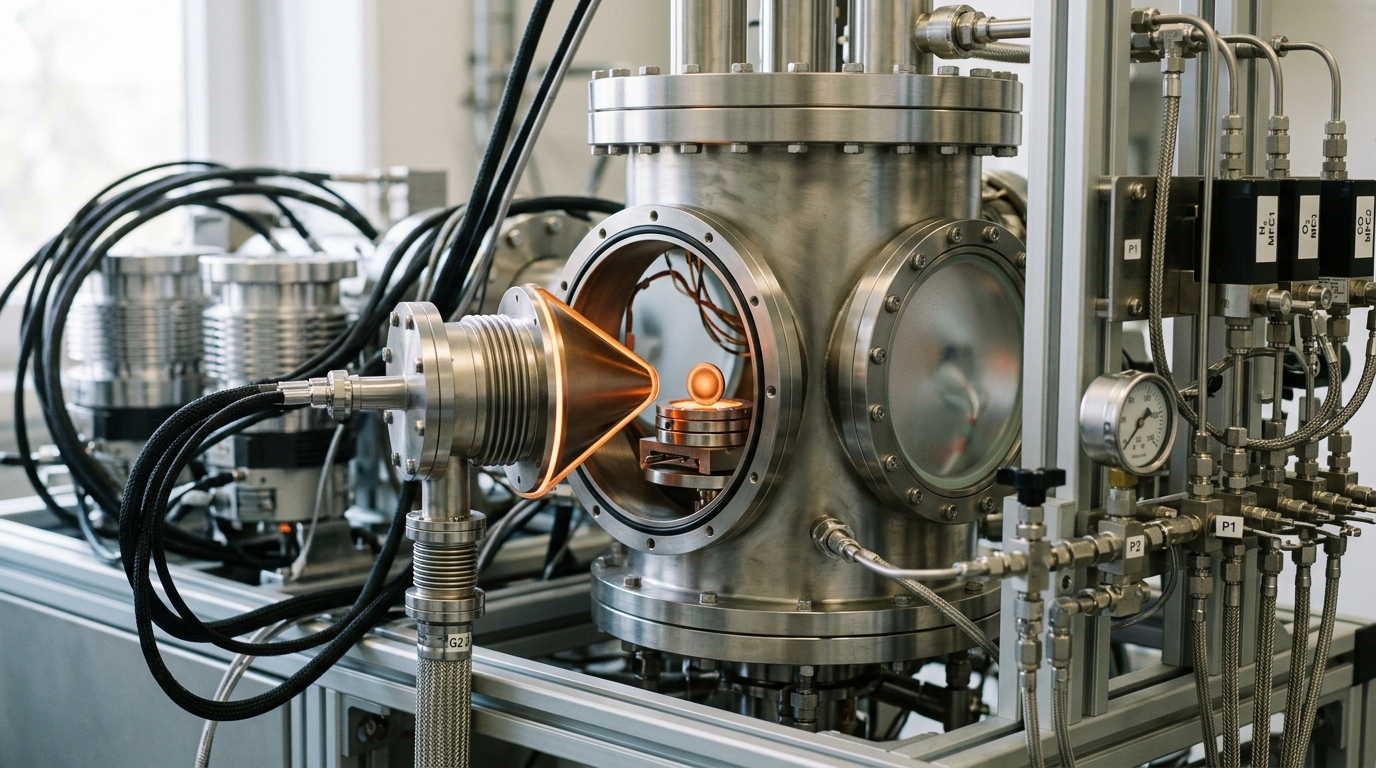
A near-ambient-pressure XPS chamber lets the analyzer watch a catalyst surface while it is actually exposed to reactive gas, not after it has been pumped down and cooled. — Image prompt and art direction by Brecht Corbeel; generation pending.
Abstract
Catalysis is often described loosely as "speeding up a reaction," which hides the actual mechanics: a surface offers reactants a lower-energy sequence of bond-breaking and bond-making steps, and which of several possible products dominates is a kinetic competition, not a thermodynamic one. This briefing walks through the Sabatier principle and d-band model of metal catalysis, the precise meaning of selectivity, how operando X-ray spectroscopy observes a working catalyst under real gas or electrolyte exposure, and why gas-diffusion electrode geometry currently caps industrial electrocatalytic scale-up.
“Speeds up the reaction” is the sentence every catalysis explainer reaches for, and it is the sentence that hides everything interesting. A catalyst does not touch the thermodynamics of a reaction — the free-energy difference between reactants and products is fixed by the molecules themselves, catalyst or not. What a catalyst actually does is offer a different sequence of elementary steps, usually across a surface, whose highest point sits lower than the uncatalyzed path’s. That is the entire mechanism, and almost every practical question in industrial chemistry — which metal, which support, which temperature, which product — is a question about how to shape that alternative path.
Binding has to be just right, not strong
On a metal surface, catalysis works by breaking a reactant’s bonds through chemisorption, holding the resulting fragments long enough for a new bond to form between them, then releasing the product. Each of those three steps needs a different binding strength: too weak and the reactant never adsorbs in the first place; too strong and the product sticks to the surface instead of leaving, and the exposed metal atoms simply become the fastest, most efficient means of building their own permanent monolayer of product. This is the Sabatier principle, and it turns catalyst screening into an optimization problem rather than a search for “the strongest catalyst.” Nørskov and coauthors formalized it using the d-band model, which relates a transition metal’s catalytic behavior to the energy of its d-electron band relative to the Fermi level — shift that band down and adsorbates bind more weakly; shift it up and they bind more strongly [1]. Plotting catalytic activity against a single descriptor like this binding energy produces the characteristic “volcano” curve: activity rises with binding strength up to a peak, then falls as the surface fouls itself with product. The peak metal for a given reaction is a compromise, not a maximum.
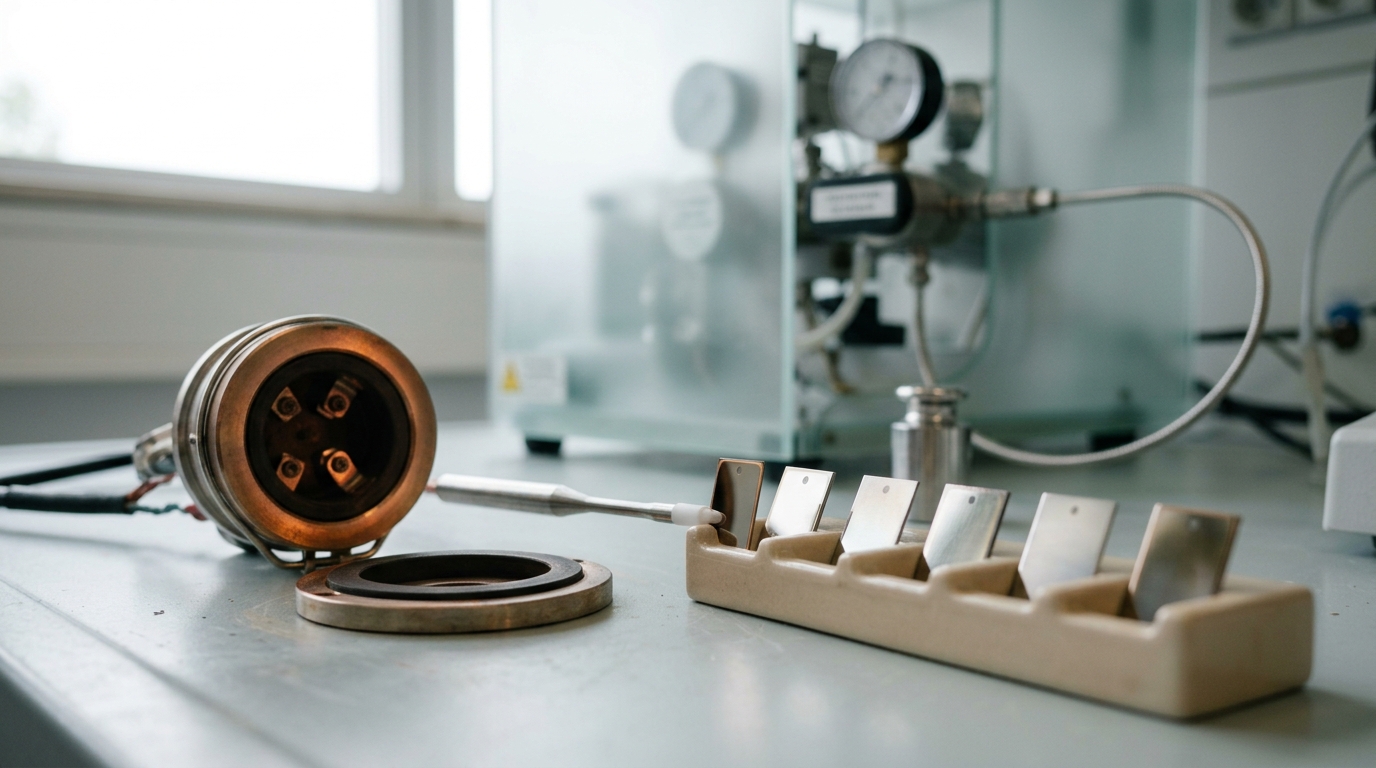
Figure 1. Different metals bind reaction intermediates with different strength; a coupon rig like this is how binding-energy trends get measured coupon by coupon. — Image prompt and art direction by Brecht Corbeel; generation pending.
A useful way to see why the peak exists at all is the Arrhenius picture underneath it. The observed rate constant is
k = A\, e^{-E_a/RT}
and a catalyst’s whole job is to substitute a smaller E_a — the barrier of the new surface-mediated path — for the barrier of the uncatalyzed reaction, without introducing a rate-limiting binding or release step that reintroduces a large barrier somewhere else in the cycle.
Selectivity is a race, not a preference
When a reaction can plausibly form more than one product — partial versus complete oxidation, a straight-chain versus branched hydrocarbon, hydrogen versus oxygen evolution as a side reaction — “selectivity” names which pathway wins, and IUPAC defines it with no vocabulary that presumes anything about the catalyst’s intent: fractional selectivity for a given product is the extent-of-reaction rate toward that product divided by the sum of rates toward all products, S_F = \xi_i / \sum_j \xi_j, and relative selectivity between two products is simply the ratio of their two rates [2]. Selectivity is therefore a kinetic competition among simultaneous pathways, decided by which transition state a given surface site makes cheapest, not a property the catalyst “prefers.” Engineering selectivity means engineering which of several transition states sits lowest — through the identity of the metal, the geometry of exposed facets, a promoter atom that blocks one adsorption geometry, or a support that stabilizes one intermediate over another. A catalyst can be highly active and still commercially useless if it is not selective for the wanted product over faster side reactions.
Watching the surface do it, not the leftovers afterward
For decades, catalyst characterization mostly happened before or after the reaction — a used catalyst pulled from a reactor, cooled, and examined under vacuum, telling chemists what the surface looked like once the reaction had already stopped. Operando spectroscopy instead measures the catalyst while the reaction is running, under real gas pressure, at real temperature, sometimes with real electrolyte and applied potential. Near-ambient-pressure X-ray photoelectron spectroscopy (NAP-XPS) is the workhorse technique: a differentially pumped aperture lets the analyzer look at a sample sitting in several torr of reactive gas instead of ultrahigh vacuum, so oxidation states, adsorbed intermediates, and surface reconstructions can be read off directly instead of inferred from a post-mortem sample. For electrocatalytic reactions specifically — hydrogen and oxygen evolution chief among them — operando X-ray spectroscopy has been used to track how a catalyst’s oxidation state and local coordination shift the moment current starts flowing, distinguishing the catalytically active surface phase from the as-synthesized one, which are frequently not the same material [3]. That distinction is the whole point of the method: a catalyst characterized only before use is, in a meaningful sense, being characterized as the wrong material.
Where the chemistry meets an engineering wall
Electrocatalysis built on gas-diffusion electrodes — thin porous layers that let a gas like CO2 reach a catalyst held against a liquid electrolyte — routinely demonstrates excellent selectivity and current density at laboratory scale, on electrodes a few square centimeters in area. Scaling that same electrode up hits a specific, measured mechanical constraint rather than a chemical one: gas-diffusion electrodes operate inside a narrow pressure-balance window between the gas and liquid sides of the membrane, and Baumgartner and coauthors showed that this window sets a practical ceiling on how tall a flow-by electrolyzer’s electrode can be before flooding or drying failure appears, independent of the catalyst’s intrinsic activity [4]. That is a fact, not an inference: a specific engineering bottleneck, measured directly, that determines how large a working electrolyzer stack can actually be built today.
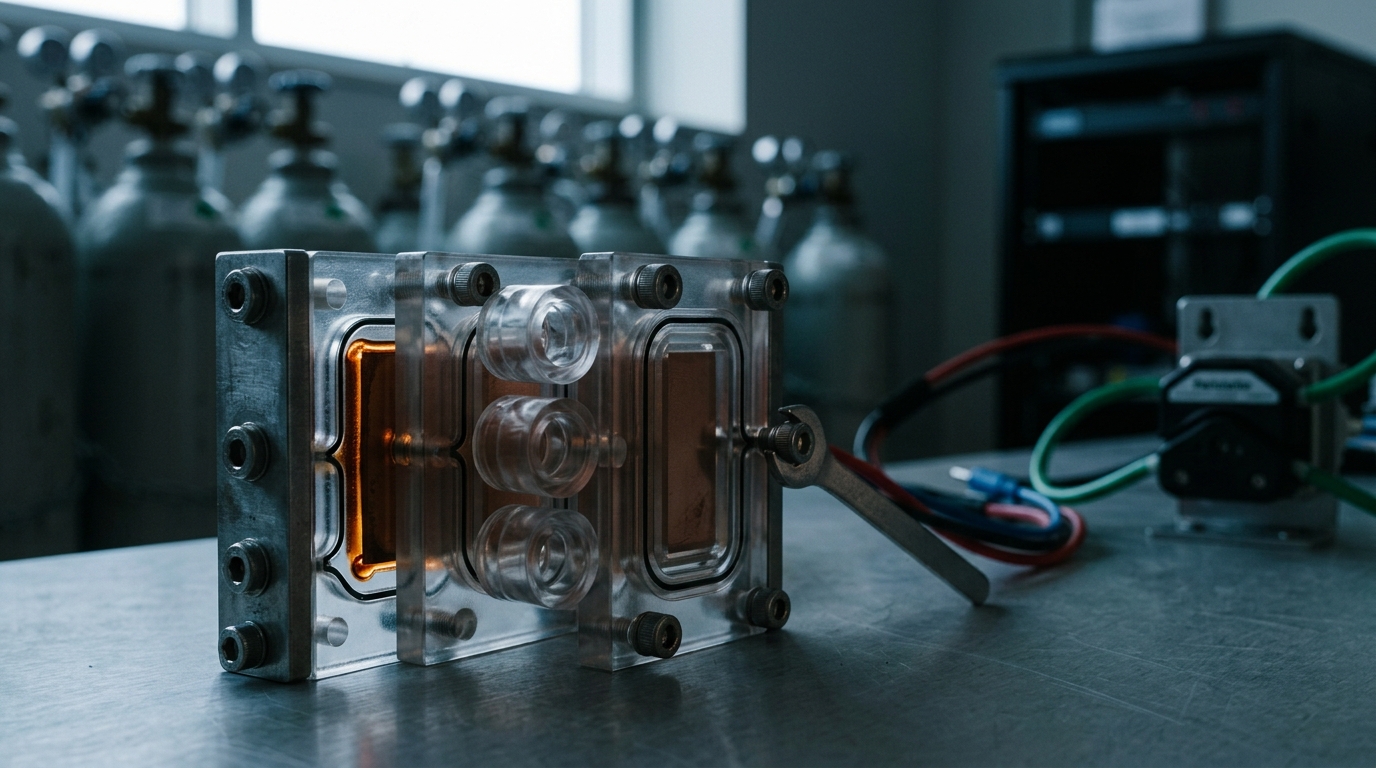
Figure 2. A gas-diffusion electrode flow cell run at high current density is where electrocatalysis selectivity meets an unglamorous engineering limit: pressure balance across a wet membrane. — Image prompt and art direction by Brecht Corbeel; generation pending.
It is worth separating the categories explicitly here, in the spirit this publication insists on. It is fact that binding-energy trends and volcano curves are measured and reproducible descriptors of catalytic activity [1]. It would be vendor-style overclaim to say any single catalyst “solves” a target reaction — Sabatier-optimal binding is reaction- and product-specific, and a catalyst tuned for one selectivity target is usually mistuned for another. It is analysis, not established fact, to say that gas-diffusion electrode geometry is currently a harder constraint on electrocatalytic scale-up than catalyst discovery is — that judgment follows from the measured pressure window but extrapolates it into a comparative claim the source itself does not make. A reasonable scenario, not a claim already demonstrated, is that thinner, mechanically reinforced gas-diffusion electrodes could widen that pressure window enough to permit taller industrial stacks within the next decade; the observable indicator would be published electrode designs exceeding today’s height ceiling at unchanged current density, and the condition that would disconfirm it is scale-up instead moving toward many small parallel cells rather than taller single ones, which would mean the mechanical constraint was routed around rather than solved.
Operando measurement is the connective tissue across all of this: it is the reason catalyst design has moved from trial-and-error metal screening toward reading, directly, which surface phase is doing the chemistry right now — and increasingly, in electrocatalysis, whether the phase doing the chemistry survives long enough at scale to matter.
Sources
- A. J. Medford, A. Vojvodic, J. S. Hummelshøj, J. Voss, F. Abild-Pedersen, F. Studt, T. Bligaard, A. Nilsson, J. K. Nørskov. From the Sabatier principle to a predictive theory of transition-metal heterogeneous catalysis. Journal of Catalysis (2015). DOI: 10.1016/j.jcat.2014.12.033.
- IUPAC. Selectivity, S (in catalysis) — IUPAC Compendium of Chemical Terminology. IUPAC Gold Book (2014). DOI: 10.1351/goldbook.S05563.
- Varsha M V, Gomathi Nageswaran. Operando X-Ray Spectroscopic Techniques: A Focus on Hydrogen and Oxygen Evolution Reactions. Frontiers in Chemistry (2020). DOI: 10.3389/fchem.2020.00023.
- Lorenz M. Baumgartner, Christel I. Koopman, Antoni Forner-Cuenca, David A. Vermaas. Narrow Pressure Stability Window of Gas Diffusion Electrodes Limits the Scale-Up of CO2 Electrolyzers. ACS Sustainable Chemistry & Engineering (2022). DOI: 10.1021/acssuschemeng.2c00160.
Originally published at https://absolutedigitalpublishers.com/articles/how-chemical-dynamics-and-catalysis-actually-works.