Hominin Evolution and Deep Prehistory in Practice: An Advanced Technical Guide
Inside the clean rooms, dating rigs, and phylogenetic workstations where a fossil becomes a data point: how ancient DNA is pulled from a petrous bone, how a site gets a cross-validated age, and how species trees get built.

Ancient-DNA extraction begins inside positive-pressure isolation, long before any sequencer is involved, because the DNA that matters is usually outnumbered a thousand to one by everything else in the bone. — Image prompt and art direction by Brecht Corbeel; generation pending.
Abstract
Paleoanthropology's public story is a family tree; its working reality is a set of laboratory and field protocols that make any given branch defensible. This guide follows three of those protocols end to end: pulling authenticated ancient DNA out of a fossil under contamination control, dating a hominin site with several independent physical clocks that must agree before anyone trusts the number, and building a species-level phylogeny from morphological and genetic evidence that were never meant to be combined in the same matrix. Each method is grounded in a specific published protocol or case study, with fact, vendor claim, analysis, scenario, and prediction kept explicitly separate throughout.
Paleoanthropology’s public face is a chart: a branching tree of skulls, with Homo sapiens at the top and a scatter of extinct cousins feeding into it from below. The working reality behind any single branch on that chart is a stack of laboratory and field protocols, each with its own failure modes, each independently checkable. This guide walks through three of them in the order a working paleoanthropologist actually encounters them: pulling authenticated DNA out of a fossil, dating the sediment that fossil came from by more than one physical method, and building the tree itself from evidence that was never designed to sit in one matrix.
1. Extracting and sequencing ancient DNA without fooling yourself
The core problem: you are outnumbered
A 40,000-year-old bone buried in ordinary soil is saturated with modern DNA — from bacteria, fungi, and the archaeologists, curators, and museum visitors who have handled it for over a century. The endogenous ancient molecules of interest are typically a small minority of the DNA present, and they are also chemically damaged: fragmented to lengths often well under 100 base pairs, with a characteristic pattern of cytosine deamination concentrated at fragment ends. Any protocol has to solve two problems at once — enrich for the real signal, and prove afterward that what came out the far end of the sequencer is not contamination.
Sample selection. The single highest-leverage decision happens before any wet lab work: which bone, and which part of it. The petrous portion of the temporal bone — the dense pyramid of bone that houses the inner ear — has repeatedly been shown to preserve DNA far better than other skeletal elements, because its exceptional density restricts the microbial and fluid access that drives post-mortem degradation. Sampling protocols developed around this observation, and the ultra-short-fragment recovery methods built on it, are described in the reconstruction of a complete Middle Pleistocene cave-bear mitochondrial genome from degraded material using a modified silica-based extraction that specifically favors retention of very short DNA fragments — the same length range where most surviving Pleistocene hominin DNA is found [5].
Contamination control starts with the room, not the reagent. Ancient-DNA work is done in physically isolated, positive-pressure clean-room facilities, separate from any facility that has ever processed modern human DNA or PCR products, with UV-sterilized surfaces, full-body coveralls, and dedicated equipment. This is not a formality: modern contaminating sequences are generally longer, less fragmented, and lack the ancient-specific deamination signature, and it is that signature — not the clean room alone — that lets a genuine ancient molecule be distinguished analytically from a contaminating one after the fact.
Library preparation: turning damage into a diagnostic
Because the ancient signature (cytosine deamination near fragment ends, read as C-to-T substitutions relative to a reference) is diagnostic rather than purely a nuisance, some library preparation methods deliberately treat it as data. The most widely used chemical control is treatment with a combination of enzymes — uracil-DNA glycosylase and endonuclease VIII — that excise the majority of deaminated cytosines before sequencing. This does two things simultaneously: it removes most of the artificial substitutions that would otherwise be mistaken for genuine ancient population-genetic signal, and it concentrates the remaining, diagnostic damage at the very ends of molecules, which paradoxically makes authenticity easier to verify statistically after sequencing, because the residual damage pattern still has the expected shape even though its overall rate has dropped [4]. Reporting a damage-rate curve by position along the read is now close to a minimum bar for defending a set of reads as ancient rather than modern contamination.
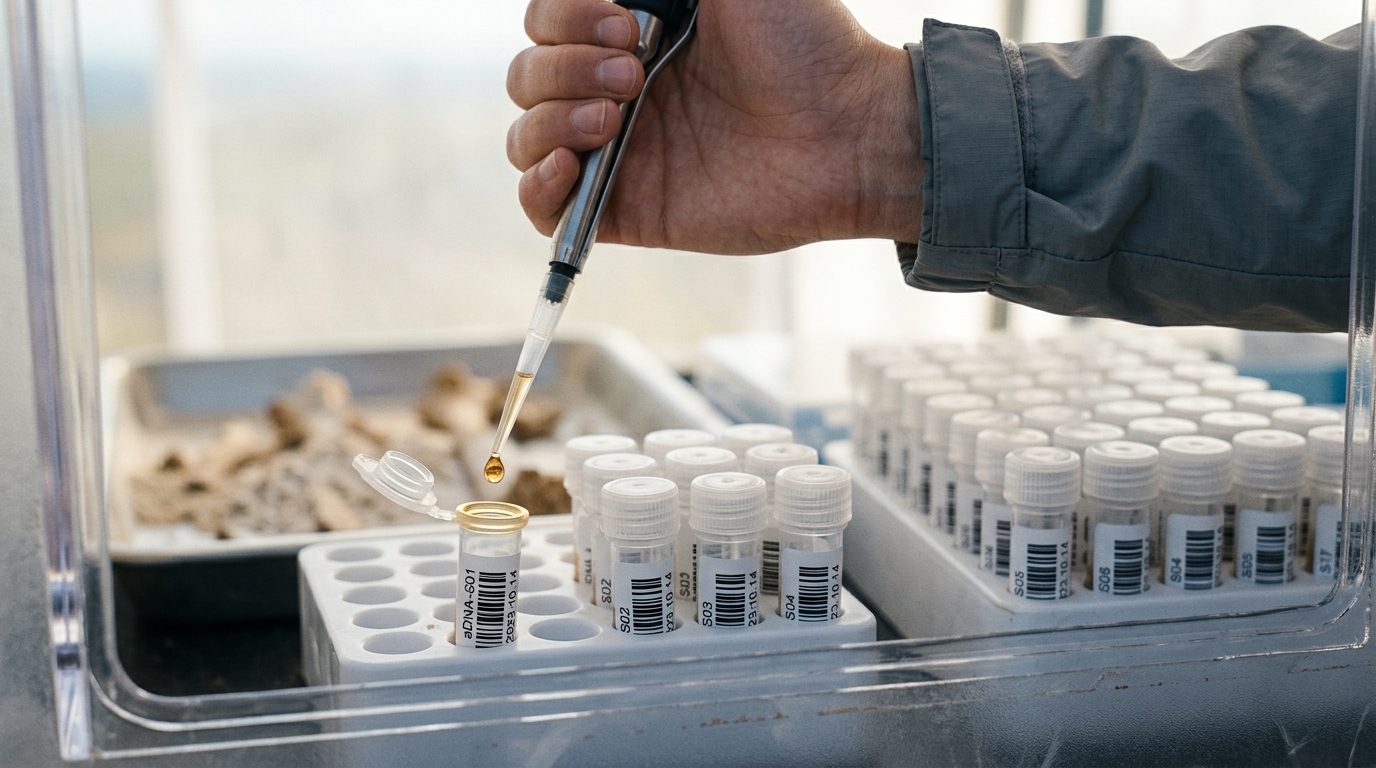
Figure 1. Before sequencing, damaged ancient DNA molecules are chemically repaired and turned into indexed libraries — the step that decides whether a genome or a smear of noise comes out the other end. — Image prompt and art direction by Brecht Corbeel; image generated to that direction.
Single-stranded library preparation, developed to recover molecules so short and so damaged that standard double-stranded methods lose them entirely, was central to reconstructing genomes from some of the most degraded specimens in the record, including the cave-bear mitochondrial genome noted above and, later, exceptionally short-fragment hominin remains [5].
Sequencing and computational authentication
Once libraries are built, sequencing itself (short-read platforms generating tens to hundreds of millions of reads per library) is comparatively routine molecular biology. The harder work is downstream: reads are aligned to a reference genome, and only reads meeting minimum mapping-quality thresholds are retained. Analysts then compute, per sample, the fraction of reads showing terminal C-to-T substitution, the fragment length distribution, and — for mitochondrial or Y-chromosome data — a contamination estimate based on the proportion of reads inconsistent with a single haploid source. A sample that fails these checks is not sequenced further regardless of how promising the morphology of its source bone looked in the field.

Figure 2. A flow cell loaded onto a benchtop sequencer converts millions of short, chemically damaged DNA fragments into raw base calls that must then be filtered for authenticity before anyone calls them ancient. — Image prompt and art direction by Brecht Corbeel; generation pending.
This combination of clean-room protocol, damage-informed library chemistry, and post-hoc statistical authentication is what allowed the first published draft Neanderthal nuclear genome to be defended as genuinely ancient rather than a mix of modern human contamination — the project explicitly reported mitochondrial contamination estimates alongside the nuclear sequence for this reason [1]. The same combination of methods later authenticated an entirely unanticipated result: DNA extracted from a small fragment of finger bone at Denisova Cave did not match either Neanderthal or modern human reference sequences well enough to be either, and instead defined what is now called the Denisovan lineage, initially from mitochondrial DNA and then from a high-coverage nuclear genome generated using the single-stranded library method [2, 3]. A further Denisova Cave individual, sequenced using the same clean-room and authentication pipeline, turned out to be the direct offspring of a Neanderthal mother and a Denisovan father — a first-generation hybrid identified purely from the pattern of allele sharing in a single genome, with no morphological evidence available at all [9]. None of these findings would survive scrutiny without the authentication pipeline described above; a review of the field’s first decade catalogs how central these authentication standards became to every subsequent ancient hominin genome project [10].
What this method cannot tell you. Ancient DNA degrades faster in warm, humid, or acidic burial environments, and most tropical and many Middle Pleistocene contexts have so far yielded no usable DNA at all. The absence of DNA from a fossil is not evidence about its population relationships — it is usually a statement about local diagenesis, not biology.
2. Dating a hominin site: why one method is never enough
The core problem: every clock has a blind spot
No single dating method is trusted alone for a claim that will reshape the hominin timeline, because every physical clock has a specific failure mode. Radiocarbon dating saturates beyond roughly 50,000 years and is vulnerable to contamination by younger carbon. Uranium-series dating of speleothems or tooth enamel depends on assumptions about uranium uptake history that do not always hold. Optically stimulated luminescence (OSL) and thermoluminescence (TL) measure time since mineral grains were last exposed to sunlight or heat, but require accurate reconstruction of the radiation dose rate in the burial environment. Practicing site geochronologists therefore treat convergence across independent methods, not any single date, as the actual evidence.
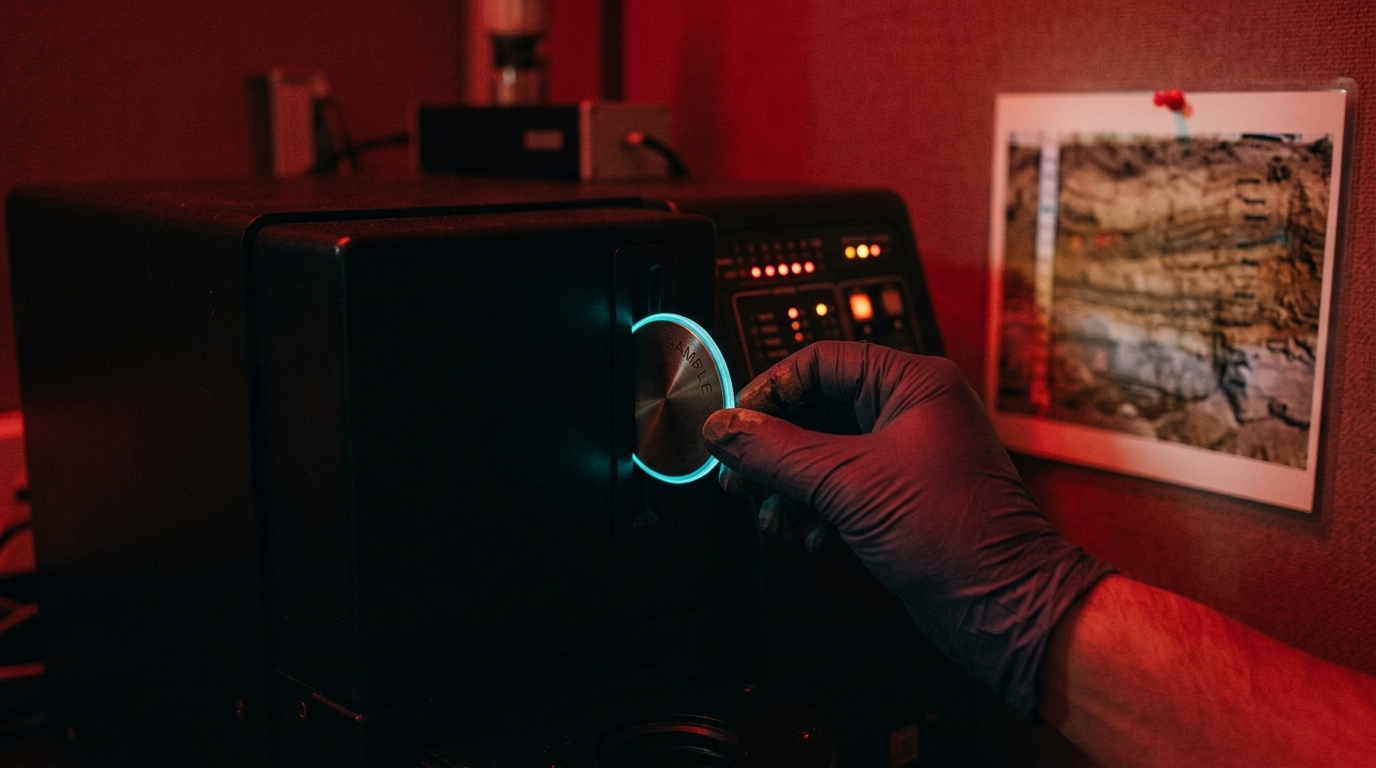
Figure 3. Optically stimulated luminescence measures time since a sediment grain last saw sunlight — a completely different physical clock from radiocarbon or uranium-series, which is exactly why sites use several at once. — Image prompt and art direction by Brecht Corbeel; generation pending.
A worked case: re-dating Jebel Irhoud
The clearest published illustration of this practice is the 2017 re-dating of the Jebel Irhoud hominin site in Morocco. The fossils there had long been assigned a Middle Pleistocene age of roughly 160,000 years based on comparatively coarse earlier work, but a systematic recent re-analysis combined thermoluminescence dating of heated flint artifacts found in direct association with the hominin remains with electron spin resonance (ESR) dating applied directly to one of the hominin teeth. The two methods use entirely different physical mechanisms — TL measures trapped electron charge accumulated in a crystal lattice since the flint was last heated in a hearth, while ESR measures trapped charge accumulated in tooth enamel since burial, calibrated against reconstructed uranium-uptake history in the tooth itself. Because the two methods share essentially no common source of systematic error, their agreement is informative in a way that repeating either method alone would not be. The combined analysis pushed the accepted age of the Jebel Irhoud material back to approximately 300,000 years, making it, at the time of publication, among the oldest securely dated fossils attributed to Homo sapiens and substantially revising the geographic and temporal picture of the species’ early history [6]. This is a fact about a well-documented, published cross-validation exercise; it is not a claim that every subsequent re-analysis will move a date this far, and later fossils could still push the picture again.
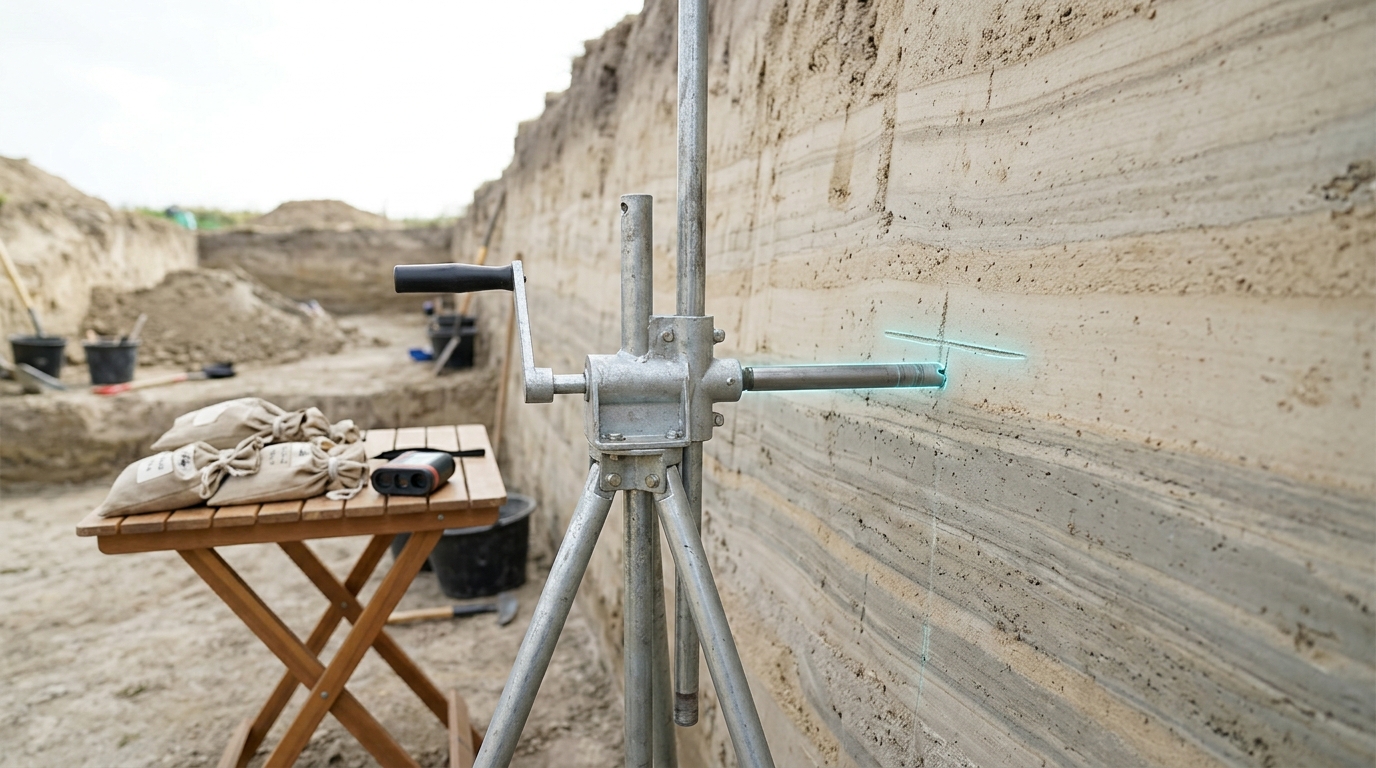
Figure 4. Independent dates only cross-validate a site if they attach to the same layers the fossils came from, which is why field sampling for uranium-series and cosmogenic methods happens meters from the dig, not back in a lab. — Image prompt and art direction by Brecht Corbeel; generation pending.
A second worked case: dating a cave with no organic material to date directly
Rising Star Cave in South Africa, which yielded the Homo naledi remains, presented a different problem: no material suitable for U-series or radiocarbon dating was directly associated with most of the fossils, and the sedimentary context was structurally complex. The dating team applied a combination of paleomagnetic analysis of the sediment (to establish whether deposition occurred during a normal or reversed geomagnetic polarity chron), uranium-thorium dating of flowstone layers that could be shown stratigraphically to postdate the fossil-bearing sediments, and OSL dating of the sediments themselves, cross-checked against the paleomagnetic constraint. Each method alone left a wide or ambiguous age range; combined, they converged on a surprisingly young age of roughly 236,000 to 335,000 years for material with a markedly primitive, small-brained morphology — overturning an initial assumption, based on morphology alone, that the species must be far older [7]. This case is the sharpest illustration available of why morphological “primitiveness” and geological age are separate lines of evidence that must each be independently measured: had the excavators simply assumed an old age matching the primitive anatomy, they would have been wrong by over a million years in one direction, and had they assumed a young age matched only modern human association, they would likely have been wrong in the other.
Analysis, not fact: the broader implication paleoanthropologists draw from these two cases — that morphology is a weak, potentially misleading proxy for absolute age in the hominin record — is an interpretive conclusion built on top of the dating results, not a direct measurement itself, and it remains contested in cases where independent dating is not available.
3. Building the tree: combining bones and genomes in one phylogeny
The core problem: two evidence types, two different mathematics
Morphological phylogenetics scores discrete anatomical character states (a particular tooth cusp pattern present or absent, a particular cranial suture configuration) across specimens and infers a tree that requires the fewest independent character changes, or the tree with the highest likelihood under an explicit model of character change. Molecular phylogenetics compares actual base-by-base genetic sequence differences between populations under an explicit model of mutation and genetic drift. These are not the same kind of evidence, they do not decay or accumulate at comparable rates, and for the overwhelming majority of the hominin fossil record no DNA exists at all — so any single method, used alone, is blind to either most of the tree’s structure (genetics-only, limited to the small fraction of fossils with recoverable DNA) or to absolute time and precise relatedness (morphology-only).
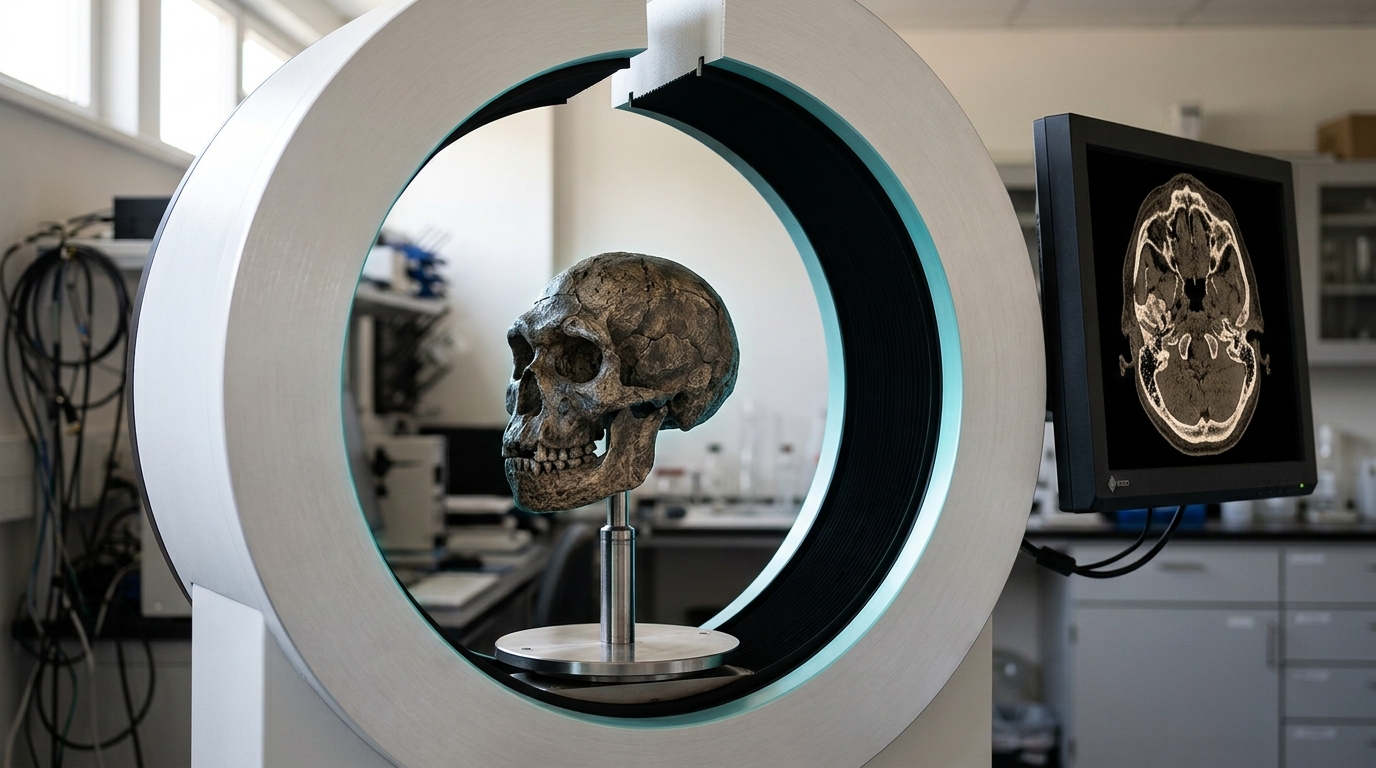
Figure 5. Micro-CT lets a cranium's internal structure — cortical bone thickness, sinuses, a virtual endocast — be measured without cutting into an irreplaceable fossil, feeding the same phylogenetic matrix as external shape data. — Image prompt and art direction by Brecht Corbeel; generation pending.
How a combined, dated tree is actually assembled
The practical solution used across recent hominin phylogenetics is “tip-dated” or “total-evidence” Bayesian phylogenetic analysis, which takes three separate matrices as simultaneous input to one statistical model: a discrete morphological character matrix scored from actual specimens (increasingly informed by micro-CT-derived internal structure — cortical bone thickness, sinus morphology, a virtual endocast reconstructed from cranial CT data — in addition to external shape); independently derived radiometric ages for each fossil tip, entered as calibration priors rather than fixed points, with their own measurement uncertainty carried through the analysis; and, where available, genetic distance data for the subset of taxa with recoverable ancient DNA. A Bayesian tip-dating model then searches for the tree topology and set of divergence times that best explains all three data types jointly, propagating uncertainty from the dating step (Part 2 above) directly into uncertainty about branch lengths and even topology, rather than treating a fossil’s age as a known constant once a dating paper is published.
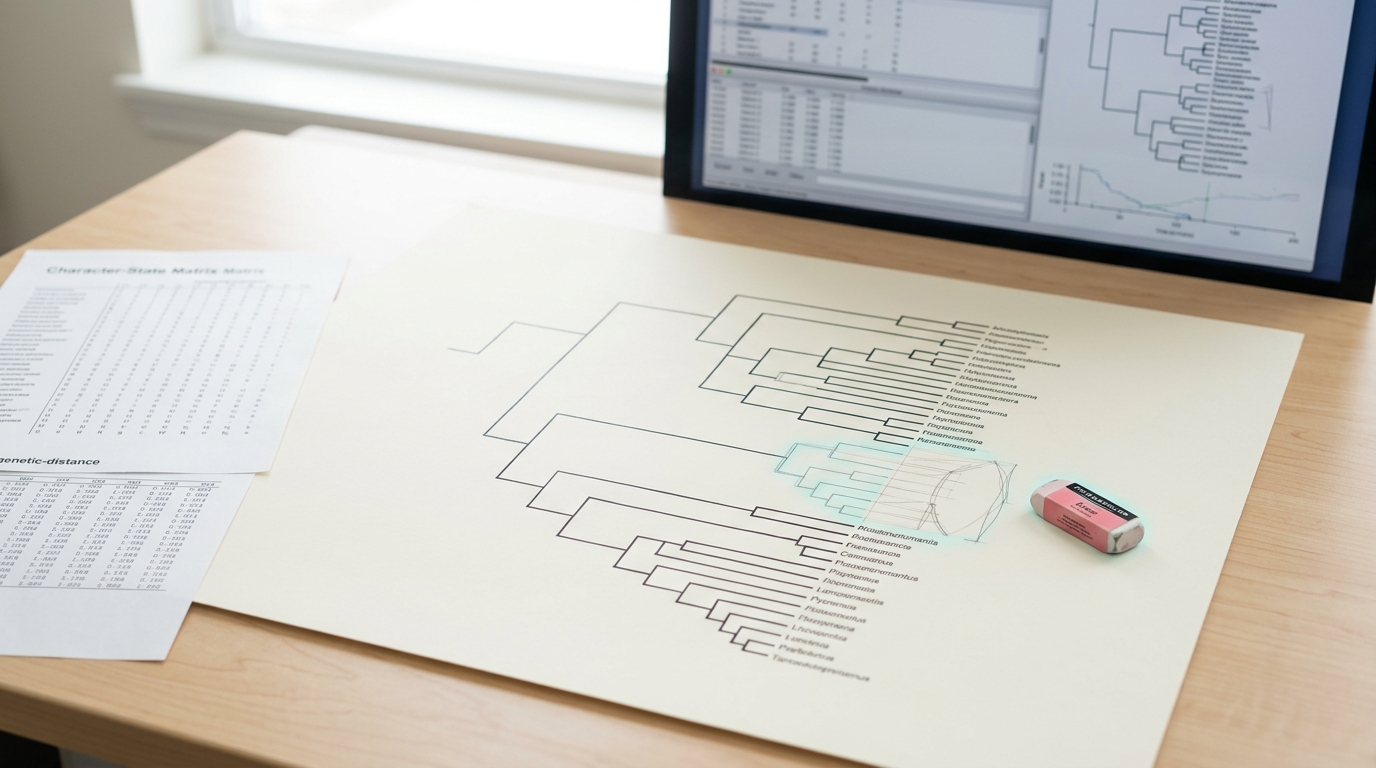
Figure 6. A combined hominin phylogeny is assembled by hand and by software together — morphological character states, genetic distances, and radiometric ages entered as separate matrices that a Bayesian model then reconciles into one dated tree. — Image prompt and art direction by Brecht Corbeel; generation pending.
The published assessment of Homo naledi’s phylogenetic position is a direct example of this combined method: the analysis explicitly used dated Bayesian phylogenetic methods that incorporated the site’s cross-validated age range (established in Part 2) as a calibration constraint alongside a morphological character matrix, precisely because the fossils’ unexpectedly young geological age and their primitive morphology could not be reconciled by morphology or age data considered in isolation [8]. Where ancient genomes exist, they anchor the tree far more tightly than morphology alone: the Neanderthal and Denisovan nuclear genomes provided direct measurements of divergence times and admixture proportions with modern humans that no morphological analysis could have produced, since gene flow between lineages is essentially invisible to a discrete-character morphological matrix built on bones alone [1, 3]. This is why a modern hominin family-tree diagram increasingly shows not just branching lines but crossing arrows representing admixture events — a graphical convention that exists specifically because genomic data revealed a history that a strictly bifurcating tree, the traditional output of morphology-only cladistics, cannot represent at all.
Detecting admixture once the tree is built
A total-evidence tree gives a topology and divergence dates, but it does not by itself reveal gene flow between branches after they diverged — and for the hominin record, that gene flow turned out to be one of the most consequential findings the genomic data produced. Detecting it relies on a different class of statistic than tree-building itself: formal tests of allele-sharing patterns across four populations, commonly called D-statistics or f4-statistics, which compare how often a variant allele is shared between specific pairs of lineages relative to a null expectation under a strictly bifurcating tree with no post-divergence contact. A significant asymmetry in that sharing pattern is evidence of gene flow between one of the four lineages and one of the others, without requiring a fossil, a date, or a morphological character at all — the signal lives entirely in the pattern of shared variants across present-day and ancient genomes. This is precisely the class of test that first demonstrated Neanderthal ancestry persists in present-day non-African populations at a few percent of the genome [1], and a structurally similar test demonstrated Denisovan ancestry in present-day Melanesian and other Oceanian populations at a substantially higher percentage [3]. Later work built on the same statistical family to identify additional, more subtle admixture events, including gene flow from an as-yet morphologically unidentified “superarchaic” or ghost lineage inferred purely from patterns in the Denisovan genome that could not be attributed to either known Neanderthal or Denisovan ancestry components [10]. The Denisova 11 hybrid individual described above is the clearest possible confirmation that these statistical inferences correspond to real, biologically ordinary events: a person whose mother was Neanderthal and whose father was Denisovan is not a rare statistical artifact requiring one-off explanation, but the direct fossil counterpart of exactly the kind of event the admixture statistics had already been inferring indirectly for years beforehand [9].
Vendor-claim boundary, marked explicitly: commercial ancestry-testing services that report “Neanderthal percentage” to consumers use a related but methodologically simplified calculation on modern reference panels, not the full formal admixture-statistic framework described above; the number such a service reports to a customer should be read as a marketing-facing estimate built on published population genetics, not as equivalent in rigor to a peer-reviewed admixture analysis.
What changes, and what does not, when a new fossil or genome appears
Fact: every element of this pipeline — clean-room protocol, damage authentication, multi-method dating, and total-evidence phylogenetics — is designed so that a single new data point can revise a specific, bounded part of the tree (a divergence date, a branch’s position, an admixture proportion) without requiring the entire published methodology to be re-derived from scratch.
Analysis: in practice, this means the popular narrative of hominin evolution being “rewritten” by a new fossil is usually an overstatement of what changed. The Jebel Irhoud and Rising Star cases each shifted a specific age estimate by using better-controlled versions of existing methods on new samples; neither discovery invalidated the underlying dating techniques, and neither retroactively falsified fossils dated by different, independently cross-validated methods elsewhere.
Scenario, clearly marked as such: if a well-preserved petrous bone is recovered from a Middle Pleistocene African hominin site with a burial environment cool and dry enough to have preserved DNA — a combination that has not yet been documented in the published record for that time depth and region — the resulting genome would let researchers directly test proposed deep-time admixture events between now-extinct African lineages and early modern humans that are currently inferred only indirectly, from patterns of introgression detected in living African genomes rather than from direct ancient sequence.
Prediction, with horizon and disconfirmation condition: over the next ten years, expect the total number of hominin fossils with directly sequenced ancient DNA to expand geographically beyond the presently DNA-favorable temperate and cold regions (Eurasia, high-altitude and cave sites) as extraction chemistry continues to improve for degraded, warm- climate samples — an extrapolation from the trajectory documented across the field’s first decade [10], not a guaranteed outcome. The indicator to watch is the number of published tropical or low-latitude African hominin genomes older than roughly 100,000 years; if that count has not measurably increased by the mid-2030s despite continued extraction-method development, the prediction should be treated as disconfirmed rather than merely delayed, since it would indicate a diagenetic ceiling rather than a solvable technical bottleneck.
Practitioner checklist
For a practicing paleoanthropologist or a careful reader of a new claim, three questions travel across all three methods above and are worth asking of any reported result: Was contamination or authenticity explicitly quantified, not merely asserted? Was the reported age produced by at least two methods with genuinely independent sources of systematic error, and did they agree within stated uncertainty? And was any phylogenetic placement built from a stated, inspectable character or distance matrix, with uncertainty in dating propagated into the tree rather than treated as settled before the analysis began? A result that cannot answer these three questions in the affirmative is not necessarily wrong, but it has not yet done the specific work this field uses to distinguish a defensible finding from an interesting one.
Sources
- Richard E. Green et al.. A Draft Sequence of the Neandertal Genome. Science (2010). DOI: 10.1126/science.1188021.
- David Reich et al.. Genetic history of an archaic hominin group from Denisova Cave in Siberia. Nature (2010). DOI: 10.1038/nature09710.
- Matthias Meyer et al.. A High-Coverage Genome Sequence from an Archaic Denisovan Individual. Science (2012). DOI: 10.1126/science.1224344.
- Adrian W. Briggs et al.. Removal of deaminated cytosines and detection of in vivo methylation in ancient DNA. Nucleic Acids Research (2010). DOI: 10.1093/nar/gkp1163.
- Jesse Dabney et al.. Complete mitochondrial genome sequence of a Middle Pleistocene cave bear reconstructed from ultrashort DNA fragments. Proceedings of the National Academy of Sciences (2013). DOI: 10.1073/pnas.1314445110.
- Daniel Richter et al.. The age of the hominin fossils from Jebel Irhoud, Morocco, and the origins of the Middle Stone Age. Nature (2017). DOI: 10.1038/nature22335.
- Paul H.G.M. Dirks et al.. The age of Homo naledi and associated sediments in the Rising Star Cave, South Africa. eLife (2017). DOI: 10.7554/eLife.24231.
- Mana Dembo et al.. The evolutionary relationships and age of Homo naledi: An assessment using dated Bayesian phylogenetic methods. Journal of Human Evolution (2016). DOI: 10.1016/j.jhevol.2016.04.008.
- Viviane Slon et al.. The genome of the offspring of a Neanderthal mother and a Denisovan father. Nature (2018). DOI: 10.1038/s41586-018-0455-x.
- Pontus Skoglund and Iain Mathieson. Ancient Genomics of Modern Humans: The First Decade. Annual Review of Genomics and Human Genetics (2018). DOI: 10.1146/annurev-genom-083117-021749.
Originally published at https://absolutedigitalpublishers.com/articles/hominin-evolution-and-deep-prehistory-in-practice-an-advanced-technical-guide.