Hominin Evolution and Deep Prehistory: A First-Principles Introduction
How fossils are identified and dated, how ancient DNA proves interbreeding between Homo sapiens, Neanderthals, and Denisovans, and what remains genuinely unresolved about the human family tree.

Ancient-DNA work begins not with a genome but with a few milligrams of bone powder, drawn under filtered air to keep modern contamination out of a signal that is already faint. — Image prompt and art direction by Brecht Corbeel; generation pending.
Abstract
Paleoanthropology reconstructs deep human prehistory from two very different evidence streams: fragmentary fossilized bone dated by radiometric and stratigraphic methods, and ancient DNA extracted from bone, teeth, and cave sediment and read against population-genetic models. This introduction lays out, from scratch, how a fossil becomes a named species, how radiometric and paleomagnetic dating actually work, how ancient-DNA studies proved that Homo sapiens interbred with both Neanderthals and Denisovans, and where the field's real disagreements sit — contested species boundaries, an incomplete and geographically biased fossil record, and family trees that keep being redrawn as new sites and genomes appear. It separates established fact from vendor-style overclaim, marks out analysis and open scenario explicitly, and ends with conditional expectations for what the next decade of excavation and sequencing is likely to resolve and what it probably will not.
Paleoanthropology is often narrated as a settled story: apes became bipeds, bipeds became tool users, tool users became us, in a tidy relay from ape to modern human silhouette. That silhouette — the marching row of increasingly upright figures — is a museum-shop poster, not a research finding. The actual evidence base is fragmentary bone, faint ancient DNA, and disputed sediment ages, and the tree it supports is a bush with many extinct side branches, several of which interbred with our own lineage more recently than most people realize. This article sets out, from scratch, how that evidence is generated and read, and where the field’s genuine disagreements sit.
What counts as a hominin fossil, and what a species name means
“Hominin” is the technical term for humans and our extinct close relatives, back to the split from the chimpanzee lineage roughly 6-7 million years ago. A hominin fossil is rarely a complete skeleton. It is far more often a tooth, a jaw fragment, a piece of cranial vault, or a single limb bone, recovered from sediment that itself has to be dated. The 2015 discovery of LD 350-1, a partial lower jaw from Ledi-Geraru in Ethiopia’s Afar region, illustrates the ordinary case well: five teeth and part of a mandible, argued to represent the genus Homo at 2.8-2.75 million years ago, roughly 400,000 years earlier than the previously accepted oldest Homo fossils [6]. That is the raw material the whole field works from — a jaw, not a skeleton.
Naming a new species from material like this is an argument, not a measurement. Researchers compare a set of traits — tooth cusp patterns, brow ridge shape, cranial capacity, limb proportions — against the range of variation already documented in known species and against other candidate fossils. When a specimen’s combination of traits does not fit comfortably inside any known species’ range, and enough independent lines of anatomical evidence converge, researchers propose a new name. This is exactly the argument structure behind Homo naledi, described from more than 1,550 fossil elements recovered from the Dinaledi Chamber of the Rising Star cave system in South Africa: a body plan combining an australopithecine-like small brain and shoulder with markedly more human-like hands, wrists, legs, and feet, a mosaic that did not match any previously named species [4]. The same logic, run on very different material, produced Homo floresiensis from Liang Bua cave on the Indonesian island of Flores: an adult skeleton with an estimated stature near one meter and endocranial volume around 380 cubic centimeters, comparable to the smallest known australopithecines despite dating to the late Pleistocene, tens of thousands of years after such small brains had supposedly disappeared from the human lineage elsewhere [5].
Fact: species boundaries in paleoanthropology are drawn from clusters of measured anatomical traits compared against known variation, not from a single diagnostic feature or a genetic sequence in most cases (ancient DNA is available for only a small fraction of hominin fossils). Analysis: this means a species name is a hypothesis about where the boundaries of biological variation fall, and it can be — and regularly is — revised as more comparative material turns up. Calling a specimen “Homo naledi” is not the same kind of claim as measuring the mass of an object; it is closer to a well-argued classification that remains open to revision by the next fossil.
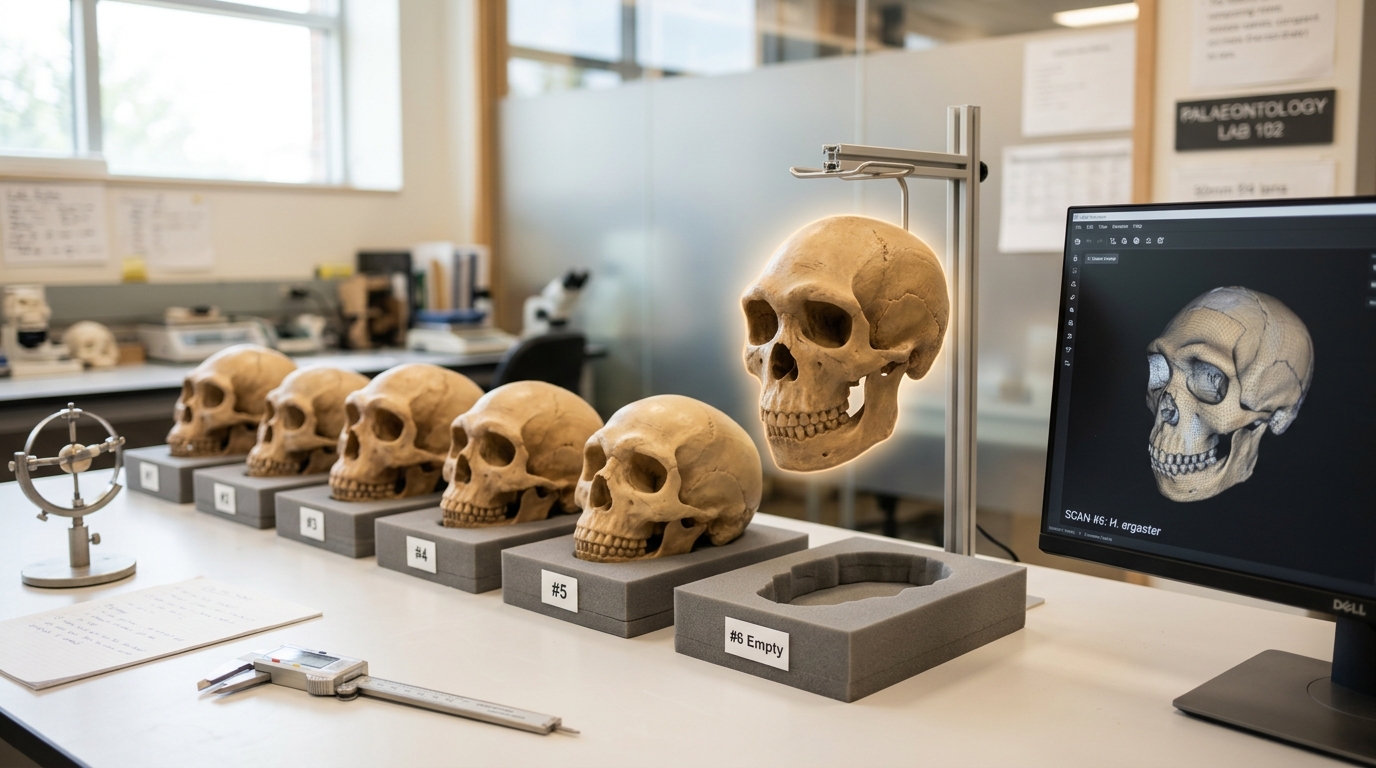
Figure 1. A species name is not read directly off a bone; it is argued from a constellation of measured traits compared, cast by cast, against every other specimen that might plausibly be a close relative. — Image prompt and art direction by Brecht Corbeel; generation pending.
Dating: what actually tells you a fossil’s age
A bone itself is usually not what gets dated. Direct radiocarbon dating of bone collagen works only out to roughly 50,000 years, because carbon-14 decays with a half-life of about 5,730 years and beyond ten or so half-lives there is too little left to measure reliably. Older hominin fossils are dated through the sediments and minerals that entomb them: potassium-argon and its more precise successor argon-argon dating measure the decay of radioactive potassium into argon gas trapped in volcanic ash layers that sandwich a fossil-bearing horizon; paleomagnetic dating reads the orientation of magnetic minerals in the rock against the well-established timeline of Earth’s magnetic field reversals; and optically stimulated luminescence measures the time since quartz or feldspar grains were last exposed to sunlight, which is useful for dating the sediment a fossil was buried in even where no volcanic ash is present.
Each method has a different failure mode, which is precisely why cross-checking them matters. A single method giving an anomalous date is a data point to investigate, not a fact to publish; agreement across two or three independent methods, plus the fossil’s position relative to other securely dated layers (stratigraphy — older layers below, younger above, barring disturbance), is what gives a date real standing. The re-dating of the Jebel Irhoud hominin fossils in Morocco is a useful case study of a single site being pushed back by more than 100,000 years once thermoluminescence dating of heated flint tools associated with the skeletal material was applied systematically, moving the site’s Homo sapiens-associated fossils to roughly 300,000-350,000 years old and reshaping the geography of where the earliest anatomically modern traits appear [3]. Before that redating, the fossils had been informally assigned to Neanderthals or an unresolved archaic population; the change in age was inseparable from a change in how the fossils themselves were interpreted.
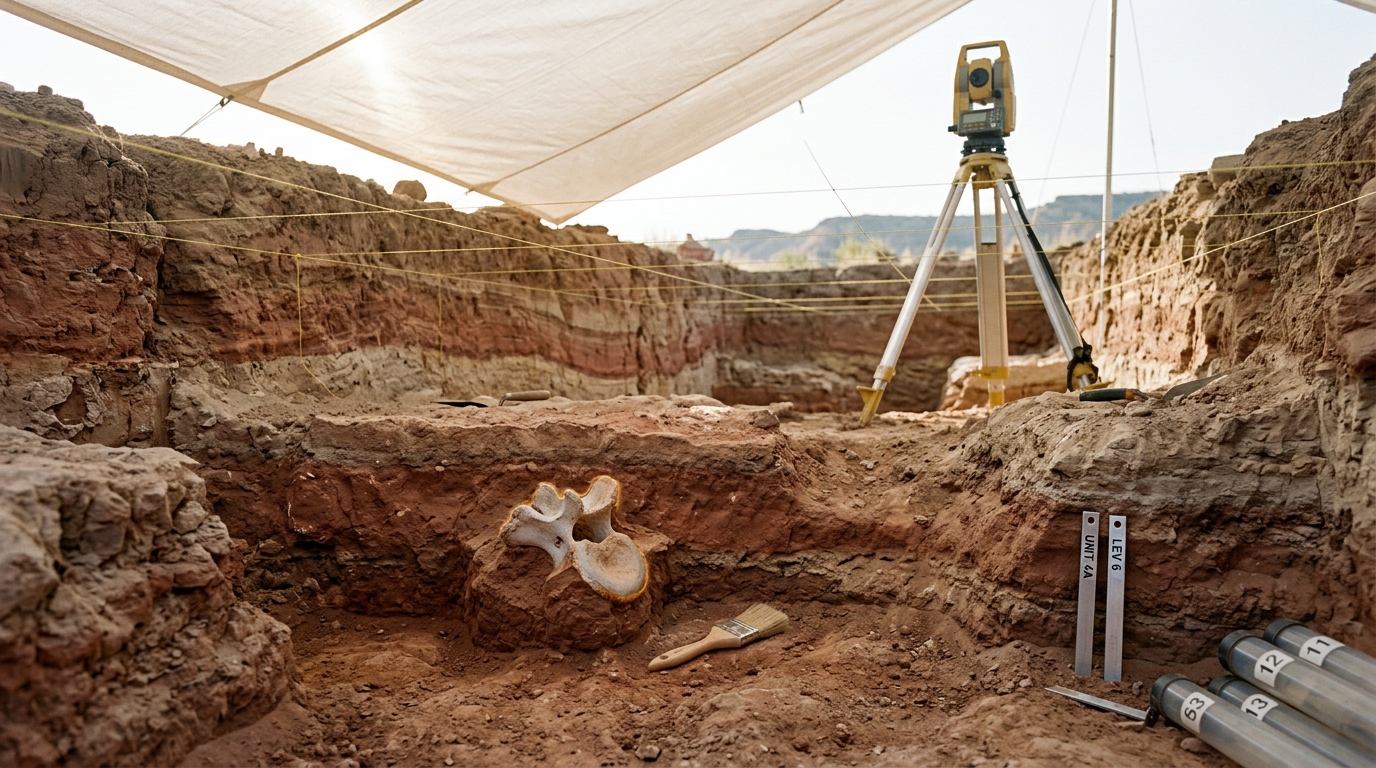
Figure 2. Dating a fossil starts in the ground: the layer it sits in, and what lies above and below it, constrain its age before any laboratory instrument is involved. — Image prompt and art direction by Brecht Corbeel; generation pending.
Vendor-style overclaim to watch for: a popular headline claiming a single fossil “rewrites human origins” based on one dating method run once is not how the field actually works, and should be read skeptically until independent dating and independent excavation teams have weighed in. Fact, by contrast: Jebel Irhoud’s revised age rests on multiple dated flint samples using thermoluminescence, cross-checked against electron spin resonance dating of a tooth, converging on a consistent age range [3] — that is what a defensible date looks like.
Ancient DNA: a second, independent evidence stream
Fossils and stone tools tell you about anatomy and behavior at a place and time. Ancient DNA tells you something fossils cannot: who was actually breeding with whom. The technique became viable at genome scale only in the past two decades, driven by methods for recovering the tiny, degraded fragments of DNA that survive in cold, dry, or otherwise favorable burial conditions, and for statistically distinguishing authentic ancient sequence from modern contamination.
The 2010 publication of a draft Neanderthal genome, sequenced from bone fragments recovered in Croatia, was the field’s watershed moment. Comparing that genome against present-day human populations from different continents, the study found that non-African populations carry a small but consistent excess of DNA sequence shared with Neanderthals relative to African populations — a pattern most parsimoniously explained by interbreeding between Neanderthals and the ancestors of non-African modern humans, estimated at roughly 1-4% of the genome in present-day non-Africans [1]. That same year, DNA extracted from a single finger bone fragment and a tooth found in Denisova Cave in southern Siberia revealed an entirely different archaic population — now called Denisovans — known almost entirely from genetic evidence rather than a distinctive fossil anatomy, and detectably contributing ancestry to present-day populations in Oceania and parts of Asia [2].
How admixture is actually estimated
The basic tool for estimating what fraction of a genome derives from an archaic population is comparative allele sharing: for a given modern population, count how much more genetic variation it shares with an archaic genome than a population known to lack that admixture does, and scale by how much variation the archaic and comparison genomes share with each other overall. A simplified version of the widely used D-statistic framework expresses this as:
\hat{f} = \frac{\sum_{i} (P_2(i) - P_1(i))\,(P_4(i) - P_1(i))}{\sum_{i} (P_3(i) - P_1(i))\,(P_4(i) - P_1(i))}
where P_1 through P_4 are allele frequencies at site i in an outgroup, a candidate-admixed population, a comparison population without the admixture, and the archaic source, respectively. The estimator exploits a simple logic: if population P_2 has interbred with the archaic lineage P_4 and P_3 has not, P_2 should share systematically more rare variants with P_4 than P_3 does, in proportion to the fraction of its genome that traces to that admixture event. This is why admixture claims in the literature are reported as percentages with confidence intervals rather than as a binary yes/no — the estimate is statistical, built from many thousands of sites, not read off a single marker.

Figure 3. Interbreeding between lineages is detected statistically, as a small but consistent excess of shared genetic variants, not as a single diagnostic marker. — Image prompt and art direction by Brecht Corbeel; generation pending.
Fact: interbreeding between Homo sapiens and both Neanderthals and Denisovans is supported by multiple independent genomic studies and is not seriously contested in the field [1] [2] [7]. Analysis: the consistency of the signal across many present-day populations and multiple archaic genomes since sequenced is what elevates this from a single surprising result to an established feature of recent human population history — precisely the kind of convergent evidence that a lone anomalous fossil date lacks.
What genuinely remains contested
It would misrepresent the field to present the human family tree as settled once admixture is accepted. Several things remain genuinely open, and saying so plainly is different from vendor-style hedging.
First, species boundaries for several fossil populations are actively debated rather than resolved. Homo naledi’s very young geological age relative to its primitive-looking anatomy, and unresolved questions about whether some specimens attributed to early Homo actually belong to Australopithecus, are live disputes rather than settled facts [4] [6]. Second, the fossil record is geographically and temporally patchy: preservation favors certain climates and sediment types, meaning entire regions and time windows are represented by a handful of fragments or nothing at all, which makes absence of a fossil weak evidence for absence of a population. Third, ancient DNA itself degrades faster in warm and humid environments, so the genomic record is heavily biased toward cold climates — Europe, Siberia, high-altitude sites — and comparatively silent on tropical Africa and Southeast Asia during the same periods, even though those regions were almost certainly home to important, and possibly still-undiscovered, archaic populations [7].
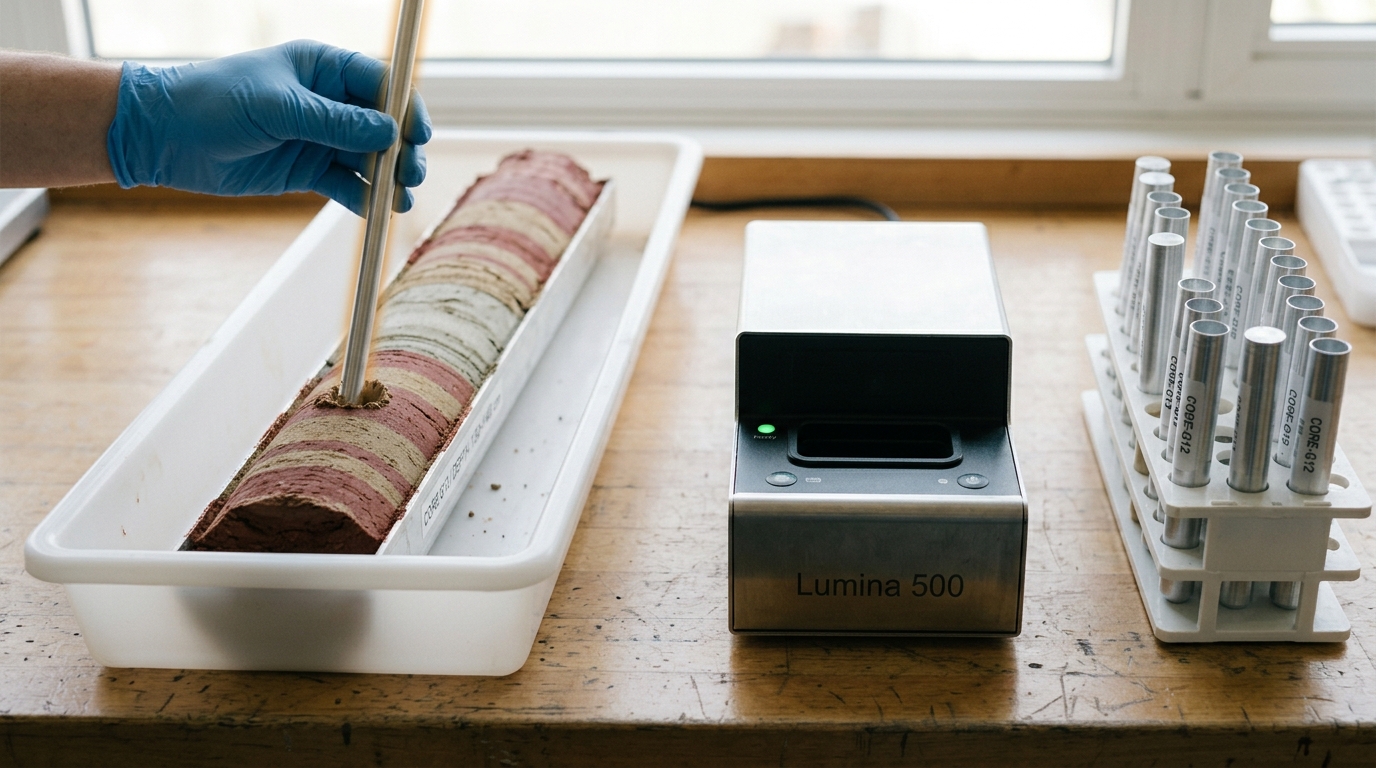
Figure 4. Radiometric and luminescence methods date the sediment and minerals around a fossil, which is often more reliable than trying to date fragile bone directly. — Image prompt and art direction by Brecht Corbeel; generation pending.
Where experts disagree, characterized rather than adjudicated: some researchers argue for a model of largely separate regional lineages with limited gene flow; others argue for a more thoroughly interconnected, pan-African “braided stream” origin for Homo sapiens, with the Jebel Irhoud material cited as evidence for the latter view precisely because its combination of modern facial anatomy and more primitive braincase shape does not fit a single-origin-point model cleanly [3]. Neither position currently commands unanimous acceptance, and readers should treat confident single-sentence summaries of “how humans evolved” with appropriate suspicion.
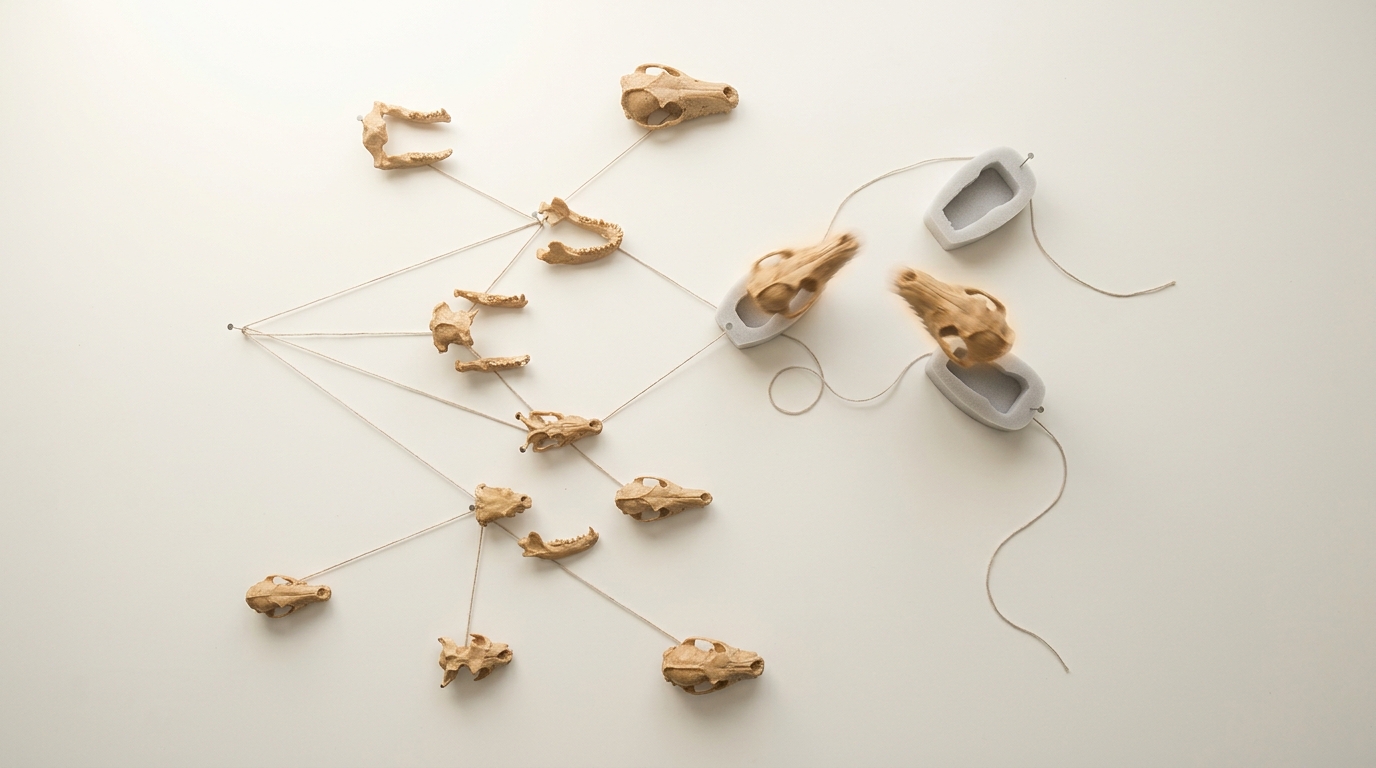
Figure 5. Where a fossil sits on the family tree is often the least settled part of the finding; specimens get physically remeasured and reassigned as new comparative material appears. — Image prompt and art direction by Brecht Corbeel; generation pending.
Scenario and prediction: what the next decade of evidence is likely to change
Scenario, clearly marked as such: if ancient-DNA recovery methods continue improving — particularly for degraded DNA from warm climates, an active area of methodological research — it is plausible that genomic evidence for one or more additional archaic populations in tropical Africa will be recovered within the next decade, given that Denisovan ancestry patterns in some living populations already imply an unsampled source population.
Prediction, with horizon, assumptions, and disconfirmation condition stated explicitly: over the next ten years (horizon: by roughly 2036), assuming current rates of new hominin fossil discovery and ancient-DNA sequencing throughput continue or increase, expect at least one currently accepted hominin species boundary to be substantively revised — either split or merged — as new comparative fossils or genomes are published. The observable indicator would be a peer-reviewed reclassification, not just a popular news claim. This prediction would be disconfirmed if a full decade passes with the current species list essentially unchanged despite continued excavation and sequencing activity at comparable or higher rates than the 2015-2025 decade, which would suggest the field has reached a more stable equilibrium than its recent history implies.
Migration, behavior, and the archaeology that dates them jointly
Fossils and DNA are the two evidence streams most people associate with human origins research, but a third body of evidence — stone tools, cut-marked animal bone, hearths, and settlement layouts — carries much of the weight for questions about behavior and migration that neither bone nor genome answers on its own. A skeleton can show that a hominin was capable of a certain gait or grip; it cannot by itself show what that hominin actually did day to day. Stone-tool assemblages are dated by the same stratigraphic and radiometric methods used for fossils, and because tools are far more abundant and durable than bone, they often provide a denser record of where and when a population was present, even at sites where no skeletal remains have survived at all. This is one reason paleoanthropologists treat “no fossils found here” as a weak claim: an assemblage of worked stone can place a hominin population at a site for tens of thousands of years with no accompanying bone whatsoever.
Migration routes are reconstructed by combining this archaeological presence-and-absence data with the genetic evidence discussed above. Ancient DNA sampled across many sites and time periods lets researchers track how genetic ancestry components move and mix geographically over time — for example, tracing the geographic spread of Neanderthal-derived ancestry within early non-African modern human populations, or reconstructing the multiple, temporally separated pulses of Denisovan gene flow implied by differences in Denisovan ancestry proportions among present-day populations in New Guinea, Australia, and mainland Asia [7]. These are not single migrations captured in a single genome; they are patterns extracted by comparing many genomes against each other and against the archaeological chronology built independently from stone tools and site stratigraphy. Where the two records agree — genetic and archaeological chronologies both signaling a population’s arrival in a region within an overlapping date range — a migration event is treated as reasonably well established. Where they disagree, or where only one record exists, an origin story remains provisional rather than a fact fit for a museum wall label.
Fact: behavioral inferences (tool use, diet, mobility, and inferred social organization) rest primarily on archaeological evidence — the durable residue of past activity — cross-dated against the same stratigraphic and radiometric methods used on fossils, not on skeletal anatomy alone. Analysis: this is why a species can be well characterized anatomically from bone while its behavior remains poorly known, or the reverse — a behaviorally rich archaeological sequence with almost no associated skeletal material, as is the case at many Middle Stone Age African sites. The two evidence types answer different questions and neither substitutes for the other.
None of this uncertainty undermines the two central, well-supported findings this article opened with: that fossil hominin species are named through comparative anatomical argument checked against independently dated sediment, and that ancient DNA has directly demonstrated interbreeding between Homo sapiens and at least two other hominin populations, Neanderthals and Denisovans, leaving a measurable trace in people alive today [1] [2]. What remains open is not whether these methods work, but how complete a picture they can currently give of a record that is inherently partial, unevenly preserved, and still being actively dug out of the ground [8].
Sources
- Richard E. Green, Johannes Krause, Adrian W. Briggs, et al.. A Draft Sequence of the Neandertal Genome. Science (2010). DOI: 10.1126/science.1188021.
- David Reich, Richard E. Green, Martin Kircher, et al.. Genetic history of an archaic hominin group from Denisova Cave in Siberia. Nature (2010). DOI: 10.1038/nature09710.
- Jean-Jacques Hublin, Abdelouahed Ben-Ncer, Shara E. Bailey, et al.. New fossils from Jebel Irhoud, Morocco and the pan-African origin of Homo sapiens. Nature (2017). DOI: 10.1038/nature22336.
- Lee R. Berger, John Hawks, Darryl J. de Ruiter, et al.. Homo naledi, a new species of the genus Homo from the Dinaledi Chamber, South Africa. eLife (2015). DOI: 10.7554/eLife.09560.
- Peter Brown, Thomas Sutikna, Michael J. Morwood, et al.. A new small-bodied hominin from the Late Pleistocene of Flores, Indonesia. Nature (2004). DOI: 10.1038/nature02999.
- Brian Villmoare, William H. Kimbel, Chalachew Seyoum, et al.. Early Homo at 2.8 Ma from Ledi-Geraru, Afar, Ethiopia. Science (2015). DOI: 10.1126/science.aaa1343.
- Pontus Skoglund and Iain Mathieson. Ancient Genomics of Modern Humans: The First Decade. Annual Review of Genomics and Human Genetics (2018). DOI: 10.1146/annurev-genom-083117-021749.
- Smithsonian National Museum of Natural History. Species: Human Fossils. Smithsonian Institution's Human Origins Program (2024).
Originally published at https://absolutedigitalpublishers.com/articles/hominin-evolution-and-deep-prehistory-a-first-principles-introduction.