From Origins to Frontier: A History of Quantum Foundations and Measurement
From a 1935 thought experiment to a 2022 Nobel Prize, the century-long argument over what quantum measurement means was settled not by philosophy but by photon-counting apparatus built to close one loophole at a time.
The argument that started it all was conducted on paper, but the instruments of the era were already asking the same question of light. — Image prompt and art direction by Brecht Corbeel; generation pending.
Abstract
Quantum foundations research began as an argument about whether quantum mechanics is complete and became, through John Bell's 1964 theorem, a testable question about nature itself. This article traces that turn from the 1935 Einstein-Podolsky-Rosen paper and the Bohr-Einstein debates through Bell's inequality, the first experimental violations by Clauser and by Aspect's group in the early 1980s, the closing of the locality and detection loopholes across three independent 2015 experiments, the parallel development of decoherence theory as an account of the quantum-classical boundary, and the 2022 Nobel Prize in Physics that recognized this fifty-year experimental program. Fact, interpretation, and open questions are kept explicitly separate throughout, and quantum information science is treated as the practical inheritance of a debate that began as a purely conceptual dispute over realism and locality.
A dispute that began on paper
In May 1935, Albert Einstein, Boris Podolsky, and Nathan Rosen published a four-page paper in Physical Review arguing that quantum mechanics, as then formulated, could not be a complete description of physical reality [1]. Their argument rested on a specific criterion: if, without disturbing a system, one can predict with certainty the value of a physical quantity, then that quantity corresponds to an “element of reality.” Applied to a pair of particles prepared so that a measurement on one instantaneously determines a corresponding property of the other, however far apart the two might be, the paper concluded that quantum mechanics must be either incomplete or committed to an implausible action at a distance.
This is a fact about the historical record: the EPR paper did not claim quantum mechanics was wrong. It claimed the theory, taken as a complete description of nature, forced an uncomfortable choice between abandoning locality (the idea that distant events cannot instantaneously influence each other) or accepting that quantum mechanics leaves something out — some further, “hidden” variable that would restore a classical picture of definite, pre-existing properties. That is an interpretive framing choice by the authors, not a measured result; in 1935 there was no experiment capable of adjudicating it.
Niels Bohr replied within months, rejecting the EPR reality criterion on the grounds that it presupposed a classical separability between the two particles that quantum mechanics does not grant. The ensuing Bohr-Einstein exchange became one of the most closely read disputes in twentieth-century physics, and it is worth being precise about what it was and was not. It was not an argument over whether quantum mechanics gave correct predictions — both sides agreed it did. It was an argument over what those predictions meant: whether the theory described an objective, observer-independent reality with definite values waiting to be revealed, or whether talk of “reality” prior to measurement was itself a category error. For roughly three decades this remained, in the words later used by the physics community itself, a matter that could be debated but not settled — a question of interpretation with no experimental purchase.
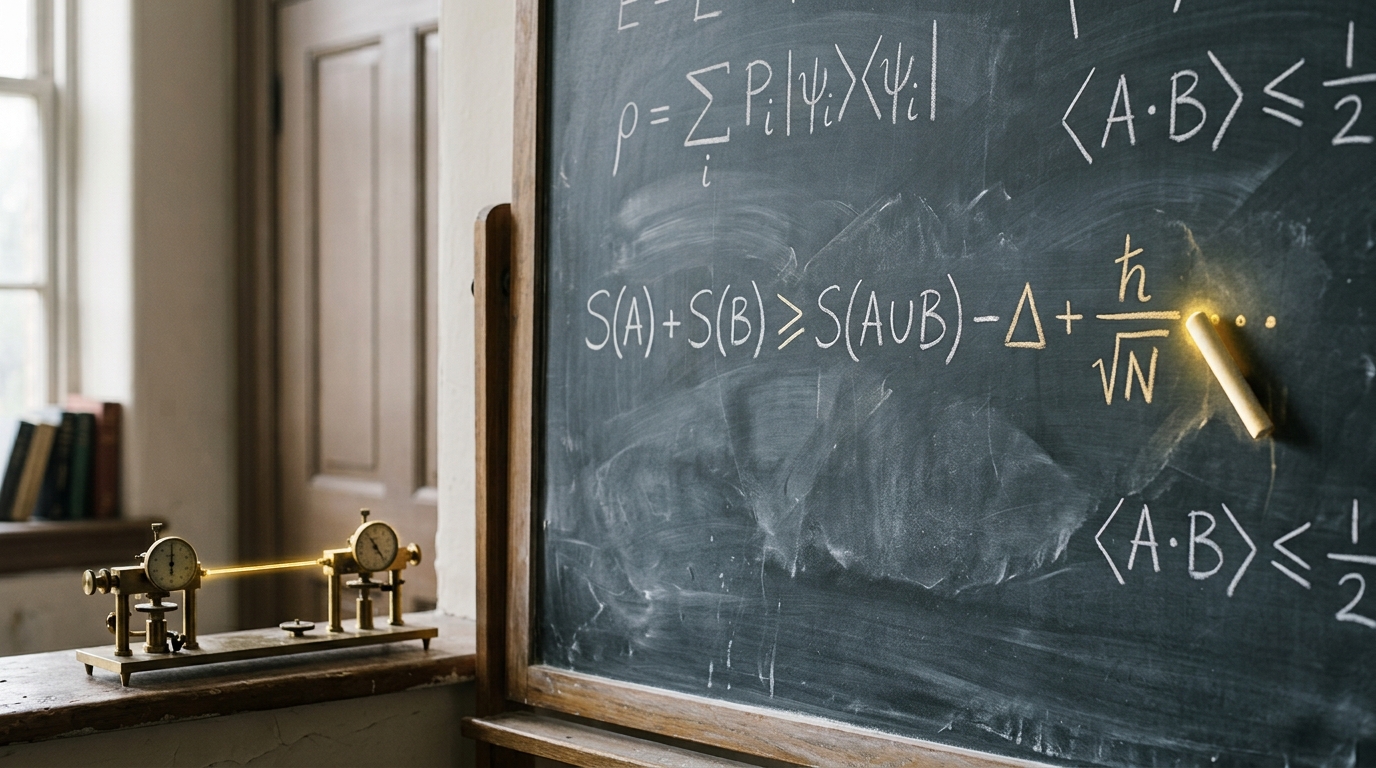
Figure 1. Bell's 1964 theorem turned a philosophical dispute into an arithmetic one: a number that local hidden variables could not exceed, and that quantum mechanics predicted they would. — Image prompt and art direction by Brecht Corbeel; generation pending.
Bell’s 1964 theorem: turning philosophy into arithmetic
That changed with a single paper. In 1964, the Irish physicist John Stewart Bell, then working at CERN, submitted “On the Einstein Podolsky Rosen Paradox” to a short-lived journal called Physics Physique Fizika [2]. Bell did something neither Einstein nor Bohr had done: he derived a quantitative constraint. Assuming only that (a) the two members of an entangled pair carry some set of predetermined, local properties — the “hidden variables” that could restore the classical picture EPR wanted — and (b) a measurement on one particle cannot instantaneously affect the result of a measurement on the other, Bell showed that the statistical correlations between measurement outcomes on the two particles must obey an inequality. Quantum mechanics, in contrast, predicts correlations that violate this inequality for suitably chosen measurement angles.
This is the hinge of the whole history recounted here. Bell’s theorem converted a seemingly unfalsifiable metaphysical dispute — does nature “really” have definite local properties before measurement? — into a number that a laboratory bench could measure. If the correlations observed between distant entangled particles ever exceeded Bell’s bound, no theory built on local hidden variables, however cleverly constructed, could reproduce the result. It would not prove quantum mechanics correct in every particular, but it would prove that no local realist theory — one in which particles carry definite pre-set properties and cannot influence one another faster than light — could account for what was seen.
It is worth stating plainly what Bell’s paper did not do: it did not perform an experiment, and it did not by itself refute local hidden variables. It supplied the test. Fifty more years of apparatus building followed to actually run it, and to run it in a way immune to the ways an imperfect experiment could fake a violation.
First violations: Clauser, Freedman, and the loophole problem
The first laboratory tests came in the early-to-mid 1970s, led among others by John Clauser, who with Michael Horne, Abner Shimony, and Richard Holt reformulated Bell’s inequality into a form — the CHSH inequality — that could be tested with realistic, imperfect polarizers and detectors rather than the idealized ones Bell had assumed. Clauser and Stuart Freedman’s 1972 experiment using correlated photons from a calcium cascade source found agreement with quantum mechanics and a violation of the Bell-type inequality, encouraging further work but leaving open two serious objections that would occupy the field for the next four decades.
The first was the locality loophole: if the setting of each polarization analyzer is fixed before the experiment begins, a hidden, subluminal signal between the two measurement stations could in principle explain the correlation without invoking any genuine nonlocality. The second was the detection loophole: because early photon detectors caught only a small fraction of the pairs produced, a hidden-variable model could in principle explain the observed violation by supposing that the detected subsample was unrepresentative of the whole — an assumption sometimes called “fair sampling,” which cannot be verified from the data actually collected. Distinguishing a genuine quantum effect from an experimental artifact meant designing an apparatus that closed both gaps at once, and that was a hardware problem, not a conceptual one.
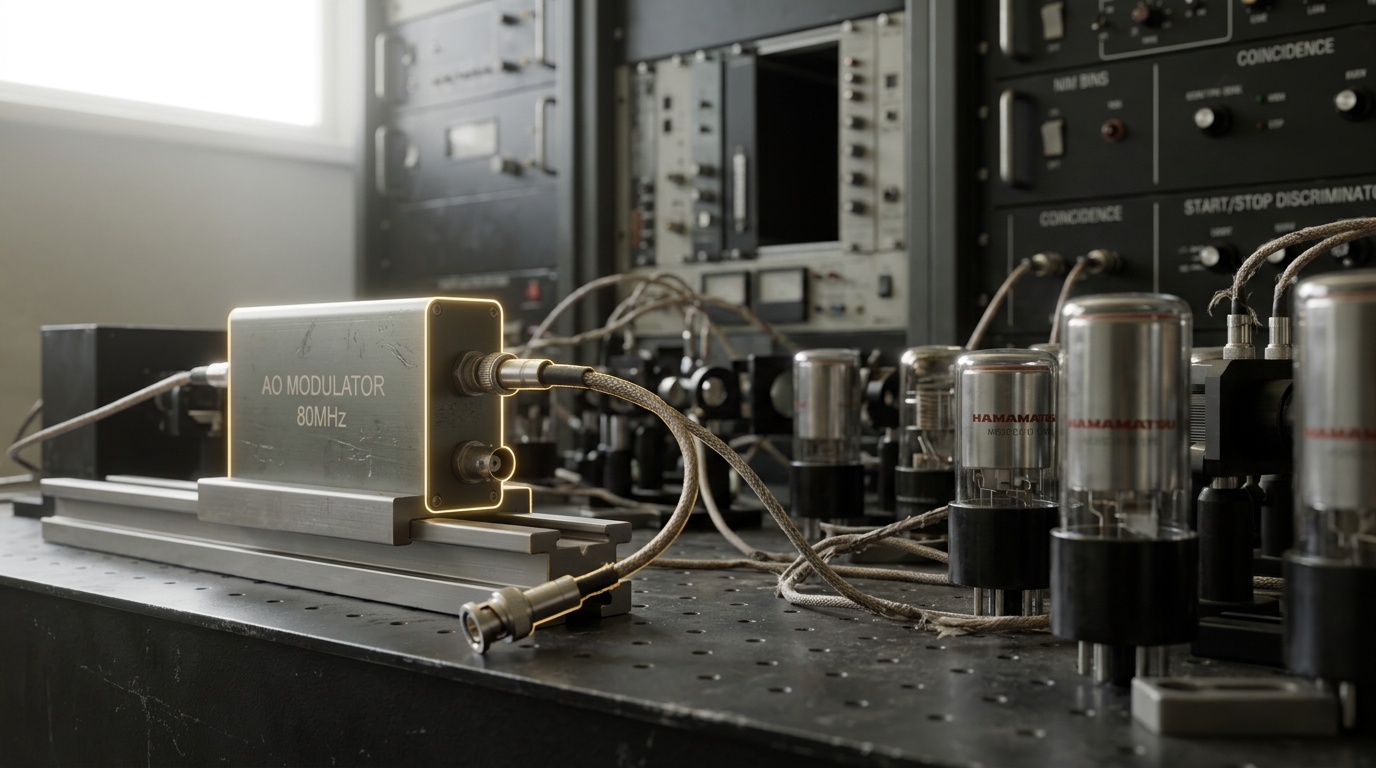
Figure 2. Aspect's Orsay apparatus switched the analyzer setting on each photon after it had already left its source — the first experiment designed to close the locality loophole. — Image prompt and art direction by Brecht Corbeel; generation pending.
Aspect’s experiments: switching the analyzer after the photon has left
The most consequential attempt to close the locality loophole came from a group at the Institut d’Optique in Orsay led by Alain Aspect. In a series of experiments through 1981 and 1982, Aspect, Philippe Grangier, Gérard Roger, and Jean Dalibard used pairs of photons emitted in a calcium atomic cascade and measured their polarization correlations at two well-separated stations.
The most decisive of these experiments, published in Physical Review Letters in December 1982, used acousto-optic switches to change each analyzer’s orientation while the photons were already in flight between the source and the detectors [3]. The switches operated at frequencies near 50 megahertz, incommensurate with each other, so that the choice of measurement setting at each station changed on a timescale shorter than light would need to cross from one station to the other. This is the specific engineering move that mattered: if no signal, however fast, could carry information about one station’s setting to the other in time to influence the outcome, then any correlation exceeding Bell’s bound could not be explained by a local mechanism reacting to the distant setting. Aspect’s group measured a violation of the Bell inequality by five standard deviations, in agreement with the quantum mechanical prediction.
It is accurate to call this experiment a turning point rather than a final closing of the case. The switching in Aspect’s 1982 apparatus was periodic and quasi-random rather than genuinely unpredictable, which left a narrower version of the locality loophole open in principle, and photon detection efficiencies at the time remained too low to close the detection loophole. What the experiment established as fact is that, under conditions substantially harder for a local hidden-variable model to satisfy than any prior test, nature’s correlations still matched quantum mechanics and still violated Bell’s inequality. What it left as open scientific business was whether an even more stringent test — one closing every loophole simultaneously, in the same run — would show the same thing.
Figure 3. By 2015, three independent groups had closed the locality, detection, and freedom-of-choice loopholes at once, using electron spins, entangled photons, and kilometers of fiber. — Image prompt and art direction by Brecht Corbeel; generation pending.
Closing every loophole: the 2015 experiments
That stringent test took another thirty-three years of detector and source engineering to achieve. Three independent groups reported loophole-free Bell tests within months of each other in 2015.
A team at Delft led by Ronald Hanson used electron spins trapped in nitrogen-vacancy defect centers in diamond, held in two laboratories 1.3 kilometers apart, and used entanglement swapping — heralded by photons collected from each site — to entangle the distant electron spins directly [4]. Because the spin states could be measured with near-unit efficiency once entanglement was established, this design closed the detection loophole by construction, and the physical separation combined with fast random-number generators for choosing measurement settings closed the locality loophole as well. Around the same time, a NIST-led team under Lynden Shalm reported a complementary photon-based experiment using high-efficiency transition-edge sensor detectors and a bright polarization-entangled photon source, achieving a violation of local realism with a p-value as small as 5.9 × 10⁻⁹ while keeping the measurement stations spacelike separated [5]. A third group in Vienna, led by Anton Zeilinger, reported a similar loophole-free photonic test in the same window.
Taken together, these three experiments are properly described as closing the two major loopholes — locality and detection — simultaneously and independently, using different physical systems (solid-state spins and photons) and different detector technologies. That convergence across unrelated experimental platforms is itself evidentiary: it is much harder to imagine a single undetected artifact that would produce the same violation in a diamond-spin experiment in the Netherlands and a transition-edge-sensor photon experiment in Colorado. A further, more exotic concern — the “freedom-of-choice” or “superdeterminism” loophole, the logically available but physically radical possibility that the settings chosen by the experimenters and the state of the particles were correlated from some common cause in the past — remains, as a matter of principle, never fully closable by any experiment run inside a causal universe. Physicists generally treat this loophole as outside the scope of empirical falsification rather than as a live experimental question, though it is worth naming as the one gap that engineering cannot in principle shut, only narrow, for example by using measurement settings derived from light from distant astronomical sources so that any common cause would have to reach back further than the birth of the solar system.
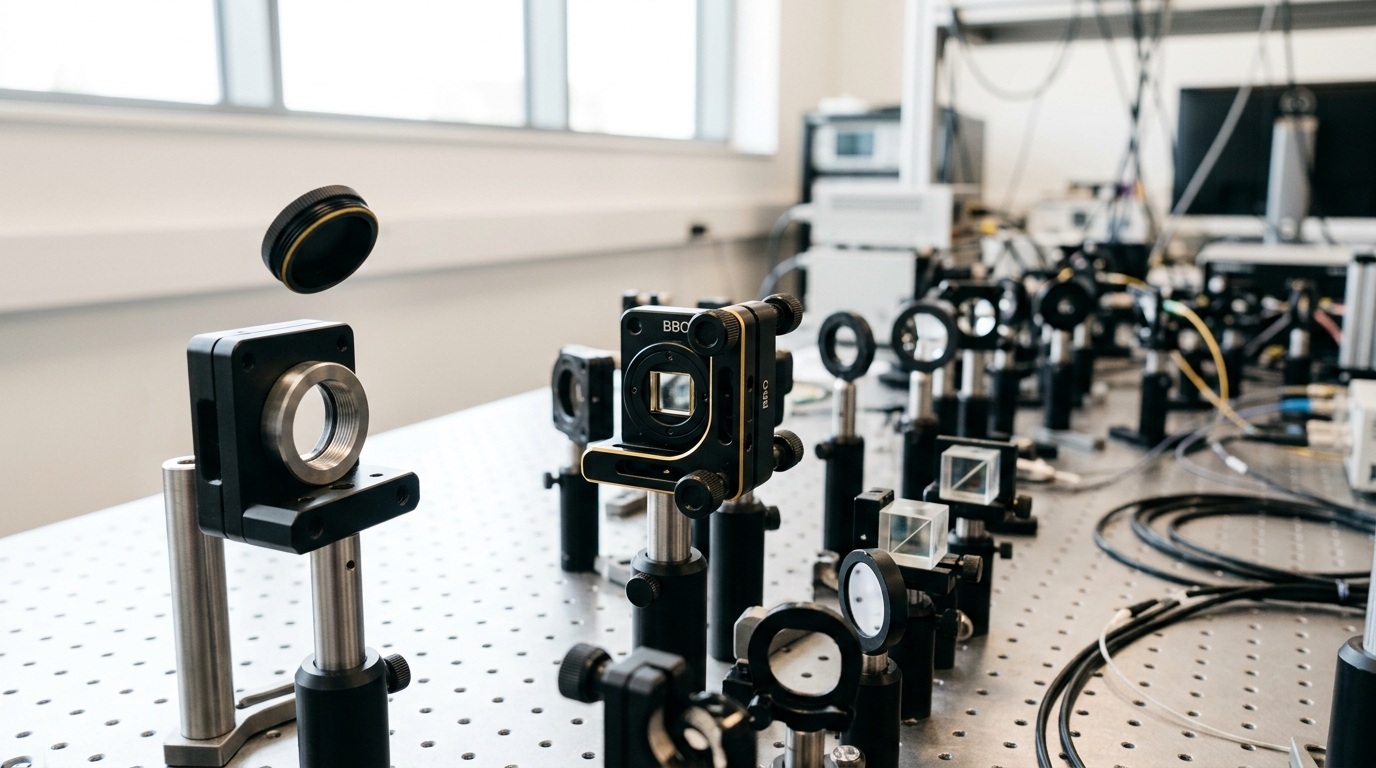
Figure 4. Decoherence theory reframed the puzzle: classical behavior does not require a new physical law, only a system's entanglement with a large, unmonitored environment. — Image prompt and art direction by Brecht Corbeel; generation pending.
Decoherence: why the world looks classical anyway
Running in parallel with the Bell-test program was a distinct, complementary line of foundations research addressing a different question: not whether quantum correlations are real, but why everyday macroscopic objects — tables, cats, measuring needles — never seem to show quantum superposition even though quantum mechanics in principle allows it. Wojciech Zurek’s 1991 Physics Today article “Decoherence and the Transition from Quantum to Classical” laid out the now-standard answer: a quantum system coupled to a large, uncontrolled environment rapidly loses the ability to display interference between its possible states, not because a new physical law intervenes, but because the environment becomes entangled with the system and effectively “measures” it continuously [6]. Superpositions do not vanish; they become inaccessible to any observer who only has access to the system and not the vast number of environmental degrees of freedom it has become correlated with.
This is best understood as a distinct scientific contribution from Bell’s theorem, not a restatement of it, and conflating the two is a common misreading. Decoherence explains why macroscopic superpositions are never observed in practice; it does not, by itself, resolve which interpretation of quantum measurement is correct, nor does it bear directly on the question Bell’s theorem addresses — whether the correlations between distant entangled particles admit a local hidden-variable explanation. A system can be fully decohered from the perspective of a macroscopic observer and still, at the level of the underlying entangled state, violate a Bell inequality if measured with the right apparatus. The two research programs — closing loopholes on entanglement, and explaining the emergence of classicality — developed largely independently through the 1980s and 1990s and are best treated in this history as parallel tracks that later fed a common field: quantum information science.
From foundations to application: entanglement as a resource
The Bell-test program had a consequence its early participants did not set out to produce: it turned entanglement from a philosophical curiosity into an engineering resource. Anton Zeilinger’s group in Innsbruck, drawing directly on the same entangled-photon techniques developed for Bell tests, demonstrated experimental quantum teleportation in 1997 — transferring the polarization state of one photon onto a second, distant photon via a joint measurement and classical communication, without the state ever traveling the intervening distance as a quantum system in transit [7]. That demonstration, along with parallel work on quantum key distribution and quantum computing architectures through the 1990s and 2000s, is the direct technological lineage of the foundational dispute traced above: the apparatus built to test whether nature really violates Bell’s inequality is, with modest modification, the same apparatus used to build entanglement-based quantum networks.
It is worth being explicit here about the line between established fact and forward-looking claim. That teleportation and quantum key distribution work as demonstrated laboratory protocols is a matter of published, replicated record. That entanglement-based quantum networks will scale to continental distances with practical error rates within a given decade is a prediction, not a settled fact, and depends on assumptions — chiefly, continued improvement in photon-loss suppression and quantum memory coherence times — that have not yet been demonstrated at the required scale. A reasonable disconfirmation condition for that prediction would be a decade of flat or worsening loss-rate scaling in fielded fiber and satellite links despite sustained research investment.
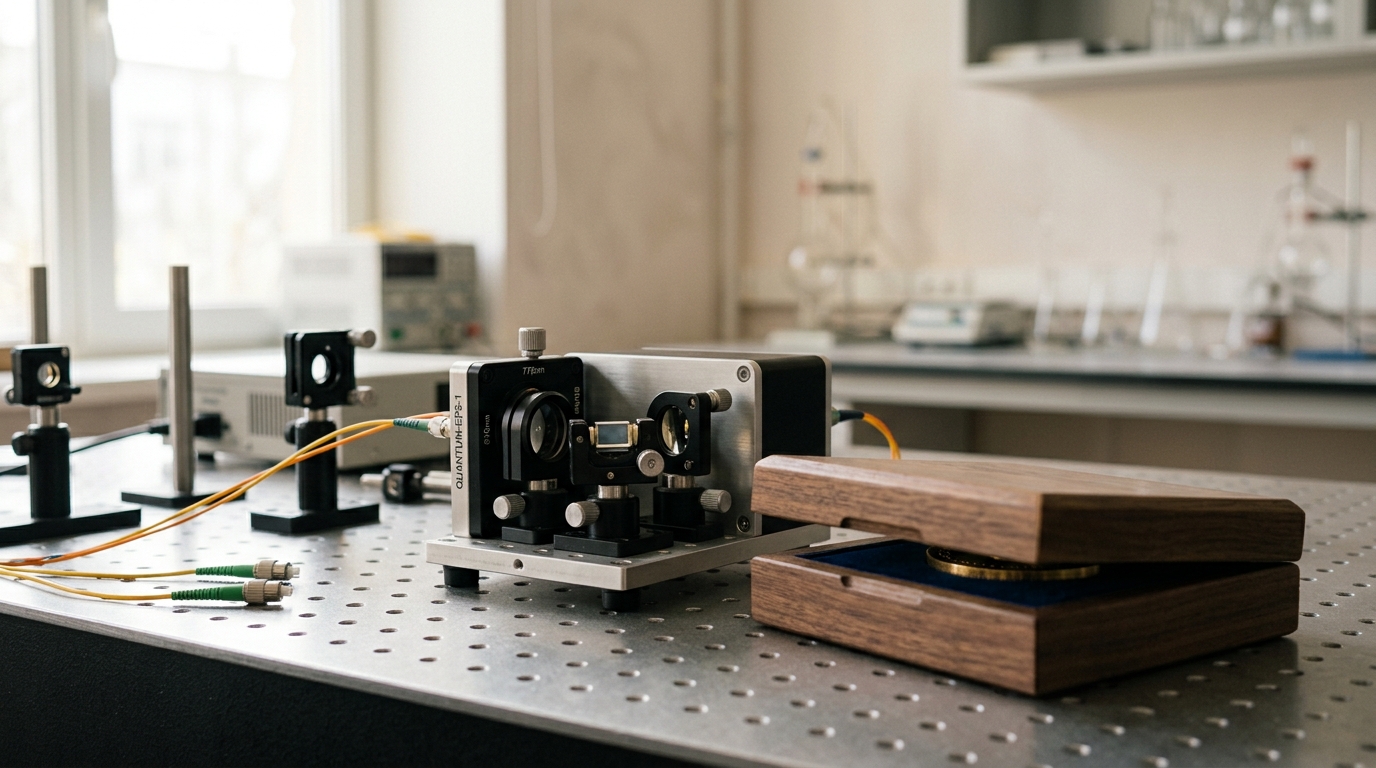
Figure 5. In 2022, the Nobel Prize in Physics recognized Clauser, Aspect, and Zeilinger for turning Bell's inequality into a body of experiments — the culmination, not the end, of the program. — Image prompt and art direction by Brecht Corbeel; generation pending.
The 2022 Nobel Prize
On 4 October 2022, the Royal Swedish Academy of Sciences awarded the Nobel Prize in Physics jointly to Alain Aspect, John Clauser, and Anton Zeilinger “for experiments with entangled photons, establishing the violation of Bell inequalities and pioneering quantum information science” [8]. The Academy’s press release credits Clauser with building the first apparatus to test Bell-type inequalities experimentally, Aspect with the analyzer-switching design that closed the locality loophole, and Zeilinger with a range of refined entanglement experiments including teleportation and multi-photon entanglement that opened the door to quantum information applications.
The award is a fact of institutional record, and it is fair, as a matter of historical interpretation rather than raw fact, to read it as closing a fifty-eight-year arc that began with Bell’s 1964 paper: a theoretical result once regarded as a matter for philosophers of physics had, by 2022, become an experimentally settled body of work substantial enough for the discipline’s highest honor. What the prize does not settle — and no experiment can settle — is which interpretation of quantum mechanics (Copenhagen, many-worlds, pilot-wave, objective collapse, or others) best explains why nature behaves this way. The Bell-test program rules out an entire broad class of theories, local hidden-variable models, but multiple surviving interpretations remain fully consistent with every experimental result described here, and choosing among them remains, honestly, a matter on which working physicists disagree, characterized more by differing intuitions about explanatory economy than by any further data that could adjudicate the dispute.
What the history leaves open
Three genuinely open threads run forward from this history, and each deserves to be stated as an open question rather than resolved by assertion. First, contextuality — the Kochen-Specker-type result that quantum measurement outcomes cannot in general be assigned values independent of which other compatible measurements are performed alongside them — sits alongside Bell nonlocality as a second, related but distinct constraint on hidden-variable pictures, and its experimental tests continue in parallel with entanglement work. Second, the boundary between decoherence’s account of apparent classicality and a genuine resolution of the quantum measurement problem — the question of why any single outcome is realized at all, rather than a superposition of all possible outcomes persisting indefinitely — remains actively contested among interpretations, and decoherence theory, whatever its explanatory power, does not by itself require the observer to see one outcome rather than a superposition of all of them from a god’s-eye view. Third, the freedom-of-choice loophole noted above sets a hard limit on what any Bell-test experiment, however well engineered, can claim to prove, and it is intellectually honest to note that limit rather than treat the loophole-closing program as having produced absolute metaphysical certainty. History here has been a sequence of increasingly hard-to-evade experimental tests, not a philosophical proof, and the next chapter — plausibly involving cosmic Bell tests using photons from quasars billions of light-years apart to push the freedom-of-choice loophole back to the earliest moments of the observable universe — will extend that same experimental discipline rather than replace it.
Sources
- Albert Einstein, Boris Podolsky, and Nathan Rosen. Can Quantum-Mechanical Description of Physical Reality Be Considered Complete?. Physical Review (1935). DOI: 10.1103/PhysRev.47.777.
- John S. Bell. On the Einstein Podolsky Rosen Paradox. Physics Physique Fizika (1964). DOI: 10.1103/PhysicsPhysiqueFizika.1.195.
- Alain Aspect, Jean Dalibard, and Gérard Roger. Experimental Test of Bell's Inequalities Using Time-Varying Analyzers. Physical Review Letters (1982). DOI: 10.1103/PhysRevLett.49.1804.
- Bas Hensen et al.. Loophole-free Bell inequality violation using electron spins separated by 1.3 kilometres. Nature (2015). DOI: 10.1038/srep30289.
- Lynden K. Shalm et al.. Strong Loophole-Free Test of Local Realism. Physical Review Letters (2015). DOI: 10.1103/PhysRevLett.115.250402.
- Wojciech H. Zurek. Decoherence and the Transition from Quantum to Classical. Physics Today (1991).
- Dik Bouwmeester, Jian-Wei Pan, Klaus Mattle, Manfred Eibl, Harald Weinfurter, and Anton Zeilinger. Experimental Quantum Teleportation. Nature (1997). DOI: 10.1038/37539.
- The Royal Swedish Academy of Sciences. The Nobel Prize in Physics 2022 — Press Release. NobelPrize.org (2022).
Originally published at https://absolutedigitalpublishers.com/articles/from-origins-to-frontier-a-history-of-quantum-foundations-and-measurement.