From Origins to Frontier: A History of Precision Cosmology
How cosmology went from one man's plate measurements at a mountaintop dome to a discipline that pins the universe's age to four significant figures — and why its two best instruments now disagree.
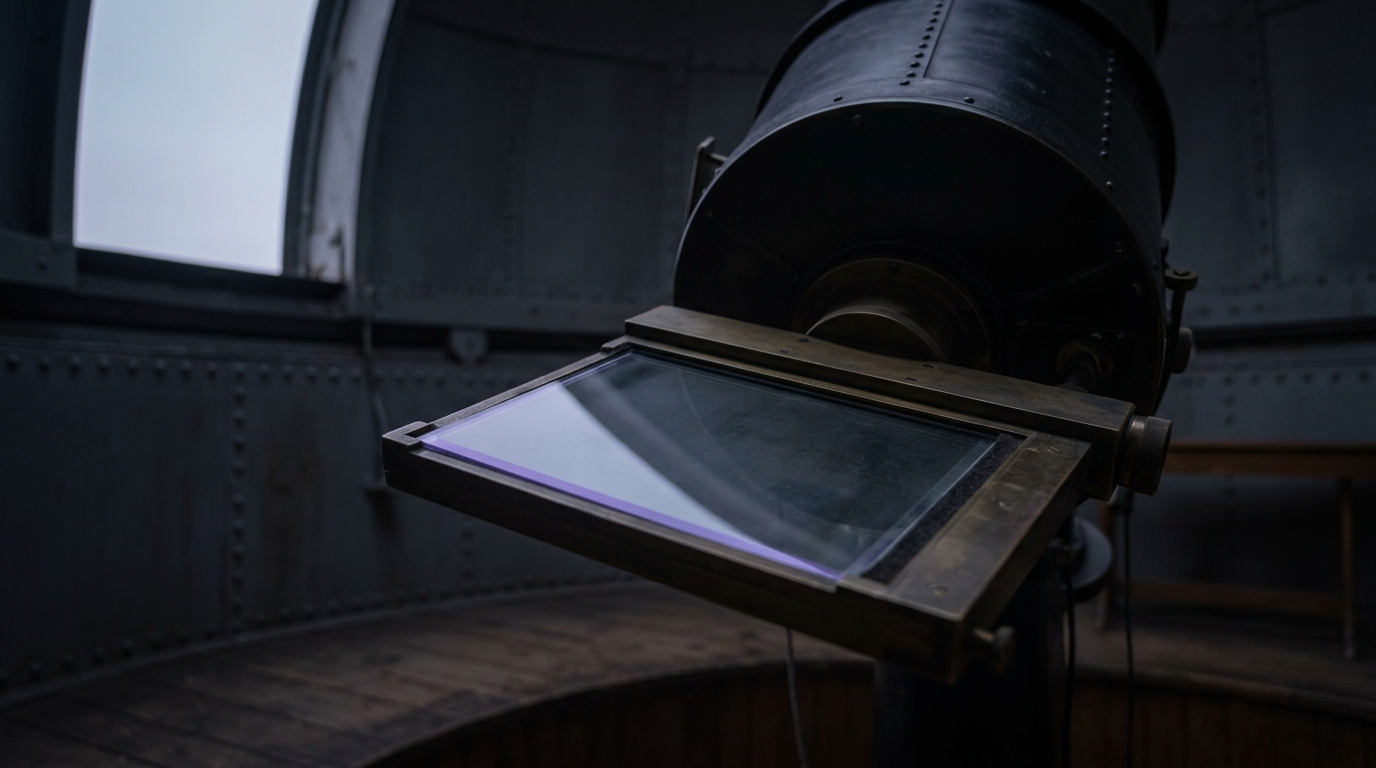
Mount Wilson Observatory, 1920s: the instrument that first resolved individual stars in Andromeda and measured the redshift-distance relation. — Image prompt and art direction by Brecht Corbeel; generation pending.
Abstract
Precision cosmology is younger than it looks. This article traces its instrumented history from Edwin Hubble's 1929 distance-velocity relation through the accidental 1965 discovery of the cosmic microwave background, the 1998 supernova campaigns that revealed cosmic acceleration, the satellite era of COBE, WMAP, and Planck that turned cosmological parameters into measured numbers with error bars, and the current Hubble-tension standoff between early- and late-universe measurements. It separates verified milestones from interpretation, and closes with an honest look at where the field's inference chain is still assumption-dependent.
Cosmology’s reputation for precision is recent. For most of the twentieth century, the discipline argued in factors of two: the age of the universe, its expansion rate, even whether it was expanding at all, moved in and out of controversy for decades at a time. What changed was not a single insight but a chain of instruments, each one converting a qualitative claim about the universe into a number with a stated uncertainty. This is a history of that chain, told through what was actually measured, when, by whom, and with what margin of error — and through the disagreement, unresolved as of this writing, that the chain’s own precision has exposed at its far end.
Hubble’s redshift and the case for expansion
Edwin Hubble did not discover that the universe was expanding in a single moment. He built the case across a short 1929 paper that compared distances to twenty-four galaxies — inferred mostly from the brightness of stars he could resolve in them with the Hooker telescope’s 100-inch mirror at Mount Wilson — against radial velocities that Vesto Slipher and others had already measured from their spectra [1]. The paper reported a roughly linear relation between distance and recession velocity: farther objects receded faster. Hubble himself was cautious about what this implied physically, and the paper’s language stays close to the data. The cosmological interpretation — that space itself is expanding, stretching the wavelength of light in transit, rather than galaxies moving through static space — came from theorists including Georges Lemaître, who had proposed an expanding-universe solution to Einstein’s field equations before Hubble’s observational paper appeared, and Alexander Friedmann before him. The historical credit is therefore shared, and modern references to “Hubble’s law” describe an empirical relation whose theoretical framework had multiple independent originators.
What is not in dispute is the number’s fragility at the time. Hubble’s original data set was small, his distance calibrations were later found to be off by a large factor because of an uncorrected mixture of two different types of variable star used as distance markers, and the expansion rate he published was roughly seven times larger than the value accepted today. Precision cosmology’s history is partly a history of steadily removing exactly this kind of systematic error from an otherwise sound method — a pattern that recurs at every later stage of this story, including the current one.
A second nineteenth-and-twentieth-century thread ran in parallel and stayed unresolved far longer. In 1933, examining velocity dispersions of galaxies in the Coma cluster, Fritz Zwicky found that the cluster’s galaxies moved far too fast to be held together by the gravity of their visible stars alone — by his estimate, the dynamical mass implied by their motions exceeded the photometric mass by close to a factor of ten [9]. Zwicky’s proposed explanation, “dunkle Materie” (dark matter), assumed it took a mundane form — faint stars, cold gas, solid bodies — and the finding drew little sustained attention for decades. It would take flat rotation curves in spiral galaxies, confirmed independently through the 1970s, before the astronomical community treated missing mass as a structural feature of the universe rather than a measurement artifact. Both threads — an expanding universe and a universe with unseen mass — sat in cosmology for generations before either had a mechanism, and neither problem is what finally made cosmology “precision” cosmology. That took a third, accidental discovery.
An antenna, a noise problem, and the relic radiation
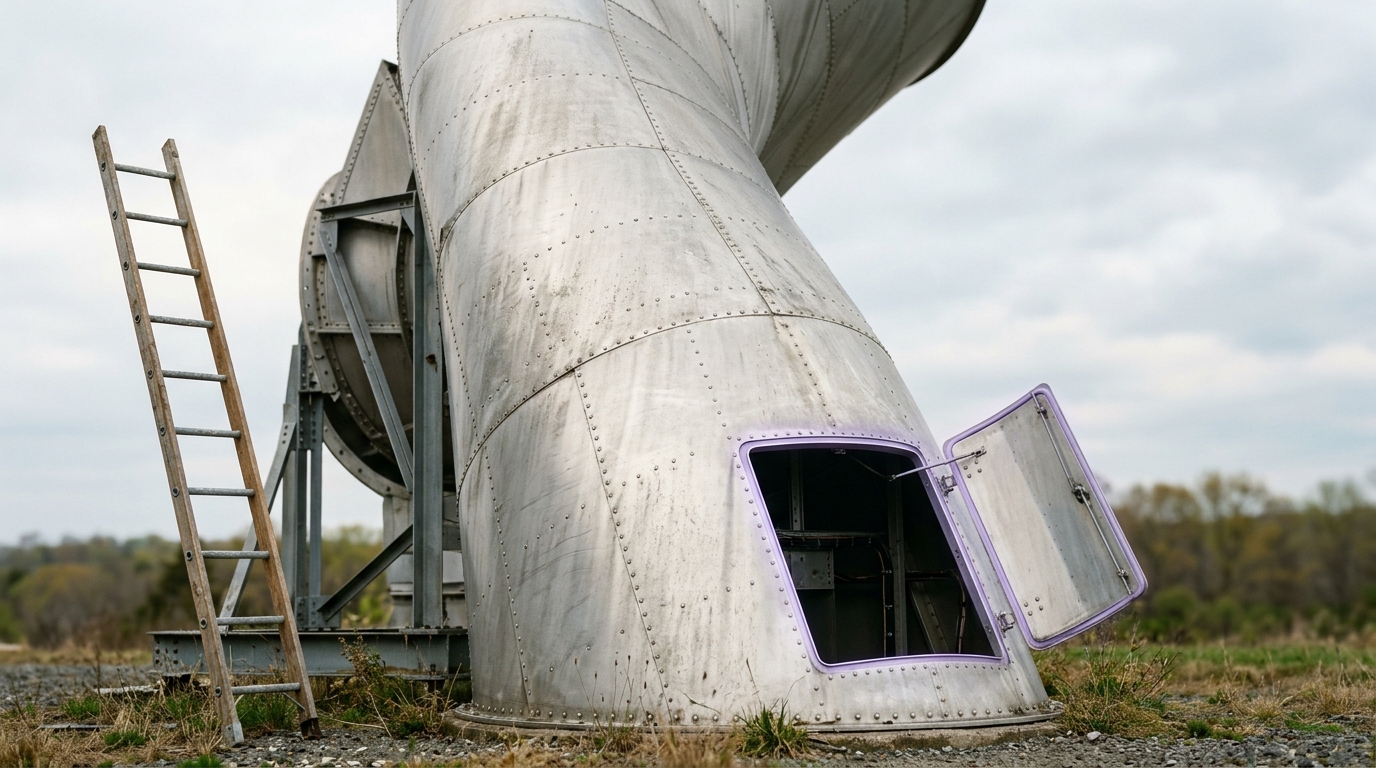
Figure 1. Holmdel, New Jersey, 1964: a horn antenna built for satellite communication picked up a faint hiss that would not go away. — Image prompt and art direction by Brecht Corbeel; generation pending.
In 1964, Arno Penzias and Robert Wilson at Bell Telephone Laboratories were trying to eliminate noise from a large horn-reflector antenna at Holmdel, New Jersey, built originally for satellite communication work. After ruling out ground pickup, urban radio interference, and even pigeon droppings inside the horn, they were left with a faint, uniform microwave signal that would not go away no matter which direction the antenna pointed. Their 1965 paper reported an excess antenna temperature of about 3.5 kelvin at a wavelength of 7.3 centimeters, isotropic, unpolarized, and free of seasonal variation [2]. The paper is notable for what it does not claim: it describes the measurement and explicitly defers interpretation, in the same issue, to a companion theoretical paper by Robert Dicke, James Peebles, Peter Roll, and David Wilkinson at Princeton, who had independently been building an instrument to search for exactly this signal — the cooled relic radiation predicted by a hot early universe. Penzias and Wilson received the 1978 Nobel Prize in Physics for the measurement.
The cosmic microwave background’s existence supported an expanding, cooling universe with a hot origin, but a single antenna measurement at one frequency could not establish that the radiation was truly a thermal blackbody spectrum, the specific prediction that distinguished a relic thermal bath from other explanations. That confirmation came in 1990, when the Cosmic Background Explorer satellite’s FIRAS instrument returned a spectrum matching a blackbody at 2.735 kelvin to within about one percent of the peak intensity across the observed range, with no submillimeter excess and no Rayleigh-Jeans deviation of the kind some rival theories predicted [3]. COBE’s Differential Microwave Radiometer instrument, on the same spacecraft, went on to detect the CMB’s faint temperature anisotropies — variations of only a few parts in one hundred thousand across the sky — the seeds later interpreted as the density fluctuations that grew into galaxies and clusters.
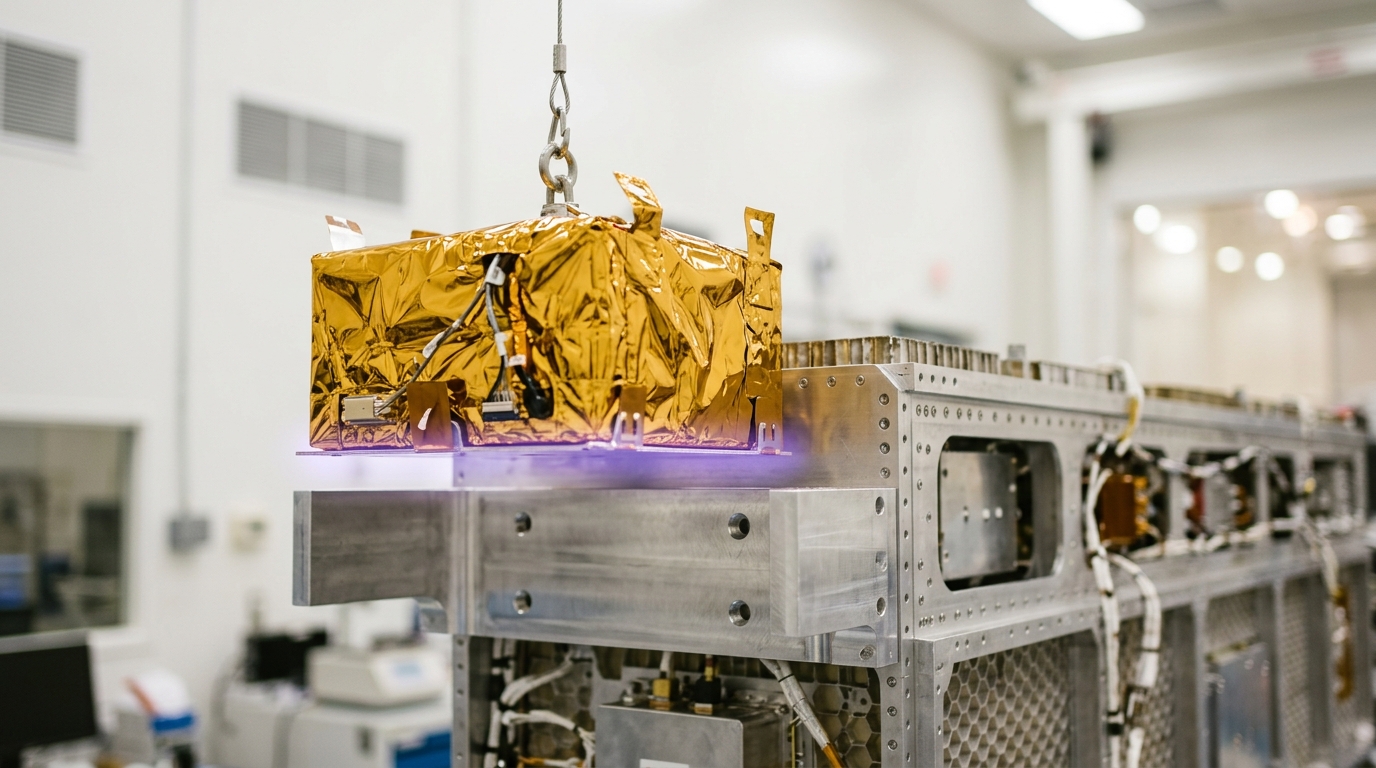
Figure 2. Goddard Space Flight Center, circa 1989: the instrument that measured the cosmic microwave background's blackbody spectrum to better than one percent. — Image prompt and art direction by Brecht Corbeel; generation pending.
Standard candles and an unexpected acceleration
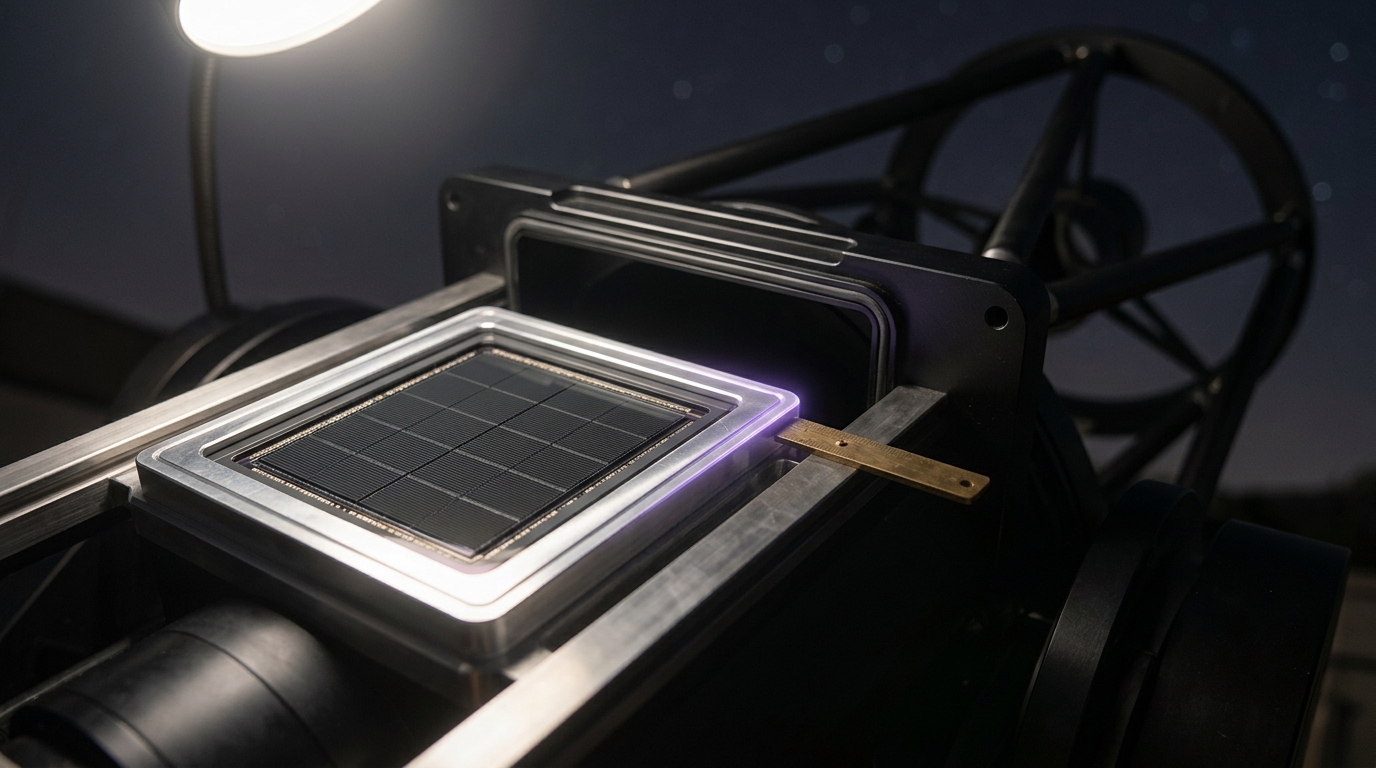
Figure 3. Cerro Tololo, mid-1990s: wide-field CCD cameras repeatedly imaged the same patches of sky, hunting for the faint new points of light that would reveal cosmic acceleration. — Image prompt and art direction by Brecht Corbeel; generation pending.
By the 1990s, two competing teams — the Supernova Cosmology Project, led by Saul Perlmutter, and the High-z Supernova Search Team, led by Brian Schmidt and including Adam Riess — were using Type Ia supernovae as standardizable candles to measure how the universe’s expansion rate had changed over billions of years. Type Ia supernovae detonate with a characteristic peak brightness, letting astronomers infer distance from how bright a given supernova appears; comparing that distance to the supernova’s redshift traces the expansion history directly. Both teams expected to measure a small deceleration, consistent with gravity slowing the expansion down over cosmic time. Instead, in 1998, both teams independently found that distant supernovae appeared fainter — and therefore farther away — than a decelerating or even a steadily expanding universe would predict. The expansion was speeding up.
The finding was startling enough that both groups spent considerable effort checking it against dust extinction, evolving supernova populations, and calibration error before publishing it as a discovery rather than an anomaly. It held up. In 2011 the Royal Swedish Academy of Sciences awarded the Nobel Prize in Physics half to Perlmutter and the other half jointly to Schmidt and Riess “for the discovery of the accelerating expansion of the Universe through observations of distant supernovae” [4]. The Nobel committee’s own language is careful to describe the observation rather than to endorse any specific explanation for it: the acceleration is attributed to a “dark energy” whose physical nature remains unknown, described in the committee’s popular summary as perhaps the greatest outstanding enigma in physics. That qualification is worth preserving precisely: 1998 established a measured cosmological fact — the expansion rate is increasing — not a theory of what drives it. The cosmological constant, a repulsive term in Einstein’s original field equations that Einstein himself had once regarded as an error, became the leading placeholder explanation because it fits the data economically, not because a physical mechanism for it has been identified.
The satellite era: turning cosmology into parameter estimation
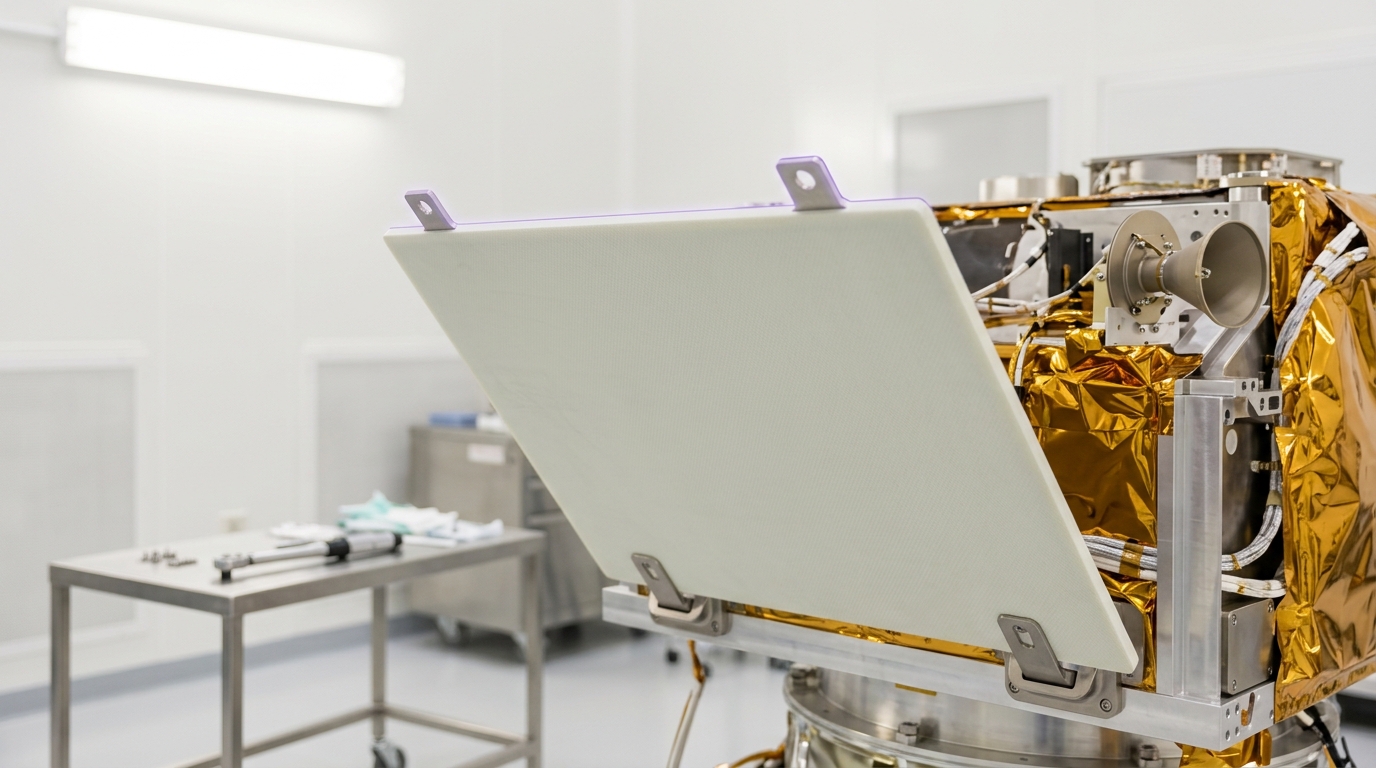
Figure 4. Kennedy Space Center, 2001: the probe that would spend nine years at the second Lagrange point pinning down the age and geometry of the universe. — Image prompt and art direction by Brecht Corbeel; generation pending.
The 1998 supernova result converted cosmology’s central open question from “is the universe accelerating” to “what are the numbers.” Answering that required mapping the cosmic microwave background’s temperature fluctuations with far greater sensitivity and angular resolution than COBE had provided, because the pattern of fluctuations at different angular scales encodes the universe’s geometry, its matter and energy content, and the physics of the plasma that emitted the light. NASA’s Wilkinson Microwave Anisotropy Probe, launched in 2001 to an orbit around the second Sun-Earth Lagrange point, produced full-sky temperature maps over nine years of operation. Its final data release constrained the Hubble constant to 69.32 ± 0.80 kilometers per second per megaparsec, the universe’s age to 13.772 ± 0.059 billion years, and reduced the allowed volume of six-parameter cosmological model space by a factor of roughly 68,000 relative to pre-WMAP constraints [5]. That last figure is the real measure of what “precision cosmology” came to mean in practice: not a single improved number, but a joint fit across many parameters simultaneously, each one now constrained tightly enough to falsify entire classes of alternative models.
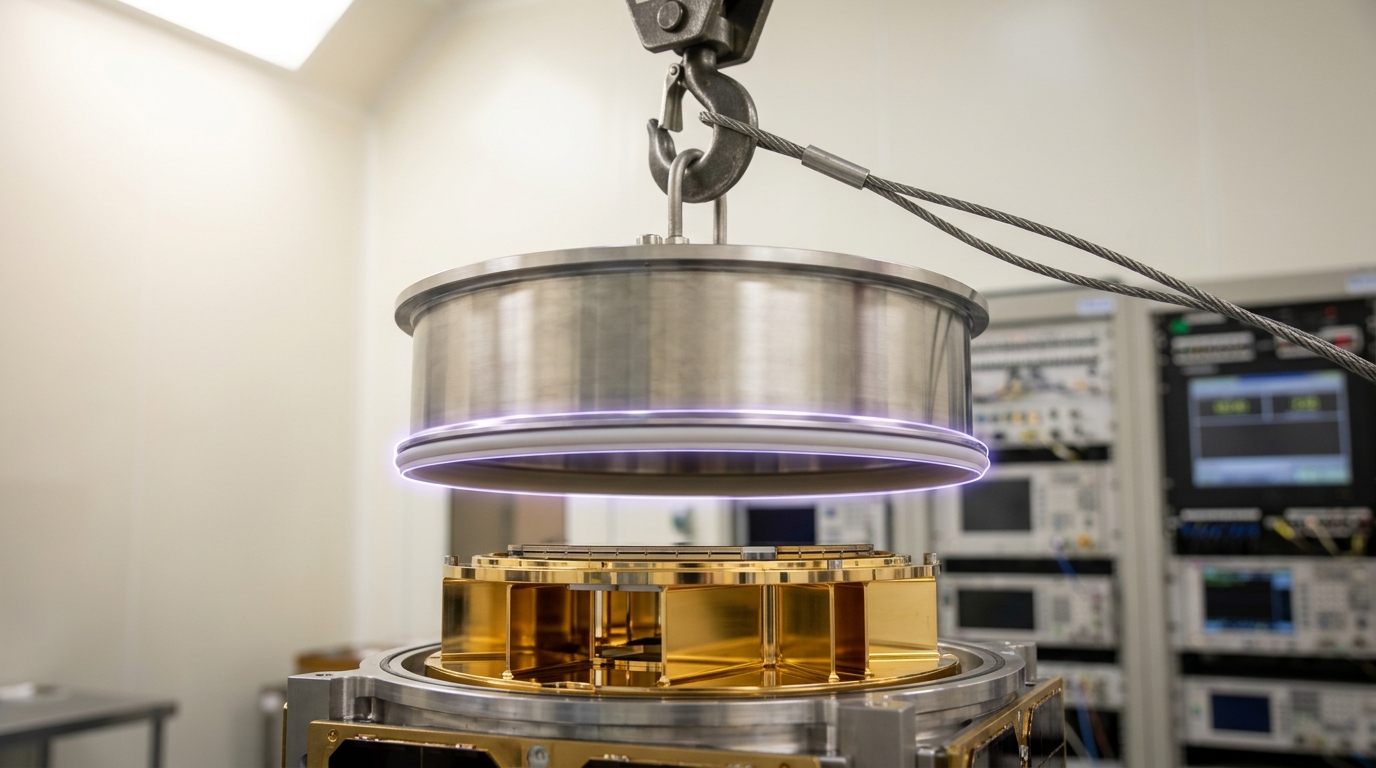
Figure 5. Planck, 2009: cooled to a fraction of a degree above absolute zero, its bolometers mapped the cosmic microwave background to a precision that ended the WMAP era. — Image prompt and art direction by Brecht Corbeel; generation pending.
The European Space Agency’s Planck satellite, launched in 2009 and operating until 2013, extended this to still finer angular resolution and a wider frequency range, cooling its bolometer detectors to a fraction of a degree above absolute zero to suppress instrumental noise. Planck’s 2018 final cosmological parameter release fit the standard six-parameter flat Lambda-CDM model to its temperature and polarization data, reporting the acoustic scale — the characteristic angular size of the sound-wave pattern imprinted on the CMB — to 0.03 percent precision, a cold dark matter density of 0.120 ± 0.001 (in units of the density parameter times the reduced Hubble parameter squared), and a Hubble constant inferred from CMB physics of about 67.4 kilometers per second per megaparsec [6]. The acoustic scale itself follows from a genuine physical model worth writing down explicitly, because the whole CMB-based measurement chain depends on it:
\theta_* = \frac{r_*}{D_A(z_*)}
where r_* is the physical size of the sound horizon at recombination — how far a pressure wave in the primordial plasma could travel before the plasma became neutral and transparent — and D_A(z_*) is the angular diameter distance to that same epoch. Planck measures \theta_* directly from the angular spacing of peaks in the CMB power spectrum to extraordinary precision; converting that angle into a present-day expansion rate H_0 requires assuming a cosmological model (matter content, radiation content, and the equation of state of dark energy) to relate r_* and D_A(z_*) to H_0. This is the crux of the tension discussed below: Planck’s H_0 is a model-dependent inference from an early-universe ruler, not a direct local measurement.
The Hubble tension
The local, late-universe route to H_0 does not go through the CMB at all. It is built from a distance ladder: geometric parallax anchors the distance to nearby Cepheid variable stars, Cepheids calibrate the peak luminosity of Type Ia supernovae in the same host galaxies, and those calibrated supernovae are then used to measure distances — and thus the expansion rate — out to galaxies far enough that their recession velocity is dominated by cosmic expansion rather than local motion. The SH0ES team’s 2022 analysis, using Hubble Space Telescope observations of Cepheids in the hosts of forty-two Type Ia supernovae, reported a local H_0 of 73.04 ± 1.04 kilometers per second per megaparsec [7].
That number sits roughly five standard deviations away from Planck’s CMB-inferred value near 67.4. Both measurements have, individually, become far more precise over the past decade — which is exactly why the disagreement between them, once comfortably inside the error bars, is now a real discrepancy rather than noise. This is the Hubble tension, and it is the field’s most important open problem for one specific reason: it pits two independent, mature, heavily cross-checked measurement chains against each other, rather than one shaky number against a stable one. It is worth being precise about what has and has not been ruled out. Distance-ladder systematics — the Cepheid period- luminosity calibration, supernova standardization, photometric zero points — have been checked repeatedly, including by comparing SH0ES’s Cepheid calibration against an independent one using the tip of the red-giant branch, with only partial convergence. On the early-universe side, the acoustic scale itself is not in question, but the assumed pre-recombination physics used to convert it into H_0 could in principle be incomplete — an early form of dark energy, extra relativistic species, or modified matter behavior before recombination could each shift the inferred r_* and thus H_0 without Planck’s raw measurement being wrong. No single proposed fix currently resolves the tension without introducing tension with some other, independent dataset. As of this writing the honest summary is not “here is the answer” but “the disagreement is real, well-measured on both sides, and unexplained.”
Independent geometry: galaxy surveys and the acoustic ruler
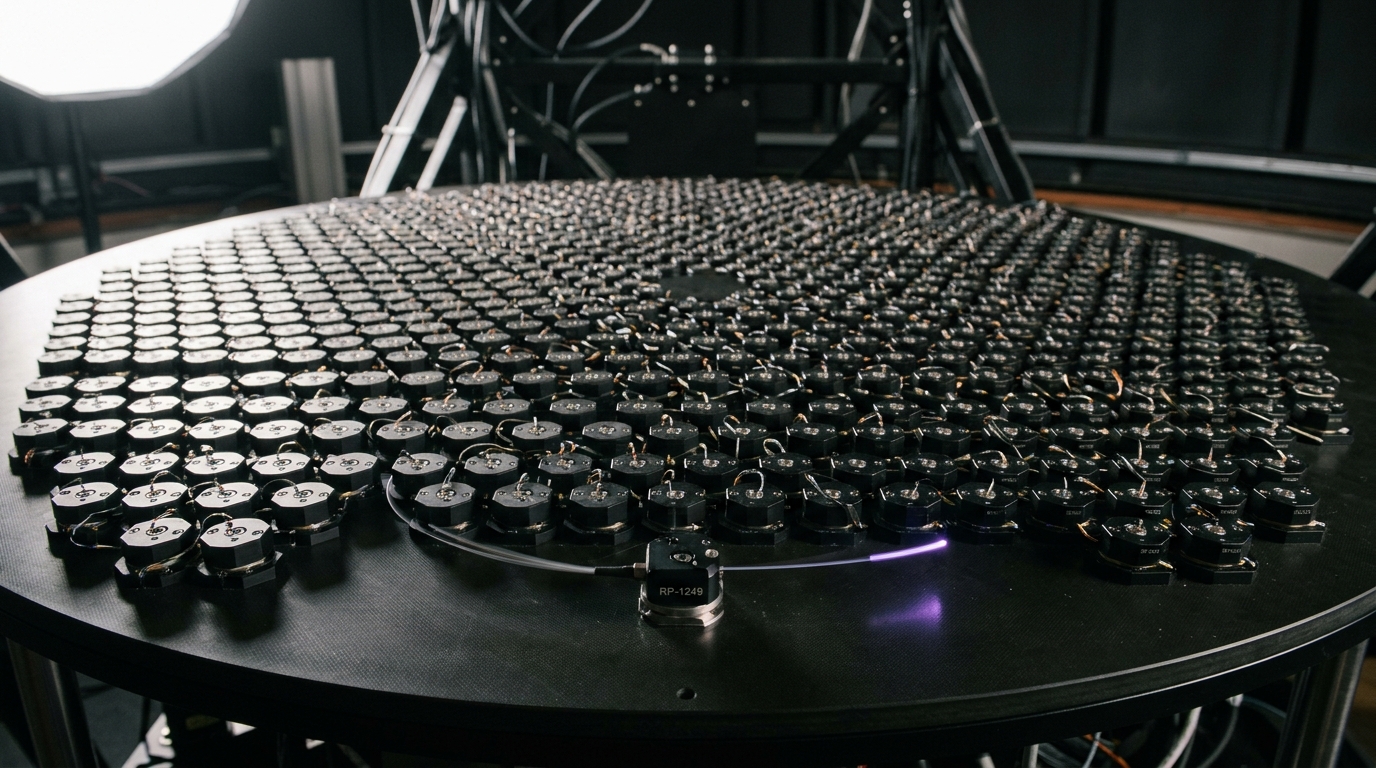
Figure 6. Kitt Peak, present day: five thousand robotic positioners aim optical fibers at pre-selected galaxies each night, building the largest 3D map of the universe yet made. — Image prompt and art direction by Brecht Corbeel; generation pending.
A third, independent method has entered the field in the past two decades: baryon acoustic oscillations imprinted not on the CMB but on the later, three-dimensional distribution of galaxies themselves. The same sound waves that set the CMB’s acoustic scale also left a faint, statistically detectable preferred separation between galaxies — a standard ruler that can be measured at many different cosmic epochs by surveying galaxy positions and redshifts in bulk. The Dark Energy Spectroscopic Instrument, operating at Kitt Peak with roughly five thousand robotically positioned optical fibers that can each be aimed at a separate pre-selected galaxy or quasar every exposure, released its first-year cosmological results in 2024 from more than six million extragalactic objects across redshifts from 0.1 to 4.2. Combined with a Big Bang nucleosynthesis prior on the baryon density and the CMB-measured acoustic angular scale, DESI’s first-year analysis returned a matter density of \Omega_m = 0.295 \pm 0.015 and H_0 = 68.52 \pm 0.62 kilometers per second per megaparsec [8] — a value between the CMB-only and local-ladder numbers, and, notably, mild evidence favoring a dark energy equation of state that evolves with time rather than the constant value assumed by the simplest Lambda-CDM model. That evolving-dark-energy hint is preliminary: it depends on which combination of datasets is used and has not reached the standard of evidence the field applies to a genuine model revision. It is reported here as exactly that — an early, statistically interesting signal under active follow-up, not a settled result.
What the history actually establishes
Stripped of interpretation, four things in this history are secure observational facts, each confirmed by more than one independent method: the universe’s light is redshifted in a way consistent with metric expansion (Hubble, and every redshift survey since); the universe was once hot and opaque and left behind a near-perfect blackbody relic radiation (Penzias-Wilson and COBE); galaxies and clusters move as though far more mass is present than is seen in starlight (Zwicky, and rotation-curve and lensing studies since); and the expansion rate is increasing rather than decreasing (the 1998 supernova campaigns, since corroborated by CMB and BAO geometry). What remains genuinely open is the physical identity of dark matter and dark energy, and — the newest item on the list — why two well-tested routes to the same present-day expansion rate disagree by an amount too large to be an accident of measurement. Precision cosmology’s history is not a story of a problem being solved; it is a story of the error bars around an unsolved problem shrinking fast enough that the disagreement itself became the discovery.
It is worth dwelling on how unusual this situation is for an empirical science. In most fields, a persistent discrepancy between two measurements of the same quantity is resolved by finding the weaker method and improving it. Here, both methods have already withstood roughly two decades of adversarial scrutiny. The distance ladder has been rebuilt with three independent stellar calibrators — classical Cepheids, the tip of the red-giant branch, and Mira variables — each anchored by a different absolute-distance technique, and each produces a local H_0 well above Planck’s inferred value, though not always identical to SH0ES’s own number. The CMB-based inference has likewise been cross-checked against an entirely separate CMB experiment, the Atacama Cosmology Telescope, and against the South Pole Telescope, both of which recover parameters consistent with Planck’s. This is why the tension is treated as a serious anomaly rather than a rounding error to be absorbed by better bookkeeping: the redundancy on both sides of the disagreement has already been built, and it did not make the gap close.
The methodological lesson from a century of this history is that “precision” in cosmology has always meant something narrower than “certainty.” Each instrument in this chain produced a number with a small formal uncertainty and a much larger, harder-to-quantify systematic budget: Hubble’s Cepheid mixing problem, COBE’s need to rule out Galactic foreground contamination before trusting its blackbody fit, the supernova teams’ years of dust and selection-effect checks before 1998’s result was accepted, and now the distance ladder’s calibrator choice and the CMB’s assumed pre-recombination physics. None of these systematics were visible from the size of the statistical error bar alone. That is the pattern worth carrying forward: a cosmological number’s published uncertainty describes how well an instrument repeats itself, not how confident the field should be that the underlying model is complete. The Hubble tension is what happens when that gap between statistical precision and model confidence finally becomes larger than the statistical error bars themselves.
Looking ahead, the working assumption among most cosmologists is that either a distance-ladder systematic yet unidentified, or new early-universe physics beyond standard Lambda-CDM, resolves the Hubble tension within the next decade, as DESI’s later data releases, the Vera Rubin Observatory’s wide-field survey, and further JWST-based distance-ladder cross-checks accumulate. That is a reasonable expectation, not a settled prediction: its disconfirmation condition is straightforward — if both the local and CMB-based measurements keep tightening their error bars over the next several years and the roughly five-sigma gap between them persists or grows, the tension will have graduated from an anomaly to a signal that the standard cosmological model itself is incomplete, which would be the field’s most consequential finding since 1998.
Sources
- Edwin Hubble. A Relation between Distance and Radial Velocity among Extra-Galactic Nebulae. Proceedings of the National Academy of Sciences (1929). DOI: 10.1073/pnas.15.3.168.
- A. A. Penzias and R. W. Wilson. A Measurement of Excess Antenna Temperature at 4080 Mc/s. The Astrophysical Journal (1965).
- John C. Mather et al.. Scientific results from the Cosmic Background Explorer (COBE). Proceedings of the National Academy of Sciences (1993). DOI: 10.1073/pnas.90.11.4766.
- The Royal Swedish Academy of Sciences. The Nobel Prize in Physics 2011 — Press release. NobelPrize.org (2011).
- G. Hinshaw et al.. Nine-Year Wilkinson Microwave Anisotropy Probe (WMAP) Observations: Cosmological Parameter Results. The Astrophysical Journal Supplement Series (2013). DOI: 10.1088/0067-0049/208/2/19.
- Planck Collaboration. Planck 2018 results. VI. Cosmological parameters. Astronomy & Astrophysics (2018). DOI: 10.1051/0004-6361/201833910.
- Adam G. Riess et al.. A Comprehensive Measurement of the Local Value of the Hubble Constant with 1 km/s/Mpc Uncertainty from the Hubble Space Telescope and the SH0ES Team. The Astrophysical Journal Letters (2022). DOI: 10.3847/2041-8213/ac5c5b.
- DESI Collaboration. DESI 2024 VI: cosmological constraints from the measurements of baryon acoustic oscillations. Journal of Cosmology and Astroparticle Physics (2024).
- Gianfranco Bertone and Dan Hooper. A History of Dark Matter. NASA/IPAC Extragalactic Database (NED) Level 5 (2018).
Originally published at https://absolutedigitalpublishers.com/articles/from-origins-to-frontier-a-history-of-precision-cosmology.