From Origins to Frontier: A History of Particle Physics Beyond the Standard Model
The Standard Model was completed in 2012 and has not cracked since. This is the history of the search for what comes after it — and of the null results that quietly rewrote the search itself.
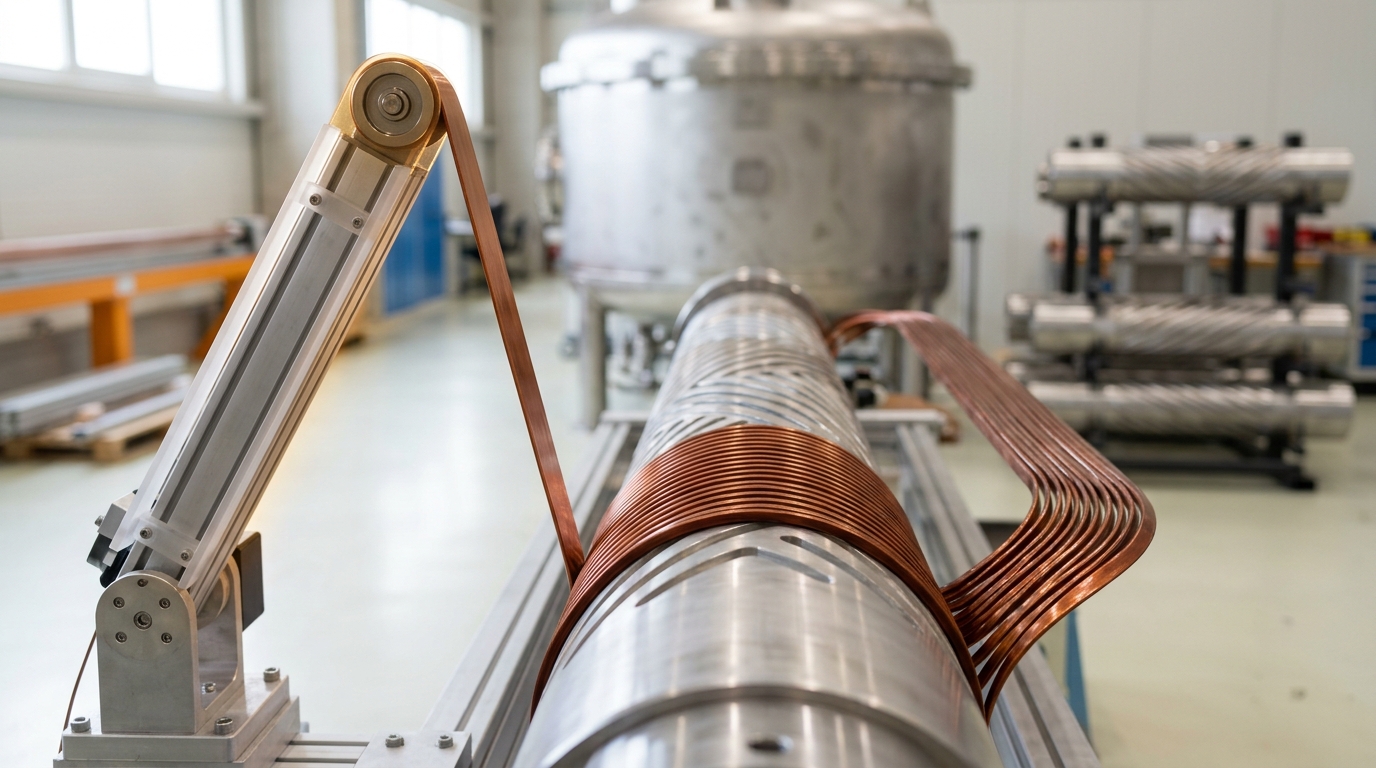
A dipole magnet coil part-wound in a CERN-style assembly hall — the physical infrastructure that turns a theoretical search into beam energy. — Image prompt and art direction by Brecht Corbeel; generation pending.
Abstract
On 4 July 2012, ATLAS and CMS announced a new particle consistent with the Higgs boson, completing the Standard Model's roster after nearly five decades. This article traces what happened next: the neutrino-oscillation discoveries that had already proven the model incomplete, the long, increasingly stringent supersymmetry searches that found nothing at the LHC, the rise and partial retreat of flavor anomalies at LHCb, the persistent tension in the muon's magnetic moment, the contested W-boson mass, and the null results from dark-matter direct-detection experiments. It separates confirmed fact from vendor-style overclaim, characterizes live disagreements honestly, and closes with the concrete, dated case for the next generation of facilities — the Future Circular Collider foremost among them — built to either find something or exclude a much larger swath of theory space.
A model completed, and a model known to be incomplete, on the same day
On 4 July 2012, in an auditorium at CERN packed with physicists who had waited the better part of five decades, the spokespersons of the ATLAS and CMS experiments announced the observation of a new particle at a mass near 125–126 GeV, with decay properties consistent with the long-sought Higgs boson [1]. The ATLAS collaboration’s own paper, published later that year in Science, reported a local significance for the excess and framed it carefully as a particle “consistent with” the Higgs mechanism’s predictions rather than a fully characterized confirmation of every expected coupling [2]. That caution mattered: a discovery announcement is a statistical claim about an excess of events, not yet a complete portrait of a particle’s properties, and the collaborations spent the following decade measuring couplings, spin, and parity to nail down that the object really was the scalar the Standard Model required.
The completion was real. Every particle the Standard Model predicted — quarks, leptons, gauge bosons, and finally the Higgs — had now been observed. But “complete” in this narrow technical sense did not mean “sufficient.” By the time the Higgs was found, physicists already possessed unambiguous laboratory proof that the Standard Model as written was wrong about at least one thing: neutrinos have mass, and the Standard Model’s original formulation gave them none. This is the paradox that has shaped the last decade and a half of the field, and it is worth stating plainly at the outset, because it is a fact, not a rhetorical flourish: the Standard Model was simultaneously completed and known to be incomplete, and the history of the search for what lies beyond it begins from that contradiction.
The neutrino crack, discovered before the capstone was laid
The proof came from underground. Super-Kamiokande, a 50,000-ton water-Cherenkov detector in a zinc mine northwest of Tokyo, measured atmospheric neutrinos arriving from directly overhead and from the opposite side of the Earth, and found that the flux of muon neutrinos that had traveled the long path through the planet was suppressed relative to the short path — a discrepancy explained only if neutrinos change flavor, or “oscillate,” in flight, which is possible only if they carry mass [3]. The Sudbury Neutrino Observatory, using heavy water in a nickel mine in Ontario, independently confirmed flavor change using solar neutrinos, closing the case from a second, complementary direction. Takaaki Kajita and Arthur McDonald shared the 2015 Nobel Prize in Physics for these results [3].
Massive, oscillating neutrinos cannot be accommodated by the Standard Model’s original field content without an addition — most simply, right-handed neutrino fields or a seesaw mechanism, both are extensions beyond the model as originally written. This is worth separating from vaguer talk of “new physics”: neutrino mass is not a hint or an anomaly at some sigma level, it is an established, repeatedly confirmed fact, and it is already, definitionally, physics beyond the original Standard Model. Everything that follows in this history — supersymmetry, flavor anomalies, dark matter searches — is a search for further extensions on top of a model that neutrino oscillation had already forced open.
Supersymmetry: the leading hypothesis, tested until it wasn’t the leading hypothesis anymore
For much of the 1990s and 2000s, supersymmetry (SUSY) was the dominant theoretical framework for what should lie beyond the Standard Model. It proposed a superpartner for every known particle, offered a natural candidate for dark matter in its lightest stable partner, and — most attractively to theorists — stabilized the Higgs boson’s mass against enormous quantum corrections that would otherwise require delicate, “unnatural” cancellation. When the LHC turned on, SUSY searches were near the top of nearly every experimental priority list.
They found nothing. Run 1 of the LHC excluded gluinos and squarks below roughly a TeV in simple benchmark scenarios; Run 2, with far higher luminosity and 13 TeV collisions, pushed those limits substantially further — a recent review of ATLAS and CMS SUSY searches summarizes exclusions reaching around 2 TeV for gluinos, above 1 TeV for top and bottom squarks in many scenarios, and above roughly 500 GeV to 1 TeV for charginos and neutralinos depending on the decay topology assumed [4]. No significant excess over Standard Model background has been observed in any of these channels through the analyses compiled in that review.
It is important to state precisely what a null result of this kind does and does not mean. It does not prove supersymmetry is false — the searches are model-dependent, built around specific decay assumptions (simplified models), and large classes of “natural” SUSY spectra with light higgsinos, compressed mass splittings, or R-parity violation remain far less constrained than the headline gluino and squark limits suggest. What the null results do establish is narrower and still consequential: the simplest, most “natural” weak-scale SUSY spectra that were the field’s leading motivation in the 1990s and 2000s are excluded. The theoretical appeal of SUSY as a solution to the hierarchy problem has correspondingly weakened, because naturalness arguments work best when superpartners are light, and the superpartners that would make the argument work cleanly are, at minimum, not sitting where the simplest models put them. This is an honest characterization of disagreement: some theorists still consider SUSY at higher mass scales well-motivated on other grounds (grand unification, dark matter), while others have shifted attention to alternative frameworks precisely because naturalness now requires increasingly fine-tuned cancellations. Neither position is a fact; both are live, defensible positions in a field where the sociological center of gravity has visibly moved.
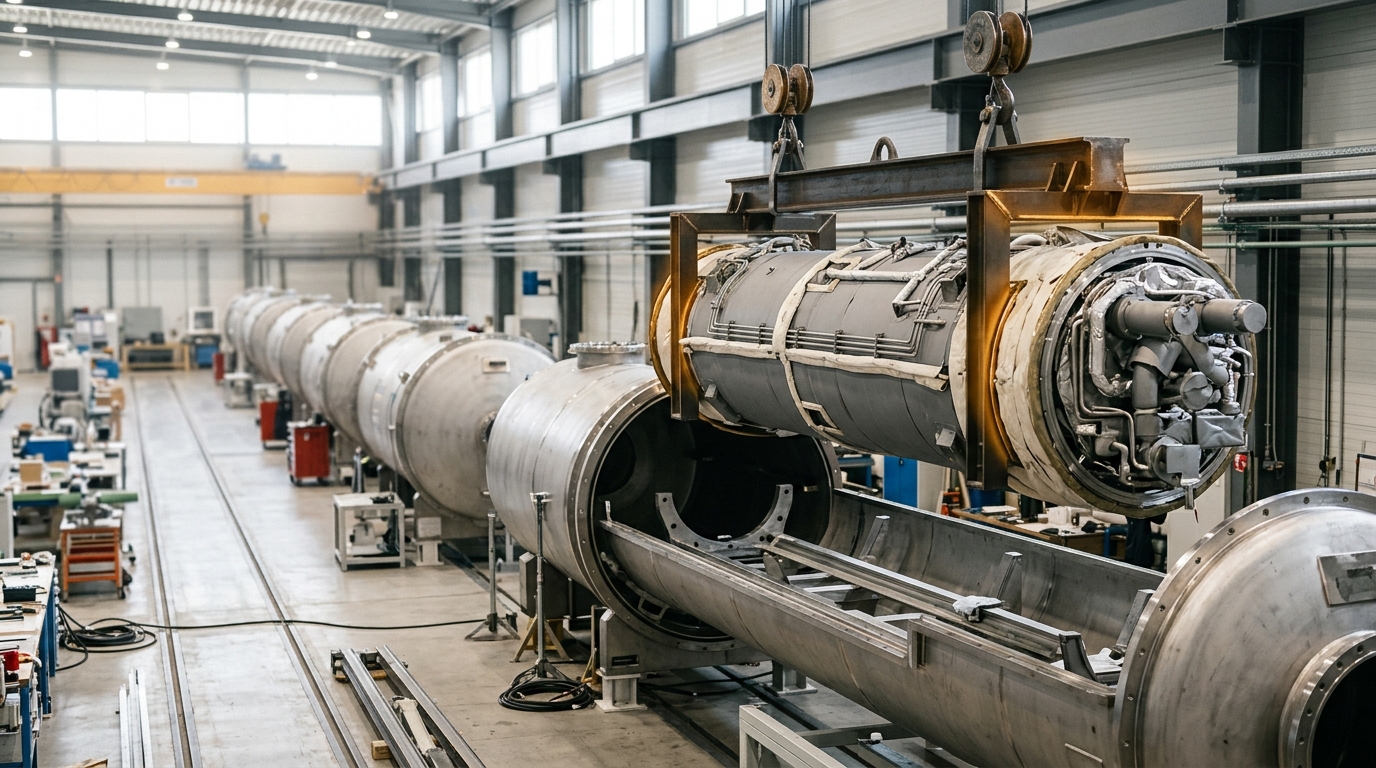
Figure 1. A completed cold mass poised over its cryostat — the last mechanical step before a magnet becomes part of a beamline for years. — Image prompt and art direction by Brecht Corbeel; generation pending.
Effective field theory: what physicists do while waiting for a mass to appear
The extended silence from direct searches for new particles pushed much of the theoretical community toward a different strategy: rather than assuming a specific new particle and calculating its signature, treat any new physics as too heavy to produce directly, and parametrize its indirect effects on Standard Model processes using an effective field theory (EFT). The Standard Model Effective Field Theory (SMEFT) adds higher-dimension operators, suppressed by inverse powers of some new physics scale \Lambda, to the ordinary Standard Model Lagrangian:
\mathcal{L}_{\text{SMEFT}} = \mathcal{L}_{\text{SM}} + \sum_i \frac{c_i}{\Lambda^{2}} \mathcal{O}_i^{(6)} + \mathcal{O}\!\left(\frac{1}{\Lambda^{4}}\right)
Here each \mathcal{O}_i^{(6)} is a dimension-six operator built from Standard Model fields respecting its gauge symmetries, and c_i is a dimensionless Wilson coefficient encoding the strength and structure of whatever heavy new physics generated it. This is not a discovery claim; it is a bookkeeping device, and its value is precisely that it is agnostic about what the new physics is. A single measured deviation — in a Higgs coupling, in a rare decay rate, in an electroweak precision observable — constrains a combination of these coefficients without committing to SUSY, extra dimensions, or any other specific completion. The framework became central exactly because two decades of direct searches had not handed theorists a specific particle to build a model around; EFT lets the data itself outline the shape of whatever is missing, before anyone commits to a story about what fills that shape in. It is a methodological shift as much as a theoretical one, and it is fair to call it the field’s dominant working language today, alongside — not replacing — continued direct searches for specific particles.
Anomalies that did not survive, and one that has
Flavor physics produced the decade’s most closely watched near-misses. Between roughly 2014 and 2021, LHCb’s measurements of B-meson decays into muon pairs versus electron pairs — the “R(K)” and R(K^{*}) ratios that the Standard Model predicts should equal one if the model’s lepton universality holds — showed persistent tensions with that prediction, at one point reaching a statistical significance of 3.1 standard deviations and drawing serious theoretical attention as a possible sign of new particles coupling differently to muons than to electrons [7]. In December 2022, an improved, higher-statistics LHCb analysis brought the measured ratios back into agreement with the Standard Model prediction [7]. The anomaly, as a statistical excess, is gone; what remains is a lesson about how this science actually proceeds — an intriguing few-sigma deviation generated years of theoretical model-building before more data resolved it in the Standard Model’s favor, and reporting that treated the early hints as an established discovery would have been simply wrong. This is a fact worth stating without hedging: the flavor anomalies as originally reported did not hold up.
Contrast that with the muon’s anomalous magnetic moment, a_\mu = (g-2)/2, which remains unresolved. The Fermilab Muon g-2 experiment’s most precise measurement to date, released in August 2023, gives a_\mu(\text{FNAL}) = 116{,}592{,}040(54)\times10^{-11}, a result precise to 0.20 parts per million [5, 6]. Combined with the experiment’s earlier data, the measured value differs from one widely used Standard Model theoretical prediction by (251\pm59)\times10^{-11}, a discrepancy the collaboration itself describes as reaching 4.2 standard deviations [6]. This is a genuine, still-live tension, and it is also a genuine, still-live disagreement among theorists — not about the experimental number, which is not seriously disputed, but about the Standard Model prediction it is compared against. Different theoretical approaches to computing the hadronic vacuum polarization contribution, the largest and hardest-to-calculate piece of the prediction, disagree with each other by more than enough to account for the discrepancy with experiment. Until that theoretical disagreement is settled — by improved lattice QCD calculations, by new low-energy cross-section data, or by both converging — it is not honest to call the muon g-2 result unambiguous evidence of new physics, nor is it honest to dismiss it as resolved. It sits exactly where a real anomaly sits: real, precisely measured, and contested at the point where experiment meets theoretical prediction rather than at the point of the measurement itself.
A second electroweak-sector tension follows a similar arc. In 2022, the CDF collaboration, using data collected years earlier at Fermilab’s now-shuttered Tevatron, published a W-boson mass measurement roughly 0.7% above the Standard Model’s predicted value, a discrepancy the collaboration and subsequent analyses characterized as reaching 7 standard deviations against the prediction and 4–5 standard deviations against other direct measurements of the same quantity [10]. The result was startling enough that CERN Courier covered it as setting CDF’s number “against the Standard Model” itself. It has not held up as cleanly as the muon anomaly: a subsequent CMS measurement at the LHC reported a W mass consistent with the Standard Model prediction, in tension with CDF’s outlier value rather than confirming it [10]. The honest current state is unresolved discord between two precision measurements from two different accelerators, not a confirmed anomaly — a case study in why particle physics insists on independent replication before treating any single result, however statistically significant in isolation, as established.
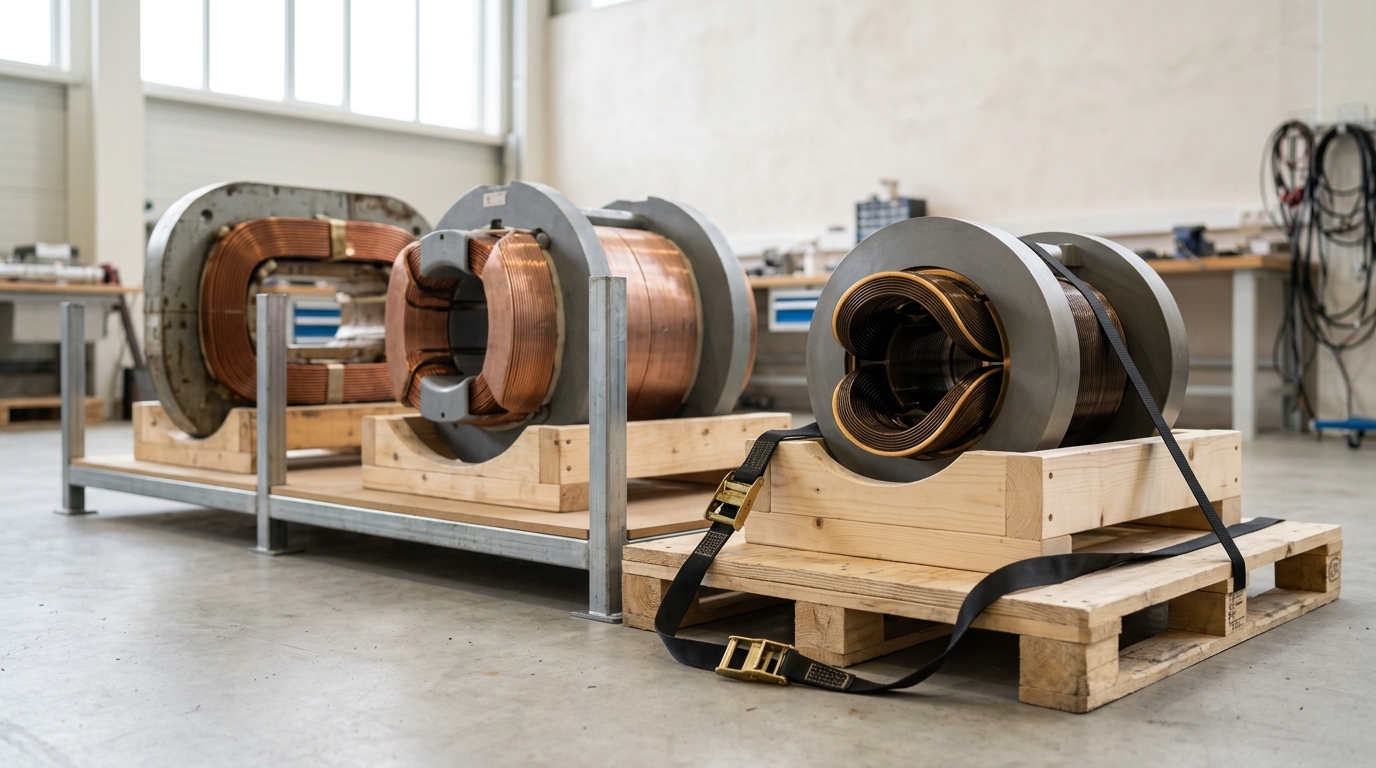
Figure 2. Three magnet generations laid side by side — an iron-dominated LEP-era design, a current Nb-Ti LHC dipole segment, and a prototype Nb3Sn high-field coil. — Image prompt and art direction by Brecht Corbeel; generation pending.
The dark sector’s escalating null results
A parallel, quieter history has run through direct dark-matter detection. Weakly Interacting Massive Particles (WIMPs) were, for two decades, the theoretically favored dark-matter candidate, in large part because a stable, weak-scale supersymmetric partner would naturally produce roughly the right relic abundance — the same theoretical structure that motivated collider SUSY searches also motivated underground WIMP searches, and the two literatures grew up together. The XENONnT experiment’s first WIMP search results, published in 2023, found no significant excess of nuclear-recoil events in its blinded analysis and set an upper limit on the spin-independent WIMP-nucleon scattering cross-section of 2.58\times10^{-47}\,\text{cm}^2 for a 28 GeV/c^2 WIMP at 90% confidence, achieved with a background rate roughly five times lower than its XENON1T predecessor [8]. This is, again, an exclusion, not a disproof: it rules out an increasingly large region of WIMP mass and coupling parameter space, pressing the community toward lighter dark-matter candidates, axions, or entirely different production mechanisms, rather than closing the dark-matter question outright.
The pattern across supersymmetry, WIMPs, and (initially) the flavor anomalies is the same pattern, and it is the central empirical fact of this history: three independent experimental programs, built around variations of the same weak-scale new-physics hypothesis that dominated theoretical thinking from the 1990s onward, have each returned null or retracted results at ever-increasing sensitivity. That is not a failure of the experiments — each one is a technical triumph of precision engineering — and it is not proof that the underlying theoretical framework is wrong. It is a real, cumulative pattern that has shifted the field’s center of theoretical gravity away from the specific weak-scale scenarios that null results have most tightly constrained, toward EFT-based model-independent approaches, lighter or more weakly coupled dark-sector candidates, and continued precision tests like the muon anomaly where a discrepancy is measured rather than merely searched for.
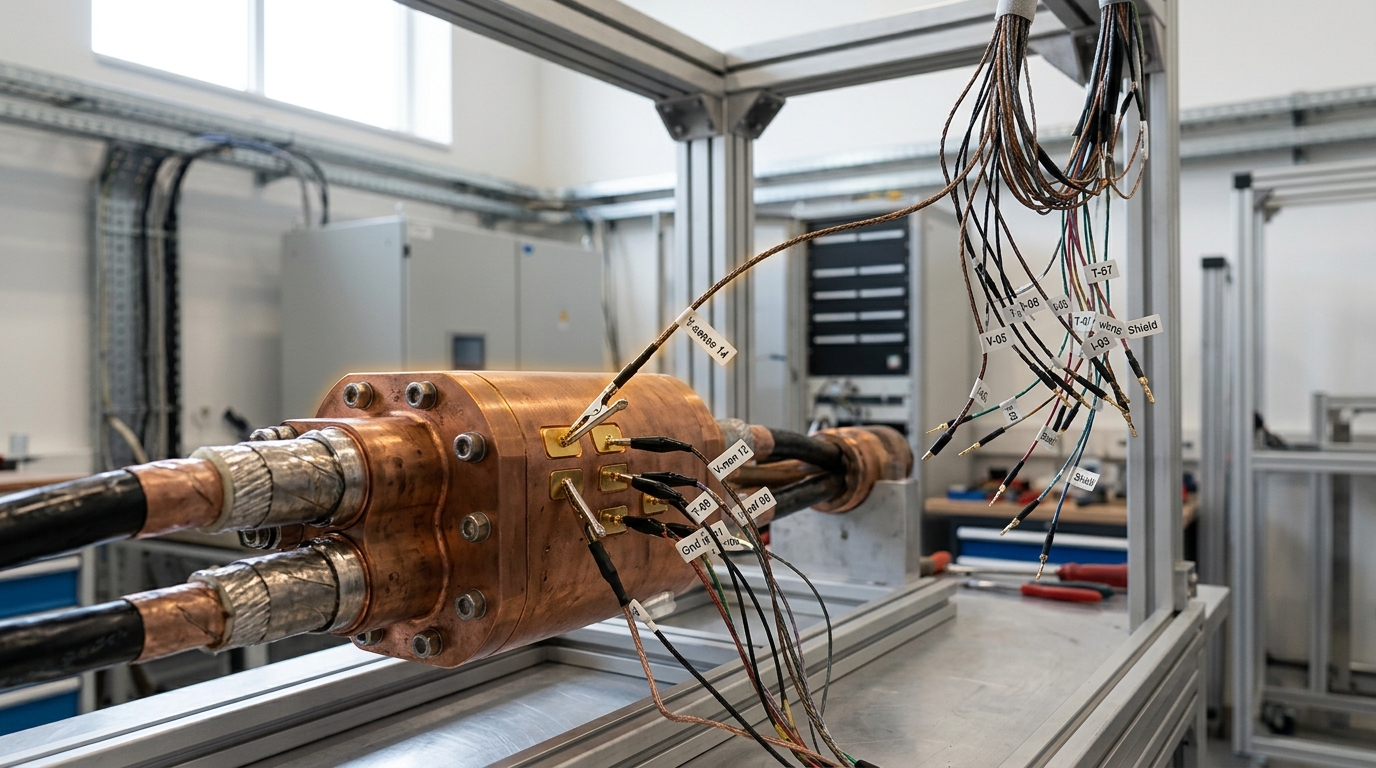
Figure 3. A cable joint under instrumentation ahead of a quench-protection test — the unglamorous validation work behind every exclusion limit the same magnets later enable. — Image prompt and art direction by Brecht Corbeel; generation pending.
What the next generation of facilities is actually built to do
CERN’s Future Circular Collider study, whose feasibility report was issued on 31 March 2025 and reviewed by the CERN Council in November 2025, proposes a roughly 90.7-kilometer tunnel to house a two-stage machine: first an electron-positron collider (FCC-ee) for high-precision measurements of the Higgs, Z, and W bosons, and later a hadron collider (FCC-hh) reaching energies well beyond the LHC’s, intended to succeed the LHC when it retires in the 2040s [9]. Independent expert committees reviewing the study reported that the project appears technically feasible with no showstoppers identified so far, and the CERN Council’s approval process is scheduled to bring recommendations forward in May 2026, with a final construction decision expected around 2028 [9]. Those are facts about a review process and a proposal, not a commitment to build; the project still requires funding decisions and formal Council approval that have not yet occurred as of this writing, and readers should treat “the FCC will be built” as a scenario contingent on that approval, not as an established fact.
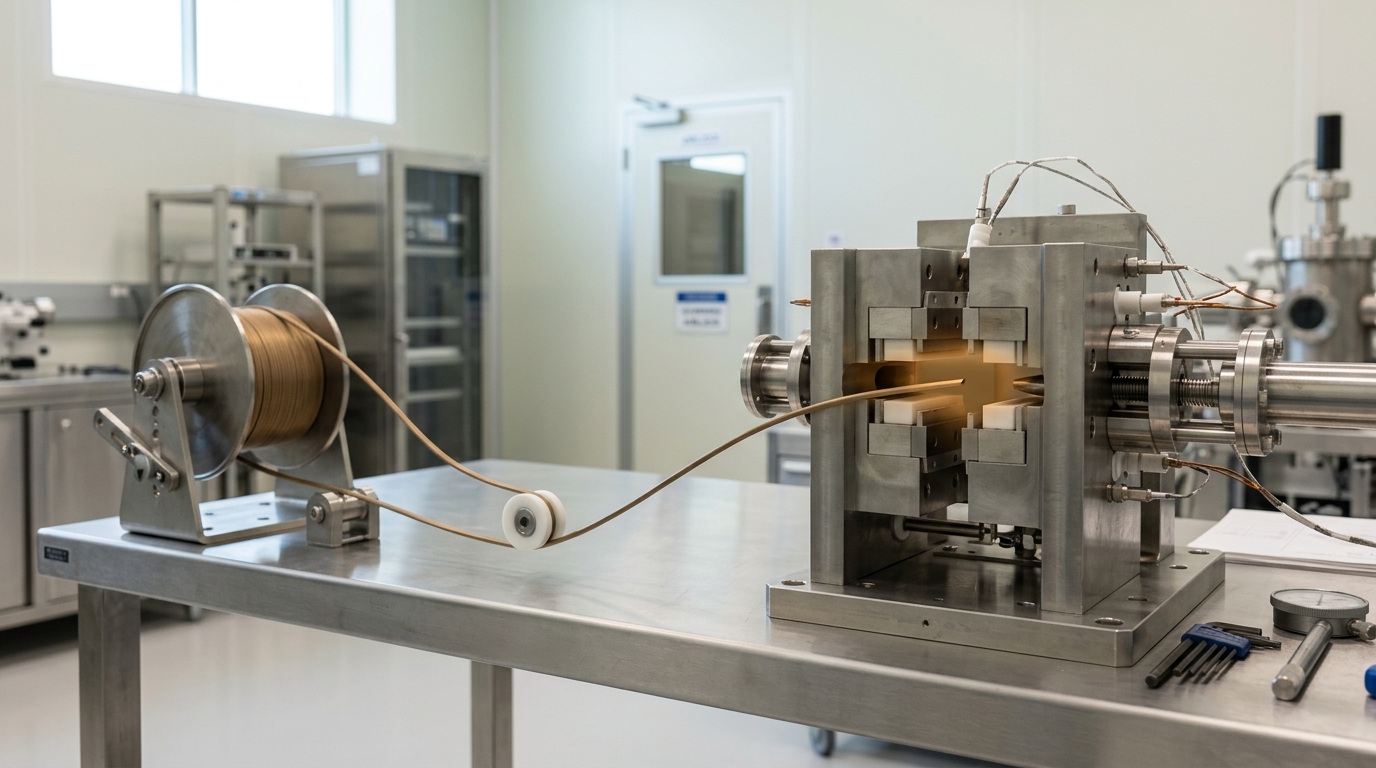
Figure 4. Brittle niobium-tin conductor destined for a next-generation high-field magnet — the material bet the Future Circular Collider's magnets depend on. — Image prompt and art direction by Brecht Corbeel; generation pending.
The physics case for such a machine follows directly from the history above. An electron-positron stage running at the Higgs and Z-boson resonance would measure Higgs couplings, the W mass, and electroweak precision observables with far greater precision than the LHC can achieve, which would directly test whether the CDF W-mass anomaly is a real deviation, a systematic effect, or noise — and would tighten the EFT constraints that currently summarize the LHC’s null direct searches into indirect bounds. A subsequent hadron stage at multi-tens-of-TeV collision energy would extend direct search reach for heavy new particles — including supersymmetric partners, if they exist at all — well past what even the High-Luminosity LHC upgrade can probe. None of this guarantees discovery. The explicit, falsifiable expectation is narrower and more honest: if new particles exist within the mass reach such a machine would achieve, it would either find them or exclude that entire mass range at a level of confidence no current or already-approved facility can reach. That is the actual claim a next-generation collider makes, and it is testable in the ordinary sense — a null result at FCC-hh energies would itself be a strong, informative fact about nature, exactly as the LHC’s SUSY null results have already been.

Figure 5. A helium transfer-line coupling part-turned onto a cryostat's service port — the continuous cryogenic thread that keeps a magnet superconducting for a decade of running. — Image prompt and art direction by Brecht Corbeel; generation pending.
Reading this history honestly
Put together, the last decade and a half divides cleanly into established fact, genuine open tension, and speculative scenario, and conflating these categories is the most common way this subject gets misreported. It is established fact that the Higgs boson was discovered in 2012 and that its basic properties match Standard Model predictions to good precision [1, 2]. It is established fact that neutrinos oscillate and therefore have mass, which the original Standard Model did not accommodate [3]. It is established fact that decades of increasingly sensitive searches for weak-scale supersymmetric particles and WIMP dark matter have returned null results at collider and underground experiments alike [4, 8], and that the once-prominent B-meson flavor anomalies did not survive improved statistics [7]. It is a genuine, unresolved tension — not yet fact in either direction — that the muon’s magnetic moment and the W-boson mass each show discrepancies against Standard Model predictions that remain contested at the level of theoretical calculation or cross-experiment replication [6, 10]. And it is scenario, not fact, that the Future Circular Collider will be built, when it might run, and what it might find — real possibilities worth planning around, contingent on funding and Council decisions still pending as of 2026 [9]. The Particle Data Group’s Review of Particle Physics remains the field’s authoritative, continuously updated ledger of which of these categories any given number currently belongs in, and is the right place to check whether any claim in this article has since moved from one column to another [11].

Figure 6. A control-room desk between shifts — the decades of continuous, unglamorous operation behind every null result and every discovery alike. — Image prompt and art direction by Brecht Corbeel; generation pending.
The through-line is not a story of failure. A field that spends four decades building ever more sensitive instruments, finds nothing where its leading hypothesis said something should be, and responds by discarding that hypothesis’s simplest form rather than defending it indefinitely, is a field working exactly as it should. The Standard Model’s completion in 2012 did not end the search for what lies beyond it; it removed the last easy target and left the harder, more interesting question standing alone — one that neutrino mass had already answered “yes, there is more” for, and that the next generation of colliders is now built specifically to press further.
Sources
- CERN Communications. New results indicate that particle discovered at CERN is a Higgs boson. CERN (2013).
- ATLAS Collaboration. Observation of a New Particle in the Search for the Standard Model Higgs Boson with the ATLAS Detector at the LHC. Science / CERN Document Server (2012). DOI: 10.1126/science.1232005.
- The Royal Swedish Academy of Sciences. The Nobel Prize in Physics 2015: Popular Information. NobelPrize.org (2015).
- Various authors, LHC SUSY working groups. Supersymmetry searches at ATLAS and CMS. arXiv (2025).
- Fermilab News. Muon g-2 doubles down with latest measurement, explores uncharted territory in search of new physics. Fermi National Accelerator Laboratory (2023).
- Muon g-2 Collaboration. Measurement of the Muon Magnetic Anomaly a_mu in the Muon g-2 Experiment at Fermilab. arXiv (Phys. Rev. Lett.) (2023).
- CERN Courier staff. LHCb brings leptons into line. CERN Courier (2022).
- XENON Collaboration. First WIMP Search Results from the XENONnT Experiment. Interactions.org (press release, Phys. Rev. Lett.) (2023).
- CERN Communications. CERN Council reviews feasibility study for a next-generation collider. CERN (2025).
- CERN Courier staff. CDF sets W mass against the Standard Model. CERN Courier (2022).
- Particle Data Group. Review of Particle Physics. Lawrence Berkeley National Laboratory (2026).
Originally published at https://absolutedigitalpublishers.com/articles/from-origins-to-frontier-a-history-of-particle-physics-beyond-the-standard-model.