From Origins to Frontier: A History of Labor, Automation, and Human Capability
Three documented episodes—frame-breaking, scientific management, and postwar collective bargaining—show what actually happens to tasks, skills, and wages when machines and managers redraw the shop floor.

Three instruments of labor history, laid out together: a frame-knitter's needle-bar, a time-and-motion stopwatch, and a union local's dues stamp. — Image prompt and art direction by Brecht Corbeel; generation pending.
Abstract
Popular retellings of labor history compress a century and a half of documented struggle into a single myth: workers who "feared technology." The archival record says something more precise. The Nottinghamshire framework-knitters of 1811-1816 objected to specific wage cuts and a specific machine, not to machinery as such. Scientific management did not merely speed up factory work; it relocated planning authority from workers to a new managerial class, with measurable deskilling effects that labor-process researchers still debate. Postwar collective bargaining then built, and later lost, the institutional machinery that had kept pay moving with productivity. This article traces each episode through primary and peer-reviewed sources, separates documented fact from contested interpretation, and uses the task-based framework from contemporary labor economics to ask what those three centuries actually predict about automation, wages, and bargaining power now.
Every generation that meets a new machine also meets an old story about the last one: that workers instinctively fear technology, smash it in a panic, and are eventually proven wrong when the machine turns out to create more jobs than it destroys. The story is comforting because it resolves into a lesson — don’t worry, it always works out — and it is almost entirely wrong about the actual documented events it claims to summarize. The archival record of the Nottinghamshire framework-knitters who broke stocking frames between 1811 and 1816 describes something much more specific than technophobia: a dispute over piece rates, apprenticeship rules, and one particular machine’s output quality [2]. The record of scientific management a century later describes something more specific than “efficiency”: a deliberate transfer of planning authority from the people doing the work to a new professional class hired to think for them [4]. And the record of postwar collective bargaining describes something more specific than “workers organized”: a set of institutions that, for about three decades, kept ordinary pay rising in step with output, and whose erosion coincides almost exactly with the point pay and productivity stopped moving together [5].
This article follows those three episodes in the order they happened, using only what primary and institutional sources actually document, and then asks what a task-based reading of labor economics — the framework used today to analyze automation — says those episodes should have predicted. The point is not to draw a straight line from stocking frames to large language models. It is to notice that the same handful of variables recur across two centuries: who controls the task, who captures the productivity gain, and what bargaining power the displaced worker has left when the dust settles.
What the framework-knitters actually said they wanted
The standard cartoon version has Luddites opposing machinery itself, smashing looms out of superstition or fear of the unfamiliar. The National Archives’ own account of the events, drawn from contemporary petitions, trial records, and the “General Ludd” letters the rioters themselves circulated, describes a narrower and much more legible grievance [2]. The first documented attack came on 11 March 1811 in Arnold, Nottinghamshire, against wide stocking frames — not narrow frames, not frames as a category, but specifically the “wide frame,” a machine that let a hosier produce cheap, poorly finished stocking material at a fraction of the labor cost of the traditional narrow frame, while paying workers a fraction of the established piece rate for it [2]. Over the following weeks more than a hundred frames were broken across Sutton-in-Ashfield, Kirkby-in-Ashfield, Woodborough, Lambley, Bulwell, and Ilkeston [2].
Three distinct grievances recur in the sources, and they are worth separating because they map onto three different modern debates. First, a wage grievance: framework-knitters described their actions as “vengeance upon some of the hosiers, for reducing the established prices for making stockings” — a direct statement that the target was a rate cut, not a machine [2]. Second, a training and entry grievance: hosiers were increasingly employing “unapprenticed” youths on the new frames, bypassing the seven-year apprenticeship that had previously controlled entry into the trade and, with it, controlled labor supply and bargaining leverage [2]. Third, a quality and market grievance: the wide frame’s output was inferior “cut-up” stocking material that undercut the reputation and the price of full-fashioned work, so its adoption was seen as degrading the trade’s own product, not merely automating its production [2].
None of that is a rejection of technology as such. Framework-knitters had used mechanical stocking frames — William Lee’s invention from the late sixteenth century — as their trade’s core tool for two centuries before 1811; the frame itself was not new and was not the target. What was new, and what was targeted, was a specific configuration of that machine paired with a specific set of wage and training practices. This is the distinction the popular myth erases, and it matters because it is also the distinction a modern economist would draw between a technology and the labor-market institution surrounding its deployment.
The state’s response was calibrated to treat this as a security emergency rather than a labor dispute. Parliament made frame-breaking a capital offense in 1812 — the Frame Breaking Act — and deployed thousands of troops to the affected counties, more soldiers by some contemporary counts than Wellington had in the Peninsula at the same moment [3]. At a special commission convened in York in January 1813, seventeen men were hanged for frame-breaking and related offenses, with others transported to penal colonies [2]. Frame-breaking recurred in 1814 and again in Leicestershire in the autumn of 1816, driven in part by a collapse in hosiery prices and wartime economic disruption layered on top of the original wage dispute [2]. The proclamations issued under the name “Ned Ludd” — the semi-mythical figure the movement took its name from — read less like manifestos against machinery than like industrial ultimatums addressed to specific hosiers over specific rates [3].
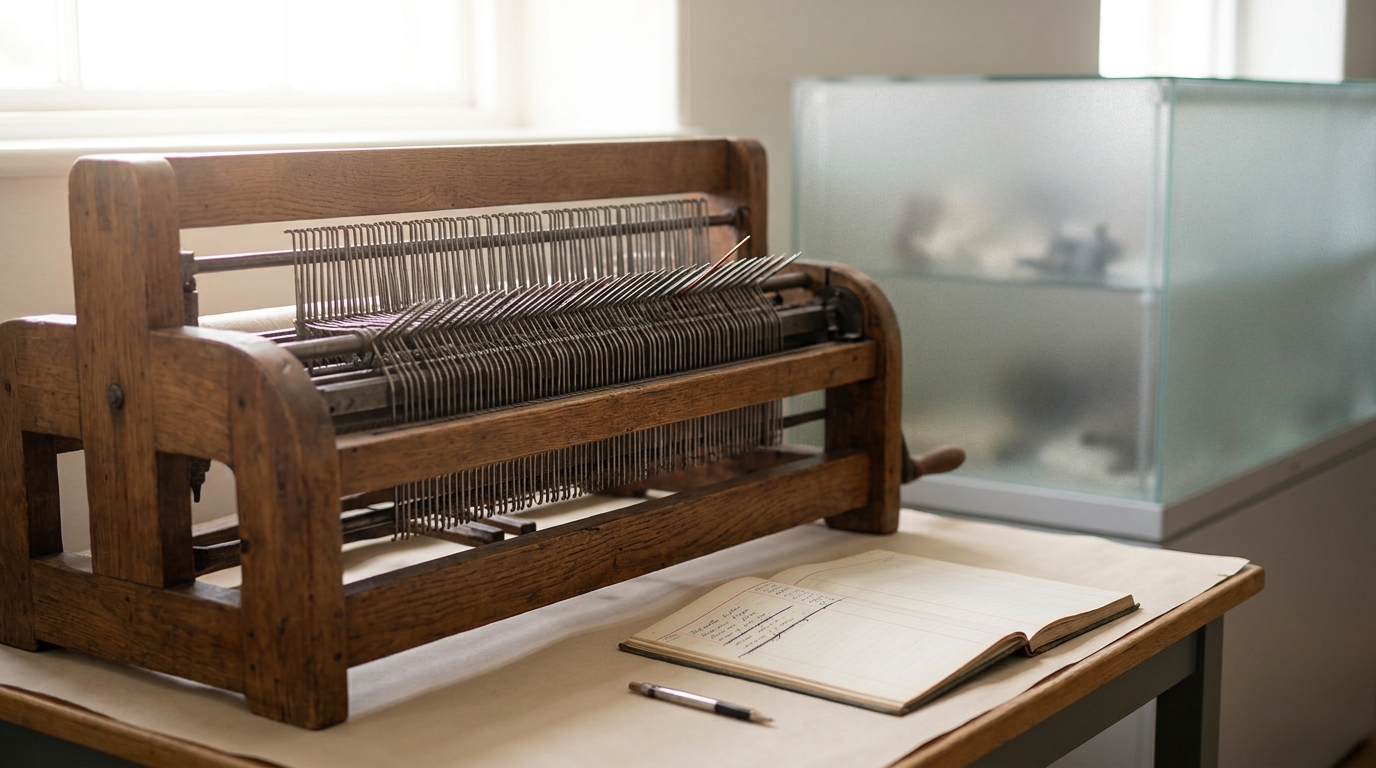
Figure 1. The wide stocking frame and the wage ledger it displaced: framework-knitters' 1811 grievance was a specific rate cut, not machinery in general. — Image prompt and art direction by Brecht Corbeel; generation pending.
Fact, clearly attributable to primary and institutional sources: the 1811-1816 disturbances targeted specific wage cuts, specific unapprenticed labor practices, and a specific machine configuration (the wide frame), not mechanization in general, and the state response criminalized the act of frame-breaking with capital punishment. Popular-myth claim, not supported by the record: that Luddites opposed technological progress as a category or acted from fear of the unfamiliar rather than from a documented wage and training dispute.
Scientific management and the relocation of judgment
A century later a different kind of technological change reorganized work without necessarily introducing new machines at all. Frederick Winslow Taylor’s scientific management, developed and popularized from the 1880s through the 1910s, proposed that any task, however skilled it appeared, could be decomposed into its constituent motions, timed, and reassembled into a single “one best way” that management — not the worker — would specify [4]. The tool most associated with this program was mundane: a stopwatch and a clipboard, used to time each sub-motion of a job and strip out whatever the timed observation judged to be waste.
Harry Braverman’s 1974 study Labor and Monopoly Capital remains the central reference point for what scientific management did to the content of jobs, and it is worth being precise about what is documented fact in this literature versus what is Braverman’s own contested interpretive thesis. The documented fact, uncontroversial among labor-process researchers even where they disagree with Braverman’s larger argument, is that Taylorist reorganization moved the planning function for a job — the decision about how a task should be done — away from the worker performing it and into a separate managerial and engineering staff [4]. Complex craft processes that a single skilled worker had previously planned, executed, and adjusted end-to-end were broken into discrete, narrowly defined operations, each assigned to a worker responsible only for executing that one step to a specification set elsewhere [4]. This is what the literature calls the separation of conception from execution.
Braverman’s own thesis — that this separation was not an incidental side effect of efficiency-seeking but capitalism’s deliberate and central strategy for controlling labor and suppressing wages — is a contested interpretation, not a settled fact, and later labor-process researchers have pushed back on parts of it, arguing that workers retained more informal control over the shop floor than Braverman’s account allows, and that deskilling was neither as uniform nor as intentional across industries as the “degradation of labor” framing implies [4]. What survives that debate, though, is the narrower and more measurable claim: the historical process of subdividing labor, present already in early manufacturing’s division of labor, was substantially intensified and formalized by Taylorist time-and-motion methods in the late nineteenth and early twentieth centuries, and it left a durable institutional legacy — the professional management layer — that still exists in essentially every modern firm [4].

Figure 2. A chronocyclegraph rig of the kind used to trace and decompose a worker's motions into measurable, reassignable steps. — Image prompt and art direction by Brecht Corbeel; generation pending.

Figure 3. The time-and-motion clipboard: Taylorist engineers timed and reassigned sub-motions, moving planning authority off the shop floor. — Image prompt and art direction by Brecht Corbeel; generation pending.
Fact: scientific management introduced systematic, instrument-based decomposition of tasks (the stopwatch study) and relocated the planning of how work was done from the worker to a separate managerial function. Contested analytical thesis, attributed to Braverman specifically: that this was primarily or exclusively a mechanism of labor control and wage suppression rather than a genuine efficiency gain with distributional side effects. Where experts disagree: later labor-process scholars accept the deskilling and separation-of-conception-and-execution findings while disputing how total, how intentional, and how one-directional the process was across different industries and periods.
The task, not the job, is the unit that changes
Modern labor economics gives this history a vocabulary it lacked at the time. The task-based framework, developed most influentially by David Autor, Frank Levy, and Richard Murnane in their 2003 study of computerization’s effect on labor demand, argues that the right unit of analysis for what technology does to work is not the job or the industry but the task — a specific activity within a job [1]. Computer capital, in their framework, substitutes for a well-defined category of human activity: routine tasks, whether manual or cognitive, that can be fully specified by explicit, programmable rules. It complements a different category: non-routine tasks requiring flexible judgment, problem-solving, or interpersonal adaptation that resist that kind of specification [1]. Their empirical work found that within-occupation shifts in task content — not just movement of workers between occupations — accounted for the largest share of the demand shift toward more-educated labor in the United States between 1970 and 1998 [1].
Read backward, this framework clarifies what both the framework-knitters and the Taylorized factory workers were actually experiencing. The wide stocking frame did not eliminate the task of “making hosiery”; it took the routine, codifiable portion of that task — repetitive frame operation — and made it cheap, while leaving the judgment-heavy portions of full-fashioned knitting comparatively untouched, and it was precisely the routine portion’s collapse in price that produced the wage cut framework-knitters were reacting to. Scientific management performed an even more literal version of the same operation on the shop floor: it made the routine, codifiable components of a craftsman’s job explicit and reassignable to lower-paid unskilled labor, while consolidating the non-routine planning components into a smaller, better-paid managerial class. In both cases the job title survived while its task content was hollowed out from the middle, which is exactly the pattern Autor, Levy, and Murnane later documented for computerization at the end of the twentieth century, and which Carl Benedikt Frey and Michael Osborne extended into a forward-looking estimate in 2013, finding that roughly 47 percent of U.S. employment sat in occupations whose task content was, on their model, highly susceptible to computerization, with wages and educational attainment strongly negatively correlated with that susceptibility [6].
Daron Acemoglu and Pascual Restrepo’s subsequent work adds the piece that both the Luddite and Taylorist episodes illustrate but that a purely mechanical “tasks get automated” story misses: automation is not the only thing happening to the task menu at any given moment. Their displacement-and-reinstatement framework treats automation as one force that shifts task allocation away from labor, always reducing labor’s share of value added in the automated task even as it can raise aggregate output, counterbalanced by a second force — the creation of genuinely new tasks in which labor retains a comparative advantage — which shifts allocation back toward labor and raises both the labor share and labor demand [7]. Their empirical decomposition of recent U.S. history finds that automation has significantly outpaced reinstatement since the 1980s, and that this imbalance — an accelerating displacement effect, concentrated in manufacturing, alongside a weaker reinstatement effect and slower overall productivity growth than in earlier decades — accounts for an estimated 50 to 70 percent of the change in the U.S. wage structure over that period [7].
This is the analytical lens the two historical episodes lacked at the time but that their outcomes retrospectively support: the wide frame and the Taylorist stopwatch were early, unusually well-documented instances of a displacement effect running with little contemporaneous reinstatement for the specific workers affected. Framework-knitters had no comparative-advantage task waiting for them once wide-frame output collapsed their piece rate; deskilled factory operatives had no equivalent path back into the planning function scientific management had removed from their job. The economic mechanism these two nineteenth- and early-twentieth-century episodes illustrate is not a historical curiosity — it is the same displacement-without-reinstatement pattern the task-based literature finds accelerating again in recent decades.

Figure 5. A contemporary task-survey clipboard, cross-referencing job titles against routine and non-routine activities, set beside the older instruments it descends from. — Image prompt and art direction by Brecht Corbeel; generation pending.
Bargaining power as the variable historical accounts undercount
The framework above explains what happens to tasks. It does not by itself explain what happens to pay, and here the postwar history of collective bargaining supplies the missing mechanism: institutional bargaining power over how a given productivity gain gets divided between capital and labor.
In the United States, the National Labor Relations Act of 1935 for the first time gave workers a federally protected right to organize and established the National Labor Relations Board to enforce it [8]. Union density rose from roughly 12.8 percent of the workforce in 1935 to a peak of 34.2 percent in 1945, and — despite modest year-to-year variation — stayed above 30 percent in every year from 1943 through 1961 [8]. At its postwar peak, organized labor was, by the U.S. Treasury’s own account, the most influential labor-market institution in the American economy: landmark collective-bargaining agreements set wages, benefits, and working conditions not only for unionized workers directly but as reference points that shaped compensation for millions of nonunion workers as well [9].
The Economic Policy Institute’s long-running productivity-pay tracking supplies the other half of the pattern, and the timing is exact rather than approximate. From the end of the Second World War until 1979, inflation-adjusted hourly pay for typical workers grew in lockstep with productivity [5]. After 1979 — the decade in which union density began its long decline from its postwar peak — a wedge opens and never closes: from 1979 to the present, net productivity has grown by roughly 90 percent while typical worker pay has grown by roughly 33 percent over the same interval, with the Institute attributing the divergence to a bundle of policy and institutional changes including deunionization, deregulation, globalization of production, an eroding minimum wage, and macroeconomic policy that tolerated higher unemployment [5].
It is important to be precise about what this correlation does and does not establish. Fact: union density and the productivity-pay gap moved together — postwar union strength coincided with productivity and pay rising in tandem, and the post-1979 decline in union density coincided with the two series decoupling. Analysis, not a proven causal claim from a single study: EPI attributes the divergence to a specific bundle of causes, deunionization among them, but the productivity-pay gap has multiple institutional and macroeconomic contributors operating simultaneously across the same decades, and isolating collective bargaining’s specific causal weight from globalization, deregulation, and monetary policy in the same period requires more than the correlation itself. What the postwar record does establish cleanly is that bargaining power is a variable separate from task content: two workers whose jobs contain identical routine/non-routine task mixes can see very different pay outcomes from an identical productivity gain, depending on whether either has an institutional mechanism to claim a share of it.
This is the piece missing from a purely task-based reading of the Luddite and Taylorist episodes. Framework-knitters in 1811 had no legal collective-bargaining mechanism available to them at all — trade unions were themselves criminalized under the Combination Acts still in force at the time — which is one reason their response took the form of direct action against the machine rather than negotiation over its introduction. Taylorized factory workers in the 1900s and 1910s likewise organized against scientific management’s spread well before most American workers had any protected right to bargain collectively; the NLRA is a full generation later. Both episodes occurred, in other words, in a bargaining-power vacuum that the postwar period briefly and partially filled, and whose refilling or non-refilling for today’s automated tasks is an open institutional question rather than a technological one.

Figure 4. A union local's ballot box and dues stamp: the postwar institutions that briefly kept pay moving with productivity. — Image prompt and art direction by Brecht Corbeel; generation pending.
Transition costs the task framework does not price
One further asymmetry recurs across all three episodes and deserves separate treatment: the task-based framework describes an economy-wide reallocation of labor demand, but it says little about the transition cost borne by a specific worker whose specific task is displaced before any reinstatement effect reaches them personally. A framework-knitter whose wide-frame competitor cut the going piece rate did not experience “aggregate labor demand shifting toward non-routine cognitive tasks”; he experienced an immediate wage cut in a trade he had spent seven apprenticed years learning, with no institutional bridge to whatever task the broader economy might eventually reinstate labor into, and often no realistic prospect of moving into it himself given his age, location, and specific skill. The same asymmetry applies to a deskilled factory operative in 1910 and, per Frey and Osborne’s own emphasis on the strong negative correlation between wages, education, and computerization risk, to workers in occupations flagged as automation-susceptible today [6].
This is a genuine gap in the economic literature’s public communication, not a flaw in the task-based framework itself: aggregate reinstatement, even when Acemoglu and Restrepo’s data shows it occurring, is a statement about labor demand summed across the whole economy and often a different set of occupations, not a guarantee available to the individual whose task was just automated [7]. Historically, the institutions that softened this individual-level transition cost — apprenticeship systems that controlled entry and thereby protected incumbent wages, and later collective-bargaining agreements that could negotiate severance, retraining, or seniority-based protection — are exactly the institutions whose weakening or absence the three episodes above have in common.
Reading the pattern forward, with the disconfirmation conditions stated
Scenario, not a prediction, and explicitly conditional: if the current wave of task automation in language- and knowledge-based occupations follows the displacement-reinstatement pattern Acemoglu and Restrepo document for the preceding four decades — automation running ahead of new-task creation, in a labor market with historically low collective-bargaining coverage relative to the postwar peak — then the task-based literature’s own logic implies a further widening of the productivity-pay gap rather than a narrowing of it, concentrated among workers in the routine-task-heavy occupations Frey and Osborne’s model flags as most exposed [6] [7]. This is a conditional extrapolation from documented historical mechanisms, not a forecast with a fixed date.
Horizon: the next decade, roughly to the mid-2030s, is the window in which this scenario’s assumptions are testable against data of the same kind cited above (union density, occupational task-content shifts, the aggregate productivity-pay series). Assumptions: that no comparable institutional intervention to the NLRA — a change expanding bargaining coverage or otherwise redistributing bargaining power toward displaced workers — is enacted in that window, and that the pace of task automation continues at or above its recent trend. Observable indicators that would confirm the scenario: continued or accelerating divergence in the EPI productivity-pay series; continued decline or stagnation in union density per CRS tracking; occupation-level wage data showing routine-task-heavy occupations losing ground relative to non-routine ones, consistent with Autor, Levy, and Murnane’s original within-occupation mechanism. Explicit disconfirmation condition: if union density and bargaining coverage rise meaningfully from their current levels, or if a new institutional mechanism functionally equivalent to the NLRA’s protected bargaining right is enacted and produces a measurable narrowing of the productivity-pay gap within the stated horizon, the scenario above is falsified, and the more relevant historical analogy becomes the 1935-1979 period rather than the post-1979 one.
None of this licenses a ranking of “AI versus the Industrial Revolution” or a claim that any specific current technology will replicate any specific historical episode’s magnitude — the underlying task categories, occupational structures, and institutional starting points differ too much between 1811, 1911, 1955, and today for that kind of comparison to be more than rhetorical. What the documented record of frame-breaking, scientific management, and postwar bargaining actually supports is narrower and more useful: task content, not job titles, is what technological change actually redraws; deskilling and reskilling are institutional outcomes shaped by who controls the redrawing, not automatic consequences of the technology itself; and bargaining power, demonstrably absent for the Nottinghamshire knitters and only partially present for early Taylorized workers, is the variable that determined who kept a share of the resulting gains and who did not.
Sources
- David H. Autor, Frank Levy, Richard J. Murnane. The Skill Content of Recent Technological Change: An Empirical Exploration. NBER Working Paper 8337 / Quarterly Journal of Economics (2003). DOI: 10.1162/003355303322552801.
- The National Archives (UK). Why did the Luddites protest?. The National Archives (2023).
- The National Archives (UK). The proclamation of Ned Ludd. The National Archives (2023).
- New Labor Forum editorial staff. Revisiting Harry Braverman's Classic Labor and Monopoly Capital. New Labor Forum, CUNY (2025).
- Josh Bivens, Jori Kandra. The Productivity-Pay Gap. Economic Policy Institute (2026).
- Carl Benedikt Frey, Michael A. Osborne. The Future of Employment: How Susceptible Are Jobs to Computerisation?. University of Oxford, Oxford Martin School Working Paper (2013).
- Daron Acemoglu, Pascual Restrepo. Automation and New Tasks: How Technology Displaces and Reinstates Labor. Journal of Economic Perspectives (2019). DOI: 10.1257/jep.33.2.3.
- Congressional Research Service. A Brief Examination of Union Membership Data. Congress.gov / CRS (2023).
- U.S. Department of the Treasury. Labor Unions and the Middle Class. U.S. Department of the Treasury (2023).
Originally published at https://absolutedigitalpublishers.com/articles/from-origins-to-frontier-a-history-of-labor-automation-and-human-capability.