From Origins to Frontier: A History of Hominin Evolution and Deep Prehistory
From a speculative 1871 book with no fossils to back it, through a 30-percent skeleton in an Ethiopian gully, to a genome pulled from a 40,000-year-old finger bone — how the hominin family tree was built, broken, and rebuilt by evidence.
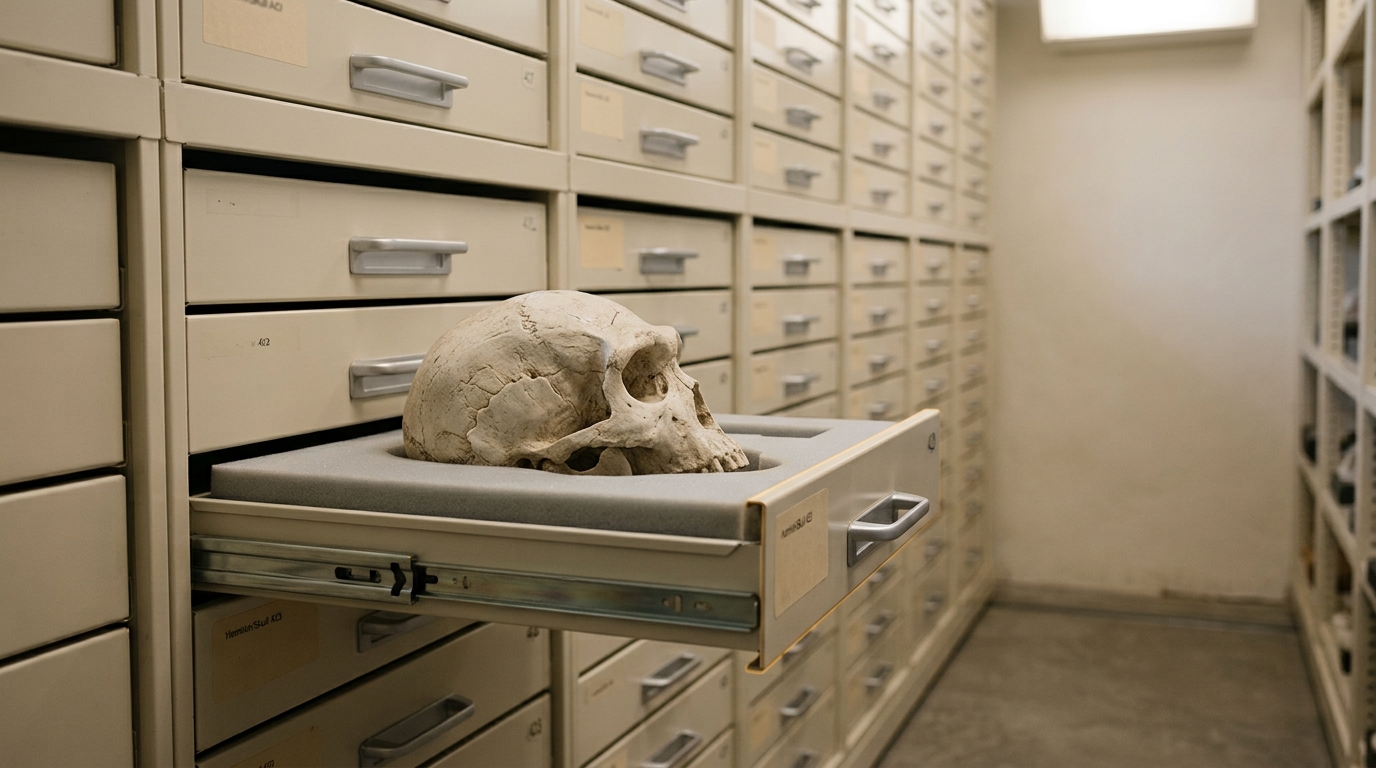
The hominin family tree lives in drawers before it lives in textbooks. — Image prompt and art direction by Brecht Corbeel; generation pending.
Abstract
In 1871 Charles Darwin argued for African human origins with no African hominin fossil in hand to support it. This article traces the century and a half of fieldwork, laboratory technique, and dispute that followed: the first Australopithecus finds, the 1974 discovery of "Lucy" at Hadar, the molecular turn that let Svante Pääbo's team sequence a full Neanderthal genome in 2010, the same year's identification of a wholly new hominin population from a single finger bone at Denisova Cave, and the 2013–2015 recovery of Homo naledi from a cave chamber reachable only through a cramped vertical chute. At each stage it separates confirmed fact from the interpretive claims built on top of it, and shows how thoroughly the human family tree has been redrawn — and how often it still is.
A theory published before the evidence existed
In 1871, twelve years after On the Origin of Species, Charles Darwin published The Descent of Man, and Selection in Relation to Sex. In it he made a specific, falsifiable geographic claim: that because humans are most closely related to gorillas and chimpanzees, and because those apes live in Africa, “it is somewhat more probable that our early progenitors lived on the African continent than elsewhere” [1]. This is worth stating plainly as a fact about the history of the field, not a retrospective compliment: Darwin made this argument with no African hominin fossil in hand. Not one had yet been found. The claim was an inference from living-primate anatomy and geography, not a description of physical evidence, and it would remain untested for more than fifty years.
That gap between claim and evidence is the shape of this entire history. Hominin paleoanthropology has repeatedly advanced by a specific, narrow physical find — a skull, a partial skeleton, a single bone fragment, a wisp of preserved DNA — that either confirmed or upended what theory alone had proposed. This article follows four such moments in detail: Darwin’s 1871 prediction, the 1974 discovery of “Lucy” in Ethiopia, the 2010 sequencing of a full Neanderthal genome alongside that same year’s identification of the Denisovans from a single finger bone, and the 2013–2015 recovery of Homo naledi from a South African cave chamber. Read in sequence, they trace how the field moved from armchair inference, to skeletal anatomy, to a molecular record that can now speak for hominins whose bones tell only part of the story — and how the human family tree has been redrawn, not once, but repeatedly, by each new physical find.
The century between claim and confirmation
Darwin’s African hypothesis did not go uncontested even among his contemporaries. Many nineteenth and early twentieth-century researchers instead favored Asia, partly because the first well-publicized fossil hominins — Eugène Dubois’s Pithecanthropus erectus (now classified within Homo erectus), found in Java in 1891, and the Peking Man fossils recovered from Zhoukoudian starting in the 1920s — came from Asia, not Africa. This is a case worth naming precisely: the scientific consensus of the period did not follow Darwin’s inference simply because he had made it. Evidence, when it existed, pointed toward Asia for several decades, and much of the field followed the evidence rather than the earlier theoretical claim.
The turn back toward Africa began with Raymond Dart’s 1924 description of the Taung Child, a small fossil skull from South Africa that Dart argued belonged to a new genus bridging ape and human, which he named Australopithecus africanus. Dart’s claim was initially rejected or ignored by much of the European scientific establishment, which continued to favor an Asian or a fraudulent British origin story (the notorious Piltdown Man forgery, only exposed as a hoax in 1953, actively distorted the field’s expectations during these same decades). It took further Australopithecus finds by Robert Broom in South African cave sites through the 1930s and 1940s, and the definitive 1953 unmasking of Piltdown Man as a deliberate fraud combining a modern human cranium with an orangutan jaw, before the field’s center of gravity shifted decisively toward Africa. By the 1950s and 1960s, Louis and Mary Leakey’s discoveries at Olduvai Gorge in Tanzania, including Paranthropus boisei in 1959 and early Homo habilis material in the early 1960s, had made East Africa as central to the field as South Africa. Darwin’s geographic hypothesis, made in 1871 without a single confirming fossil, was substantially vindicated by the accumulated African fossil record roughly eighty years later — but only after decades in which the field’s working consensus pointed elsewhere, a genuine example of theory outrunning evidence and then being overtaken by it rather than smoothly confirmed.

Figure 1. A single gray fragment in a sieve, before anyone yet knows what it belongs to. — Image prompt and art direction by Brecht Corbeel; generation pending.
Lucy: a skeleton, not a skull
On November 24, 1974, Donald Johanson and his student Tom Gray were surveying at Hadar, in the Afar region of Ethiopia, when Johanson spotted a forearm bone fragment on a slope that had already been checked that season. Over the following weeks the team recovered roughly 40 percent of a single individual’s skeleton — an extraordinary proportion for a hominin fossil of this age, since most earlier finds consisted of isolated teeth or skull fragments. The skeleton, cataloged as AL 288-1, was nicknamed “Lucy” after the Beatles song “Lucy in the Sky with Diamonds,” which was playing on a tape recorder at the camp the night of the discovery [2]. Dating placed the skeleton at approximately 3.2 million years old.
Lucy mattered for a specific reason beyond her completeness: her pelvis and leg bones showed clear evidence of habitual upright bipedal walking, while her skull retained a small, ape-sized braincase. This combination — walking upright well before the brain had enlarged — was a direct empirical answer to a live theoretical dispute of the time about which trait came first in human evolution, bipedalism or big brains. Lucy’s anatomy settled that particular question in favor of bipedalism first, brain expansion later, at least for her lineage and time period.
In 1978, Mary Leakey’s team at Laetoli in Tanzania recovered a roughly 3.6-million-year-old trail of fossilized hominin footprints preserved in volcanic ash, independently corroborating upright bipedal locomotion at a similarly early date and in a different location from Hadar. In 1979, Johanson and Tim White formally published the systematic description assigning the Hadar and Laetoli fossils — including Lucy — to a new species, Australopithecus afarensis, arguing it represented a single, sexually dimorphic species ancestral to later Australopithecus and Homo lineages [3]. That taxonomic claim was, and remains, a genuine scientific argument rather than a settled fact beyond dispute: some researchers at the time argued the Hadar sample was too anatomically variable to represent one species, and debate over exactly how Au. afarensis relates to other Pliocene hominins has continued in the decades since. The fossil evidence itself — the completeness of the skeleton, its date, and its mixed bipedal-and-small-brained anatomy — is not contested; the species-level interpretation built on top of it is a separate, ongoing argument, and it is worth being precise about which is which.
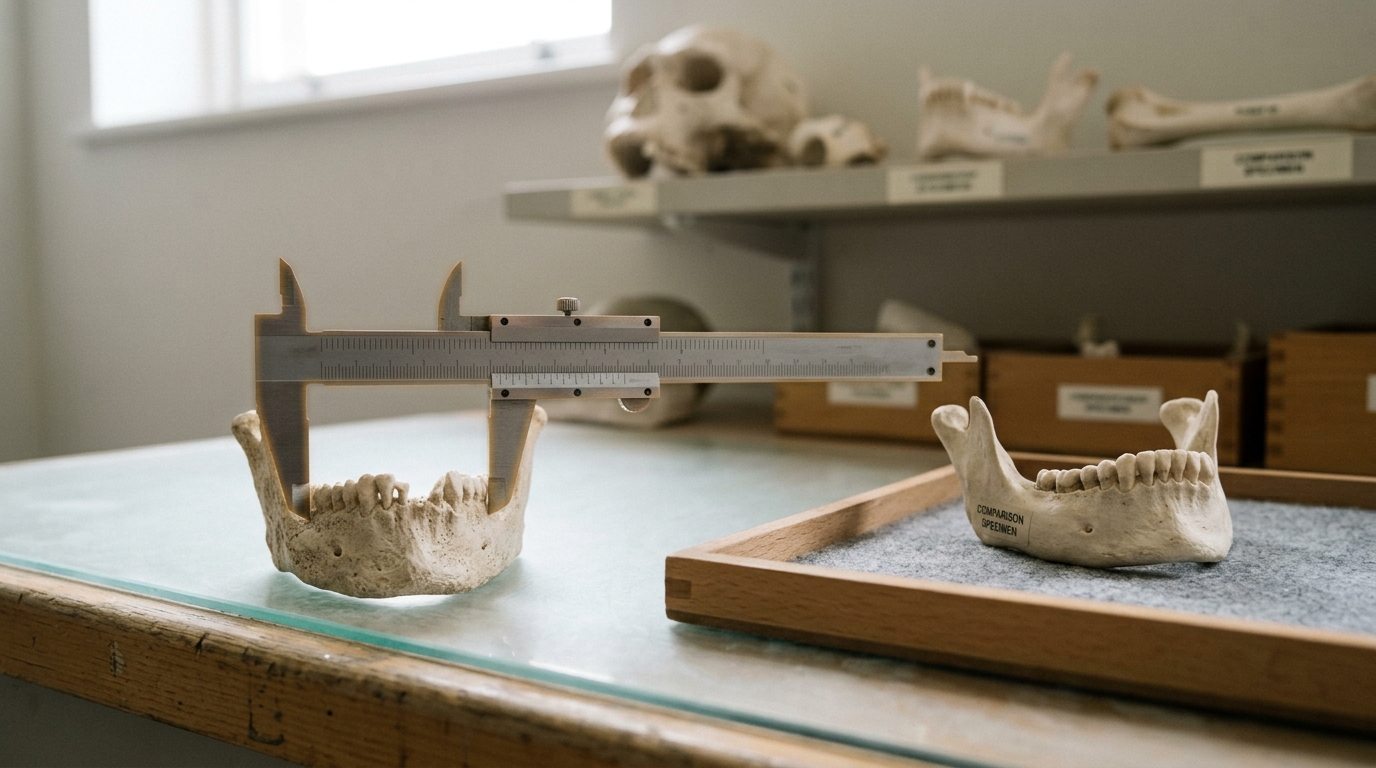
Figure 2. Naming a new species starts with a caliper, not a headline. — Image prompt and art direction by Brecht Corbeel; generation pending.
The molecular turn: reading hominins who left no complete skeleton
For more than a century, the field’s evidence base was almost entirely morphological: what bones and teeth looked like, how they compared to other specimens, and where and when they were found. That changed with the maturation of ancient DNA sequencing, a technical achievement built up over decades of methodological work on degraded, contaminated, chemically damaged genetic material — work substantially led by Svante Pääbo and colleagues, first at the University of Munich and later at the Max Planck Institute for Evolutionary Anthropology in Leipzig.
In May 2010, Green, Krause, Pääbo, and a large international team published a draft sequence of the Neandertal nuclear genome, assembled from bone samples recovered from Vindija Cave in Croatia and other sites, sequenced to roughly 1.3-fold genomic coverage [4]. The paper’s central and, at the time, genuinely surprising finding was that present-day humans outside Africa carry a small but measurable proportion of Neanderthal-derived DNA — roughly 1 to 4 percent of the genome in the population samples analyzed — while sub-Saharan African populations sampled did not show the same signal to the same degree. The straightforward interpretation offered was that Neanderthals and the ancestors of non-African modern humans interbred at some point after modern humans left Africa but before the ancestral non-African population diversified into the distinct groups sampled — direct genetic evidence of admixture between two hominin lineages that had been treated, for over a century, primarily as a replacement story: one lineage supposedly succeeding the other rather than mixing with it. It is important to be precise about what this result does and does not establish: it demonstrates gene flow occurred and constrains rough timing and magnitude; it does not, by itself, describe the social or behavioral circumstances of that interbreeding, which remain a matter of inference and reasonable disagreement rather than direct observation.

Figure 3. A few milligrams of powdered bone, handled as if it were the only sample left. — Image prompt and art direction by Brecht Corbeel; generation pending.
A new hominin identified from a single bone
The same broad research effort produced an even more striking result later in 2010. A small bone fragment — a distal phalanx, part of a child’s little finger — had been recovered from Denisova Cave in the Altai Mountains of Siberia. Rather than relying on morphology, which was nearly impossible given how small and non-diagnostic the fragment was, Reich, Green, Kircher, Krause, Pääbo and colleagues sequenced its mitochondrial and later nuclear DNA and found it did not match either known modern humans or known Neanderthals [5] [9]. Instead, the genetic data indicated a third, previously unknown hominin lineage, now called Denisovans, that had diverged from the Neanderthal lineage after both had split from the ancestors of modern humans. The same study found that present-day Melanesian populations carry an estimated 4 to 6 percent Denisovan-derived ancestry, indicating a second, independent instance of admixture between modern humans and an archaic hominin population, geographically and demographically distinct from the Neanderthal admixture event.
This is a case that deserves particular emphasis for what it demonstrates about the field’s current evidentiary frontier: an entire hominin population, otherwise essentially unknown from skeletal anatomy at the time of its identification, was defined almost entirely from a genetic signal preserved in a single small bone. No comparably complete Denisovan skeleton has been recovered even now; much of what is inferred about Denisovan biology comes from genetics, a handful of additional fragmentary specimens (including a jawbone found on the Tibetan Plateau, identified via ancient protein analysis rather than DNA), and comparative reasoning, not from a type specimen in the traditional sense that a field built on Darwin-era comparative osteology would have required. In 2022, the Nobel Assembly awarded Svante Pääbo the Nobel Prize in Physiology or Medicine specifically for his discoveries concerning the genomes of extinct hominins and human evolution, citing this body of work [8]. That prize is a fact about institutional recognition, not additional scientific evidence in itself, and it is worth keeping those two things separate: the underlying genomic findings stand or fall on replication and further data, independent of any prize awarded for them.

Figure 4. One finger bone, smaller than a fingernail, that redrew the family tree. — Image prompt and art direction by Brecht Corbeel; generation pending.
Homo naledi: a new species reached through an 18-centimeter gap
In 2013, cavers exploring the Rising Star cave system northwest of Johannesburg, South Africa, reported hominin-like bones in a chamber called the Dinaledi Chamber, reachable only through a narrow, near-vertical chute measuring as little as roughly 18 centimeters at its tightest point. Lee Berger organized a recovery expedition specifically requiring excavators small enough to fit through the chute, a genuinely unusual logistical constraint for a paleoanthropological dig. The team recovered more than 1,550 fossil elements representing a minimum of fifteen individuals, one of the largest single-site hominin fossil assemblages ever found in Africa. In 2015, Berger, Hawks, de Ruiter and a large collaborating team formally described the material as a new species, Homo naledi, noting a distinctive mosaic of anatomical features — a small, Australopithecus-like brain size alongside hands and feet more similar to those of the genus Homo — that did not match any previously known hominin species [6].
The species description alone left an open and consequential question: how old were these fossils? Because the bones had been found isolated in a deep cave chamber with no easily datable volcanic ash layers of the kind that anchor the ages of many East African sites, an initial estimate was not possible from the 2015 description. In 2017, Dirks, Roberts, Hilbert-Wolf, Kramers, Hawks and colleagues published uranium-series and electron-spin-resonance dating of the flowstone and teeth associated with the fossils, constraining the age of the Homo naledi remains to between approximately 236,000 and 335,000 years ago [7]. That date was genuinely startling to much of the field: it placed a small-brained, anatomically primitive-looking hominin as contemporaneous with early anatomically modern humans and late Homo heidelbergensis populations elsewhere in Africa, rather than as a much older relic, as its anatomy alone might have suggested. The dating result does not, by itself, establish how Homo naledi’s remains came to be concentrated in the chamber — Berger’s team has proposed deliberate body deposition by Homo naledi itself as one hypothesis, a claim that remains genuinely contested within the field rather than an established fact, since alternative explanations involving water transport or other natural accumulation processes have not been fully excluded to the satisfaction of all researchers evaluating the site.

Figure 5. The chamber that held Homo naledi was reachable only through a gap eighteen centimeters wide. — Image prompt and art direction by Brecht Corbeel; generation pending.
What the museum drawer does not show
None of these findings arrived as a finished specimen with an obvious label attached. Every fossil described above passed through a long chain of ordinary, unglamorous laboratory work before it became a claim in a journal: cleaning and consolidating fragile bone, comparing it fragment by fragment against reference casts of already-described species, measuring cusp shapes and cortical thickness with sliding calipers and osteometric boards, and only then arguing for a taxonomic placement. Johanson and White’s 1979 description of Australopithecus afarensis rested on exactly this kind of comparative measurement work across the Hadar and Laetoli collections, not on a single diagnostic trait [3]. The same is true of the Homo naledi description: Berger, Hawks, de Ruiter and colleagues built their species diagnosis from comparative measurements across skull, hand, foot and pelvic elements from more than a dozen individuals, precisely because a mosaic of primitive and derived traits cannot be established from a single bone or a single measurement [6]. This bench-level comparative work rarely appears in popular summaries of these discoveries, which tend to compress months or years of measurement into a single sentence about a named species, but it is the evidentiary foundation the species names rest on, and it is where disputes about a classification are actually settled or continue.
The ancient-DNA side of the field has its own equivalent of this unglamorous groundwork, arguably more demanding: extracting authentic ancient genetic material from a sample that is simultaneously degraded, chemically damaged, present in vanishingly small quantities, and easily overwhelmed by contaminating modern human DNA from anyone who has ever touched the specimen or the lab. The methodological advances that made the 2010 Neandertal genome and Denisova results possible — clean room protocols, damage-pattern authentication of ancient sequences, and library preparation methods suited to short, degraded DNA fragments — were built up over roughly two decades of incremental technical work at Pääbo’s laboratories before they reached the point where a single small bone fragment could yield a reliable genome-scale result [4] [8]. That two-decade technical buildup is easy to omit from a retelling that jumps straight from “no genetic evidence” to “full genome,” but it is why the Neandertal and Denisova results arrived when they did rather than decades earlier: the fossils had been sitting in museum collections for years before the technique existed to read them.
What kind of tree this history has actually drawn
It is tempting to read this sequence — Darwin, Lucy, the Neanderthal genome, Denisovans, Homo naledi — as a steady accumulation toward a single, increasingly resolved family tree. The actual history resists that framing. Each major discovery covered in this article did not simply add a branch to an existing, stable diagram; each one forced revision of the diagram’s basic shape. Before Lucy, the relationship between bipedalism and brain expansion was an open theoretical question that skeletal evidence had not yet settled. Before 2010, the relationship between Neanderthals and modern humans was widely treated as one of replacement without admixture; the genomic evidence overturned that framing for a large fraction of the field within a single year. Before the Denisova finger bone, no researcher had positively identified the Denisovan lineage at all — it did not merely revise a branch, it added one that had not been hypothesized to exist in that form. Before the 2017 dating result, Homo naledi’s anatomical primitiveness would reasonably have suggested a much older placement in time than the fossils turned out to have.
The consistent lesson across all four cases is not that the family tree is now essentially finished and merely awaiting minor corrections. It is that the tree has been substantially redrawn by nearly every major evidentiary advance the field has produced, and that ancient DNA in particular has demonstrated the existence of admixture events and entire lineages that skeletal anatomy alone, however carefully studied, had not detected. This is a documented historical pattern, not a prediction about what will happen next — but it is a pattern that should inform how much confidence is placed in any single current diagram of hominin relationships. The Smithsonian’s Human Origins program, among other institutional summaries of the field, presents the current consensus tree with explicit acknowledgment that it continues to be revised as new fossil and genetic evidence accumulates [10]; that caveat is not boilerplate caution, it is a direct extrapolation from exactly the history traced here.
Separating fact from interpretation, one more time
A final point of discipline, consistent with how each finding above has been presented: the fossil and genetic data points described in this article — Lucy’s skeletal completeness and anatomy, the Neanderthal genome’s admixture signal, the Denisova phalanx’s genetic distinctiveness, the Homo naledi assemblage’s anatomy and its 2017 dating range — are established findings, replicated or cross-checked by multiple independent lines of evidence in each case. The taxonomic assignments built on top of them (whether Au. afarensis is one species or several; whether Homo naledi deliberately deposited its dead; how Denisovan biology should be reconstructed from limited skeletal material) are scientific arguments under active, legitimate dispute, not settled background fact, and this article has tried to flag each such argument as it appeared rather than present it with the same certainty as the physical measurements underneath it. Readers encountering a confident single-line summary of “the” human family tree elsewhere should treat that confidence as a simplification of a genuinely contested, actively revised research field — one that has changed its own basic shape at least four times in the century and a half since Darwin published a geographic hypothesis with no fossil yet in hand to support it.
Sources
- Charles Darwin. The Descent of Man, and Selection in Relation to Sex. John Murray (Project Gutenberg text) (1871).
- Institute of Human Origins. Lucy's Story. Arizona State University (2024).
- Donald C. Johanson and Tim D. White. A Systematic Assessment of Early African Hominids. Science (1979). DOI: 10.1126/science.104384.
- Richard E. Green, Johannes Krause, Adrian W. Briggs, Tomislav Maricic, et al.. A Draft Sequence of the Neandertal Genome. Science (2010). DOI: 10.1126/science.1188021.
- David Reich, Richard E. Green, Martin Kircher, Johannes Krause, et al.. Genetic History of an Archaic Hominin Group from Denisova Cave in Siberia. Nature (2010). DOI: 10.1038/nature09710.
- Lee R. Berger, John Hawks, Darryl J. de Ruiter, et al.. Homo naledi, a New Species of the Genus Homo from the Dinaledi Chamber, South Africa. eLife (2015). DOI: 10.7554/eLife.09560.
- Paul H. G. M. Dirks, Eric M. Roberts, Hannah Hilbert-Wolf, et al.. The Age of Homo naledi and Associated Sediments in the Rising Star Cave, South Africa. eLife (2017). DOI: 10.7554/eLife.24231.
- Max Planck Society. Medicine Nobel Prize 2022 for Svante Pääbo. Max Planck Institute for Evolutionary Anthropology (2022).
- John Roach. New Type of Human Discovered via Single Pinky Finger. National Geographic (2010).
- Smithsonian Human Origins Program. What Does It Mean To Be Human?. Smithsonian National Museum of Natural History (2024).
Originally published at https://absolutedigitalpublishers.com/articles/from-origins-to-frontier-a-history-of-hominin-evolution-and-deep-prehistory.