From Origins to Frontier: A History of Evolutionary Biology and Ecology
From a joint reading at the Linnean Society to a flask lineage still dividing in a Michigan incubator, the history of evolutionary biology is a record of theory forced to meet measurement.
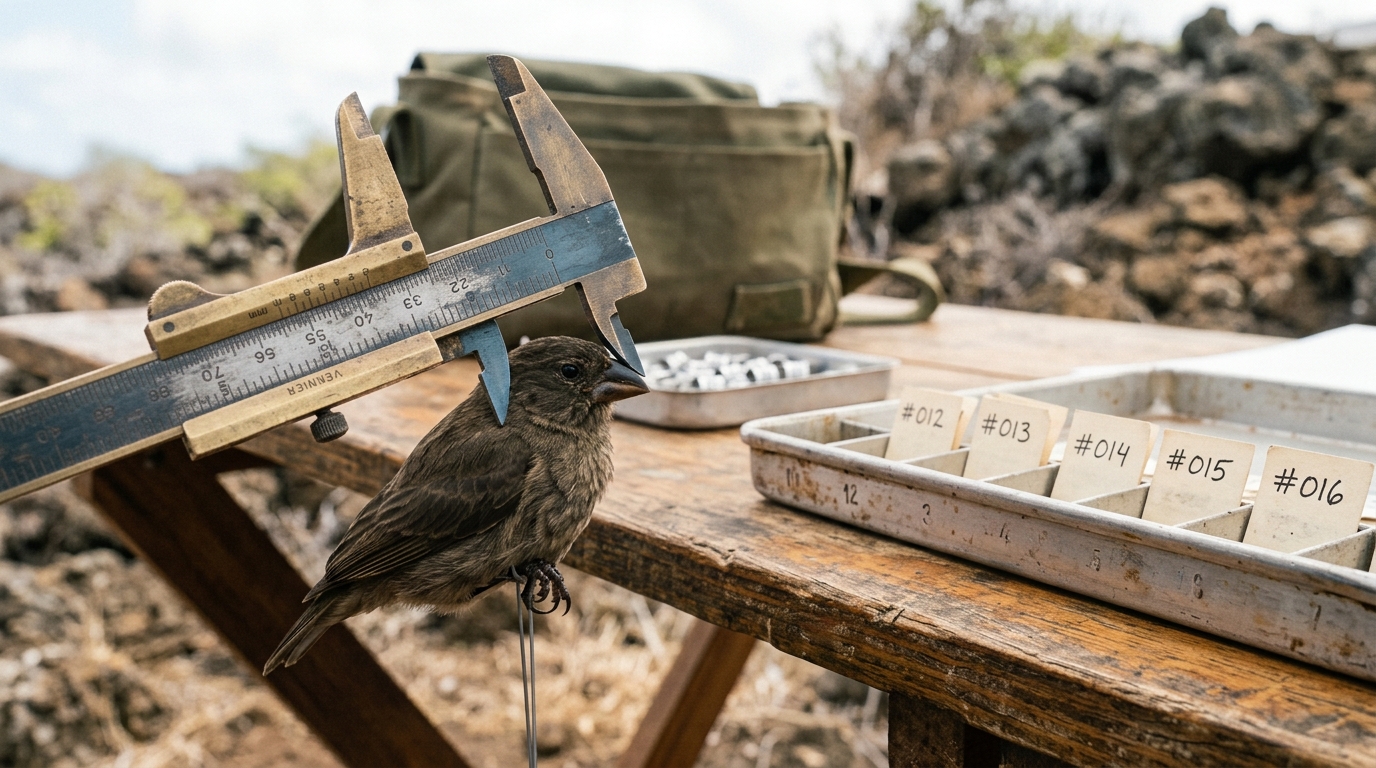
Four decades of measuring the same beaks on Daphne Major turned a single island population into the longest running test of natural selection acting in real time. — Image prompt and art direction by Brecht Corbeel; image generated to that direction.
Abstract
This article traces evolutionary biology and ecology from the 1858 joint reading of Darwin and Wallace through the population-genetics formalism of the Modern Synthesis, the multi-decade Galápagos finch fieldwork of Peter and Rosemary Grant, and Richard Lenski's ongoing long-term evolution experiment with Escherichia coli. It closes on the field's current frontier — measuring biodiversity loss and extinction risk at planetary scale — and separates, at each stage, established fact from interpretive claim, vendor-style overreach, and open scenario.
A joint reading, not a discovery announced alone
Evolutionary biology does not begin with a single eureka. It begins with a coincidence that could have produced a priority dispute and instead produced a shared paper. In 1858, Alfred Russel Wallace, working in the Malay Archipelago, sent Charles Darwin a manuscript outlining a theory of natural selection strikingly similar to one Darwin had been developing privately for two decades. Rather than let either man’s claim eclipse the other’s, colleagues arranged for extracts of Darwin’s earlier writing and Wallace’s new essay to be read together to the Linnean Society of London on the first of July 1858, under both names. Darwin followed the next year with the fuller argument, “On the Origin of Species by Means of Natural Selection,” a book whose first edition sold out within weeks of publication and whose central claim — that natural populations vary, that variation is heritable, and that some variants leave more descendants than others — has structured biology ever since [1].
It is worth being precise about what the 1859 book did and did not establish. Darwin proposed a mechanism, marshalled an extraordinary range of circumstantial evidence for it — domestic breeding, biogeography, comparative anatomy, the fossil record as then known — and argued for descent with modification from common ancestors. He did not have a theory of heredity that could survive scrutiny; the blending-inheritance assumptions common in his era actually worked against natural selection, since blending tends to average out variation rather than let a beneficial variant persist. That gap would not close for another seventy years, and closing it is the second act of this history.

Figure 1. In 1858, a manuscript from a naturalist working in the Malay Archipelago reached Darwin and precipitated a joint reading rather than a priority dispute. — Image prompt and art direction by Brecht Corbeel; image generated to that direction.
The Modern Synthesis: giving selection a mechanism for heredity
The rediscovery of Gregor Mendel’s inheritance rules around 1900 supplied particulate genetics, but for three decades it sat awkwardly beside Darwinian selection: many geneticists initially treated Mendelian mutation and natural selection as rival explanations of change rather than complementary parts of one process. The reconciliation, retrospectively called the Modern Synthesis, was built substantially through mathematics rather than new fossils or new field observation.
R. A. Fisher’s 1930 book, “The Genetical Theory of Natural Selection,” recast selection as an equation of population genetics: cast a population’s fitness variance in terms of allele frequencies, and selection’s effect on mean fitness can be described formally rather than only narratively [2]. Fisher’s fundamental theorem states, in essence, that the rate of increase in mean fitness attributable to natural selection at any time is proportional to the additive genetic variance in fitness at that time — a claim about a rate of change under an idealized set of assumptions (large population, additive gene action, a fixed environment), not a universal law of biological improvement. J. B. S. Haldane worked the same problem from a different angle, computing the actual strength of selection needed to produce specific, historically documented changes in wild populations, most famously showing that the increase of the dark form of the peppered moth in industrial England was consistent with a selection coefficient strong enough to be observed within a human lifetime rather than requiring geological time.
Sewall Wright’s 1931 paper, “Evolution in Mendelian Populations,” added the piece Fisher’s and Haldane’s more deterministic treatments lacked: a formal account of genetic drift, the random change in allele frequency from generation to generation caused by finite population size [3]. Wright showed that in a randomly mating population of effective size N_e, the variance in allele frequency change per generation from sampling alone is
\operatorname{Var}(\Delta p) = \frac{p(1-p)}{2N_e},
for a diploid population starting at allele frequency p. This single expression carries a real consequence: small populations can fix or lose alleles by chance alone, independent of whether those alleles are beneficial, neutral, or mildly deleterious, and the smaller the effective population, the faster that random fixation proceeds. Wright’s “shifting balance” framework, in which small subpopulations explore a rugged fitness landscape partly by drift and partly by selection, remains debated in its strong form, but the underlying mathematics of drift is uncontroversial and became a permanent part of population genetics.
Together, Fisher, Haldane and Wright gave Darwinian selection what it lacked in 1859: a mechanism of inheritance (Mendelian particulate genetics) and a quantitative apparatus (allele-frequency dynamics under selection, mutation, migration and drift) capable of generating testable numerical predictions rather than only qualitative ones. That is the specific, historically locatable content of “the Modern Synthesis” — not a vague consensus, but a set of derivations that a working biologist could apply to a real population.

Figure 2. Fisher, Haldane and Wright rebuilt Darwinian selection and Mendelian inheritance as a single quantitative machinery of allele frequencies. — Image prompt and art direction by Brecht Corbeel; image generated to that direction.
A basic case illustrates the kind of prediction this apparatus makes possible. For a single locus with two alleles under simple directional selection with selection coefficient s favoring an allele at frequency p, one classical discrete-generation recursion is
p_{t+1} = \frac{p_t(1+s)}{1 + s\,p_t}.
This is a deliberately simplified model — haploid, one locus, constant s, no drift, no linkage — and real populations violate several of its assumptions routinely. Its value is not as a literal forecast of any specific population but as a baseline against which departures (frequency-dependent selection, epistasis, drift-dominated dynamics in small populations) can be identified and measured.
Watching selection happen: the Grants and Daphne Major
Population genetics gave evolutionary biology equations; it did not, by itself, prove that natural selection acts at a speed observable within a single research career. That demonstration required decades of unglamorous, repeated fieldwork on a single population, and its most complete public record comes from Peter and Rosemary Grant’s study of Darwin’s finches on the small Galápagos island of Daphne Major, begun in 1973 and still being analyzed decades later.
The Grants and their collaborators individually marked, measured and tracked thousands of medium ground finches (Geospiza fortis) and related species across more than three decades, recording beak dimensions, body size, survival and reproduction for near-complete generational cohorts. Their 2002 synthesis in Science, “Unpredictable Evolution in a 30-Year Study of Darwin’s Finches,” reported measurable shifts in mean beak depth and body size tracking rainfall-driven changes in seed availability: droughts favored birds able to crack the larger, harder seeds that persisted when small soft seeds ran out, while wet years reversed the pressure toward smaller beaks better suited to abundant small seeds [4]. Selection differentials of a magnitude that population geneticists had modeled abstractly were measured directly, generation to generation, in a wild population.
The paper’s title is itself an important corrective to a popular misreading of adaptation. “Unpredictable” does not mean “absent” or “random in the sense of directionless”; it means that the direction and strength of selection reversed with fluctuating climate, so that no simple monotonic trend in beak shape emerged over thirty years. Evolution by natural selection, observed in real time, tracked a moving target rather than climbing steadily toward one optimum. This is a fact about how selection behaves in a genuinely variable environment, not a claim that selection is somehow illusory; conflating the two is a common misreading worth naming explicitly. The Grants’ work also demonstrated hybridization and introgression between finch species as a source of new genetic variation, complicating any simple story of one lineage adapting in isolation.
A second observatory: evolution in a flask
Fieldwork on wild populations faces an unavoidable limit: the researcher cannot rerun history to see whether a different chance mutation, arriving in a different order, would have produced a different outcome. Richard Lenski’s long-term evolution experiment (LTEE), begun in 1988 at Michigan State University, was designed specifically to make that question answerable, using a organism whose short generation time compresses decades of evolution into a laboratory timescale.
Lenski and colleagues founded twelve genetically identical populations of Escherichia coli from a single ancestral clone and have propagated them by transferring one percent of each population into fresh minimal-glucose medium every single day since, freezing samples periodically so that ancestral and descendant genotypes can later be revived and compared directly. Their first major report, in 1991, documented rapid early fitness gains and divergence among initially identical lineages purely from independent mutation and selection acting on replicate populations [5]. As of the mid-2020s the experiment has run for more than thirty years and passed eighty thousand generations, an unmatched continuous record of observed adaptation in a single organism.
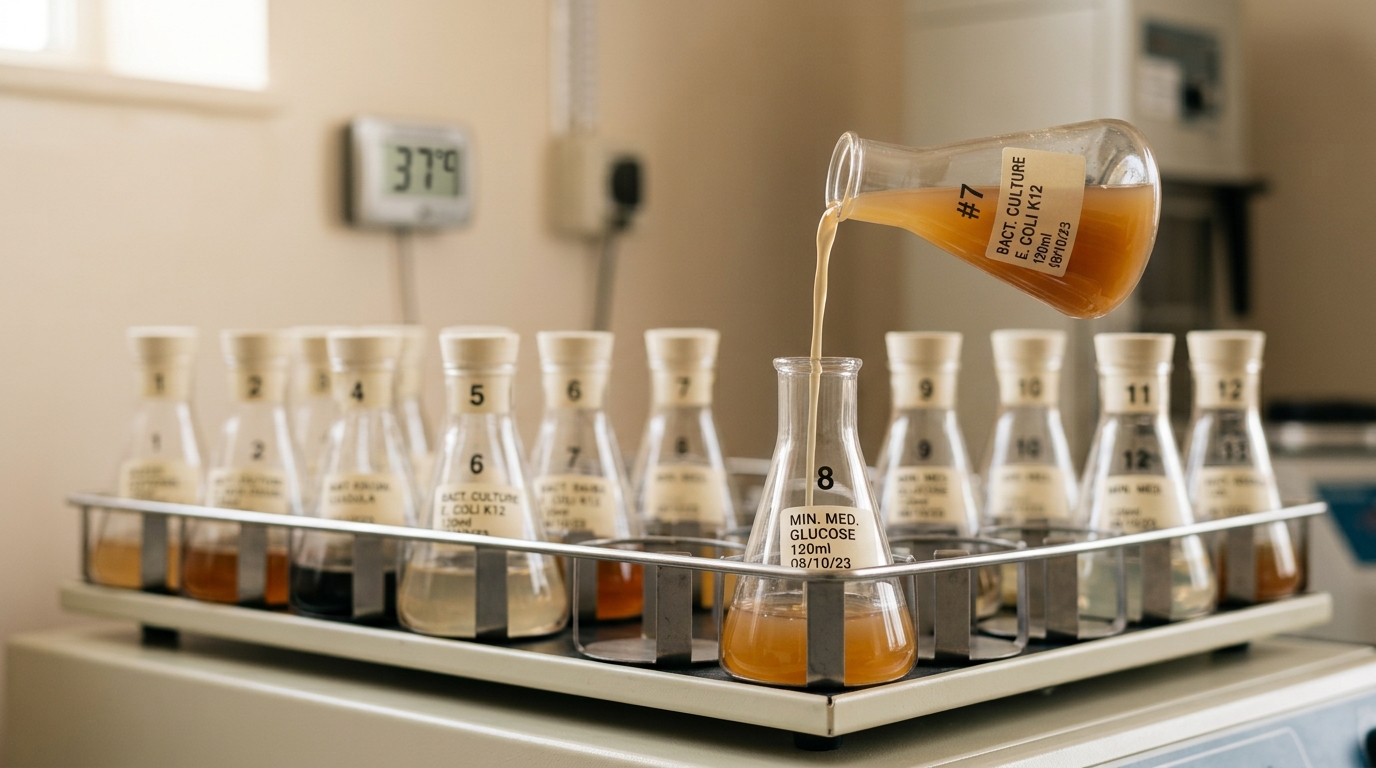
Figure 3. Since 1988, twelve initially identical Escherichia coli lineages have been carried forward by a one-percent daily transfer, accumulating more than eighty thousand generations of continuous observed evolution. — Image prompt and art direction by Brecht Corbeel; generation pending.
The LTEE’s most striking single result concerns one lineage, designated Ara-3. Around generation 31,500, that population evolved the ability to grow on citrate, a carbon source present in the growth medium but one that wild-type E. coli cannot use aerobically. Zachary Blount, Christina Borland and Lenski’s 2008 analysis in PNAS showed the innovation was not simply a single lucky mutation: replaying the population’s frozen history from earlier time points showed that only clones sampled after roughly generation 20,000 could go on to evolve citrate use, indicating that an earlier, apparently neutral “potentiating” mutation had to occur first, silently, before the later mutation that actually enabled citrate growth could have any effect [6]. This is historical contingency demonstrated experimentally rather than argued rhetorically: the same selective pressure, applied to genetically identical starting populations, produced a rare innovation in only one lineage because of an earlier, non-adaptive event in that lineage’s own history.

Figure 4. Around generation 31,500, one lineage evolved the ability to use citrate as a carbon source, a change contingent on an earlier, apparently neutral mutation carried silently for thousands of generations. — Image prompt and art direction by Brecht Corbeel; image generated to that direction.
It is worth stating plainly what the LTEE does and does not show about evolution generally. It demonstrates, in a controlled and replicated setting, that adaptation is contingent, that most independent lineages under identical selection do not converge on identical genetic solutions, and that fitness gains can plateau without stopping novel innovation. It does not demonstrate that all evolutionary innovation requires multi-decade timescales, nor that bacterial evolution is a template for the tempo of, say, vertebrate speciation; generation time, population size, mutation rate and genome architecture differ enormously across taxa, and extrapolating the LTEE’s specific numbers to other organisms is an overreach the experiment’s own authors have not made.
From populations to ecosystems: cooperation, speciation and community structure
The population-genetics and long-term-experiment traditions described above center on allele frequencies within single populations. Ecology and evolutionary biology converge on a wider set of questions once multiple interacting populations are considered together: how cooperation persists despite an apparent short-term advantage to defection, how reproductive isolation accumulates into new species, and how the resulting community of species assembles into food webs and nutrient cycles.
Kin selection and reciprocal-altruism frameworks, developed substantially after the initial Modern Synthesis, explain much (not all) of the cooperation observed among relatives and repeated social partners by showing that a gene favoring apparently self-sacrificing behavior can still increase in frequency if it sufficiently raises the reproductive success of individuals sharing copies of that gene, or if cooperative acts are reliably reciprocated over repeated interactions. Speciation research, meanwhile, has moved from a nearly exclusive focus on geographic isolation toward documented cases of speciation with ongoing gene flow, partly informed by the same finch populations the Grants studied, where hybridization has itself contributed new genetic combinations rather than only diluting existing species boundaries.
At the ecosystem scale, the object of study shifts again, from a lineage’s genetic trajectory to the standing diversity and functional structure of whole communities: which species are present, how they partition resources, and how removing or adding a species propagates through a food web. This is the level at which the field’s current frontier — measuring and forecasting biodiversity loss — is defined.
The frontier: measuring loss at planetary scale
Contemporary evolutionary biology and ecology increasingly operate under a different kind of urgency than the discipline’s founders faced: not only explaining how diversity arose, but quantifying how fast it is being lost and why. Gerardo Ceballos, Paul Ehrlich and colleagues’ 2015 analysis in Science Advances used a conservative estimate of historical background extinction rates and compared it against documented vertebrate extinctions over the past century, concluding that even the most cautious assumptions imply current extinction rates far above the long-term background rate for vertebrates, consistent with the early phase of a human-caused mass extinction event [7]. The authors were explicit about their method’s conservatism: they used the lowest plausible estimates of both background rate and modern extinction counts at each step, meaning the true disparity is very likely understated rather than exaggerated by their approach.

Figure 5. Long-running field surveys, not single snapshots, are what let biologists tell an ordinary population decline from an accelerating, human-driven extinction trend. — Image prompt and art direction by Brecht Corbeel; image generated to that direction.
The Intergovernmental Science-Policy Platform on Biodiversity and Ecosystem Services (IPBES) reached a compatible conclusion through an entirely different method: a multi-year synthesis of published literature and indigenous and local knowledge across all major terrestrial and marine biomes, approved by the plenary of more than 130 member governments in 2019. Its global assessment reported that around one million animal and plant species are threatened with extinction, many within decades, and that the rate of global change in nature over the past fifty years is unprecedented in human history [8]. This is an institutional, policy-facing synthesis rather than a single empirical study, and its headline figures depend on extrapolations across incompletely surveyed taxa (insects and marine invertebrates in particular are far less thoroughly assessed than birds and mammals); the appropriate reading is that it represents a considered consensus estimate with real uncertainty bands, not a precise count.
Separating fact from interpretation matters especially here. It is a documented fact that specific, named vertebrate species have gone extinct within the historical record at a measured rate; it is a model-dependent inference, not a direct observation, that current rates imply a mass extinction event comparable in ultimate scale to the five previous ones identified in the fossil record, since no observer can yet know how the current episode will end. Anthropogenic drivers identified across both sources — habitat conversion, overexploitation, climate change, pollution, and invasive species — are documented causes of measured local and regional declines; attributing the full global pattern to any single driver, or ranking the drivers definitively worldwide, goes beyond what the underlying country- and taxon-level data currently support with precision.
What the record actually establishes, and what remains open
Four threads run through this history and are worth holding apart. First, a fact: natural selection acting on heritable variation, formalized as changes in allele frequency, has been directly measured in wild populations (the Grants’ finches) and in experimentally manipulated ones (Lenski’s E. coli), at rates fast enough to observe within a research career, not only inferred from the fossil record. Second, a mechanism established mathematically: Fisher, Haldane and Wright’s population-genetics formalism explains how selection, mutation, migration and drift jointly determine allele-frequency change, and remains the working apparatus of the field even as it has been extended to account for epistasis, frequency dependence, and genomic-scale data unavailable to its founders. Third, an empirical demonstration with a specific, bounded scope: the LTEE shows historical contingency operating within one bacterial species under one experimental protocol, a result that should inform but not simply be extrapolated onto other organisms or timescales. Fourth, a live, actively contested measurement problem: current global extinction and biodiversity-loss rates are estimated from partial data with genuine uncertainty, and while the qualitative direction — accelerating, human-caused loss — commands wide agreement among specialists, the precise magnitude, timeline and relative weight of specific drivers remain subjects of ongoing research rather than settled figures.
The throughline connecting Darwin’s 1859 argument to a citrate-metabolizing bacterial colony in a Michigan lab is not a single unbroken theory unchanged across a century and a half. It is a discipline whose core claim — heritable variation plus differential reproduction produces change over time — has been repeatedly subjected to quantitative test, refined where the mathematics demanded refinement, and extended into domains, from single-locus population genetics to planetary biodiversity accounting, that its founders could not have anticipated needing.
Sources
- Charles Darwin. On the Origin of Species by Means of Natural Selection. John Murray (Project Gutenberg text) (1859).
- R. A. Fisher. The Genetical Theory of Natural Selection. Clarendon Press (Dover reprint scan, Internet Archive) (1930).
- Sewall Wright. Evolution in Mendelian Populations. Genetics (1931). DOI: 10.1093/genetics/16.2.97.
- Peter R. Grant and B. Rosemary Grant. Unpredictable evolution in a 30-year study of Darwin's finches. Science (2002). DOI: 10.1126/science.1070315.
- Richard E. Lenski, Michael R. Rose, Suzanne C. Simpson, and Scott C. Tadler. Long-Term Experimental Evolution in Escherichia coli. I. Adaptation and Divergence During 2,000 Generations. The American Naturalist (1991). DOI: 10.1086/285289.
- Zachary D. Blount, Christina Z. Borland, and Richard E. Lenski. Historical contingency and the evolution of a key innovation in an experimental population of Escherichia coli. Proceedings of the National Academy of Sciences (2008). DOI: 10.1073/pnas.0803151105.
- Gerardo Ceballos, Paul R. Ehrlich, Anthony D. Barnosky, Andrés García, Robert M. Pringle, and Todd M. Palmer. Accelerated modern human-induced species losses: Entering the sixth mass extinction. Science Advances (2015). DOI: 10.1126/sciadv.1400253.
- IPBES Plenary (eds. S. Díaz et al.). Summary for Policymakers of the Global Assessment Report on Biodiversity and Ecosystem Services. IPBES Secretariat / Zenodo (2019). DOI: 10.5281/zenodo.3553579.
Originally published at https://absolutedigitalpublishers.com/articles/from-origins-to-frontier-a-history-of-evolutionary-biology-and-ecology.