From Origins to Frontier: A History of Cumulative Culture and Social Learning
How a field went from Darwin's stray remarks on inherited habits to formal gene-culture models, transmission-chain experiments, and a working theory of why human culture ratchets upward while other species' does not.
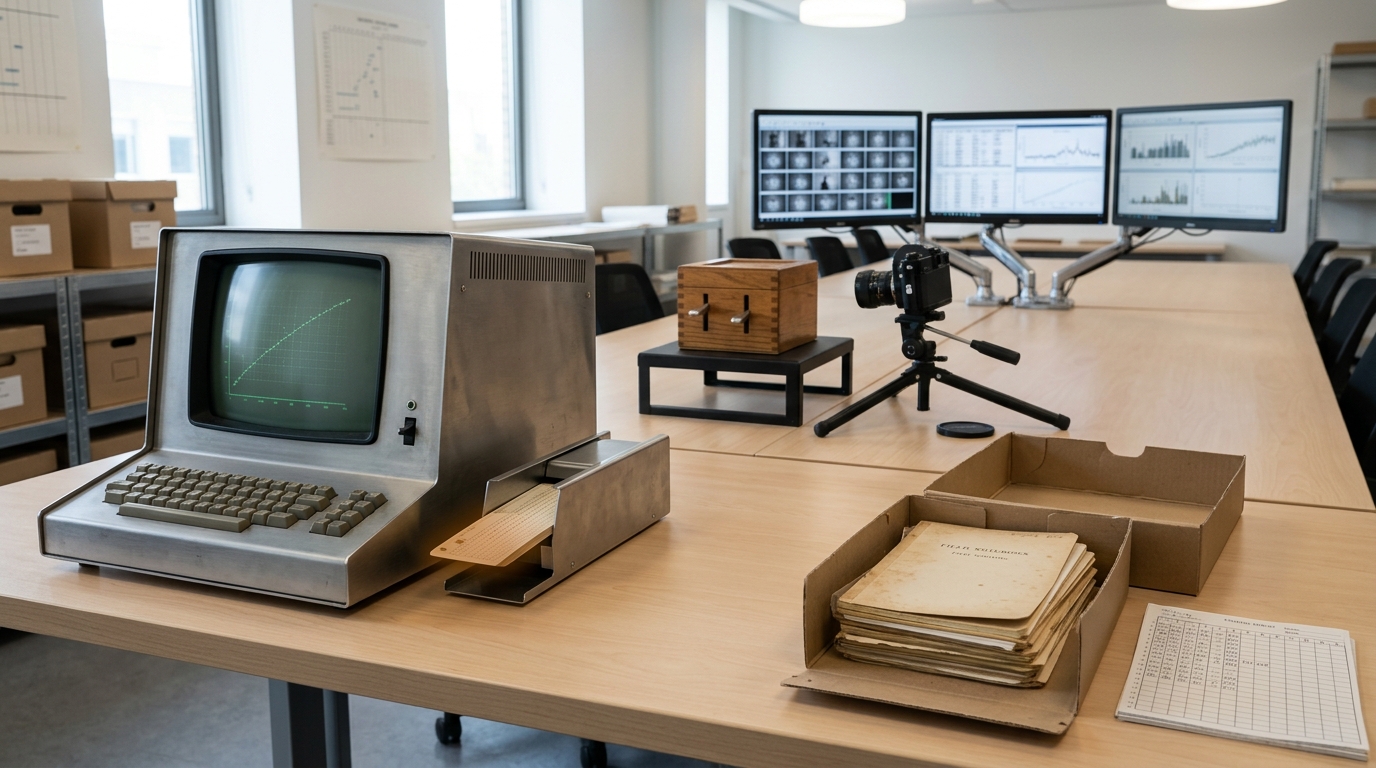
Cultural evolution became a research field, not just an observation, only once its central claims could be written as models, tested with apparatus, and rerun by someone else. — Image prompt and art direction by Brecht Corbeel; image generated to that direction.
Abstract
Cumulative culture — the accumulation of know-how across generations beyond what any one learner could invent alone — became a formal research object only in the last half-century. This article traces that history: Darwin's early remarks on inherited habit, the founding of dual-inheritance and gene-culture coevolution theory by Cavalli-Sforza and Feldman in the 1970s, Boyd and Richerson's population-level models of social learning bias, the rise of transmission-chain and diffusion-chain experiments as a laboratory method, and the comparative primate work that isolated what makes human culture cumulative. It separates established fact from contested interpretation and states plainly where the field's open disputes remain.
Cultural evolution is now a discipline with journals, formal models, and a shelf of textbooks, but for most of the twentieth century it did not exist as a research program at all — only as a scattering of remarks, mostly outside biology, about how learned habits pass between generations. This is a history of how that scattering became a field: how a handful of researchers, starting in the 1970s, built the mathematics, the experiments, and the comparative evidence that let “culture accumulates” go from an observation anyone could make to a claim that could be tested, quantified, and occasionally shown to be wrong.
Darwin’s stray remarks, and a century of silence
Charles Darwin himself is often credited with the seed of dual-inheritance thinking, and the credit is not entirely misplaced but should not be overstated. In The Descent of Man (1871) he noted that habits and customs could be transmitted by imitation and tradition among animals and humans alike, and that this transmission could interact with natural selection on instincts. This is a genuine observation, not a retrofitted one — but Darwin never built a model of it, never proposed a mechanism for how cultural and genetic transmission might combine quantitatively, and the remark sat largely fallow for a century. Twentieth-century anthropology developed rich descriptive accounts of cultural transmission — Franz Boas’s insistence that cultural traits diffuse and change independent of biological race, and later diffusionist and culture-area mapping in American anthropology — but these were classificatory and historical projects, not population-level models with testable dynamics. The gap between “culture is inherited, sort of, and changes” and “here is a formal model of how a cultural trait’s frequency changes generation to generation” is the gap this article’s central history fills.
Cavalli-Sforza and Feldman: culture gets a transmission model
The decisive move came from population geneticist Luigi Luca Cavalli-Sforza and mathematical biologist Marcus Feldman, working together at Stanford in the early-to-mid 1970s. Their 1973 paper in the American Journal of Human Genetics, “Cultural versus biological inheritance: phenotypic transmission from parents to children,” is a founding document of the field in a precise sense: it treated the resemblance between parents and children on a trait not as evidence of genetic heritability by default, but as the joint outcome of genetic transmission and a separate, quantifiable channel of cultural (parent-to-child, “vertical”) transmission [1]. The paper’s contribution was methodological as much as conceptual — it showed how to write down transmission coefficients for a cultural channel using the same formal apparatus population geneticists already used for genes, which meant cultural inheritance could for the first time be estimated from data rather than asserted from anecdote.

Figure 1. Cavalli-Sforza and Feldman's founding move was to treat cultural transmission from parent to child as a formal inheritance model, quantitatively comparable to genetic transmission rather than a vague metaphor for it. — Image prompt and art direction by Brecht Corbeel; image generated to that direction.
This was gene-culture coevolution theory in its earliest form: not a metaphor borrowed from genetics, but a literal extension of population-genetic modeling to a second inheritance system that could interact with the first. Cavalli-Sforza and Feldman went on through the late 1970s and into the 1981 book Cultural Transmission and Evolution: A Quantitative Approach to distinguish transmission modes — vertical (parent to child), oblique (non-parent adult to child, including teachers), and horizontal (peer to peer) — each with different implications for how fast a trait could spread and how much variation a population could sustain. This is a real, citable distinction that still structures the field’s vocabulary; a claim about “how culture spreads” without specifying which of these three channels is doing the work is, by this framework’s own logic, an incomplete claim.
Boyd and Richerson: culture as an evolving population process
If Cavalli-Sforza and Feldman supplied the transmission genetics, Robert Boyd and Peter Richerson supplied the population dynamics of bias — why people don’t copy at random, and what that non-randomness does over many generations. Their 1985 book Culture and the Evolutionary Process built formal models of specific social learning strategies: conformist transmission (disproportionately adopting whatever the majority already does), prestige bias (copying successful or high-status individuals preferentially), and content bias (adopting traits for their intrinsic appeal or memorability, independent of who holds them). These are not just descriptive labels; each is a term in a population-genetics-style recursion equation that predicts how a trait’s frequency changes generation to generation under that bias, holding all else constant.
The theoretical payoff came a generation later. Boyd, Richerson, and Joseph Henrich’s 2011 synthesis in PNAS, “The cultural niche,” argued that social learning of this biased, selective kind — not raw intelligence or tool-making capacity alone — is the actual load-bearing adaptation that let humans occupy environments no primate lineage had reached, because it let populations accumulate solutions faster than any individual could work them out by trial and error, and retain them reliably enough to build on later [3]. This is where “cumulative culture” stopped being a phrase and became a specific empirical claim with a mechanism attached: cumulative culture requires both innovation and high-fidelity transmission, and a population can fail at either — it can stop innovating, or it can innovate but fail to preserve what it found. Henrich and Richard McElreath’s 2003 review “The evolution of cultural evolution” laid out the resulting research program explicitly as two linked questions: what psychological mechanisms make humans unusually good social learners, and what population-level dynamics do those mechanisms produce once you let them run for many generations across many individuals [2]. That two-part framing — psychology feeding population dynamics — has organized most subsequent work in the field, including the experimental turn described below.

Figure 2. Boyd and Richerson's population-level models formalized how imitation biases such as conformity and prestige could spread or suppress a trait across a population over many generations, independent of its effect on individual fitness. — Image prompt and art direction by Brecht Corbeel; image generated to that direction.
What actually makes culture cumulative: the comparative test
A model of cumulative culture is not evidence that cumulative culture is rare, or that it depends on anything special about humans, until it is tested against species that plainly have social learning but do not show the same runaway accumulation. This comparative test came from primatology, and one of its cleanest results is Andrew Whiten, Victoria Horner, and Frans de Waal’s 2005 Nature study on conformity in chimpanzees. Two neighboring chimpanzee groups were each taught a different technique for extracting food from an apparatus; when individuals were later given the chance to use either technique, most stuck with whichever their own group had adopted, even when it was not the more efficient option available [4]. This is a genuinely important result: it shows that chimpanzees possess conformist social learning, one of the specific biases Boyd and Richerson’s models required — so conformity alone does not explain the human-chimpanzee gap in cumulative culture. Something else has to be doing additional work.

Figure 3. Comparative work on chimpanzees showed that once one technique for a task became established in a group, individuals kept using it even after a more efficient method was demonstrated to them — the conformity signature dual-inheritance theory predicted for a socially learned species. — Image prompt and art direction by Brecht Corbeel; image generated to that direction.
Lewis Dean, Rachel Kendal, and colleagues’ 2012 Science study went looking for that something else directly, running matched groups of chimpanzees, capuchin monkeys, and 3-to-5-year-old human children through the same multi-stage puzzle box, which required combining several actions in sequence to reach an increasingly valuable reward at each stage [8]. Only the children’s groups reliably progressed through all stages; the non-human groups largely stalled early. The study’s diagnostic value was in why: children, unlike the other species, spontaneously used imitation, prosocial teaching (older or successful children demonstrating to others without being asked), and language-based communication about the task — three processes that were largely absent or much weaker in the chimpanzee and capuchin groups. This let the field replace “humans have more cumulative culture” with a testable list of the specific social-cognitive ingredients that produce it, which is a meaningfully stronger and more falsifiable claim.
Alex Mesoudi and Alex Thornton’s 2018 review “What is cumulative cultural evolution?” is worth citing here as a corrective against overclaiming: it points out that the term had been used loosely enough in the literature to cover almost any change in a trait over time, and it proposes a stricter definition requiring demonstrable improvement in performance or efficiency across successive learners, not merely change or persistence [9]. That tightening matters for this history because it means later results — including some celebrated ones — have had to be re-examined against a definition that is harder to satisfy than the one originally used to describe them.
Losing culture: the Tasmanian case as a falsification test
A model of cumulative accumulation is more convincing if it also predicts loss under specified conditions, and Joseph Henrich’s 2004 paper in American Antiquity is the field’s clearest attempt at that harder test. Archaeological and ethnohistorical evidence indicates that Tasmanian Aboriginal societies, isolated by rising sea levels roughly 10,000 years ago, lost a series of technologies over the following millennia that mainland Australian groups retained or elaborated further — including bone tools, cold-weather clothing, and certain fishing technologies [7]. Henrich’s model treats this not as a mystery requiring a story about degraded intelligence or motivation, but as a predictable consequence of population size and inter-group contact: below some threshold of population and transmission opportunities, even skills that every individual learner is trying in good faith to reproduce faithfully will, purely from the compounding of small transmission errors across generations, eventually be lost — a “ratchet” that can run in reverse. This is an analytical model applied to a specific historical case, not a settled account of Tasmanian prehistory beyond dispute; the underlying archaeological and demographic evidence is itself contested in its details, and the paper should be read as the best-known formal argument that cumulative culture is a population-scale, threshold-dependent process rather than an unconditional one-way ratchet — a claim, not a fully closed case.
The transmission-chain method: watching cultural evolution happen
Everything above was theory testing itself against archaeology and comparative animal behavior. The other methodological pillar of the field is the deliberate laboratory reconstruction of cultural transmission itself, and its lineage runs back further than most cultural evolution researchers usually credit: Frederic Bartlett’s 1932 studies of serial reproduction, in which a story was retold from person to person along a chain and systematically drifted toward more conventional, culturally expected forms, are the direct ancestor of the modern transmission-chain experiment, even though Bartlett worked decades before “cultural evolution” existed as a labeled field.
Alex Mesoudi and Andrew Whiten’s 2008 review in Philosophical Transactions of the Royal Society B, “The multiple roles of cultural transmission experiments in understanding human cultural evolution,” formalized this into a modern experimental toolkit and set out what the method can and cannot show [6]. In the classic design, information — a story, a technique for building something, a set of numerical estimates — passes along a linear chain of participants, each of whom sees only the output of the person immediately before them, never the original. Because every step is a fresh act of social learning under controlled conditions, researchers can watch directly which features of the transmitted content are preserved across many generations of copying and which erode within a handful of steps, and can manipulate the chain’s structure — its length, its branching, whether participants can ask questions of their predecessor — to isolate which of those factors drives fidelity. This turned “high-fidelity transmission matters for cumulative culture” from a claim inferred indirectly from comparative animal data into something directly observable and manipulable within a single afternoon in a lab, which is a substantial methodological advance: it let researchers separate the psychological question (which cognitive biases shape what survives a single retelling) from the population question (what those biases produce after many retellings) using the same apparatus.

Figure 4. The transmission-chain method — passing information along a line of participants who each see only their immediate predecessor's output — let researchers watch which features of a skill or story survive many generations of copying and which erode within a handful. — Image prompt and art direction by Brecht Corbeel; image generated to that direction.
A live dispute the field has not resolved: which strategy wins?
Not every question in this history has a settled answer, and it is worth stating one plainly rather than smoothing it over. Boyd and Richerson’s models predicted, on theoretical grounds, that social learning strategies such as “copy the majority” or “copy successful individuals” should generally outperform individual trial-and-error learning, but theory alone could not say which specific strategy performs best, or under what conditions individual learning should be favored instead. Luke Rendell, Robert Boyd, and colleagues addressed this directly with an unusual method: an open computer-tournament, reported in Science in 2010, in which entrants submitted strategies (as computer programs) that competed against each other in a simulated environment where agents could choose to learn individually, copy another agent, or refine an existing behavior, and payoffs depended on the accumulated performance of the whole population of strategies [5]. The winning strategy relied on social learning far more heavily, and more unconditionally, than most entrants — including strategy designers who were domain experts — had expected going in; the result surprised much of the field precisely because so many contestants had built in careful conditional rules for when to switch to individual learning, and those conditional rules underperformed simpler, heavier reliance on copying. This is presented here as an empirical result from one competitive simulation design, not a universal proof about all real learning environments — the tournament’s environment had specific structural features (a fixed set of possible behaviors, a particular payoff-decay schedule) that shaped which strategies could win, and the authors themselves were explicit that generalizing beyond that structure required caution. Where the field still disagrees is on how far that result travels: some researchers treat it as strong evidence that human reliance on copying is closer to a rational default than a fallback, while others argue the tournament’s simplified payoff structure understates the value of individual verification in real, noisier environments. Both positions are represented in the literature and this article does not adjudicate between them.

Figure 5. Population-scale models later showed that a skill can be lost even while every individual learner is behaving rationally: below some threshold of contact and teaching time, high-fidelity transmission itself becomes the scarce resource, and know-how a group once had quietly stops being passed on. — Image prompt and art direction by Brecht Corbeel; image generated to that direction.
What “cultural learning” contributed before it was cultural evolution
One further strand deserves separate credit because it is easy to conflate with the population-dynamics tradition above, though it asks a different question. Michael Tomasello, Ann Cale Kruger, and Hilary Horn Ratner’s 1993 paper “Cultural learning,” in Behavioral and Brain Sciences, distinguished imitative learning, instructed learning, and collaborative learning as developmentally distinct forms of social learning in human children, each depending on a different degree of shared intentionality between learner and model [10]. This is a psychological and developmental claim, not a population-genetics-style model — it asks what cognitive capacity a single child needs to learn culturally at all, rather than what happens to a trait’s frequency across a population over generations. The two traditions turned out to be complementary rather than competing: Tomasello’s distinctions supply candidate mechanisms (what exactly counts as “high-fidelity” imitation, and why teaching might transmit information more reliably than mere observation) that the population-dynamics tradition needs as inputs to its transmission-coefficient models, and this cross-pollination is visible directly in later work — Henrich and McElreath’s synthesis explicitly builds its account of “psychological mechanisms” on developmental findings of exactly this kind.
Where the field stands, and what remains genuinely open
By the early 2020s, cumulative culture research had consolidated around a working synthesis: cultural transmission is formally modeled with vertical, oblique, and horizontal channels descended from Cavalli-Sforza and Feldman; population-level outcomes are shaped by learning biases (conformist, prestige, content) descended from Boyd and Richerson; the specific cognitive ingredients required for cumulative accumulation — imitation, teaching, and language — have been isolated through controlled comparative studies against other primates; loss as well as gain is modeled as a predictable, threshold-dependent outcome of population structure; and transmission-chain experiments give researchers a repeatable laboratory analogue of the process they are modeling. This is a genuine research program in the sense the term is used in philosophy of science — it has produced results that surprised its own practitioners (the 2010 tournament), it has been used to make and test a specific historical prediction (the Tasmanian case), and it has had to revise its own central definitions under scrutiny (Mesoudi and Thornton’s 2018 tightening of what “cumulative” should mean).
What remains open, stated as open rather than resolved: how far results from small-scale laboratory transmission chains and computer tournaments generalize to the far larger, far more heterogeneous transmission networks of real societies; whether a single set of learning biases can explain both technological accumulation (tools, techniques) and normative or institutional accumulation (law, ritual, language itself) or whether these require distinct models; and how the field’s largely small-group experimental base should be extended to test claims about cultural evolution at the scale of nations or centuries, where controlled manipulation is not possible and researchers must rely on natural experiments and historical reconstruction instead. These are not failures of the program described here — they are the visible edge of a field still young enough, as fields go, that its founding models are barely two generations old.
Sources
- L. L. Cavalli-Sforza and M. W. Feldman. Cultural versus biological inheritance: phenotypic transmission from parents to children (a theory of the effect of parental phenotypes on children's phenotypes). American Journal of Human Genetics (1973).
- Joseph Henrich and Richard McElreath. The evolution of cultural evolution. Evolutionary Anthropology (2003). DOI: 10.1002/evan.10110.
- Robert Boyd, Peter J. Richerson, and Joseph Henrich. The cultural niche: Why social learning is essential for human adaptation. Proceedings of the National Academy of Sciences (2011). DOI: 10.1073/pnas.1100290108.
- Andrew Whiten, Victoria Horner, and Frans B. M. de Waal. Conformity to cultural norms of tool use in chimpanzees. Nature (2005). DOI: 10.1038/nature04047.
- Luke Rendell, Robert Boyd, Daniel Cownden, and colleagues. Why copy others? Insights from the social learning strategies tournament. Science (2010). DOI: 10.1126/science.1184719.
- Alex Mesoudi and Andrew Whiten. The multiple roles of cultural transmission experiments in understanding human cultural evolution. Philosophical Transactions of the Royal Society B (2008). DOI: 10.1098/rstb.2008.0129.
- Joseph Henrich. Demography and cultural evolution: how adaptive cultural processes can produce maladaptive losses — the Tasmanian case. American Antiquity (2004).
- Lewis G. Dean, Rachel L. Kendal, Steven J. Schapiro, Bernard Thierry, and Kevin N. Laland. Identification of the Social and Cognitive Processes Underlying Human Cumulative Culture. Science (2012). DOI: 10.1126/science.1213969.
- Alex Mesoudi and Alex Thornton. What is cumulative cultural evolution?. Proceedings of the Royal Society B (2018). DOI: 10.1098/rspb.2018.0712.
- Michael Tomasello, Ann Cale Kruger, and Hilary Horn Ratner. Cultural learning. Behavioral and Brain Sciences (1993). DOI: 10.1017/S0140525X0003123X.
Originally published at https://absolutedigitalpublishers.com/articles/from-origins-to-frontier-a-history-of-cumulative-culture-and-social-learning.