From Origins to Frontier: A History of AI for Science and Medicine
A dated history of AI in science and medicine, from MYCIN's 1970s antibiotic rules and 1980s drug-design regressions through CASP's decades-long standstill, AlphaFold2, FDA device rules, weather models, and today's AI research agents.
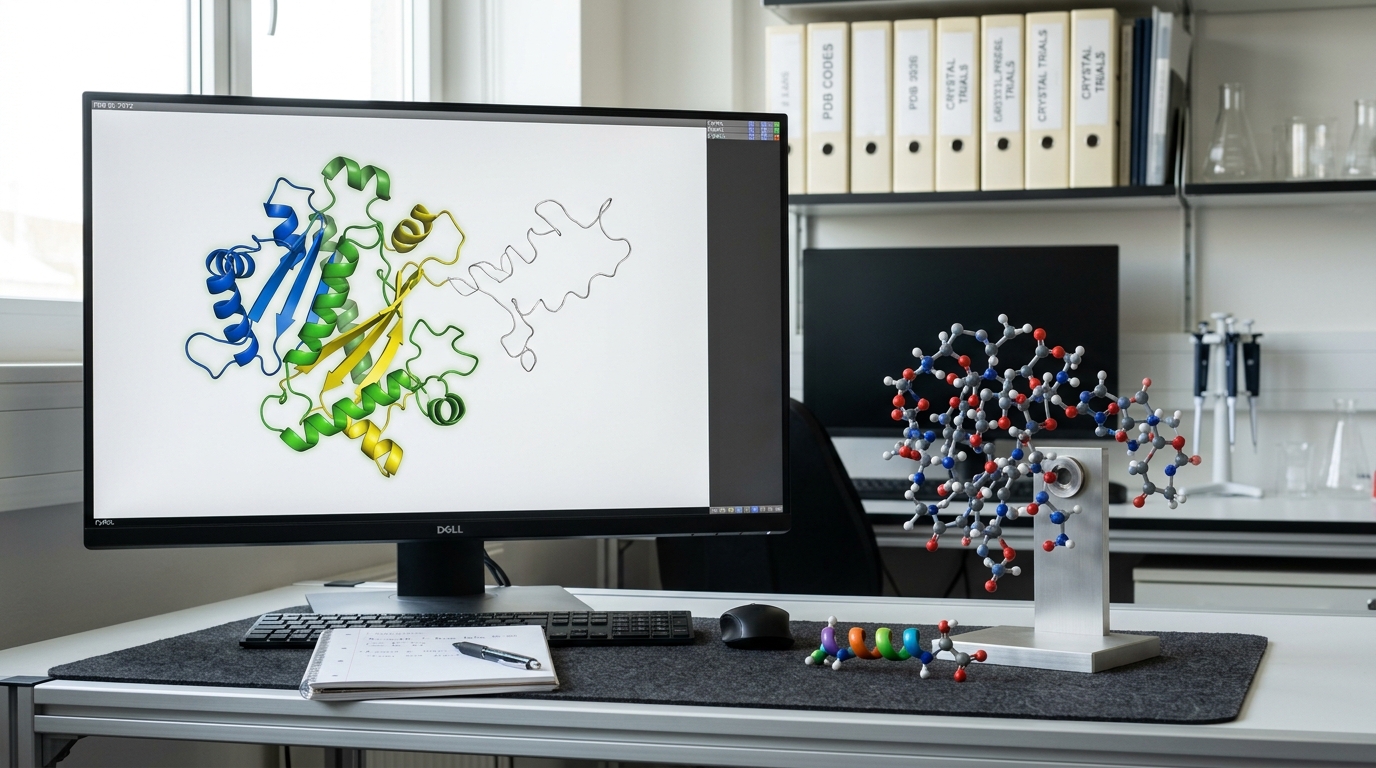
In December 2020, a model trained on solved structures produced predictions independent assessors judged close to experimental accuracy; the physical model on the bench had not yet caught up to what the screen already showed. — Image prompt and art direction by Brecht Corbeel; generation pending.
Abstract
This article traces AI for science and medicine as a dated, sourced sequence: Edward Shortliffe's MYCIN, an antibiotic-advising rule-based expert system built at Stanford in the mid-1970s and rigorously evaluated against human specialists in a 1979 blinded trial, but never deployed clinically; the QSAR and structure-based computer-aided drug design methods that matured through the 1980s and 1990s; CASP, the blind protein-structure-prediction competition founded in 1994, whose progress stalled for most of two decades; DeepMind's AlphaFold2, whose 2020 CASP14 result independent assessors described as solving single-chain structure prediction; the FDA's iterative AI/ML medical-device framework, from the 2018 autonomous authorization of a diabetic-retinopathy screening device through a 2024 predetermined-change-control guidance; GraphCast's 2023 demonstration that a trained model could outperform physics-based weather forecasts on most measured variables; and the current wave of AI research agents that design and run their own experiments. Every date and figure is attributed to a specific, independently verified source.
A history with dates attached
It is easy to tell the story of AI in science and medicine as a single hinge: nothing, then AlphaFold. The actual record is longer, messier, and considerably more interesting than that, and almost every step in it is dated, published, and independently checkable. A Stanford doctoral student built a rule-based program that argued about antibiotics before most hospitals owned a computer at all. Chemists were ranking drug candidates by regression equation while the personal computer was still a novelty. A blind competition judged protein-structure predictions for a quarter-century before any method came close to solving the problem it was designed to test. A regulator spent a decade publishing successive frameworks for software that kept changing while the paperwork was still being drafted. And the frontier now visible — models that forecast the atmosphere without solving its equations, and agents that propose and run their own experiments — did not appear from nowhere; each piece has an identifiable predecessor.
This article follows that sequence in the order it happened: the first clinical expert system and the specific, documented reasons it never reached a hospital ward; the QSAR and structure-based methods that gave computational chemistry a quantitative footing years before deep learning existed; the founding of CASP and the two-decade standstill that followed it; the 2020 result that ended that standstill; the FDA’s iterative, still-evolving framework for AI-enabled medical devices; the arrival of trained weather models that outperform physics-based forecasts on most measured variables; and the current generation of AI systems built to run science themselves, end to end.
1976: the program that argued about antibiotics
The first widely studied clinical AI system was not built to replace physicians. It was built to formalize how one narrow decision — which antibiotic to prescribe for a suspected bloodstream or meningeal infection, before laboratory culture results were back — could be represented as a set of explicit rules a machine could apply consistently. Edward Shortliffe developed MYCIN at Stanford as his doctoral research, completing his PhD in medical information sciences in 1975 and publishing the fuller account as the monograph Computer-Based Medical Consultations: MYCIN the following year [3].
MYCIN’s architecture, as Shortliffe and Bruce Buchanan later documented in detail, was a knowledge base of several hundred conditional statements of the form “if there is evidence that A and B are true, conclude there is evidence that C is true,” worked through by a backward-chaining inference engine that started from a therapeutic goal and reasoned back through the rule chains to ask the clinician only the questions needed to reach it [1]. Buchanan and Shortliffe describe MYCIN explicitly as an early instance of what the field came to call an expert system: a program built to give expert-level advice, explain its own reasoning, and be extended with new rules by domain experts rather than only by programmers [1]. That last property — an explanation subsystem that could show its chain of reasoning on request — was as central to the design as the diagnostic logic itself, because the authors judged that a system giving unexplained advice would never be trusted by the physicians it was meant to help.
The system’s performance was tested rigorously, not asserted. Victor Yu, Lawrence Fagan, and colleagues ran a blinded evaluation in which nine human prescribers and MYCIN each proposed antimicrobial therapy for real meningitis cases, and eight independent infectious-disease specialists rated every recommendation without knowing its source. MYCIN’s regimens were judged acceptable 65 percent of the time, compared with an acceptability range of 42.5 to 62.5 percent across the five participating faculty specialists, and the system never once failed to cover a pathogen that needed treatment [2]. By the narrow measure the study was designed to test, a rule-based program built in the 1970s matched or exceeded the specialists it was checked against.

Figure 1. MYCIN's roughly 600 rules were built and revised one conditional statement at a time on terminals like this one, years before any hospital had a network to run the finished program on. — Image prompt and art direction by Brecht Corbeel; generation pending.
MYCIN was never deployed in routine care, and the reasons are as well documented as the performance result. There was no legal or regulatory framework for assigning responsibility if a computer-generated recommendation contributed to patient harm. There was also no electronic health record for the system to draw on automatically — MYCIN required a clinician to type answers to a long sequence of text prompts, and in a 1970s hospital that manual burden was, by itself, close to disqualifying. Shortliffe himself came to describe MYCIN’s lasting importance as conceptual rather than clinical: it showed that specialist medical judgment could be captured as explicit rules and reasoned over by machine, a different claim from showing such a system could be dropped into a working hospital. Every AI system discussed later in this article inherits that same two-part test — does it perform well, and can it be integrated into how the work actually gets done — and the second half has proved the harder one to pass at every stage since.
Numbers before deep learning: QSAR and computer-aided drug design
While MYCIN was being built for diagnosis, a separate and older computational tradition was taking shape around drug discovery, and it long predates anything resembling modern machine learning. Quantitative structure-activity relationship modeling — QSAR — treats a molecule’s measured biological activity as a variable to be predicted from its physicochemical properties: hydrophobicity, electronic character, steric bulk. Corwin Hansch and Toshio Fujita formalized the approach in a 1964 paper correlating substituent constants with biological activity through multiple linear regression, work that a 2023 review of computer-aided drug design methodology credits, alongside contemporaneous equations from Hammett and Taft, as foundational to the entire discipline that followed [4]. A QSAR model of this kind does not simulate a molecule’s chemistry; it fits a statistical relationship between structure-derived numbers and an assay result, then uses that fit to rank candidates that have not yet been synthesized.
The 1980s added a second, geometrically explicit tool to the same goal. Irwin “Tack” Kuntz and colleagues at the University of California, San Francisco, published a program called DOCK in 1982, describing what the same review calls the technique that gave molecular docking its name: an algorithm that searches for geometrically feasible ways a small molecule could fit into a macromolecular binding site, scoring candidate poses by steric complementarity rather than requiring a full physical assay for every option [4]. Later in the same decade, comparative molecular field analysis extended this structural approach by mapping the steric and electrostatic fields around a set of aligned molecules and regressing those field values against activity, giving chemists a three-dimensional, visualizable version of the same underlying idea Hansch and Fujita had reduced to substituent tables two decades earlier.
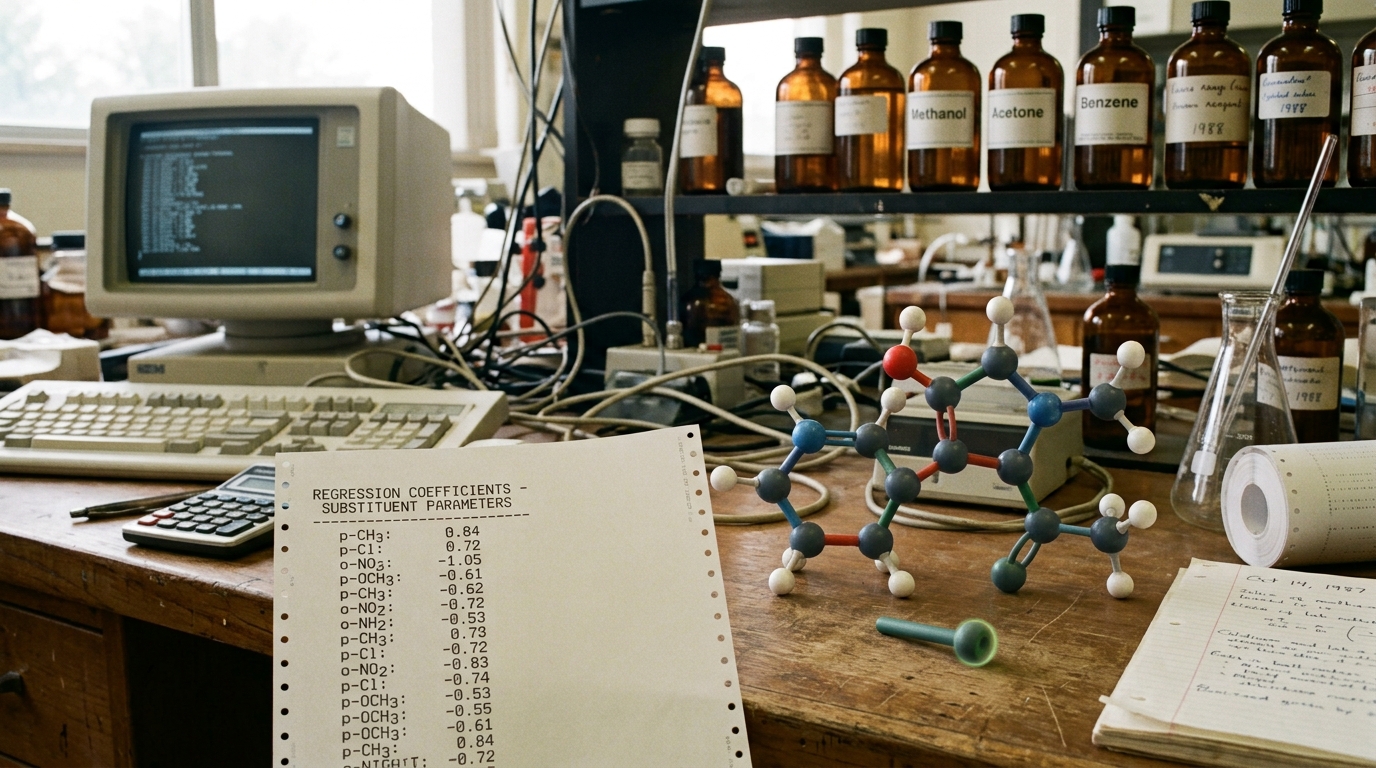
Figure 2. QSAR regressions and early docking programs let chemists rank candidate substituents before synthesizing them; the physical model on the bench still needed a hand to confirm what the printout predicted. — Image prompt and art direction by Brecht Corbeel; generation pending.
None of these methods used anything resembling a trained neural network, and it would be anachronistic to describe them as part of the same technical lineage as AlphaFold2 or a modern generative chemistry model. What they share with what came later is a narrower and more durable claim: that a computed, quantitative model of a molecule’s properties, built well before a compound is synthesized, can meaningfully narrow an experimental search space. That claim was tested, refined, and partly vindicated across roughly two decades of pharmaceutical practice before deep learning existed as a usable tool, and it is the direct ancestor of every later effort — including today’s generative and agentic drug-discovery pipelines — that treats candidate molecules as objects to be ranked computationally before a bench chemist ever touches them.
A blind test, repeated every two years, for a quarter century
Predicting a protein’s three-dimensional structure from its amino-acid sequence is a much harder and more general problem than either MYCIN’s rule-following or QSAR’s regression fitting, and the field built a specific institution to keep itself honest about how well it was actually doing. John Moult, working with Jan Pedersen, Richard Judson, and Krzysztof Fidelis, organized the first Critical Assessment of protein Structure Prediction — CASP — as a doubly blind community experiment: structural biologists contributed protein targets whose experimental structures were not yet public, prediction groups submitted computed structures without seeing the answers, and independent assessors scored the submissions against the withheld experimental data once it became available. The inaugural round met at the Asilomar conference center in California in December 1994, drawing 35 prediction groups who submitted more than one hundred predictions across three problem categories — comparative modeling, fold recognition, and prediction from sequence alone — with support from the U.S. Department of Energy, Lawrence Livermore and Sandia National Laboratories, and the National Institute of Standards and Technology [5].

Figure 3. CASP's first round in December 1994 tested predictions against structures the assessors already had and the predictors did not; the blind-envelope format that made the result trustworthy is older than any of the methods later judged by it. — Image prompt and art direction by Brecht Corbeel; generation pending.
What CASP’s biennial record shows across the following quarter-century is not a steady climb. A 2021 retrospective in the Biochemical Journal by Andrei Lupas and colleagues at the Max Planck Institute for Developmental Biology describes progress as having “largely come to a standstill” after roughly CASP5, in the early 2000s, and lasting until CASP12 — invoking a widely quoted 1997 New York Times headline, “Proteins 1, Computer 0,” as a fair summary of the field’s mood for most of that period [6]. This is worth stating plainly because it is the detail most retellings compress away: the protein-folding problem was not a young, fast-moving field that AI happened to accelerate. It was a mature, well-funded, biannually and rigorously benchmarked problem that had resisted concerted effort from, in Lupas and colleagues’ words, “some of the brightest minds in biophysics” for the better part of half a century [6]. The blind, adversarial structure of CASP itself — targets the assessors held and predictors did not — is precisely what makes that record of stalled progress credible rather than merely modest self-reporting, and it is the same structural feature that makes the result described in the next section credible too.
December 2020: the fold that changed the field’s language
At CASP14 in 2020, DeepMind’s AlphaFold2 broke the standstill decisively enough that the field’s own vocabulary shifted. Jumper and colleagues’ peer-reviewed account, published in Nature the following year, reports a median score of 92.4 on the Global Distance Test — Total Score across all CASP14 targets, a metric on which scores in the 90s are generally considered competitive with the resolution of an experimental structure [7]. Lupas and colleagues, writing as outside assessors rather than as the method’s authors, characterized the result without hedging: “the structure prediction problem for single protein chains has been solved,” a sentence they describe as “absolutely astounding” given the problem’s documented history [6].
Independent analysis of the same CASP14 results reinforces the scale of the gap rather than merely repeating DeepMind’s own numbers. Carlos Outeiral Rubiera of the Oxford Protein Informatics Group, writing shortly after the results were released in December 2020, computed that AlphaFold2’s submissions carried an average z-score of around 2.5 across all targets, rising to 3.8 on the hardest category, with the next-best-performing group trailing by a wide margin on the same scale, and roughly 36 percent of predictions landing within 2 angstroms root-mean-square deviation of the true structure [8]. The same analysis is careful to distinguish what was actually demonstrated from what was not: AlphaFold2’s own predictions still performed poorly on a handful of CASP14’s hardest targets, its method depends on the availability of related sequences through multiple sequence alignments and therefore struggles on proteins without close relatives, and — as Outeiral Rubiera puts it directly — solving structure prediction is not the same claim as solving the separate, dynamic question of how a protein actually folds over time [8]. That distinction between a narrow, rigorously benchmarked claim and a broader one it is often mistaken for recurs throughout the rest of this history, from FDA device clearances to weather models to the AI research agents discussed below.
A regulator learning by device, then by document
Medicine’s regulatory apparatus faced its own version of the same problem CASP had solved for protein structure: how do you validate software whose behavior is learned from data rather than specified by an engineer, particularly when that software might keep changing after it ships? The FDA’s answer has been built iteratively, in public documents, against real authorized devices rather than in the abstract.
The first concrete marker is a specific device authorization. In April 2018, the FDA authorized IDx-DR, an AI system that analyzes retinal photographs to screen for diabetic retinopathy, through the De Novo premarket pathway. The pivotal trial behind that authorization, led by Michael Abramoff and colleagues and published in npj Digital Medicine, enrolled 900 participants with diabetes across ten U.S. primary care sites and reported 87.2 percent sensitivity and 90.7 percent specificity against grading by the Wisconsin Fundus Photograph Reading Center; the paper describes the resulting authorization as “the first FDA authorized autonomous AI diagnostic system in any field of medicine” — autonomous meaning the system’s output could be acted on without a specialist re-reading the image [10].

Figure 4. The device authorized in 2018 to read its own retinal images without a specialist's review reached that authorization through a paper record as carefully assembled as the algorithm inside it. — Image prompt and art direction by Brecht Corbeel; generation pending.
The framework for handling AI-enabled devices more generally arrived afterward and has been revised twice since in public, dated documents. In April 2019 the FDA published a discussion paper proposing a regulatory approach for AI/ML-based software that might change after initial clearance, seeking public comment rather than issuing settled policy. It followed that discussion paper with the AI/ML-Based Software as a Medical Device Action Plan, released in January 2021, which committed the agency to developing guidance on what it called a Predetermined Change Control Plan — a pre-authorized description of how a device’s algorithm is allowed to evolve without triggering a new marketing submission for every update [9]. That guidance itself did not arrive as a finalized document until December 4, 2024, when the FDA issued final guidance titled “Marketing Submission Recommendations for a Predetermined Change Control Plan for Artificial Intelligence-Enabled Device Software Functions,” specifying what a manufacturer’s change-control plan must describe: the modifications planned, the methodology for developing and validating them, and an assessment of their impact, so that FDA can authorize a defined envelope of future changes up front rather than case by case [11]. A 2025 review in Mayo Clinic Proceedings: Digital Health situates this progression as a continuing, unfinished process rather than a settled framework, noting that oversight mechanisms for adaptive, real-world-learning algorithms remain an active area of policy development rather than a solved problem [12].
Read end to end, the sequence runs: a narrow, rigorously trialed autonomous device authorized in 2018; a request for public comment in 2019; a stated policy direction in 2021; and a binding guidance document specifying what a change-control plan must contain only at the end of 2024 — six years from first authorization to a finalized mechanism for handling the exact property, continual algorithm updates, that made AI-based devices different from conventional ones in the first place.
Ten days of weather in under a minute
Weather forecasting has run on numerical weather prediction — solving the physical equations of atmospheric motion on a supercomputer grid — since the mid-twentieth century, refined continuously by operational centers such as the European Centre for Medium-Range Weather Forecasts. GraphCast, developed by Remi Lam and colleagues at Google DeepMind, took a different approach: train a graph neural network directly on decades of historical reanalysis data to predict how the atmosphere evolves, without solving the underlying fluid-dynamics equations at inference time at all. The published account, which appeared as a 2022 preprint ahead of its 2023 publication in Science, reports that the trained model predicts hundreds of weather variables ten days ahead at a global 0.25-degree resolution in under one minute on modern hardware, and that it produced more accurate forecasts than ECMWF’s high-resolution operational system on more than 90 percent of 1,380 verification targets, rising to 99.7 percent within the troposphere specifically [13].
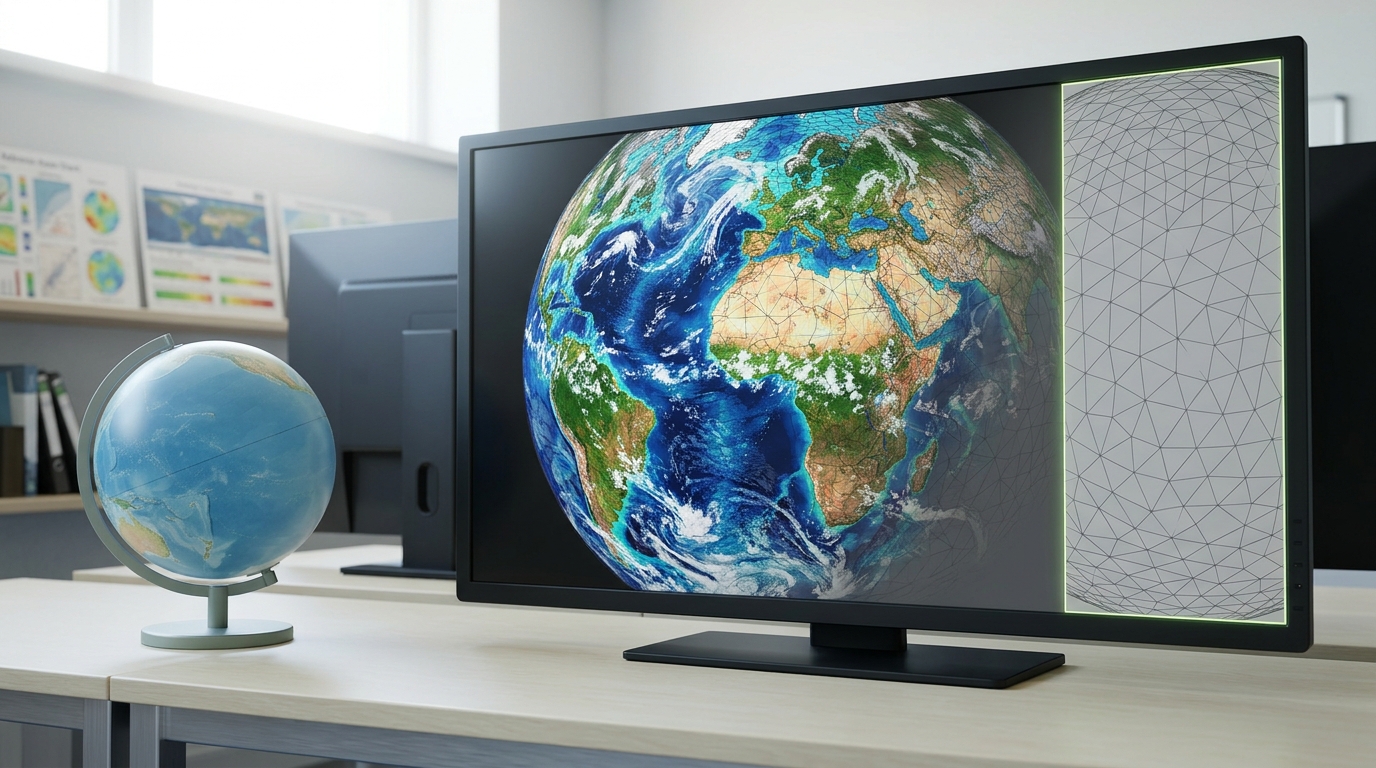
Figure 5. A model trained on a decade of reanalysis data now produces a ten-day global forecast in well under a minute; the rendering on screen is still catching up to the computation behind it. — Image prompt and art direction by Brecht Corbeel; generation pending.
The result is properly read as a demonstration that a learned model can match or exceed a physics-based forecast on most standard verification measures, not as evidence that numerical weather prediction has become unnecessary. GraphCast was trained on ERA5, a reanalysis product itself built from decades of physics-based modeling reconciled against observations, so the learned model’s skill is downstream of, not independent from, the forecasting tradition it is compared against. Operational weather centers have accordingly treated systems in GraphCast’s lineage as an additional, much cheaper forecasting tool to run alongside physical models rather than as an outright replacement for them — a distinction with a direct parallel to AlphaFold2’s own limits: a model can decisively beat the previous best approach on the metrics that approach’s own community uses to judge success, while still depending on that community’s accumulated data and remaining silent on questions the benchmark was never built to ask.
The current frontier: agents that run their own experiments
The most recent extension of this history moves the AI system from proposing an answer to running the process that finds one. Daniil Boiko and colleagues at Carnegie Mellon University described Coscientist, a GPT-4-driven system that plans and executes chemistry experiments by calling external tools — internet and documentation search, code execution, and robotic experimental hardware — reporting in Nature in December 2023 that the system successfully planned and carried out palladium-catalyzed cross-coupling reaction optimization among six demonstrated research tasks [15]. The system’s contribution was procedural as much as chemical: it demonstrated that a language model could be wired directly into laboratory automation and literature search well enough to close part of the loop between hypothesis and executed experiment, rather than only producing a written suggestion for a human to carry out.
Google DeepMind extended the same idea toward biomedical hypothesis generation specifically. Its AI co-scientist, described in a February 2025 research announcement as a multi-agent system built on Gemini 2.0 to act as a “virtual scientific collaborator,” produced results validated experimentally rather than only plausibly worded: proposed drug-repurposing candidates for acute myeloid leukemia that were subsequently confirmed to inhibit tumor viability at clinically relevant concentrations across multiple cell lines, epigenetic targets for liver fibrosis with anti-fibrotic activity confirmed in human hepatic organoids, and a proposed mechanism by which mobile genetic elements called cf-PICIs interact with phage tails to expand their host range — a hypothesis that matched experimental findings a separate laboratory had not yet published [16].

Figure 6. Today's research agents can generate a hypothesis, design an experiment and draft the write-up; what still moves the card into the far column is a check the system did not perform on itself. — Image prompt and art direction by Brecht Corbeel; generation pending.
A third effort has pushed toward automating the entire research write-up rather than one stage of it. Sakana AI’s “AI Scientist,” first released in 2024, is built to generate a research idea, search the literature, run the corresponding machine-learning experiments, and write the resulting paper in full, including its own figures. Sakana’s own account of the project’s progress to a peer-reviewed Nature publication in 2026 reports that one paper the system produced was submitted to an ICLR 2025 workshop, scored an average of 6.33 across three reviews — above both the average human-authored score and the typical acceptance threshold — before the authors withdrew it prior to publication [14]. The same account is candid about the system’s failure modes: it can produce “naive or underdeveloped ideas,” struggles with methodological rigor on more demanding tasks, and remains “susceptible to hallucinations or obvious mistakes, such as generating inaccurate citations or duplicating figures” [14]. Every one of these systems currently operates on computational or wet-lab tasks with fast, relatively cheap verification cycles; none has yet been tested against a domain where an error is expensive or slow to catch, which is exactly the condition under which MYCIN’s designers judged that trust, not raw accuracy, would be the binding constraint.
What fifty years of this history actually shows
Read the sequence end to end and one constraint recurs at every stage, dressed differently each time. MYCIN matched or beat human specialists on a rigorous blinded test in 1979 and was still never adopted, because performance on a benchmark and integration into a working system of legal and clinical responsibility are different achievements, and the second is not implied by the first [2]. QSAR and structure-based drug design proved their statistical and geometric methods useful across two decades of unglamorous, incremental pharmaceutical practice, well before any of it was called AI, establishing that a computed ranking could narrow — without replacing — an experimental search [4]. CASP’s two-decade standstill is the reason AlphaFold2’s 2020 result was credible the moment it was announced: the blind benchmark had already spent a quarter-century failing to be beaten, so when it finally was, independent assessors with no stake in the result could say so with confidence [6] [8]. The FDA’s regulatory record shows the same lag between technical capability and institutional readiness that MYCIN hit in the 1970s, just compressed from “never” to six years and counting, from one device’s 2018 authorization to a 2024 mechanism for handling the exact property — continual model updates — that distinguishes AI-based devices from the ones regulators already knew how to handle [10] [11]. GraphCast’s benchmark victory depends on the physics-based data pipeline it is measured against, not independent of it [13]. And the current wave of research agents is, by its own developers’ published account, still working through the same trust problem in miniature: fast at generating candidates, not yet reliably self-correcting about which candidates are wrong [14].
The throughline is not that AI capability has been overstated at each stage — in most of the cases documented here, independent, adversarial evaluation confirmed the central claim. It is that capability and adoption have never moved at the same speed, and every accurate history of this field has to report both numbers separately.
Predictions, with the observations that would falsify them
These are forecasts, clearly separated from the sourced history above. Horizon: 16 August 2031.
One. The gap between an AI system’s benchmark performance and its actual deployment in a regulated or high-stakes setting will remain measured in years rather than months for every domain covered here, following the pattern set by MYCIN, IDx-DR, and the FDA’s own six-year path from first AI device authorization to a finalized change-control mechanism. Disconfirmed if a comparably high-stakes AI system — a diagnostic device, an AI-designed therapeutic, or an AI-scientist-generated finding — moves from first published benchmark result to routine regulated deployment in under twelve months.
Two. Neural weather models will continue to be deployed alongside, not instead of, physics-based numerical weather prediction, because their training data remains derived from reanalysis products built by the physical modeling tradition. Disconfirmed if a major national weather service retires its physics-based operational forecasting system entirely in favor of a purely learned model with no physics-based reanalysis input anywhere in the pipeline.
Three. AI research-agent systems will be adopted first, and fastest, in domains with cheap, fast, automatable verification — computational experiments, chemistry with robotic execution, literature-grounded hypothesis generation — and slowest in domains where an incorrect output is costly or slow to detect, extending the pattern already visible in Coscientist’s and the AI co-scientist’s chosen validation domains. Disconfirmed if an AI research agent is given primary responsibility, without a human verification step, for a clinical treatment decision or an FDA-regulated claim by the horizon date.
Four. Independent, adversarial benchmarking modeled on CASP’s blind-target structure will be increasingly demanded, by name, as a condition for taking new AI-for-science claims seriously, precisely because CASP’s own two-decade record of resisting easy claims is what made the 2020 result credible. Disconfirmed if the field’s major venues continue to accept vendor-reported, non-blinded benchmark results as sufficient evidence for a comparably large claim by the horizon date.
None of these predictions requires any specific technical breakthrough. Each extrapolates a pattern already visible, repeatedly, in the fifty-year record traced above.
What to take away
Every dramatic moment in this history sits on top of a slower one that made it legible. MYCIN’s 65 percent acceptability rating meant something only because it was measured blind, against named human comparators, by evaluators who did not know which recommendation came from the machine. AlphaFold2’s median GDT-TS of 92.4 meant something only because CASP had already spent a quarter-century failing to be beaten by anything close to it. IDx-DR’s sensitivity and specificity figures meant something only because they came from a prospective, multi-site pivotal trial rather than a retrospective convenience sample. The pattern is not that verification is a formality standing between a result and its adoption. Verification, done adversarially and in public, is the mechanism by which a result becomes a fact anyone outside the team that produced it is entitled to believe — and reading that mechanism back into each of these episodes, rather than skipping to the headline number, is what turns a list of milestones into an actual history.
Sources
- Bruce G. Buchanan and Edward H. Shortliffe. Rule-Based Expert Systems: The MYCIN Experiments of the Stanford Heuristic Programming Project (Chapter 1, "The Context of the MYCIN Experiments"). Addison-Wesley (1984).
- Victor L. Yu, Lawrence M. Fagan, et al.. Antimicrobial Selection by a Computer: A Blinded Evaluation by Infectious Diseases Experts (reprinted as "An Evaluation of MYCIN's Advice"). JAMA (1979).
- Wikipedia contributors. Edward H. Shortliffe. Wikipedia (2026).
- Davide Bassani and Stefano Moro. Past, Present, and Future Perspectives on Computer-Aided Drug Design Methodologies. Molecules (2023). DOI: 10.3390/molecules28093906.
- John Moult, Jan T. Pedersen, Krzysztof Fidelis, and organizers. CASP1 (1994): Description and History. Prediction Center (CASP) (1994).
- Andrei N. Lupas, Joana Pereira, Vikram Alva, Felipe Merino, Murray Coles, and Marcus D. Hartmann. The Breakthrough in Protein Structure Prediction. Biochemical Journal (2021).
- John Jumper et al.. Highly Accurate Protein Structure Prediction with AlphaFold. Nature (2021). DOI: 10.1038/s41586-021-03819-2.
- Carlos Outeiral Rubiera. CASP14: What Google DeepMind's AlphaFold 2 Really Achieved, and What It Means for Protein Folding, Biology and Bioinformatics. Oxford Protein Informatics Group (2020).
- U.S. Food and Drug Administration. Artificial Intelligence/Machine Learning (AI/ML)-Based Software as a Medical Device (SaMD) Action Plan. FDA (2021).
- Michael D. Abramoff, Philip T. Lavin, Michele Birch, Nilay Shah, and James C. Folk. Pivotal Trial of an Autonomous AI-Based Diagnostic System for Detection of Diabetic Retinopathy in Primary Care Offices. npj Digital Medicine (2018). DOI: 10.1038/s41746-018-0040-6.
- U.S. Food and Drug Administration. Marketing Submission Recommendations for a Predetermined Change Control Plan for Artificial Intelligence-Enabled Device Software Functions. Federal Register (2024).
- Vidhi Singh, Susan Cheng, Alan C. Kwan, and Joseph Ebinger. United States Food and Drug Administration Regulation of Clinical Software in the Era of Artificial Intelligence and Machine Learning. Mayo Clinic Proceedings: Digital Health (2025).
- Remi Lam et al.. GraphCast: Learning Skillful Medium-Range Global Weather Forecasting. Science (2023). DOI: 10.1126/science.adi2336.
- Sakana AI. The AI Scientist: Towards Fully Automated Open-Ended Scientific Discovery, Now Published in Nature. Sakana AI (2026).
- Daniil A. Boiko, Robert MacKnight, Ben Kline, and Gabe Gomes. Autonomous Chemical Research with Large Language Models. Nature (2023). DOI: 10.1038/s41586-023-06792-0.
- Google Research. Accelerating Scientific Breakthroughs with an AI Co-Scientist. Google Research Blog (2025).
Originally published at https://absolutedigitalpublishers.com/articles/from-origins-to-frontier-a-history-of-ai-for-science-and-medicine.