Flight at the Energy Floor: Transport Selection to 2100
Every transport lineage answers one equation: energy per kilogram under a physics floor. Kerosene beats batteries, the boom rule capped Concorde's market, and reuse cut launch cost by an order of magnitude.
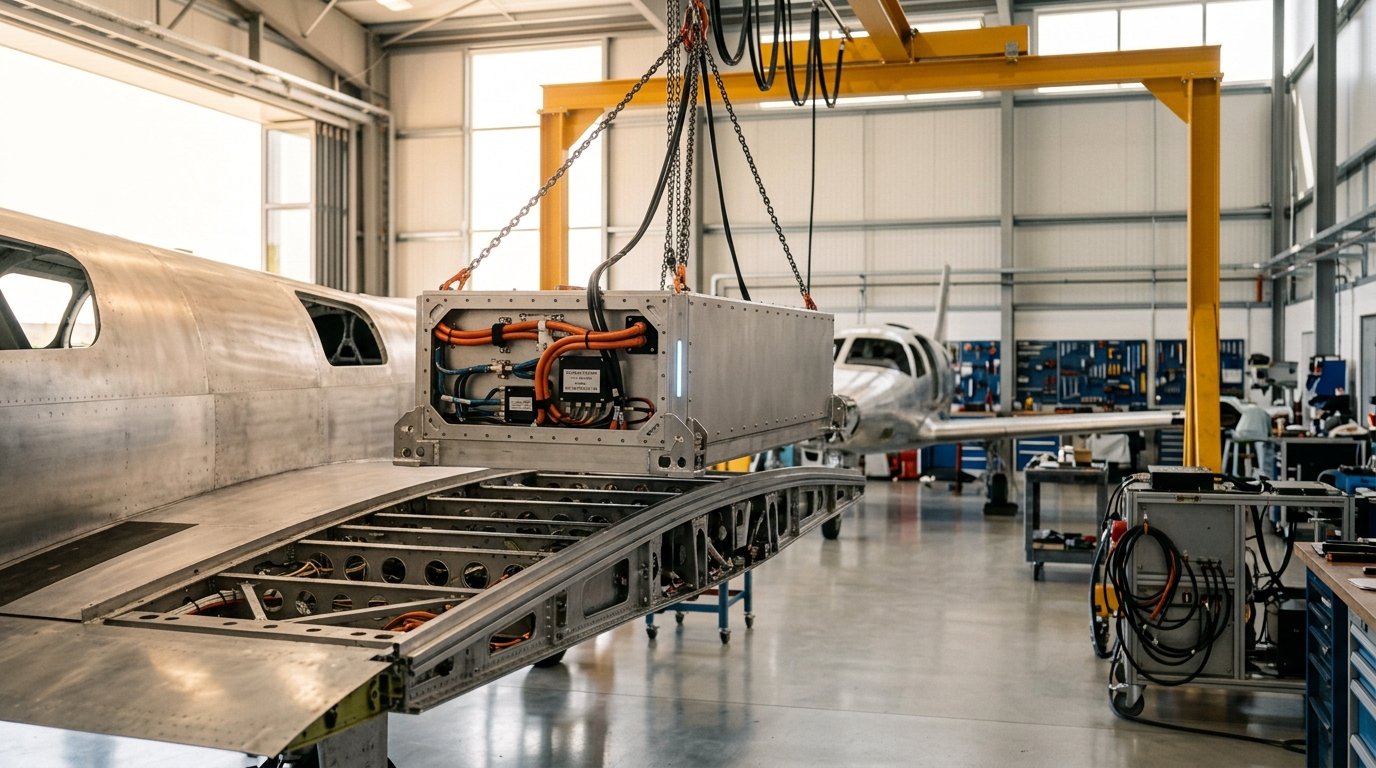
Every claim in this article is an argument about what this exact operation can and cannot substitute for a fuel tank. — Image prompt and art direction by Brecht Corbeel; generation pending.
Abstract
Transport modes do not compete on style; they compete on how many watt-hours of usable energy they can carry per kilogram of vehicle mass, and on which routes a regulator will let them fly at all. This article works that arithmetic through four cases: battery-electric aviation against kerosene's roughly twelve-thousand-watt-hour-per-kilogram advantage; supersonic and hypersonic flight against the sonic-boom rule that foreclosed Concorde's overland market regardless of its economics; orbital and suborbital launch against the exponential cost of delta-v; and autonomy as a selection pressure that frees vehicle mass and shape from the requirement to keep a crew alive. Every program named is checked against what it has actually flown, certified, or shipped as of 2026, not what it has rendered, and every claim reaching past that date states whose forecast it is, what would confirm it, and what would prove it wrong.
Every transport lineage is negotiating with the same equation
A ship, an aircraft, and a rocket are not three different problems. Each one is a structure carrying an energy source and a payload against a resistance — drag, gravity, or both — and the fraction of the vehicle’s mass that can be payload instead of energy-carrier is set almost entirely by one number: how many watt-hours of usable energy the carrier holds per kilogram of its own mass. That number is a physics floor, not a design choice, and it is calculable today for every mode this article covers. What differs between modes is not ambition but which floor they are pressed against, and which of two selection pressures — the economics of the floor itself, or a regulator’s decision about what may legally operate — is doing the culling.
Treat each propulsion approach as a lineage in the evolutionary sense: an inherited body plan (turbofan-and-kerosene, battery-and-motor, staged-and-expendable, staged-and-reusable) that a manufacturer cannot simply redesign from a blank sheet each generation, because the tooling, the supply chain, the regulatory pathway, and the airport or launch-pad infrastructure are all locked into that plan already. A lineage improves along an S-curve — fast early gains, a long flattening tail — and it stops improving not when engineers stop trying but when it presses against a floor set by chemistry, aerodynamics, or orbital mechanics. A new lineage does not out-compete an old one by being a better idea; it displaces it only when the floor itself moves, or when a regulatory filter removes an entire niche from the old lineage’s reach the way the sonic-boom rule did to supersonic transport, independent of whether the aircraft flying it was otherwise viable.
This matters because the trap in writing about transport’s future is concept-art futurism: a rendering can put a reusable spaceplane, a hypersonic airliner, and a battery-electric widebody on the same runway, because a rendering pays no thermodynamic or regulatory cost for including all three. This article does not do that. Every program named below is checked against what it has actually flown, certified, or shipped as of August 2026, not what it has announced; every claim reaching past that date states whose forecast it is, what observable indicator would support it, and what would prove it wrong.
The Breguet range equation is the aviation lineage’s argument in one line
Aircraft range is not a free parameter; it is fixed by a single classical relation once cruise speed, aerodynamic efficiency, and fuel fraction are set. In its standard Mach-number form, the range an aircraft can fly in cruise is:
R = \frac{aM}{g\,c_T}\cdot\frac{L}{D}\cdot\ln\!\left(\frac{W_1}{W_2}\right)
where a is the local speed of sound, M is cruise Mach number, g is standard gravity, c_T is thrust-specific fuel consumption, L/D is the lift-to-drag ratio, and W_1 and W_2 are the aircraft’s weight at the start and end of the cruise segment [1]. Three of those four factors — speed, engine efficiency, and aerodynamic efficiency — are where a century of aeronautical engineering has already done most of its work and where further gains now come in single-digit percentages per generation, the flattened tail of aviation’s S-curve. The fourth factor, the mass-ratio term \ln(W_1/W_2), is where the aviation lineage’s entire battery-versus-kerosene argument actually lives, because W_1/W_2 is set by how much of the aircraft’s total weight has to be energy-carrier to deliver a given amount of usable energy — and that, in turn, is set directly by the energy-carrier’s specific energy in watt-hours per kilogram. A carrier with low specific energy needs more of the aircraft’s weight budget just to hold the same energy, which shrinks \ln(W_1/W_2) for any given range target and forces a designer to trade range against payload, payload against range, or accept a shorter mission than the same airframe could fly on a denser fuel. Nothing about propeller efficiency, wing aspect ratio, or engine bypass ratio changes that trade; it is set upstream of all of them, by chemistry.
Figure 1. The same arithmetic — how much energy moves per kilogram carried — is what every lineage in this article is negotiating with, just with a different apparatus. — Image prompt and art direction by Brecht Corbeel; generation pending.
Kerosene’s mass advantage over batteries is not a gap that effort closes
Jet fuel carries about 43 megajoules of chemical energy per kilogram, or roughly 11,944 watt-hours per kilogram [2]. A modern commercial lithium-ion cell, by contrast, runs 160 to 300 watt-hours per kilogram at the cell level, with specialty laboratory cells using silicon-anode and graphene-enhanced chemistries reaching a record of roughly 450 watt-hours per kilogram [3] — figures that describe a bare cell, not a certified aircraft pack, which must add cooling, structure, wiring, and safety margin on top. A widely cited 2018 estimate for a packaged aviation battery, including that overhead, put usable specific energy at around 160 watt-hours per kilogram, or about two percent of aviation fuel’s figure on the same basis [4]. The same analysis worked the arithmetic for a 19-seat regional turboprop flying a mission requiring the usual instrument-flight-rules fuel reserves: the mission needs 308 kilograms of jet fuel, or 4,300 kilograms of 250-watt-hour-per-kilogram batteries to store the same usable energy — nearly fourteen times the mass for the same energy content [4]. Run that mass penalty back through the Breguet equation’s \ln(W_1/W_2) term and the result is not a smaller aircraft flying the same mission; it is the same aircraft flying a much shorter one, which is exactly the pattern the verified programs below show. The same source states the scaling problem in its starkest form: for a large passenger aircraft, closing the gap to kerosene parity would require roughly a twentyfold improvement in energy density over today’s lithium-ion chemistry [4] — not a chemistry refinement but a chemistry replacement.
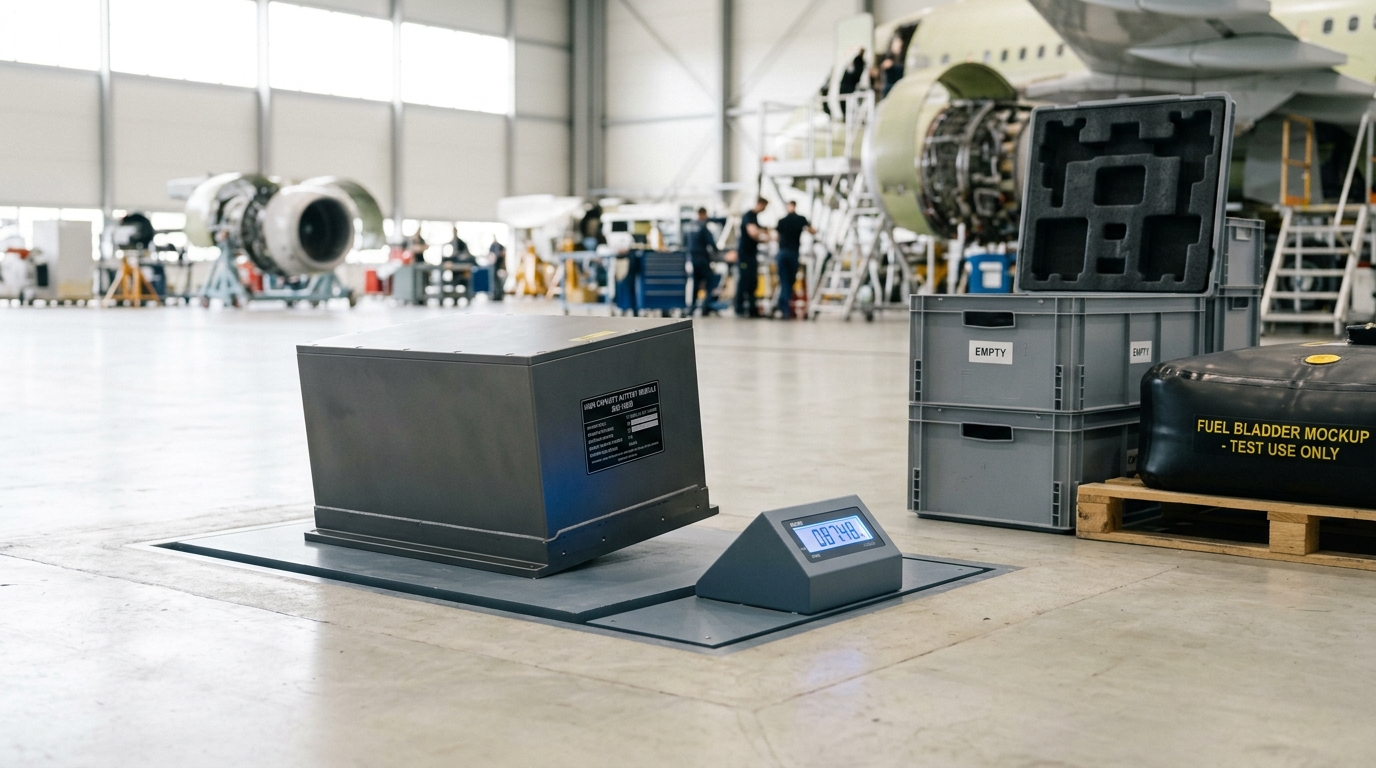
Figure 2. Roughly twelve thousand watt-hours per kilogram of kerosene against a few hundred for a packaged cell is not a gap technology closes by trying harder; it is the arithmetic the Breguet equation is built from. — Image prompt and art direction by Brecht Corbeel; generation pending.
This is exactly the kind of number a vendor has an incentive to promise past. In 2023, the Chinese battery manufacturer CATL announced what it calls a condensed battery, claiming an energy density of up to 500 watt-hours per kilogram and naming passenger-aircraft electrification explicitly as a target application, alongside a stated intent to work with aviation partners toward flight-qualified versions while an automotive-grade version was to enter mass production the same year [5]. Treat that number for what it is: a company’s own claim about its own unreleased product, made in a press release, not a figure independently verified in a certified aircraft pack — and even taken at face value, 500 watt-hours per kilogram is still roughly one-twenty-fourth of kerosene’s figure, an improvement over today’s packaged aviation cells but nowhere near the twentyfold jump the physics above calls for. The named falsifier for this article’s claim that battery-electric aviation has a hard regional ceiling is specific and checkable: a certified aircraft battery pack, independently verified rather than vendor-claimed, at or above 800 watt-hours per kilogram. Nothing flying or announced as of 2026 is within striking distance of that number.
What the arithmetic permits is regional electric flight, and even that is provisional
Three companies have taken this arithmetic as far as anyone has flown it, and none of the three has produced a transoceanic, or even a genuinely long-haul, result — nor is any of the three free of the schedule slippage that the mass penalty above predicts. Eviation’s Alice, a nine-passenger all-electric aircraft, flew for the first time on 27 September 2022, an eight-minute test sortie; the company subsequently revised its proposed range down from 440 nautical miles to 250 nautical miles, and certification, originally targeted for 2023, slipped to a planned 2027 [6]. In February 2025 the company laid off most of its staff amid a dispute between its co-founders and its majority owner, and as of this article’s research the aircraft’s status is on hold, with the project suspended indefinitely [6] — a program that hit the mass-ratio wall directly enough to halve its own range target before its funding also gave out.
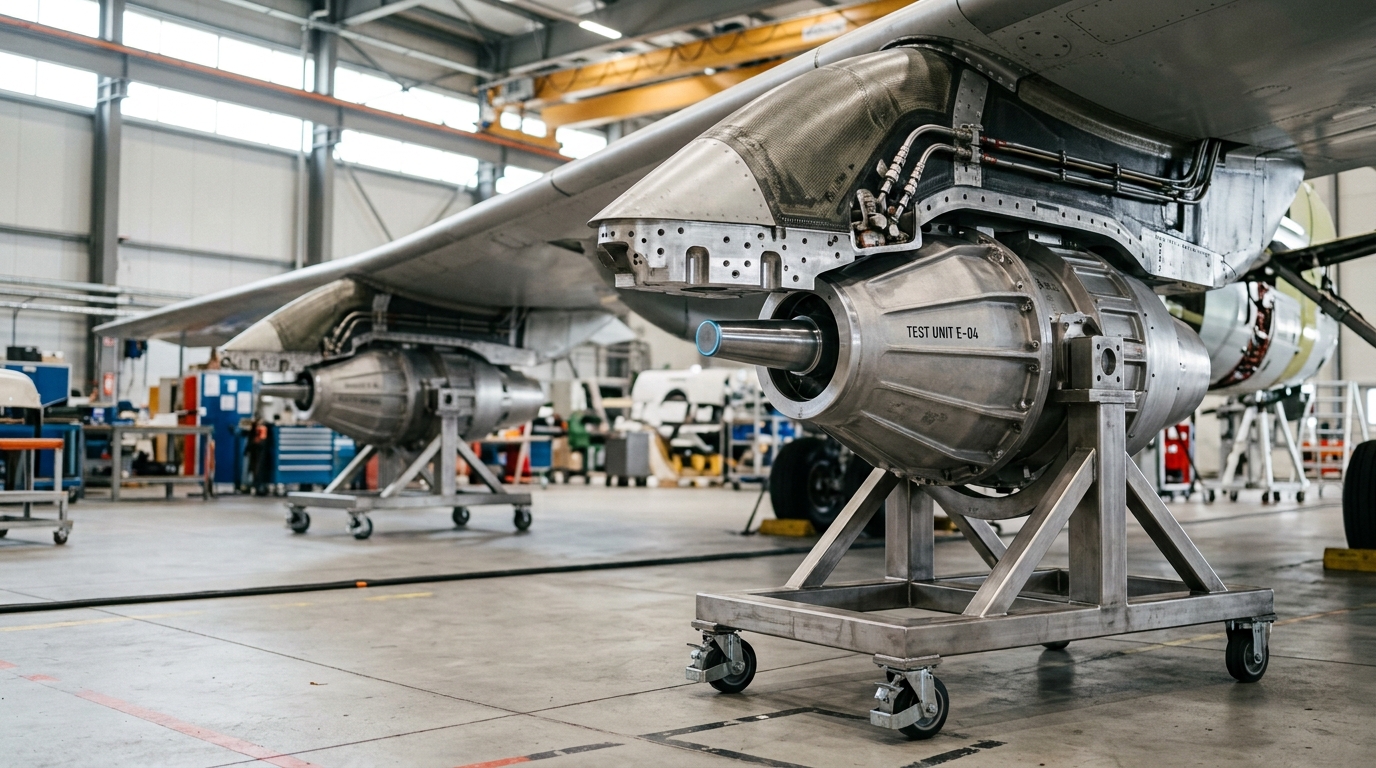
Figure 3. This is what a certified program actually looks like at this stage — a nacelle test-fitted onto a stand, not a rendering of a finished aircraft on a runway that does not yet exist. — Image prompt and art direction by Brecht Corbeel; generation pending.
Heart Aerospace’s ES-30 takes a different route around the same arithmetic: it is a hybrid-electric, not a pure battery-electric, regional aircraft, seating 30 passengers with an all-electric range of 125 miles (200 kilometres) and a combined hybrid range of 500 miles (800 kilometres), targeting type certification and entry into service in 2031 [7]. The hybrid architecture is itself an admission of the same ceiling: pure battery power alone only clears a quarter of the aircraft’s total design range, and a combustion generator has to carry the rest. Beta Technologies’ ALIA has demonstrated 336 nautical miles of range in flight testing and has moved into real operational use — four completed engagements with the US Department of Defense, more than thirty company pilots qualified, and commercial partnerships including UPS, Air New Zealand, and Bristow, with a stated backlog exceeding 800 aircraft [8] — but the company’s own public materials do not confirm a completed FAA type certificate for the platform as of 2026, and its most visible recent progress has been in hybrid-electric military variants rather than the pure-electric commercial baseline [8]. Read together, these three programs are the aviation lineage’s electric branch pressed flat against its S-curve ceiling: real hardware, real flight hours, and a consistent pattern of ranges revised downward, timelines revised rightward, and hybrid architectures substituted in wherever pure battery power runs out of usable energy per kilogram — which is precisely what the Breguet arithmetic above predicts, and precisely what a concept-art rendering of a battery-electric widebody in 2026 would have hidden.
Sustainable fuel and hydrogen are the kerosene lineage adapting, not a rival replacing it
Two other responses to the same pressure are visible in the aviation industry today, and both are better understood as the incumbent kerosene lineage adapting under a regulatory selection pressure — decarbonization mandates — than as a new lineage displacing it. Sustainable aviation fuel is chemically a kerosene substitute: it does not change the roughly 12,000-watt-hour-per-kilogram specific-energy figure at all, because it is still a hydrocarbon burned in the same turbine architecture, so it changes the fuel’s lifecycle carbon accounting without touching the Breguet equation’s mass-ratio term in any way batteries do. As of 2024 it represented about 0.3 percent of global aviation fuel consumption, up from 0.2 percent in 2023, and it remained roughly three times the price of conventional jet fuel as of 2022 [9]. The European Union’s ReFuelEU regulation sets mandated blending shares of 6 percent by 2030, 20 percent by 2035, and 70 percent by 2050 [9] — a regulatory forcing function operating entirely on top of an unchanged airframe and unchanged engine architecture, the aviation lineage’s equivalent of a coloration change rather than a new body plan.
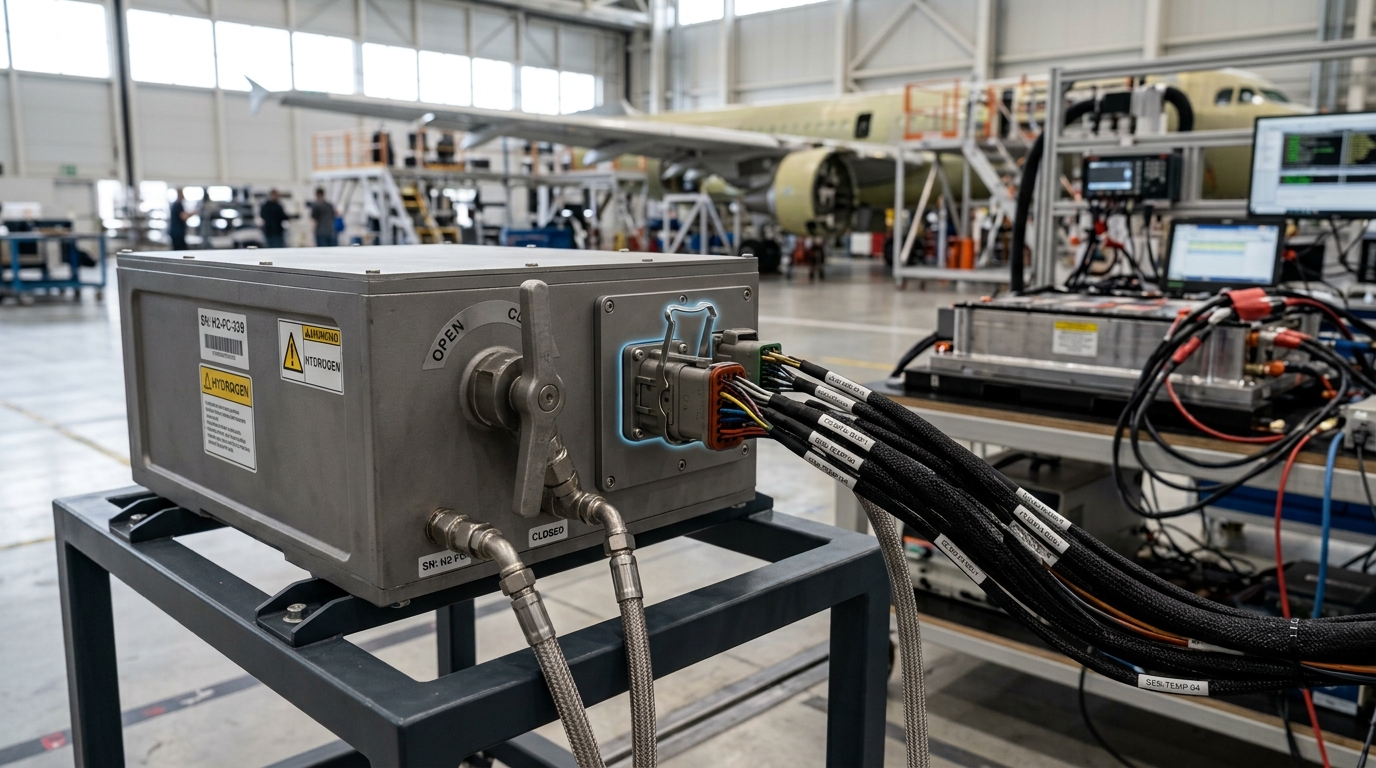
Figure 4. Sustainable fuel and hydrogen are the kerosene lineage adapting inside its own body plan, not a rival lineage replacing it — which is why this module sits cabled into the same bench as the battery, not on its own aircraft. — Image prompt and art direction by Brecht Corbeel; generation pending.
Hydrogen is the more genuine attempt at a new body plan, because liquid hydrogen’s gravimetric specific energy is roughly three times kerosene’s, but its extremely low volumetric density demands large cryogenic tankage that reshapes the airframe rather than simply refilling an existing wing tank. Airbus unveiled three liquid-hydrogen ZEROe concept designs in September 2020, originally targeting entry into service by 2035, and delivered a further roadmap update at its March 2025 summit [10] — but as of 2026 there is no flying, transport-category hydrogen-combustion or hydrogen-fuel-cell prototype at commercial scale, and the 2035 target remains a stated design goal rather than a demonstrated schedule. Both paths are worth naming for what they are: SAF is the kerosene lineage’s regulatory adaptation, unconstrained by the specific-energy floor because it never leaves it; hydrogen is a genuine attempt at a new lineage, still years from the flight-test stage the battery-electric programs above have already reached and, in several cases, already stalled at.
The sonic-boom rule is a selection pressure, not a footnote
Concorde is the clearest case in transport history of a regulatory filter, not an economic one, capping a technology’s addressable market. The aircraft cruised at Mach 2.02, carried between 92 and 128 passengers, and burned roughly 4,800 US gallons of fuel per hour at cruise, delivering about 15.8 passenger-miles per gallon against 33.3 for the Boeing 707, 46.4 for the 747, and 53.6 for the McDonnell Douglas DC-10 — the direct fuel-efficiency cost of pushing lift-to-drag ratio through the transonic and supersonic regime, exactly the L/D term in the Breguet equation collapsing even as speed M rises [11]. Its program cost ballooned from an initial 1962 estimate of 70 million pounds to somewhere between 1.5 and 2.1 billion pounds by 1976, with a unit cost of 23 million pounds per aircraft in 1977; against initial predictions of 350 aircraft sold, only 20 were ever built, 14 of them flying commercially for Air France and British Airways [11]. It was retired in 2003 amid rising maintenance costs, a collapse in passenger numbers after the July 2000 crash, and the broader post-9/11 slump in air travel [11].
But the detail that matters most for this article is upstream of any of that: Concorde’s sonic boom made supersonic flight over land impossible without triggering public complaints severe enough to force a ban, which confined its commercially viable routes to purely transoceanic crossings [11] — cutting its addressable city-pair market by regulatory fiat, independent of how its per-seat economics would otherwise have looked on an overland route. That ban is not folklore; it is codified today as 14 CFR § 91.817, which prohibits operating a civil aircraft in the United States above Mach 1 except under a specific authorization, and requires operators of any aircraft capable of exceeding Mach 1 to ensure no resulting sonic boom reaches the surface within the United States at all [12]. The rule was amended on 15 January 2021 to add a companion provision, 14 CFR § 91.818, creating a case-by-case pathway for the FAA to authorize specific flights above Mach 1 [12] — the exact regulatory doorway a future quiet-supersonic standard would need to be widened into routine use.
NASA’s X-59, flown under its Quesst mission with Lockheed Martin as prime contractor, exists specifically to generate the evidence for that widening. Rather than reduce a sonic boom’s total energy, the aircraft is shaped so the boom reaches the ground as a quiet “thump” rather than a bang, and the mission’s actual purpose is to survey public response to those thumps and hand the results to national and international regulators to establish new, data-driven noise thresholds for supersonic flight over land [13]. As an institutional, non-vendor program, its status as of this writing is concrete: the aircraft achieved its first flight in 2025 and its first supersonic flight in June 2026, with the mission’s community-overflight data collection continuing through 2029 [13]. This is the falsifiable hinge for the entire supersonic case: if the Quesst data supports a thump-based overland noise standard and the FAA or ICAO writes one into the § 91.818 pathway by the early 2030s, the exact regulatory filter that capped Concorde’s market lifts for any aircraft shaped to meet it; if the data does not support relaxation, or no rule change follows, the ceiling holds regardless of how good any future aircraft’s raw economics otherwise are.
Supersonic and hypersonic transport keeps proving the same lesson
The pattern above — technically achievable, economically marginal until the regulatory filter moves — has repeated across sixty years of hypersonic and supersonic transport programs, and two currently active efforts make the point from opposite ends. Boom Supersonic’s XB-1 demonstrator first flew in March 2024 and broke the sound barrier on 28 January 2025, reaching Mach 1.1 as, by the company’s account, the first privately developed jet to fly supersonic without an audible boom reaching the ground, using a Mach-cutoff flight profile the company calls Boomless Cruise; the demonstrator was retired on 15 February 2025 after its test program concluded [14]. The production aircraft, Overture, is specified for Mach 1.7 cruise, a 4,250-nautical-mile range, and 60 to 80 passengers, with 35 firm orders and 95 options recorded from United Airlines, American Airlines, and Japan Airlines, though Virgin Group’s earlier options have since expired [14]. Boom’s own public roadmap has moved more than once since the company’s 2016 founding, and its most recent milestones point to first flight and certification in the final years of this decade [14] — a vendor’s own schedule, stated here as exactly that, not as an independent verification.
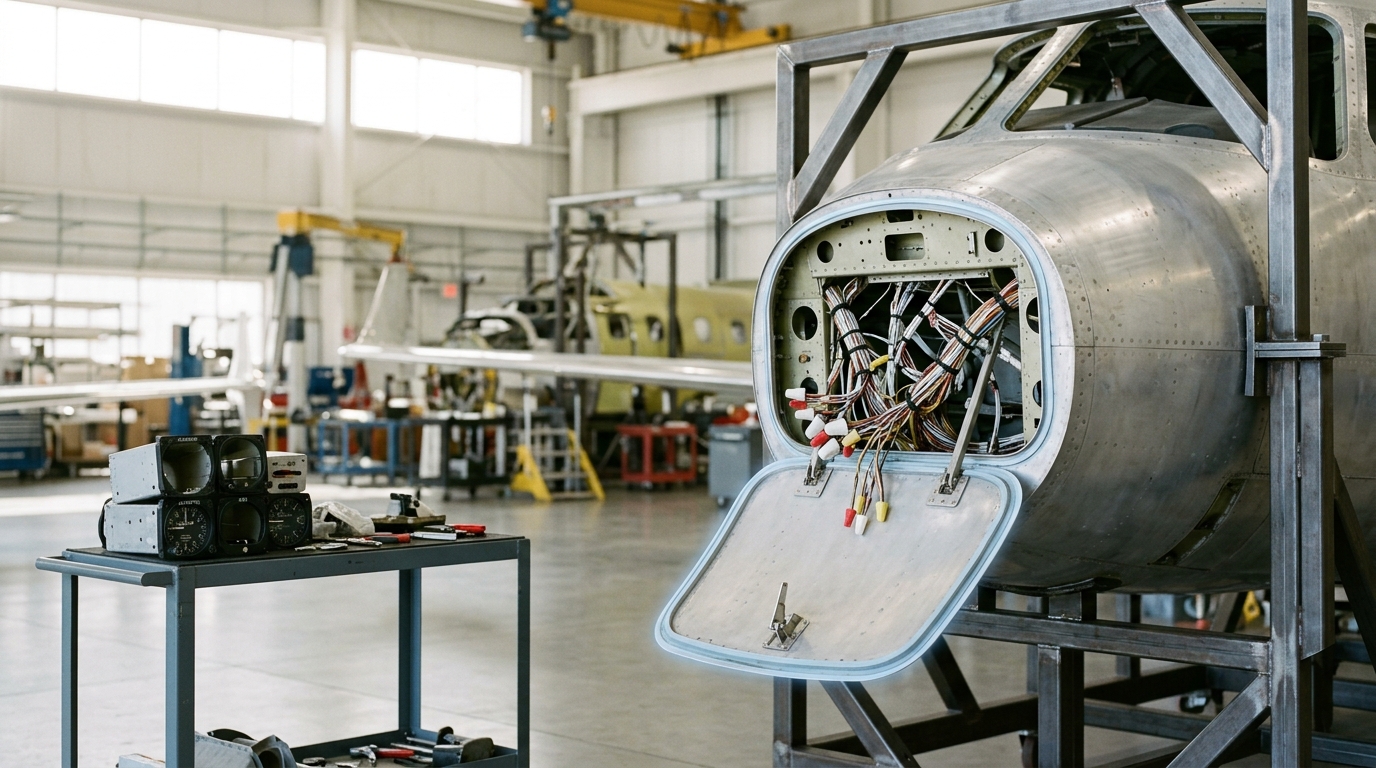
Figure 5. Removing the crew is not a software update bolted onto the same airframe; it is why this fixture has no yoke, no rudder pedals and no life-support duct at all. — Image prompt and art direction by Brecht Corbeel; generation pending.
Set that beside the clearest historical case of the same lineage failing to clear the same bar. In the 1980s, the US National Aerospace Plane program, popularly billed by President Reagan as a new “Orient Express” that would fly from Dulles to Tokyo in two hours by the end of the following decade, aimed at a single-stage-to-orbit vehicle cruising near Mach 25; it was cancelled in 1993 after no workable scramjet engine emerged, after leading-edge thermal loads above 1,650 degrees Celsius outran available materials, and after the requirement to carry a two-person crew with full safety systems made the vehicle larger, heavier, and costlier than a pure technology demonstrator needed to be [15] — a mass-and-materials ceiling closing off the same niche the aviation-electric case closes off for different physical reasons. The current entrant testing the same speed regime, Hermeus, flew its Quarterhorse Mk 1 demonstrator at Edwards Air Force Base in May 2025, followed its Mk 2.1 first flight on 2 March 2026 with a supersonic flight on its third sortie in May 2026, and is developing a Mk 3 targeting Mach 3.3 and beyond on the way to an eventual precooled turbine-ramjet hybrid engine, funded in part by a 100-million-dollar Series B round led by Sam Altman in 2022; the company states hypersonic passenger travel as its long-term objective without naming a passenger-service date [16] — a vision statement, worth distinguishing explicitly from Overture’s at-least-dated, if repeatedly moved, roadmap.
What ties Concorde, the National Aerospace Plane, Boom, and Hermeus together is not that any of them failed on engineering grounds; X-59 and XB-1 both flew supersonic within the past two years. It is that the lineage keeps radiating into the same city-pair speed-premium niche and keeps finding that niche too narrow to sustain a large fleet at any price the regulatory filter and the market jointly allow. What would specifically have to change for a different outcome is exactly two things: the overland boom filter would have to lift, roughly doubling the addressable route set the way it never did for Concorde, or the fuel-and-engine economics would have to close enough that a premium-but-not-first-class fare, rather than Concorde’s super-premium one, becomes viable at Overture’s scale.
Reusability moved the launch-cost floor by an order of magnitude
Orbital launch is governed by a different but related arithmetic: the rocket equation’s exponential relationship between delta-v and propellant mass fraction, which historically meant that most of a launch vehicle’s cost was thrown away with the vehicle itself on every flight. The Space Shuttle’s incremental cost per flight was 409 million dollars in 2010, translating to roughly 14,186 dollars per kilogram delivered to low Earth orbit; that figure excludes the program’s fixed infrastructure costs, and dividing the Shuttle program’s full 30-year, 196-billion-dollar cost by its 135 missions instead yields close to 1.5 billion dollars per launch, a starker number that captures cost the incremental figure leaves out [17]. SpaceX’s Falcon 9, a partially reusable design, currently lists at roughly 74 million dollars for a standard commercial mission, with a payload capacity to low Earth orbit of 22,800 kilograms expendable or 17,500 kilograms when recovering the booster [18] — working out, by this article’s own arithmetic from those two public figures, to roughly 3,246 dollars per kilogram expendable or 4,229 dollars per kilogram in booster-recovery mode. Either comparison represents a drop of between three and four times against the Shuttle’s own incremental figure, and closer to fourteen times against its full-program figure — the order-of-magnitude shift reusability was expected to deliver, achieved not by a new propellant chemistry but by changing which part of the vehicle’s cost the economics select on: marginal refurbishment and propellant, rather than an entirely new expendable stack every flight.
SpaceX’s Starship is the next claimed step down the same curve. The company’s own published figures list an expendable-configuration cost per launch near 100 million dollars against a payload target of 200,000 kilograms [19] — which, taken exactly at face value, implies roughly 500 dollars per kilogram, another order of magnitude below Falcon 9. Label this precisely: it is SpaceX’s own stated target, not a cost independently verified against a completed, fully reusable flight, and the same source’s companion aspiration for its Raptor engine — a 250,000-dollar-per-unit production-cost target — is itself an unmet goal rather than an achieved figure [19]. The falsifier here is specific: an independently costed Starship flight, with both stages recovered and reflown and its turnaround and refurbishment costs accounted for by a party other than SpaceX itself, coming in within an order of magnitude of that 500-dollar figure by the early 2030s. Absent that, the number remains exactly what CATL’s 500-watt-hour battery claim is in the aviation case: a company’s own target for its own unreleased capability.
Point-to-point suborbital travel is blocked by arithmetic, not imagination
A semi-ballistic suborbital hop looks, at first glance, like the aviation and launch cases combined in the most favorable possible way: genuinely fast, and requiring somewhat less energy than reaching orbit outright. Early Cold War-era analysis of the X-20 Dyna-Soar concept suggested a semi-ballistic trajectory could cross from Europe to North America in under an hour [20]. But the blocking arithmetic sits directly beneath that claim: a vehicle capable of that trajectory is, in scale relative to its payload, similar to an intercontinental ballistic missile, and while ICBM-class trajectories do require somewhat less delta-v than reaching orbit, the difference is not large [20]. Because the rocket equation’s fuel-mass-fraction requirement scales exponentially with delta-v, a modest ten-to-twenty-percent reduction in required delta-v does not translate into anything close to a proportional reduction in vehicle mass or cost per seat; the vehicle still costs, and behaves, like a rocket launch rather than an airline flight. That is exactly why suborbital point-to-point transport has historically been discussed only for high-value, extremely time-sensitive cargo, military rapid-response missions, or space tourism, rather than routine passenger service [20] — and why SpaceX’s own floated concept of using Starship for Earth-to-Earth transport remains, as of 2026, a stated possibility with no scheduled route, fare, or service date attached to it [20]. This article’s falsifier for “economics-blocked” is concrete: a scheduled, ticketed suborbital point-to-point route, sustained in revenue service for at least a year, priced within roughly five times a transoceanic business-class airfare.
Autonomy is a selection pressure that redesigns the vehicle, not just its operating cost
Removing the requirement to keep a human crew alive and rested does more than cut a line item from an operating budget; it frees mass and volume that a crewed ancestor’s body plan had committed to life support, crew rest, cockpit glazing, and control runs, and hands that budget back to payload or to more energy carrier — feeding directly back into the Breguet-style arithmetic above wherever the mode is also mass-constrained. In evolutionary terms, this is a niche vacated: once the crew-carrying constraint lifts, a vehicle’s whole shape becomes negotiable again, the way an engine bay’s layout eventually stopped being constrained by where a hand crank needed to reach once starters made the crank disappear.
Two live cases show this pressure operating at very different speeds. Norway’s Yara Birkeland, an all-electric container ship carrying a 6,800-kilowatt-hour battery and 120 twenty-foot-equivalent containers, was christened on 29 April 2022 to operate a roughly seven-nautical-mile route between Herøya and Brevik, at a cost of 25 million dollars, with the explicit goal of removing 40,000 truck loads per year from Norwegian roads [21]. Norwegian maritime regulation required the vessel to operate with a crew aboard for two years before remote or autonomous control could even be considered for certification, and as of the most recent update to its public record, in April 2026, the ship remains classified as manned, still crewed years after its christening [21]. That is a clean data point in this article’s favor: the ship is technologically capable of automation and has been since 2022, and it is regulatory sequencing, not unresolved physics, that is pacing how fast the niche opens — the mirror image of the sonic-boom case, where the physics is fine and the regulation forecloses the niche outright rather than merely pacing entry into it.
Figure 6. Nothing here is finished, which is the honest state of every claim in this article's closing table — read off energy density and regulation, not off a rendering of the year 2100. — Image prompt and art direction by Brecht Corbeel; generation pending.
Aurora Innovation’s driverless trucking shows the pressure moving faster on land. The company launched commercial driver-out operations, with no safety driver aboard, on its Dallas–Houston corridor in late April 2025; by the third quarter of 2025 it reported more than 100,000 driverless miles logged with no safety incidents attributed to its system, operating five driverless trucks across routes including a second corridor between Fort Worth and El Paso [22]. The company has stated plans to scale toward tens of trucks by the end of 2025, add night and adverse-weather operation, extend routes toward Phoenix, and move toward a “driver-as-a-service” model in which carriers purchase autonomous trucks directly from manufacturers, targeted for 2027 or sooner [22]. This remains a small fleet on specifically approved corridors, not yet a redesigned truck body: the pressure to remove driver hours-of-service limits, driver cost, and eventually the cab itself is plainly operating, but as of 2026 none of the three modes surveyed here — aviation, maritime, or trucking — has shipped a production vehicle designed from zero around having no crew station at all, rather than a crewed ancestor’s body plan with the crew station stripped, unused, or capped off. That is the specific, checkable claim this article makes about vehicle form: the evolutionary radiation into a genuinely crewless body plan, as opposed to a crewed plan with the crew removed, has not yet happened in any of these three modes, and whichever manufacturer first ships a production vehicle with no crew station provisioned at all — not merely unoccupied — is the indicator that it has begun.
What by 2100 comes down to six bets, each stated so it can be wrong
None of the sections above supports a single, unified forecast for transport in 2100, because each mode is pressed against its own floor on its own schedule. What follows is instead six separate, falsifiable claims — one per mode discussed above — each naming its binding floor, whose forecast is being extended, an observable indicator a reader can track well before 2100, and the specific evidence that would prove the claim wrong.
- Mode — Binding floor — Named forecast — Observable indicator — Falsifier
- Battery-electric aviation — Pack specific energy against kerosene’s roughly 12,000 Wh/kg — CATL’s own roadmap toward aviation-grade condensed batteries [5] — An independently verified commercial aircraft flying on a pack above 400 Wh/kg — A certified pack at or above 800 Wh/kg, independently verified
- Hydrogen and SAF combustion aviation — Cryogenic hydrogen’s volumetric density; SAF feedstock and blending-mandate supply — Airbus’s 2035 ZEROe entry-into-service target and the EU’s ReFuelEU blending schedule [10, 9] — A flying, transport-category hydrogen prototype before 2032 — 2035 arrives with no certified hydrogen airliner and SAF blending still below the EU’s 2030 six-percent mandate
- Supersonic passenger aviation — Lift-to-drag collapse near Mach 1, gated by the 14 CFR § 91.817/§ 91.818 overland boom rule — NASA’s Quesst timeline for delivering boom-threshold data by 2029; Boom’s own Overture roadmap [13, 14] — FAA or ICAO issuing a data-driven overland noise standard under the § 91.818 pathway — Quesst’s 2029 data collection ends with no rule change proposed, and Overture’s firm order book stays under 100 aircraft
- Orbital launch cost — Rocket-equation mass ratio against reusable-hardware refurbishment economics — SpaceX’s own roughly 500-dollar-per-kilogram Starship target [19] — An independently costed, fully reusable Starship flight with published turnaround accounting — By 2035, no independently verified flight comes within an order of magnitude of that figure
- Suborbital point-to-point transport — Delta-v savings over orbital are only 10-20 percent against an exponential mass-ratio cost [20] — SpaceX’s floated, undated Starship Earth-to-Earth concept — A ticketed, scheduled suborbital route entering sustained revenue service — No such route reaches a fare within five times a transoceanic business-class airfare by 2050
- Autonomous crewless vehicles — Regulatory sequencing (crew-aboard trial periods) more than unresolved technology — Aurora’s own “driver-as-a-service” target of 2027 or sooner [22] — A production vehicle, in any of the three modes above, shipped with no crew station provisioned at all — By 2100, every crewless vehicle in revenue service still carries a vestigial crewed-ancestor body plan
Read across the table, the split is not between modes that will succeed and modes that will not; it is between floors set by chemistry and orbital mechanics, which do not move on anyone’s schedule, and floors set by regulation, which move exactly when the evidence a program like Quesst or a two-year crewed trial period generates persuades a regulator to move them. Betting on which floor moves first is the only forecast this article is prepared to make, and even that bet is stated so that a reader checking back can see precisely which of the six rows moved and which stayed put.
Transport futures are read off energy density and regulation, not imagination
Every lineage in this article is still doing exactly what its physics and its regulatory environment allow, no more and no less: kerosene aircraft flying the routes a boom rule permits, battery aircraft flying the range a pack’s watt-hours-per-kilogram permits, reusable rockets launching at the cost their refurbishment economics permit, and autonomous ships and trucks operating on the corridors a multi-year certification trial permits. None of these ceilings moved because someone imagined past them; Eviation’s range fell because the mass arithmetic demanded it, Concorde’s market halved because a regulator, not a customer, drew the line, and Falcon 9’s cost fell because reusability changed which line item the economics select on. A rendering of a 2100 aircraft, ship, or launch vehicle costs nothing to draw and settles nothing, because it pays no penalty for skipping the arithmetic above. The six bets in the table above do pay that penalty: each names a specific number, a specific source for it, and a specific piece of evidence that would prove it wrong, which is the only honest way to write about a future that has not happened yet.
Sources
- Wikipedia contributors. Range (aeronautics). Wikipedia (2026).
- Wikipedia contributors. Energy density. Wikipedia (2026).
- Wikipedia contributors. Lithium-ion battery. Wikipedia (2026).
- Wikipedia contributors. Electric aircraft. Wikipedia (2026).
- CATL. CATL Unveils Condensed Battery Technology, Unlocking New Possibilities for Electrification of Sea and Air Travel. CATL Newsroom (2023).
- Wikipedia contributors. Eviation Alice. Wikipedia (2026).
- Heart Aerospace. ES-30. Heart Aerospace (2026).
- BETA Technologies. ALIA Aircraft. BETA Technologies (2026).
- Wikipedia contributors. Sustainable aviation fuel. Wikipedia (2026).
- Wikipedia contributors. Airbus ZEROe. Wikipedia (2026).
- Wikipedia contributors. Concorde. Wikipedia (2026).
- US Government / Cornell Law School Legal Information Institute. 14 CFR § 91.817 — Civil aircraft sonic boom. Legal Information Institute (2026).
- NASA. Quesst — Mission Overview. NASA (2026).
- Wikipedia contributors. Boom Overture. Wikipedia (2026).
- Wikipedia contributors. Rockwell X-30. Wikipedia (2026).
- Wikipedia contributors. Hermeus. Wikipedia (2026).
- Wikipedia contributors. Space Shuttle program. Wikipedia (2026).
- Wikipedia contributors. Falcon 9. Wikipedia (2026).
- Wikipedia contributors. SpaceX Starship. Wikipedia (2026).
- Wikipedia contributors. Suborbital spaceflight. Wikipedia (2026).
- Wikipedia contributors. MV Yara Birkeland. Wikipedia (2026).
- Wikipedia contributors. Aurora Innovation. Wikipedia (2026).
Originally published at https://absolutedigitalpublishers.com/articles/flight-at-the-energy-floor-transport-selection-to-2100.