Fine-Tuning Without a Tuner: Selection Effects in Physics
The constants look chosen for complexity, and physics' actual candidate explanations are all selection arguments. Weighed here for exactly what each one proves and where each one quietly stops proving anything.
Every fine-tuning claim is a statement about how precisely a constant is pinned down; the instruments that pin it down are the same ones built to catch it drifting. — Image prompt and art direction by Brecht Corbeel; generation pending.
Abstract
Several physical constants sit inside narrow bands outside which stars, carbon, or bound atoms do not form. This article separates that technical claim from its theological and triumphalist abuses, audits the actual calculations behind it — the cosmological constant's mismatch of roughly 120 orders of magnitude, a lattice QCD result bounding quark-mass shifts to a few percent, and a systematic parameter survey that finds much more surviving room than either headline suggests — then examines the three live explanations: anthropic self-selection across a multiverse, dynamical relaxation of the kind that dissolved the strong-CP problem, and brute necessity. Selection effects are treated throughout as a bias correction applied to evidence, not as an explanation for why any world exists at all, and the one place that discipline produced a real prediction — Weinberg's 1987 bound on the cosmological constant — is reconstructed in full alongside the measure problem that keeps the wider multiverse argument from normalizing its own claims.
Fine-tuning names a sensitivity, not a sermon
Change the strong nuclear coupling by a few percent and the reaction that builds carbon in stars stops working. Raise the vacuum energy of empty space by a large factor and no galaxy ever condenses. Weaken gravity’s relative strength differently and stars either flare out in a few thousand years or never ignite. These are not metaphors and they are not articles of faith; they are the outputs of specific calculations, each attached to a named model, a stated uncertainty, and a citation. That is the whole of what “fine-tuning” is supposed to mean in physics: a parameter sensitivity, measured by asking how far a constant can move before a described physical outcome fails.
The trouble is that almost nobody who talks about fine-tuning stops there. One camp treats the sensitivity as evidence of design, smuggling in an inference — improbable, therefore chosen — that the physics itself does not license. Another camp, having noticed that a multiverse can dissolve the improbability, treats the mere existence of a workable-sounding ensemble as though it were already confirmed, which it is not. Both camps are doing the same thing: turning a statement about parameter sensitivity into a story about ultimate origins, which is a much larger claim than the arithmetic supports. This article tries to stay on the arithmetic’s side of that line. It covers the actual calculations, states what they show and what they do not, and then treats each candidate explanation — anthropic selection across an ensemble of universes, dynamical relaxation of the kind that already dissolved one supposedly fine-tuned parameter, and brute unexplained fact — as what it structurally is: a selection argument, a mechanism, or a shrug, graded on whether it does real explanatory work or just relocates the mystery.
Martin Rees’s popularization organized the discussion around six dimensionless numbers whose values, if altered substantially, would change the qualitative behavior of the universe — from the ratio of electromagnetic to gravitational force between two protons to the amount of dark energy — and his framing is useful mainly as an inventory of which numbers the literature actually worries about, not as an argument in itself [18]. The best-documented member of that inventory, and the one every serious treatment starts from, is the cosmological constant.
The cosmological constant is the fine-tuning problem with an actual number attached
Quantum field theory predicts that empty space should carry a vacuum energy density set by the ultraviolet scales in the theory — naively, something near the Planck scale. Steven Weinberg’s 1989 review laid out the problem in its modern form: astronomical observations constrain the cosmological constant to be many orders of magnitude smaller than any of the contributions particle theory predicts for it, and the review catalogues five distinct classes of proposed solution, from supersymmetry to anthropic reasoning, none of which he judged fully satisfactory at the time [2]. The often-quoted headline is that the naive theoretical estimate and the observed value differ by around 120 orders of magnitude — not a two-fold or ten-fold discrepancy of the kind ordinary systematic error produces, but a mismatch so large that no known cancellation mechanism explains it without new physics doing the cancelling to precision far beyond anything else in the Standard Model:
\frac{\rho_{\Lambda}^{\text{naive QFT estimate}}}{\rho_{\Lambda}^{\text{observed}}} \;\sim\; 10^{120}.
This is the number that gives fine-tuning discourse its rhetorical force, and it deserves to be stated exactly this way: not as “the universe is improbable,” but as “a specific calculation in a specific theory produces a specific, enormous discrepancy with a specific measurement.” Whatever explains that discrepancy has to explain a number, not a feeling.
The Higgs mass carries a related but distinct version of the same structural problem, usually called the hierarchy problem: quantum corrections to the Higgs mass from physics at very high energy scales are, in an unprotected theory, many orders of magnitude larger than the observed electroweak scale, so keeping the observed mass small requires an extraordinarily precise cancellation between the bare mass and its corrections unless some symmetry or dynamical mechanism protects it. Supersymmetry, technicolor, and extra-dimensional models were all built, in large part, as attempts to remove that cancellation rather than accept it, which is itself evidence for how uncomfortable physicists are with brute numerical coincidence as a resting explanation.
Figure 1. A claim like "tuned to a percent" is only as good as the measurement behind it; a frequency comb is what lets a percent mean something at all. — Image prompt and art direction by Brecht Corbeel; generation pending.
The strong force is tuned to a few percent, and a lattice calculation said so
The clearest calculation of nuclear fine-tuning concerns carbon. Stars build carbon through the triple-alpha process, in which three helium-4 nuclei fuse via an intermediate, extremely short-lived beryllium-8 state; the reaction proceeds efficiently only because carbon-12 has an excited state — the Hoyle state, predicted by Fred Hoyle in 1954 on essentially anthropic grounds before it was found experimentally — sitting close enough in energy to the three-alpha threshold to act as a resonance. Move that resonance energy by very much and stellar carbon production collapses; a universe that could not build carbon efficiently in its stars would also struggle to build the oxygen, nitrogen, and everything downstream of them, since almost all of the periodic table past helium is cooked in stellar interiors and then dispersed by supernovae.
For decades this was described qualitatively. In 2011, Epelbaum, Krebs, Lee, and Meissner did what nobody had done before: they computed the low-lying states of carbon-12 directly from an effective field theory of nucleons on a spacetime lattice, without inputting the Hoyle state’s existence by hand, and found a resonance whose energy matched the experimentally measured Hoyle state to within their stated uncertainty [4]. That result turned “the Hoyle state is fine-tuned” from an assertion into a first-principles, checkable calculation. The same group then asked the sharper question directly: how much could the underlying quark masses shift before this resonance moved far enough to break carbon or oxygen production? Their 2013 follow-up in Physical Review Letters computed the binding-energy dependence of the triple-alpha process on the light quark mass explicitly [5], and one of the paper’s authors, Dean Lee, put the finding in a sentence a reader can hold onto: “in our lattice simulations, we find that more than a 2 or 3 percent change in the light quark mass would lead to problems with the abundance of either carbon or oxygen in the universe” [6]. That is a genuinely narrow window, computed rather than guessed at, and it is the single strongest piece of quantitative evidence in the entire fine-tuning literature.
It is also, by itself, a claim about one process holding everything else fixed. That caveat is not a rhetorical hedge; it is the exact place where the next section’s evidence bears down hardest.
Fred Adams checked the rest of the parameter space, and much of it survives
If the triple-alpha result were the whole story, the fine-tuning case would be close to airtight. It is not the whole story, because narrow sensitivity in one calculation does not establish narrow sensitivity everywhere, and the literature contains a systematic audit that says so at length. Fred Adams’s 2019 Physics Reports review, “The Degree of Fine-Tuning in our Universe — and Others,” surveys viability across a much wider slice of parameter space than any single nucleosynthesis calculation, holding fewer things fixed, and its conclusions are the deflationary counterweight this piece has to take as seriously as the Hoyle-state result — not softened, not explained away, given full weight [7].
Adams finds that the region of quark masses compatible with stable, working stellar nucleosynthesis spans roughly a factor of seven for the down quark and several orders of magnitude for the up quark once the full space of nuclear outcomes is considered rather than one resonance in isolation [7]. In the plane defined by the fine-structure constant and the electron-to-proton mass ratio, the region compatible with functioning stellar burning spans roughly four orders of magnitude in both directions [7]. The strong and electromagnetic couplings together tolerate a combined viable range on the order of a factor of a thousand [7]. Adams also removes two conditions earlier fine-tuning arguments had treated as load-bearing — that deuterium must be a stable bound state and that the diproton must not be — by showing that stellar nucleosynthesis can proceed through alternative reaction chains if either condition is reversed, and by cataloguing exotic but physically consistent energy sources, including dark-matter-powered stars and black-hole-powered stellar analogues, that could sustain long-lived, complex structure under parameter combinations where ordinary hydrogen burning fails entirely [7]. His summary judgment, stated plainly rather than hedged, is that “viable universes exist over a range of parameter space” substantially wider than popular fine-tuning rhetoric assumes [7].

Figure 2. A systematic survey of the parameter space finds long stretches where the lock holds; the failure points are narrower and rarer than the headline number suggests. — Image prompt and art direction by Brecht Corbeel; generation pending.
Both results are correct, and they are not actually in tension, because they are answers to different questions. Epelbaum and collaborators ask: holding essentially everything else about known physics fixed, how far can the light quark mass move before this one calculable process fails? Adams asks: across a far larger space of possible constants, including possibilities for entirely different stellar physics, how much of that space still permits some long-lived, complexity-supporting structure? A narrow corridor for one specific mechanism and a broad archipelago of viable outcomes across many mechanisms are both true simultaneously. The honest summary of the inventory, then, is not “the universe is a knife’s edge” and not “fine-tuning is a myth.” It is that some individual physical processes are calculably brittle, some regions of parameter space are far more forgiving than intuition suggests once alternative physics is allowed, and any explanation offered for fine-tuning has to be judged against the narrowest, best-established brittleness — the Hoyle state — rather than against a slogan.
A selection effect is a correction to your sample, not an explanation of the world
Arthur Eddington’s parable is the cleanest statement of the danger and the cure at once: a naturalist who samples a lake only with a net of two-inch mesh and concludes that no fish in the lake is smaller than two inches has not measured the lake; he has measured his net. The conclusion is not wrong because the reasoning is invalid — it follows validly from the data — it is wrong because the data were filtered by the instrument before they ever reached the naturalist, and he forgot to divide that filtering back out.
Brandon Carter’s 1974 paper gave this problem its name and its two canonical forms in cosmology. The weak anthropic principle, in Carter’s own formulation, holds only that “our location in the universe is necessarily privileged to the extent of being compatible with our existence as observers” — a statement about where in space, time, and parameter space an observer can find themselves, not a statement about why the universe has the properties it has [8]. The strong anthropic principle goes further, proposing that “the universe (and hence the fundamental parameters on which it depends) must be such as to admit the creation of observers within it at some stage” [8] — a claim that only does explanatory work if there is some mechanism, statistical or otherwise, that makes “admit the creation of observers” load-bearing rather than merely descriptive of the one universe we happen to inhabit.
Done correctly, the weak principle is pure statistics: it is a conditioning operation, identical in structure to correcting a biased sample in any other empirical science. A concrete instrument in this article’s own world makes the logic exact rather than analogical. A magneto-optical trap holds a cloud of atoms by continuously discarding the ones moving too fast to be captured by the cooling beams; every atom visible in the trap already survived a velocity cut. Someone who measured only the trapped cloud and concluded “the atoms in this room are unusually cold” would be committing exactly Eddington’s error — the room is not unusually cold, the trap is unusually selective, and the correction is to divide the observed distribution by the known capture probability before drawing any conclusion about the room. Observers reasoning about the constants of their universe are in the identical position: whatever they measure about the constants is filtered by the prior requirement that the measurement be made by someone, and a probability inferred from that requires the corresponding division.
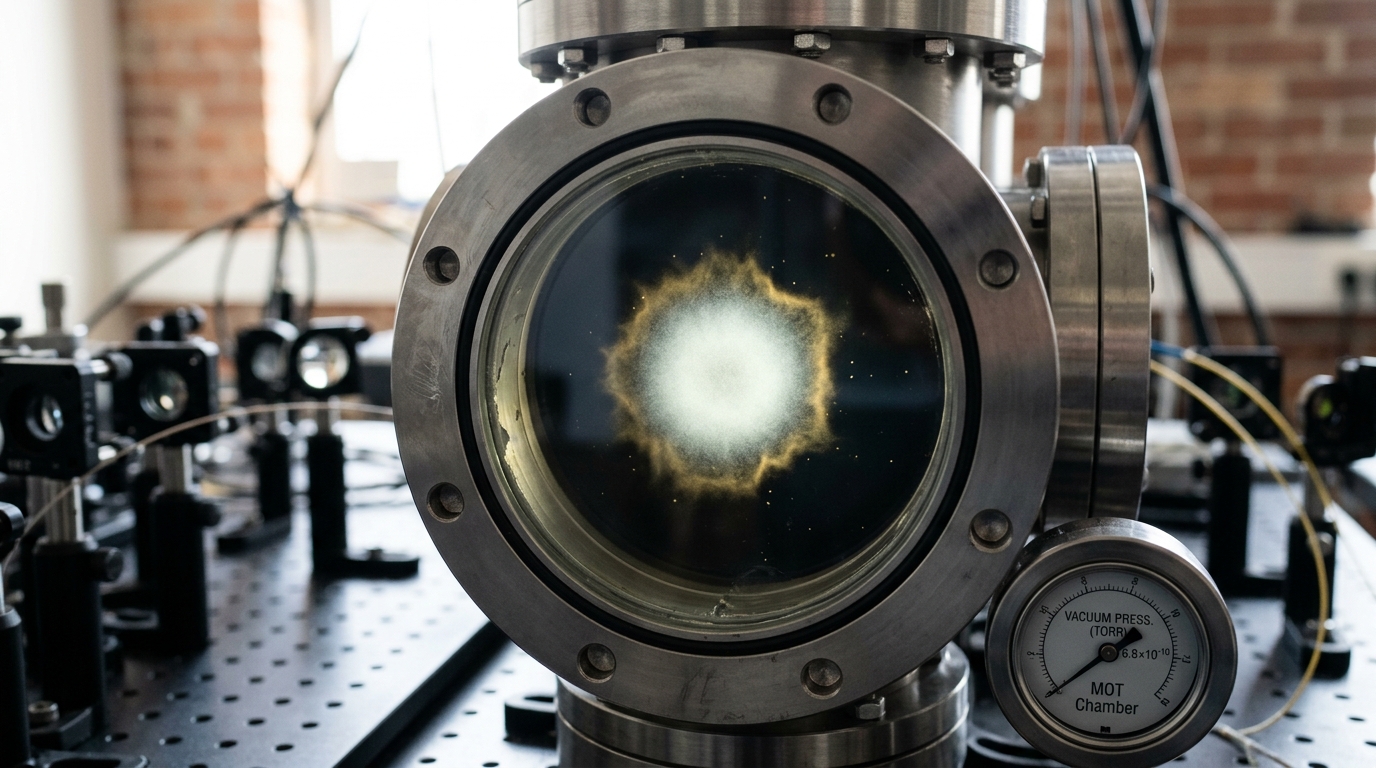
Figure 3. Every atom you can see here already passed a velocity cut; inferring the room's temperature from the trapped cloud alone, without correcting for that cut, is exactly the error observer selection exists to catch. — Image prompt and art direction by Brecht Corbeel; generation pending.
P(\lambda \mid \text{observed}) \;\propto\; P(\lambda) \times n_{\text{obs}}(\lambda)
Here is exactly where the analogy earns scrutiny rather than deference, because it also shows where it breaks. The atoms discarded by the trap unambiguously existed a moment before, in the same room, on the same table, measurable by the same experimenter had they been fast enough to catch; there is no dispute about their reality or their number, only about whether they were selected into the sample. A universe with different constants that nobody observes has no such settled status — whether it exists at all, in what sense, and how to count it relative to ours (the term n_{\text{obs}}(\lambda) in the expression above, the number or measure of observers a given value of \lambda produces) is precisely the disagreement the rest of this article has to work through. The trap analogy is exact about the logic of selection — you must condition on it — and silent about the ontology the anthropic argument additionally needs — that there be other trials to condition over in the first place. Nick Bostrom’s extended treatment of observer selection sharpens this further: he shows that even granting an ensemble of observers to sample from, the choice between competing self-sampling assumptions — reasoning as though you are a random draw from all observers in your reference class, versus other framings — changes the answers to genuine paradoxes (the Doomsday Argument, the presumptuous philosopher, and related cases), so “apply the selection effect” is not yet a fully specified recipe even once you know an ensemble exists [9]. Selection reasoning, in short, is necessary and correct as a bias correction; it becomes an explanation for the values themselves only once you additionally believe in the ensemble being conditioned over, and that belief carries all of the remaining argumentative weight.
Weinberg predicted a positive cosmological constant eleven years before anyone measured one
This is the discipline’s one clean empirical success, and it deserves to be told with the actual numbers rather than the legend that has grown around it. In 1987, working before there was any observational evidence that the cosmological constant was nonzero, Weinberg asked a narrower and more answerable question than “why is the constant small”: given that we exist, and given that galaxy formation requires matter overdensities to grow under gravity for long enough to collapse, how large could the cosmological constant possibly be without a runaway vacuum-energy-driven expansion shutting off structure formation before galaxies like ours had time to form? His answer, stated in the paper’s own abstract, was that in universes that do not recollapse, the only anthropic upper bound on the constant is that it must not be so large as to prevent gravitationally bound structures from forming at all, that this bound is “quite large,” and that a constant within one or two orders of magnitude of that upper bound would help resolve the era’s missing-mass and stellar-age puzzles, though it might be constrained by galaxy number counts [1]. Weinberg’s own conclusion at the time was cautious to the point of being nearly a null result: if a large constant near that bound turned out to be ruled out observationally, he wrote, anthropic reasoning would not explain the smallness of the cosmological constant after all [1].
Figure 4. Weinberg's 1987 bound on the cosmological constant was checked, not assumed; the discipline is the same one that tells you whether a servo trace has actually reached its target or only looks close. — Image prompt and art direction by Brecht Corbeel; generation pending.
What actually happened next is the part worth stating precisely. In 1998, two independent supernova teams measuring the expansion history of the universe with distant Type Ia supernovae found that the expansion is accelerating, and the Supernova Cosmology Project’s analysis of forty-two high-redshift supernovae reported, for a flat universe, a matter density of \Omega_M = 0.28 with combined statistical and systematic uncertainties of a few hundredths, and stated that the data indicated a nonzero, positive cosmological constant at 99 percent confidence [3]. That result places the implied vacuum energy density at roughly \Omega_\Lambda \approx 0.7 — a value sitting comfortably inside the “quite large” anthropic window Weinberg had described eleven years earlier, and specifically within the one-to-two-order-of-magnitude band he had flagged as anthropically interesting.
This is why even physicists who are skeptical of anthropic reasoning in general tend to treat this particular case with respect: it is a genuinely dated, falsifiable prediction, made in ignorance of the answer, that came out approximately right, rather than a post-hoc accommodation fitted after the measurement was already in hand. Alexander Vilenkin’s later assessment makes the standard explicit — anthropic models, he argues, can in principle “give testable predictions, which can be confirmed or falsified at a specified confidence level,” and the cosmological constant case is his central worked example of that standard actually being met [10]. But the success is conditional in a way that is easy to lose in the retelling. Weinberg’s argument only produces a probability distribution over values an observer should expect to measure — rather than a single predicted number — if there really is an ensemble of regions or universes realizing different values of the constant, weighted appropriately by how many observers each one hosts. Without that ensemble, “the constant should not be too much larger than this” is a sensible physical inequality, but “we should expect to measure a value near the top of the anthropically allowed range” is not yet a probabilistic prediction at all — it is a bound dressed as one. The entire predictive content beyond the bare inequality rests on a multiverse actually existing, which is precisely the question the next section has to confront honestly.
The landscape can supply the ensemble; nobody has normalized it
Two ingredients, developed independently in string theory and inflationary cosmology, are usually combined to supply the population of universes anthropic reasoning about the cosmological constant needs. The first is a mechanism for the constant to take many different discrete values in different regions. Bousso and Polchinski showed that four-form field-strength fluxes threading extra-dimensional cycles in string compactifications contribute to the effective four-dimensional cosmological constant in quantized steps; a single flux produces steps far too coarse to explain the observed value, but combining roughly a hundred or so independent fluxes produces a spectrum of allowed values dense enough — a “discretuum,” in their term — to contain values as small as the observed one somewhere in the combinatorics [11]. The second ingredient is a way to actually populate many of those values physically: eternal inflation, in which quantum fluctuations continually spawn new inflating regions faster than inflation ends in any of them, so that a landscape of possible vacua gets sampled by bubble nucleation across an unbounded, ever-growing spacetime.
The number of discrete vacua the string landscape might contain is where popular treatment and the underlying literature diverge most sharply, and the honest article says so plainly. Michael Douglas’s statistical approach to counting flux vacua that reproduce Standard-Model-like physics is the technical source most often credited for it [12], and Leonard Susskind’s essay popularizing the resulting picture is more careful in its own text than the number that circulates in its name: Susskind writes only that the landscape is “unimaginably large and diverse,” describing it in his own lecture as plausibly measured “not in the millions or billions but in googles or googleplexes” — a google being 10^{100} [13]. The figure of 10^{500} that dominates popular science writing is a later, more specific estimate built on the same counting methods rather than a number stated outright in either founding paper, and it should be read as an order-of-magnitude estimate from a particular counting procedure — sensitive to which class of compactifications and which moduli are held fixed — rather than a precisely derived constant of nature.
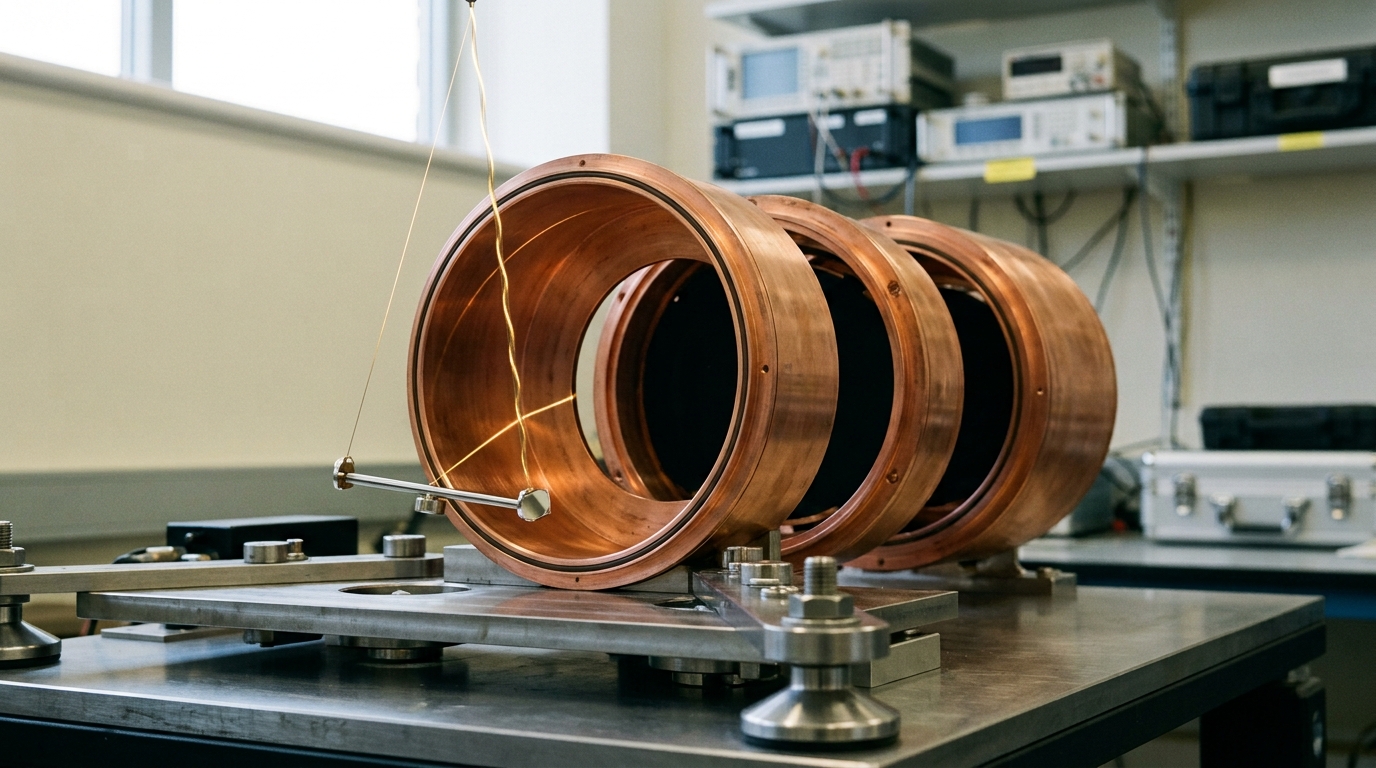
Figure 5. A landscape of possible universes without an agreed measure is a pendulum without a rest point: every ratio you quote depends on where, arbitrarily, you stopped the clock. — Image prompt and art direction by Brecht Corbeel; generation pending.
Even granting a landscape this large and a mechanism to populate it, the framework runs into a problem that is not a matter of taste but a standing, acknowledged methodological failure: nobody has a normalized way to compute probabilities within it. Alan Guth states the difficulty in its starkest form: in an eternally inflating spacetime, “anything that can happen will happen; in fact, it will happen an infinite number of times,” so that the fraction of universes with any given property becomes “infinity divided by infinity — a meaningless ratio” without an externally chosen procedure, called a measure, for regularizing the comparison [14]. Different measures give different, sometimes wildly different, answers, and Guth’s own worked pathology is the “youngness paradox”: a natural-seeming choice of time slicing predicts that it should be extraordinarily improbable for any civilization to be even one second more advanced than our own, because younger pocket universes are being created exponentially faster than older ones are aging — a conclusion nobody believes, which is exactly the point of presenting it, since it shows that a plausible-looking measure can produce an absurd prediction with no independent way to reject the measure except that its output looks wrong [14].
A second, related pathology compounds the first. Dyson, Kleban, and Susskind showed that if the cosmological constant really is a constant — meaning the universe settles permanently into accelerating, near-empty de Sitter expansion — then over unbounded future time, rare thermal fluctuations of the vacuum itself will eventually produce isolated, momentary conscious observers (so-called Boltzmann brains) far more numerous, in the infinite limit, than the ordinary observers produced by galaxies and stars during the universe’s brief habitable era, a conclusion the authors describe as one of the “disturbing implications” that a bare cosmological-constant-dominated future forces on any straightforward counting of observers [15]. Taken together, the youngness paradox and the Boltzmann-brain problem are not exotic edge cases; they are demonstrations that the most naive ways of counting observers across an eternally inflating multiverse give answers that are either absurd or dominated by noise, and the field has not converged on a measure that avoids both. This is the honest state of the art: the landscape can, in principle, supply the ensemble Weinberg’s argument needs, but the ensemble comes bundled with an unsolved normalization problem, and any claim to have “explained” the cosmological constant via the landscape is, right now, a claim resting on a probability calculation nobody can actually perform in an agreed way.
Three ways a tuning ends: selection, dynamics, or you live with it
Given a parameter that looks implausibly precise, physics has produced exactly three structurally distinct kinds of response, and it is worth being explicit that they are not competing descriptions of the same mechanism but genuinely different claims about where the explanatory work gets done.
The first is anthropic selection across an ensemble, covered above in full, together with its dependence on an unresolved measure. A structurally related but mechanistically distinct proposal is Lee Smolin’s cosmological natural selection, which replaces observer selection with a literal reproductive dynamics: universes spawn new universes through the cores of black holes, with the fundamental parameters undergoing small random changes at each bounce, so that whatever parameter combination maximizes black hole production comes to dominate the population of universes after many generations — no appeal to observers required at all, only to black-hole number as the trait under selection [19]. That proposal stands or falls on whether our universe’s parameters are actually close to a local maximum of black hole production and on whether it can be made to yield sharp, falsifiable predictions distinguishable from the alternatives; a full accounting of its mechanism and its falsifiers belongs to a companion piece on cosmological natural selection specifically, and does not fit honestly in one paragraph here.
The second response is dynamical relaxation: build a mechanism, usually a new field with its own equation of motion, that drives the troublesome parameter toward its observed value automatically, for every initial condition, with no ensemble and no selection required at all. The strong-CP problem is the field’s best worked example, and it is worth stating why physicists treat it as a genuine problem rather than an accepted brute number in the first place: quantum chromodynamics contains a CP-violating term whose coefficient, called theta, is a free parameter that could a priori take any value between zero and two pi, yet the experimental bound on the neutron’s electric dipole moment constrains it to be smaller than about one part in ten billion — a level of unexplained smallness that the field treats as a genuine problem demanding a mechanism, not a coincidence to shrug at. Roberto Peccei and Helen Quinn’s 1977 proposal supplies exactly that mechanism: promote theta to a dynamical field rather than a fixed constant, arrange the field’s potential so that its minimum sits automatically at the CP-conserving value regardless of where it started, and the fine-tuning problem simply stops existing, because the field relaxes there on its own [16]. The mechanism predicts a new light particle, the axion, as a direct physical consequence — not an added assumption but a falsifiable prediction of the same theory that dissolves the tuning.
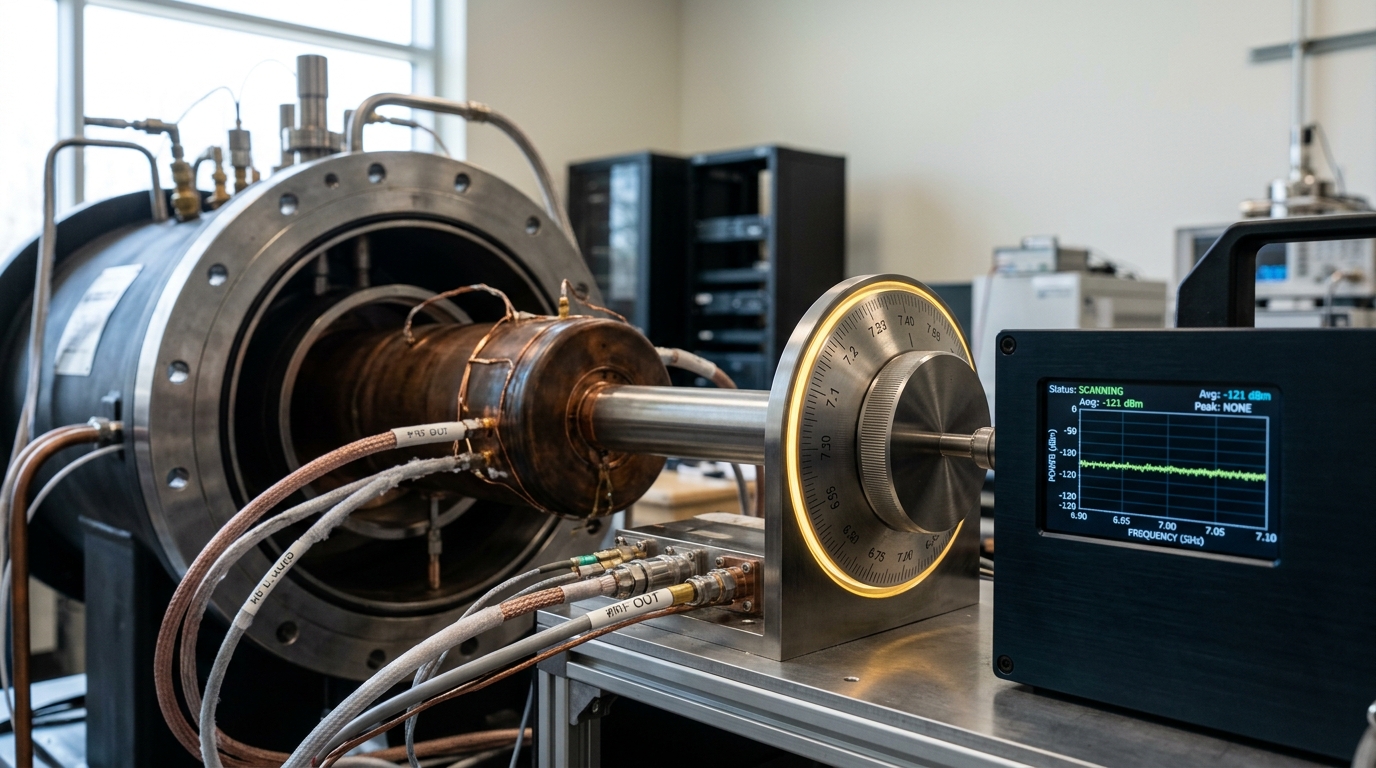
Figure 6. A dynamical field either exists at a given mass or it does not; the strong-CP tuning ends the day this scan, or one like it, finds a peak. — Image prompt and art direction by Brecht Corbeel; generation pending.
This is the moral this article has been building toward: yesterday’s fine-tuning can become tomorrow’s dynamics, and when it does, the anthropic and design arguments that had accreted around the old puzzle simply become irrelevant, not defeated in argument but bypassed by mechanism. The strong-CP problem is also, not incidentally, the live case where the field has overwhelmingly refused the third option — brute, unexplained fine-tuning — and instead spent decades building and running a direct experimental search for the dynamical solution’s physical consequence. The Axion Dark Matter eXperiment operates a tunable, ultra-low-noise microwave cavity inside a strong superconducting magnet, scanning slowly across the frequency range where a dark-matter axion of a given mass would convert into a detectable microwave photon; its most recent published run excluded, at 90 percent confidence, one class of axion models (those following the Dine-Fischler-Srednicki-Zhitnitsky coupling) across masses between roughly 3.27 and 3.34 microelectronvolts [17]. No signal yet found is not evidence against the mechanism generally — the experiment is still working through a much larger mass range, one narrow slice at a time — but it is the concrete, ongoing test of whether “yesterday’s fine-tuning is tomorrow’s dynamics” turns out to be right for the strong-CP problem specifically, rather than a comforting slogan borrowed from it.
The third response, brute necessity, is not a mechanism at all; it is the position that some constants simply have the values they have, with no selection argument and no dynamical relaxation required, and that demanding a further explanation is a category error akin to asking why a particular axiom in a formal system is true rather than some other axiom. It is intellectually available and, for some subset of constants, may turn out to be correct — not every parameter needs a discovered mechanism — but it is also, definitionally, the response that stops explaining rather than the response that explains, and the discipline’s own institutional behavior shows how physicists actually weigh it: nobody spent forty years building axion haloscopes to test a proposition they were content to accept as brute.
What would move this from philosophy to physics
Three concrete developments would change fine-tuning from a debate about interpretation into an ordinary empirical question with a determinate answer, and each comes with a horizon, an observable indicator, and an explicit way it could fail to happen.
An axion detection, at any mass, in any of the several ongoing haloscope and helioscope search programs, would convert the strong-CP case from “a dynamical solution exists and predicts a particle we have not yet found” into a demonstrated instance of tuning dissolved by mechanism — the clearest possible vindication of the dynamical-relaxation path over both anthropic selection and brute necessity for at least one parameter. Its disconfirmation condition is symmetric and already partly in motion: continued null results across the full theoretically motivated mass range, as ADMX and related experiments are actively producing, would not kill the Peccei-Quinn mechanism outright but would steadily shrink the parameter space available to it, the way each new exclusion band already has [17].
A measured, rather than merely modeled, dynamical mechanism for the cosmological constant’s smallness — something playing the role for \Lambda that Peccei-Quinn plays for theta — would do the equivalent for the discipline’s hardest fine-tuning problem, and its absence after decades of serious theoretical effort is itself informative, not neutral; it is part of why the anthropic route retains as many adherents as it does among physicists who would otherwise prefer a dynamical answer.
And a landscape prediction that risks something — a genuine, falsifiable, dated forecast of a measurable quantity, derived from a specified, argued-for measure over the string landscape, published before the relevant observation, the way Weinberg’s 1987 bound preceded the 1998 supernova measurements — would finally give multiverse reasoning the kind of empirical standing its single historical success earned it for the cosmological constant specifically. Its disconfirmation condition would be the ordinary one: the predicted quantity comes in outside the stated range. No landscape calculation has yet cleared that bar for a genuinely new, unmeasured quantity, which is the measure problem’s practical cost, not merely its theoretical embarrassment.
None of this licenses either trap this article opened by naming. It does not license treating narrow parameter sensitivity as evidence of a designer, because a sensitivity calculation is silent on mechanism and silent on intent; a knife’s edge is a fact about a function, not a signature of a hand. And it does not license treating the existence of a plausible-sounding landscape as though it already explained the constants we measure, because a population of possible universes without a working measure cannot yet tell you what to expect to see, only that many things are notionally possible — which is a much weaker claim than physicists sometimes let it sound like. The discipline this article has tried to practice throughout is the one Carter’s original weak principle actually licenses and no more: a selection effect corrects your inference from a filtered sample back toward what an unfiltered population would show. It is a bias correction, indispensable wherever observation is filtered by the requirement that someone be there to observe. It is not, by itself, an explanation for why any world — filtered or not — exists to be sampled at all.
Sources
- Steven Weinberg. Anthropic Bound on the Cosmological Constant. Physical Review Letters (1987). DOI: 10.1103/PhysRevLett.59.2607.
- Steven Weinberg. The cosmological constant problem. Reviews of Modern Physics (1989). DOI: 10.1103/RevModPhys.61.1.
- S. Perlmutter and the Supernova Cosmology Project. Measurements of Omega and Lambda from 42 High-Redshift Supernovae. The Astrophysical Journal (arXiv preprint 1998) (1999).
- Evgeny Epelbaum, Hermann Krebs, Dean Lee, and Ulf-G. Meissner. Ab initio calculation of the Hoyle state. Physical Review Letters (2011). DOI: 10.1103/PhysRevLett.106.192501.
- Evgeny Epelbaum, Hermann Krebs, Timo A. Laehde, Dean Lee, and Ulf-G. Meissner. Viability of Carbon-Based Life as a Function of the Light Quark Mass. Physical Review Letters (2013). DOI: 10.1103/PhysRevLett.110.112502.
- Bob Yirka (reporting Dean Lee). Foundations of carbon-based life leave little room for error. Phys.org (2013).
- Fred C. Adams. The degree of fine-tuning in our universe -- and others. Physics Reports (2019).
- Brandon Carter. Large Number Coincidences and the Anthropic Principle in Cosmology. IAU Symposium 63, Confrontation of Cosmological Theories with Observational Data (1974).
- Nick Bostrom. Anthropic Bias: Observation Selection Effects in Science and Philosophy. Routledge (2002).
- Alexander Vilenkin. Anthropic predictions: the case of the cosmological constant. arXiv (Universe or Multiverse?, Cambridge University Press) (2004).
- Raphael Bousso and Joseph Polchinski. Quantization of Four-form Fluxes and Dynamical Neutralization of the Cosmological Constant. Journal of High Energy Physics (2000). DOI: 10.1088/1126-6708/2000/06/006.
- Michael R. Douglas. The statistics of string/M theory vacua. Journal of High Energy Physics (2003). DOI: 10.1088/1126-6708/2003/05/046.
- Leonard Susskind. The Anthropic Landscape of String Theory. arXiv preprint (2003).
- Alan H. Guth. Eternal inflation and its implications. Journal of Physics A (2007).
- Lisa Dyson, Matthew Kleban, and Leonard Susskind. Disturbing Implications of a Cosmological Constant. Journal of High Energy Physics (2002).
- R. D. Peccei and Helen Quinn. CP Conservation in the Presence of Pseudoparticles. Physical Review Letters (1977). DOI: 10.1103/PhysRevLett.38.1440.
- ADMX Collaboration. ADMX Axion Dark Matter Bounds around 3.3 microelectronvolts with Dine-Fischler-Srednicki-Zhitnitsky Discovery Ability. Physical Review Letters (2025). DOI: 10.1103/PhysRevLett.134.111002.
- Martin Rees. Just Six Numbers: The Deep Forces That Shape the Universe. Weidenfeld and Nicolson (1999).
- Lee Smolin. Did the universe evolve?. Classical and Quantum Gravity (1992).
Originally published at https://absolutedigitalpublishers.com/articles/fine-tuning-without-a-tuner-selection-effects-in-physics.