Every Crystal Has Its Own Speed of Light
Quantum-gas microscopes and trapped-ion chains now measure a lattice's own speed of light directly. A new paper compiles nine and a half orders of magnitude of it, and computes the exact experiment that would catch the crystal's hidden rest frame.
The Crossed Fields Papers, No. 5 — this article is the paper's summary; the full text (17 pages, PDF): https://absolutedigitalpublishers.com/papers/crossed-fields-05-crystal-speed-of-light.pdf
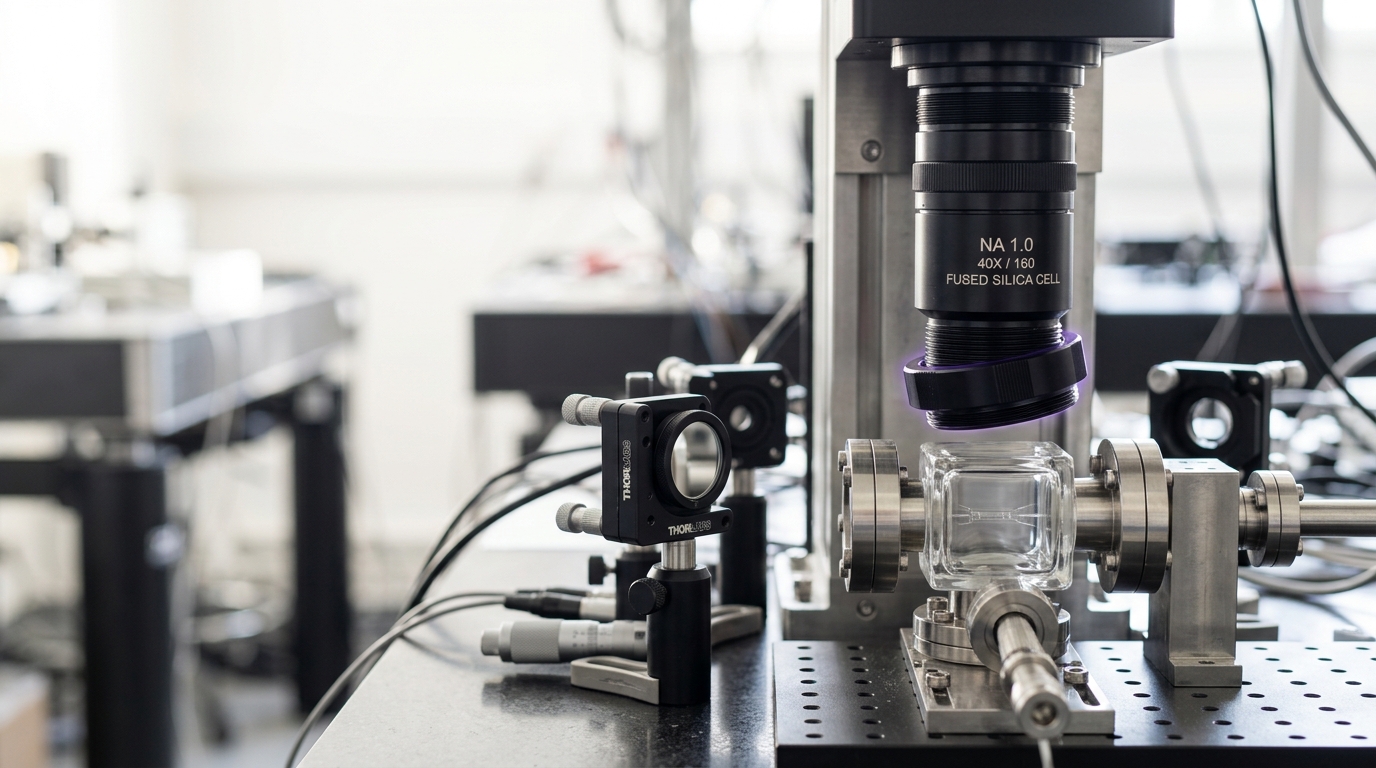
Every number in this story starts on a bench like this one: a one-dimensional chain of rubidium-87 atoms, quenched from a deep Mott insulator and imaged site by site, shows its correlations spreading in a cone at 1.1 to 1.8 millimetres per second — the gas's own measured speed of light [@cheneau-et-al-2012]. — Image prompt and art direction by Brecht Corbeel; generation pending.
Abstract
A new paper in The Crossed Fields Papers argues that the 1972 Lieb-Robinson bound, once a locality theorem nobody could test, is now a measured material property: quantum-gas microscopes and trapped-ion chains show correlations spreading in a sharp cone at a speed set by the lattice itself. Compiling every platform where that speed has actually been measured under one convention, the paper finds a span of nine and a half orders of magnitude, not the eleven a first pass suggested, from a millimetre-per-second cold-atom cone to graphene's million-metre-per-second Dirac cone, with an unfilled gap between them. It then classifies which relativistic facts a crystal keeps — causality exactly, and inside a graded window, time dilation and Klein tunneling — and which it loses by proof, chiefly the invariance under boosts that makes every crystal an ether. The paper's sharpest move inverts the historical Michelson-Morley experiment: run it inside a medium already known to have a preferred frame, and a positive result measures only the emergent window's quality, not fundamental relativity, because an interferometer built entirely from the medium's own quasiparticles would null regardless.
A quench turns a 1972 theorem into a slope you can read on a screen
Prepare a one-dimensional chain of ultracold rubidium atoms deep inside a Mott insulator, so deep that every atom sits alone on its own lattice site with no coherence between neighbours. Weaken the lattice suddenly, so atoms can hop again, and watch through a microscope that resolves individual sites. Correlations do not appear everywhere at once. They spread outward from wherever the quench acted, inside a sharply bounded cone, as if the gas had been handed its own speed of light. Marc Cheneau and collaborators ran exactly this experiment in 2012, using a chain of rubidium-87 atoms in an optical lattice with a 532-nanometre period, and read the cone’s edge directly off the data: a propagation speed of roughly 1.1 to 1.8 millimetres per second, depending on how deep the final lattice sits [2]. That is not a fast number by any ordinary measure. It is, however, a real, measured one, and a new paper in The Crossed Fields Papers series, “Every Crystal Has Its Own Speed of Light,” argues that its being measurable at all is the actual story.
The theorem behind the cone is older than the experiment by four decades. In 1972, Elliott Lieb and Derek Robinson proved that any lattice system built from short-range interactions carries a finite speed limit: disturb one site, and the disturbance’s effect on a distant site is exponentially suppressed until enough time has passed for a signal to have crossed the distance at a fixed velocity [1]. For roughly three decades that result sat inside mathematical physics as a locality theorem — a fact about operators and commutators, not something anyone expected to watch happen. Quantum-gas microscopes and trapped-ion chains changed what the theorem could be. Once an experiment can quench a many-body system and then image the result site by site, an abstract bound about the growth of operators becomes an ordinary measurement: a slope fit to a set of points, in the same spirit as fitting a speed of light to a set of arrival times.
The bound is one inequality, and the cone is what it draws
Stated formally, the bound says that for two operators A_x and B_y acting on well-separated lattice sites x and y, the size of their commutator after evolving one of them forward in time t is capped by an exponential in the distance between the sites minus the cone’s own reach:
\lVert [A_x(t), B_y] \rVert \le C\, e^{-\left(d(x,y) - c_{\mathrm{LR}}\, t\right)/\xi}
where C and \xi are constants fixed by the microscopic couplings and d(x,y) is the distance between the two sites on the lattice [1]. Outside the cone, where d(x,y) exceeds c_{\mathrm{LR}} t, the right-hand side collapses toward zero; inside it, the inequality simply has nothing to say. The velocity c_{\mathrm{LR}} plays exactly the causal role the vacuum speed c plays in relativity, with one difference that matters for everything that follows: it is a property of the material, not of empty space, and it changes from one lattice to the next.
Trapped-ion chains make that material-dependence concrete, because they let experimenters dial the range of the interaction and watch the cone respond. Philip Jurcevic and collaborators encoded a tunable-range Ising model on chains of trapped calcium-40 ions, with couplings falling off as 1/|i-j|^{\alpha} for an adjustable exponent \alpha, and extracted the fastest magnon velocity the resulting dispersion supports. At short range the measured velocity agrees with the ordinary nearest-neighbour prediction; as \alpha is pushed toward zero, toward an interaction that barely decays with distance at all, the velocity is consistent with growing without bound, and the light-cone picture stops holding [3]. The cone, in other words, is not a universal feature of matter. It is a feature of local matter, and a long-range enough crystal need not have one at all.
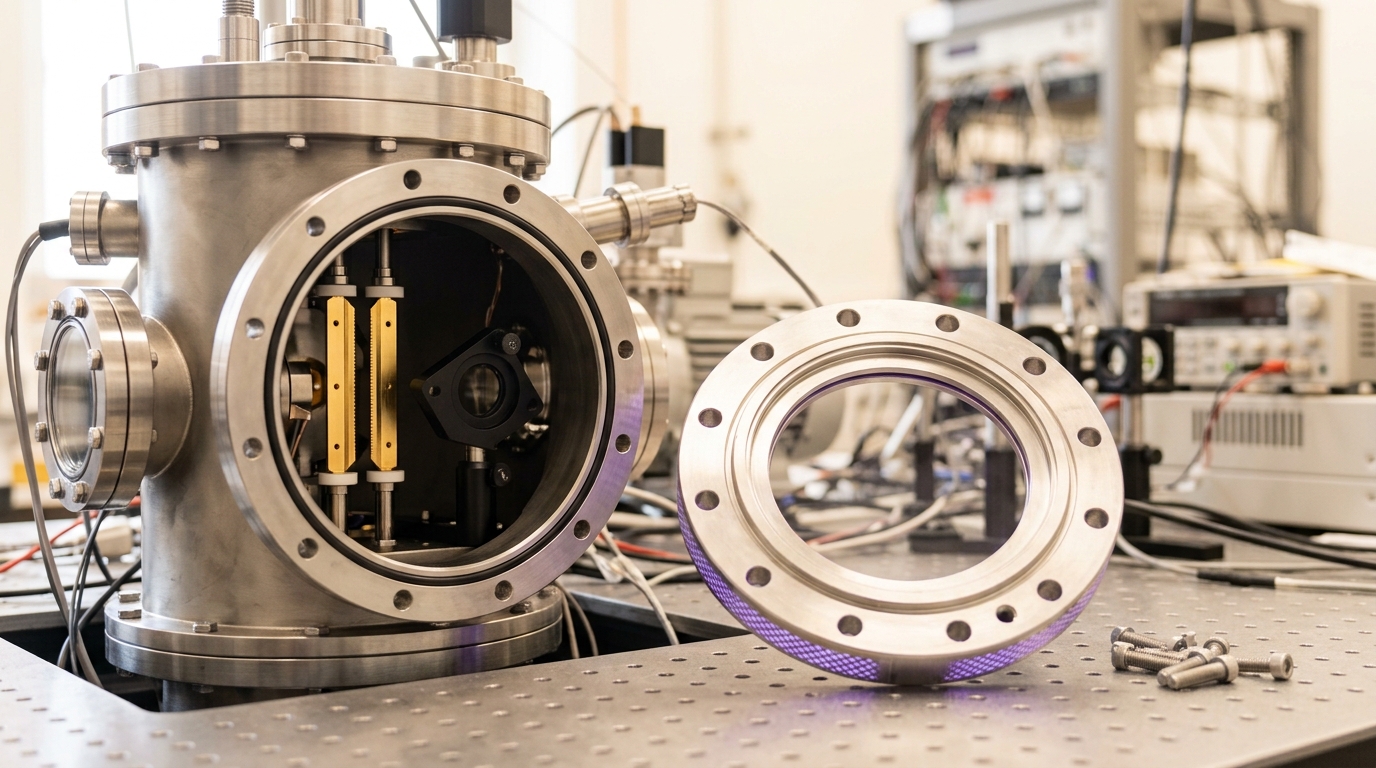
Figure 1. This is the class of hardware behind the census's slowest natural cones: an eleven-ion chain in a trap like this let Philip Richerme and collaborators tune the interaction range directly and watch the correlation cone bend, then outrun any nearest-neighbour bound, once the range grew long enough [@richerme-et-al-2014; @jurcevic-et-al-2014]. — Image prompt and art direction by Brecht Corbeel; generation pending.
Nine platforms, nine and a half orders of magnitude — not the eleven we first reached for
Line up every platform where this cone speed has actually been measured, under one fixed convention — the cone-front group velocity at the relevant filling or interaction strength — and the span comes out to nine and a half orders of magnitude, not the round eleven a first pass at the argument reached for. The bottom of the range is Cheneau’s Bose-Hubbard cone, at 1.1 millimetres per second; the top is graphene’s Dirac cone, whose Fermi velocity runs from about 1\times10^{6} metres per second at ordinary carrier density up to roughly 3\times10^{6} metres per second near the point where the conduction and valence bands touch, boosted there by weakly screened electron-electron interactions [7, 8]. Divide the two and the ratio is 10^{9.44}, not 10^{11}: still a span of nearly ten orders of magnitude, but an honest one rather than the rounder number a tidier story would have preferred.
Between those extremes sit two families with a gap between them. Engineered quantum simulators — cold-atom lattices, trapped-ion chains, Rydberg-atom arrays — cluster between 10^{-3} and 3\times10^{-2} metres per second, because their dynamics run on tunnelling and spin-exchange rates measured in kilohertz, multiplied by lattice spacings measured in hundreds of nanometres. Natural crystals run several orders faster: longitudinal sound in ordinary crystalline silicon travels at 8.433 kilometres per second [12]; the spin excitations of the near-ideal one-dimensional antiferromagnet potassium copper fluoride, with a measured exchange energy of 33.5 millielectronvolts, propagate at roughly 3\times10^{4} metres per second [11]; and a nine-transmon superconducting circuit — a lattice of qubits wired on a chip rather than atoms trapped in light — shows the same information cone in a purely electronic system, its speed a dimensionless slope in wiring distance converted through the chip’s own pitch rather than a velocity in the ordinary sense [14]. No platform measured so far sits between about 3\times10^{-2} and 2\times10^{2} metres per second, and the paper is careful about what that gap means: not a forbidden band, but a statement about what has been built, since nothing yet measured is both slow enough to watch atom by atom and fast enough to fill it.
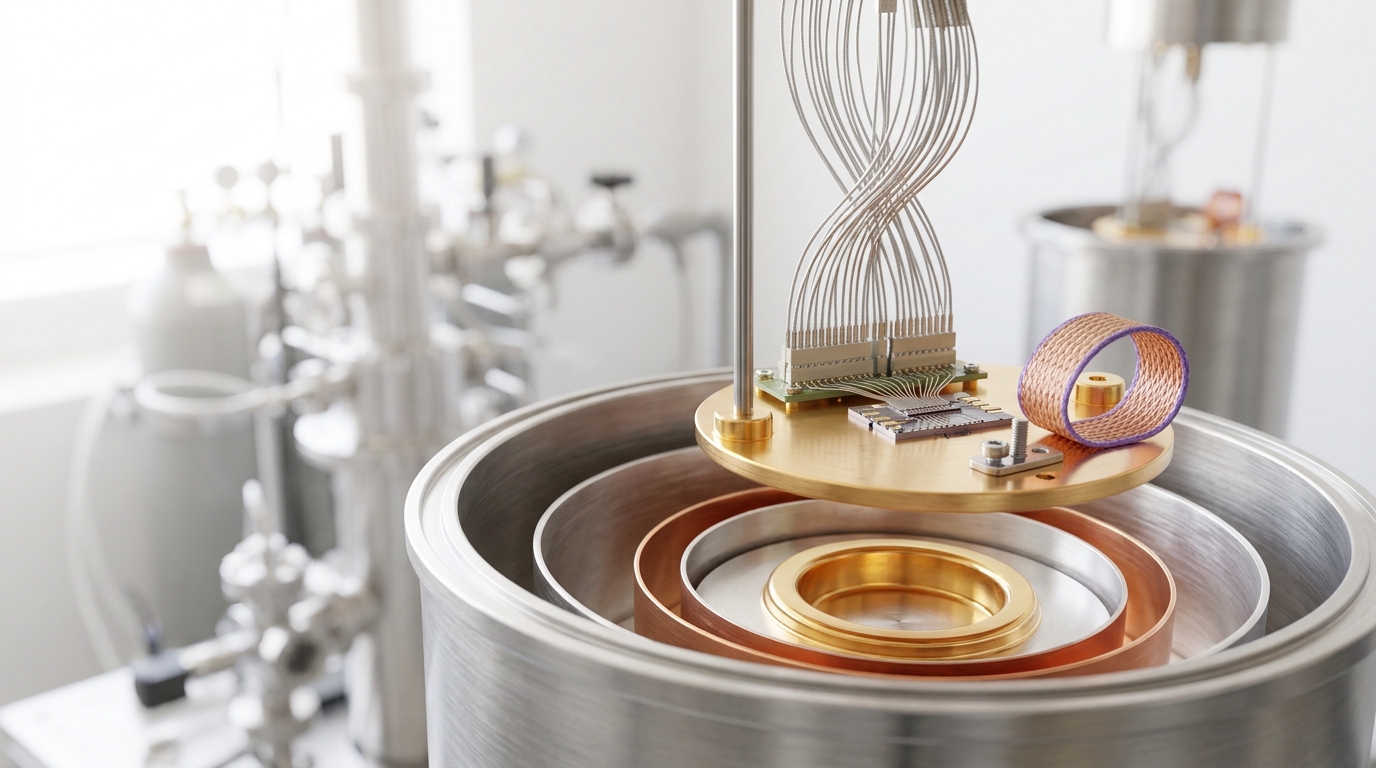
Figure 2. The census's fastest wired platform lives in a fridge like this one: a nine-transmon lattice mapped an information cone through out-of-time-ordered correlators, its speed a dimensionless slope in wiring distance rather than a velocity in the ordinary sense [@braumuller-et-al-2022]. — Image prompt and art direction by Brecht Corbeel; generation pending.
Klein tunneling is relativity replayed in a pencil trace of carbon
Graphene sits at the top of the census not because its electrons move fast in any absolute sense — three million metres per second is still a tenth of a percent of the vacuum speed of light — but because their low-energy behaviour is relativistic in form rather than merely in name. Near the point where graphene’s conduction and valence bands touch, its electrons obey a two-dimensional version of the massless Dirac equation, with the Fermi velocity v_F standing in for c. Mikhail Katsnelson, Konstantin Novoselov, and Andre Geim used that fact in 2006 to predict something the vacuum makes almost impossible to see: a chiral, massless particle hitting an electrostatic barrier head-on tunnels through with perfect transmission, regardless of the barrier’s height or width — the opposite of ordinary tunneling, whose probability collapses as the barrier grows [5]. They were explicit about why nobody had ever seen the genuine effect. A real Klein paradox, for an actual relativistic electron, needs a potential drop of order its own rest-mass energy squeezed into a Compton wavelength — electric fields above 10^{16} volts per centimetre, far past anything a laboratory can sustain. In graphene the identical physics runs at the voltages and length scales of an ordinary chip.
Andrea Young and Philip Kim measured it in 2009. Building a graphene p-n junction with top gates narrower than twenty nanometres, they resolved a shift in the fringe pattern of conductance oscillations at a characteristic magnetic field of about 0.3 tesla — a phase-sensitive signature that distinguishes perfect transmission at normal incidence from merely strong transmission, a distinction an ordinary resistance measurement cannot make [6]. This is the transfer theorem’s flagship exhibit, and the paper is careful about its grading: massless-cone kinematics transfers exactly wherever a band’s dispersion is genuinely linear, not as a loose analogy but as a measured consequence of that linearity, and Klein tunneling is the sharpest place anyone has confirmed it. A relativistic fact the vacuum keeps almost entirely out of reach shows up, unforced, in a flake of carbon on a chip.
What a crystal is allowed to keep from special relativity, and what it cannot
A material with its own speed of light does not automatically inherit the rest of special relativity along with it, and the paper’s central contribution is sorting the kinematics of relativity into three registers rather than letting the census’s headline number carry a bigger claim than the mathematics supports.
Two facts transfer exactly, with no correction term anywhere, because they follow from locality alone rather than from any emergent Lorentz symmetry. Front-speed causality is simply the Lieb-Robinson bound restated: c_{\mathrm{LR}} is a hard limit, and the statement that nothing propagates outside the cone is a proof about commutators, not an analogy borrowed from relativity. Effective causal order follows immediately — two operations separated by more than c_{\mathrm{LR}} t commute up to an exponentially small tail, so a well-defined partial order of what can affect what exists inside the crystal for the same structural reason it exists in the vacuum. Massless-cone kinematics is the third exact entry, carrying one scope condition: wherever a band is genuinely linear, its low-energy excitations obey the massless wave equation with c_{\mathrm{LR}}, or the local Fermi velocity, standing in for c, and every kinematic consequence of that equation, Klein tunneling included, replays inside the window.
A fourth fact transfers, but only with a correction the paper computes rather than sets aside. A quasiparticle wavepacket moving at speed v inside the linear window carries an internal clock — a spinor phase, a zitterbewegung oscillation — that runs slow by the familiar factor \gamma = (1 - v^2/c_{\mathrm{eff}}^2)^{-1/2}: 1.15 at v = 0.5\,c_{\mathrm{eff}}, 2.29 at 0.9\,c_{\mathrm{eff}}. That dilation is real and, in principle, measurable, but only inside a window whose edge the band’s own curvature sets. Writing the correction as a term proportional to (k/\Lambda_{\mathrm{curv}})^2, the fractional error in \gamma stays under one percent as long as the wavepacket’s momentum sits below roughly a tenth of \Lambda_{\mathrm{curv}}; for graphene, where \Lambda_{\mathrm{curv}} \approx 1.5\times10^{9} inverse metres, the clean window covers momenta up to about 1.5\times10^{8} inverse metres. Dilation is graded structured rather than exact for exactly this reason: it holds inside a window with a computable edge, and the paper’s contribution is computing where that edge sits rather than asserting the effect and moving on.
The third register fails, and it fails by proof rather than by degree. A crystal has a ground state and a lattice, and both pick out a rest frame: no continuous symmetry carries the crystal’s description in one inertial frame into its description in another, because the lattice Hamiltonian is manifestly not invariant under a boost at any speed, including c_{\mathrm{eff}}. Relativity of simultaneity fails along with it outside the linear window, and so does the idea of one universal energy-momentum relation: a crystal has many bands, each with its own dispersion and its own emergent speed, so a magnon, a phonon, and a Dirac electron sharing one lattice do not share a light cone. “The” speed of light of a material is, on this reading, a category error — there are as many as there are bands, and the census’s own table already shows it. What the crystal loses is not a technicality. It is the principle of relativity itself, and losing it is what makes the crystal an ether.
Running Michelson-Morley in a medium you already know has a rest frame
An ether is not a scandal once you can find it, and the previous section just proved the crystal has one. That licenses an experiment the vacuum could never really support: run a Michelson-Morley interferometer inside a medium whose rest frame is already known to exist, and ask not whether it registers but what registering it actually means.
The magnitude is the first surprise. In a driven or flowing lattice, the cone speed along the drift is c_{\mathrm{eff}} + v_d in one direction and c_{\mathrm{eff}} - v_d in the other, so the anisotropy between the along-drift and transverse directions is \delta c/c \simeq v_d/c_{\mathrm{eff}} — first order in the drift velocity, not the crushing second-order v^2/c^2 \sim 10^{-8} that made the 1887 experiment so demanding to run and so easy to see nothing in. At a tenth of the cone speed, the anisotropy is ten percent — a signal any competent interferometer would catch on its first pass, the mirror image of the historical null result. Such anisotropies are not a fiction of the model: ultrasonic measurements already resolve a field-angle-dependent sound velocity in the Weyl semimetal tantalum arsenide, a real, measured anisotropic cone speed in exactly the material family the paper’s own census uses for its Weyl-semimetal row [13].
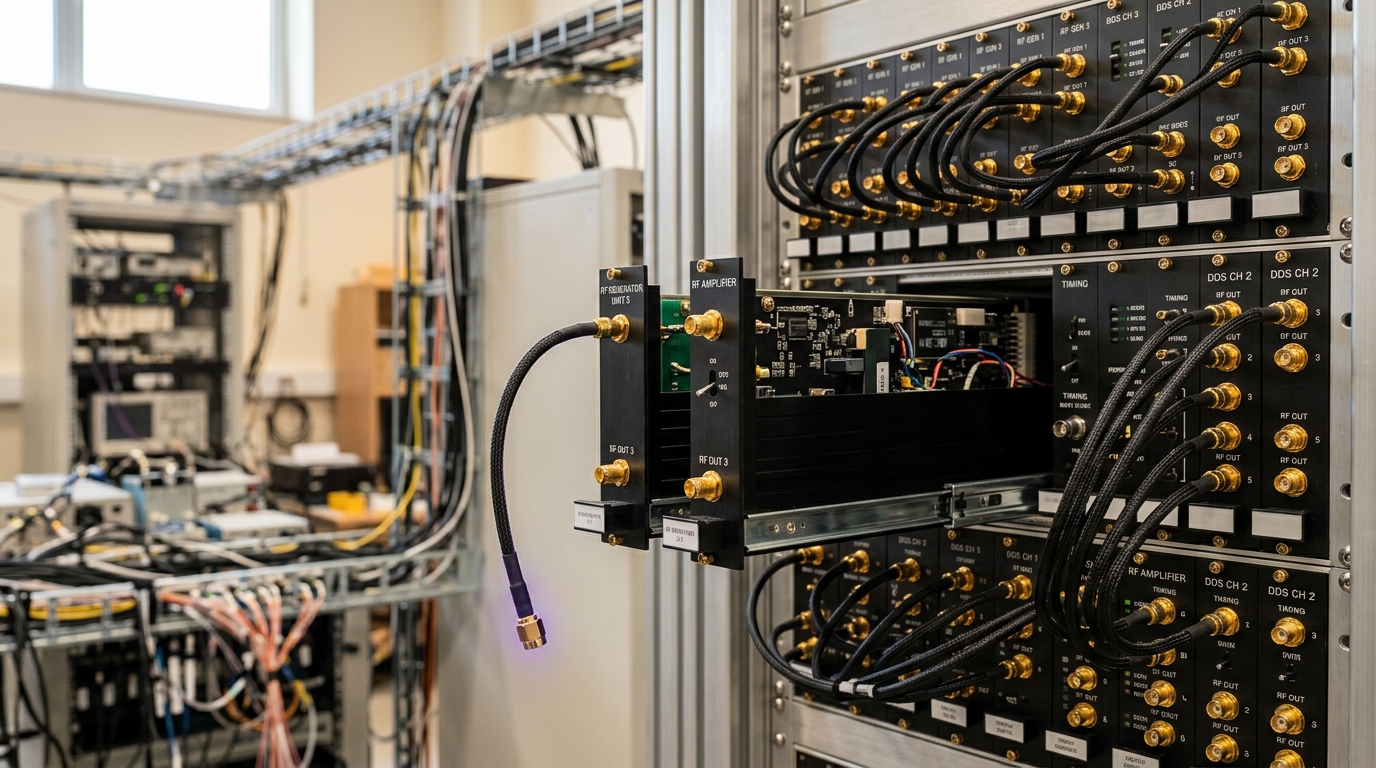
Figure 3. Driving a controlled drift through a lattice — the moving-medium half of an in-crystal Michelson–Morley design — takes exactly this kind of control electronics; the anisotropy it would chase is not hypothetical, since ultrasonic measurements already resolve a field-angle-dependent sound velocity in the Weyl semimetal tantalum arsenide [@laliberte-et-al-2020-taas-sound-anisotropy]. — Image prompt and art direction by Brecht Corbeel; generation pending.
The second surprise is the one that keeps the inversion honest. Carlos Barceló and Gil Jannes proved in 2008 that an interferometer built entirely out of the same quasiparticles it uses to measure — its splitters, its mirrors, its rulers all made from the emergent medium rather than from anything outside it — cannot detect the drift after all, because the binding fields holding its own arms together obey the same emergent wave equation as the signal racing through them, and the arms contract by exactly the factor \gamma = (1 - v_d^2/c_{\mathrm{eff}}^2)^{-1/2} needed to cancel the timing shift [9]. That result is not this paper’s discovery — it is Barceló and Jannes’ theorem, cited here at full strength — but its consequence for the crystal experiment is exact: an observer confined entirely to the emergent world reruns Michelson and Morley’s null result even though the medium genuinely has a preferred frame, because the observer’s own measuring rods shrink along with the light they are timing. Only a clock and a ruler external to the emergent physics — an actual laboratory clock, a crystallographic spacing measured independently of the quasiparticles — can see the frame the lattice keeps. Run this experiment for real, in a driven cold-atom quench, a flowing magnon fluid, or a biased graphene junction, and a positive result says nothing about whether fundamental relativity is exact. It says the crystal’s own emergent window is imperfect enough to show its seams, which is the only thing the experiment was ever built to measure.
One dataset, three verdicts, and a point nobody can explain
The transfer theorem makes a falsifiable prediction about cone shapes under long-range interactions, and one published dataset is precise enough to test it against directly. Philip Richerme and collaborators fit the boundary of a fixed correlation contour in an eleven-ion ytterbium-171 chain as r \sim t^{\zeta}, for both an Ising and an XY Hamiltonian, across four interaction ranges \alpha \in \{0.63, 0.83, 1.00, 1.19\} [4]. Measured against the long-range generalisations of the Lieb-Robinson bound, the resulting eight exponents deliver three verdicts at once, and none of the three is the single clean answer a headline would prefer.
The first verdict is a genuine win for the theory. Every exponent measured is super-linear — \zeta > 1 at seven of the eight points — exactly where the long-range bound says a finite-velocity linear cone is not guaranteed and faster-than-linear growth is required instead, and the propagation outright violates the nearest-neighbour bound v_{\mathrm{LR}} = 12eJ_{\max} once \alpha drops below 1 [4]. Read against a naive short-range picture, the ion chain is unambiguously non-local. The second verdict tempers the first: the three competing long-range thresholds theory offers — a worst-case bound, a typical-state bound, and a free-particle bound — all sit above \alpha = 2, while Richerme’s scan stops at \alpha = 1.19, so the data occupy a regime where all three theories predict the same qualitative behaviour and the experiment cannot say which one is actually being tested. Discriminating between them would need a scan crossing a threshold, which this dataset was never built to provide. The third verdict resists tidying altogether: the XY measurement at \alpha = 1.19 gives \zeta = 1.67 \pm 0.08, growing super-linearly even though a naive count of the interaction’s range would call it short enough to behave, and no published theory accounts for it. The confrontation names that gap rather than explaining it away.
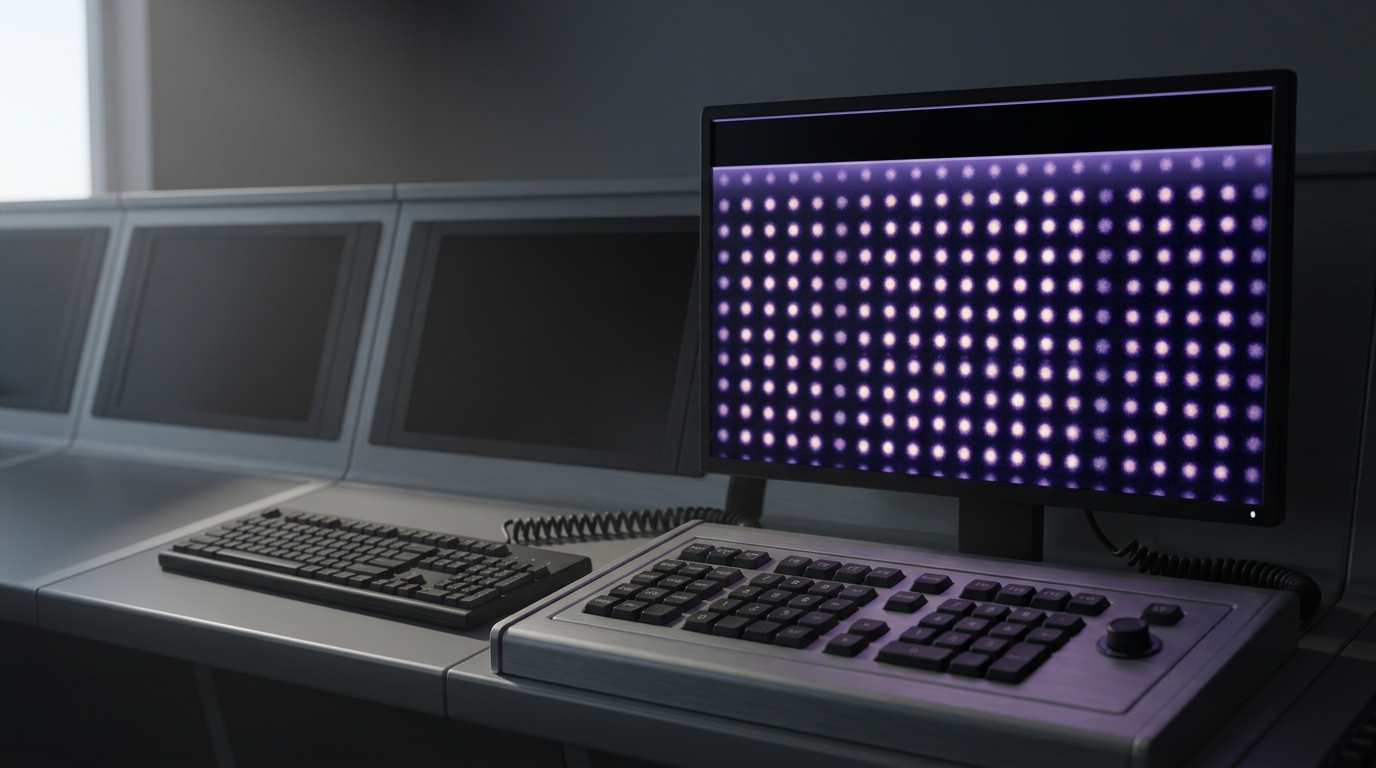
Figure 4. This kind of site-resolved image is what turns a correlation cone from theory into data: the eight error-barred exponents this paper confronts against long-range theory come from exactly this style of single-shot readout, printed in the text rather than buried in a supplement [@richerme-et-al-2014]. — Image prompt and art direction by Brecht Corbeel; generation pending.
The gap between a crystal’s window and the vacuum’s is the argument
Put the two numbers next to each other and the crystal stops being a curiosity and becomes a calibration. The best emergent-Lorentz window any measured crystal can show is of order one percent: a first-order drift anisotropy is a ten-percent effect at a tenth of the cone speed, and even graphene’s own Fermi velocity drifts by a factor of three as the Dirac point is approached. Our own vacuum is not merely somewhat better than that. Stefano Liberati’s review of Lorentz-invariance tests gives the best measured bound on a rotationally invariant electron Lorentz-violation coefficient as roughly one part in 10^{16} [10] — fourteen orders of magnitude tighter than the best window any measured crystal has ever shown.
That gap is the paper’s actual closing argument, not a footnote appended to it. The crystal is the one system in which relativity is known, rather than merely suspected, to be emergent, which makes it a measured floor for how good an unprotected emergent window looks: a lattice with a preferred frame, a breaking pattern, and observables that reveal it, sitting at roughly the percent level a naive quantum-gravity estimate would predict for an emergent Lorentz symmetry with no protecting mechanism. Our vacuum’s window sits fourteen orders above that floor, and the paper does not treat the distance as proof that our own relativity is emergent — only as a fact any proposal that it might be now has to explain, a debt rather than a discovery. Every crystal measured so far has its own speed of light. None of them has yet offered a reason for that speed to be trusted the way light’s is.
Sources
- E. H. Lieb, D. W. Robinson. The Finite Group Velocity of Quantum Spin Systems. Communications in Mathematical Physics (1972).
- M. Cheneau, P. Barmettler, D. Poletti, M. Endres, P. Schauß, T. Fukuhara, C. Gross, I. Bloch, C. Kollath, S. Kuhr. Light-Cone-Like Spreading of Correlations in a Quantum Many-Body System. Nature (2012).
- P. Jurcevic, B. P. Lanyon, P. Hauke, C. Hempel, P. Zoller, R. Blatt, C. F. Roos. Observation of Entanglement Propagation in a Quantum Many-Body System. Nature (2014).
- P. Richerme, Z.-X. Gong, A. Lee, C. Senko, J. Smith, M. Foss-Feig, S. Michalakis, A. V. Gorshkov, C. Monroe. Non-local Propagation of Correlations in Long-Range Interacting Quantum Systems. Nature (2014).
- M. I. Katsnelson, K. S. Novoselov, A. K. Geim. Chiral Tunnelling and the Klein Paradox in Graphene. Nature Physics (2006).
- A. F. Young, P. Kim. Quantum Interference and Klein Tunneling in Graphene Heterojunctions. Nature Physics (2009).
- K. S. Novoselov, A. K. Geim, S. V. Morozov, D. Jiang, M. I. Katsnelson, I. V. Grigorieva, S. V. Dubonos, A. A. Firsov. Two-Dimensional Gas of Massless Dirac Fermions in Graphene. Nature (2005).
- D. C. Elias, R. V. Gorbachev, A. S. Mayorov, S. V. Morozov, A. A. Zhukov, P. Blake, L. A. Ponomarenko, I. V. Grigorieva, K. S. Novoselov, F. Guinea, A. K. Geim. Dirac Cones Reshaped by Interaction Effects in Suspended Graphene. Nature Physics (2011).
- C. Barceló, G. Jannes. A Real Lorentz-FitzGerald Contraction. Foundations of Physics (2008).
- S. Liberati. Tests of Lorentz Invariance: A 2013 Update. Classical and Quantum Gravity (2013).
- B. Lake, D. A. Tennant, J.-S. Caux, T. Barthel, U. Schollwöck, S. E. Nagler, C. D. Frost. Multispinon Continua at Zero and Finite Temperature in a Near-Ideal Heisenberg Chain. Physical Review Letters (2013).
- G. S. MacCabe, H. Ren, J. Luo, J. D. Cohen, H. Zhou, A. Sipahigil, M. Mirhosseini, O. Painter. Phononic Bandgap Nano-Acoustic Cavity with Ultralong Phonon Lifetime. arXiv (published as Science 370, 840, 2020) (2019).
- F. Laliberté, F. Bélanger, N. L. Nair, J. G. Analytis, M.-E. Boulanger, M. Dion, L. Taillefer, J. A. Quilliam. Field-Angle Dependence of Sound Velocity in the Weyl Semimetal TaAs. Physical Review B (2020).
- J. Braumüller, A. H. Karamlou, Y. Yanay, B. Kannan, D. Kim, M. Kjaergaard, A. Melville, B. M. Niedzielski, Y. Sung, A. Vepsäläinen, R. Winik, J. L. Yoder, T. P. Orlando, S. Gustavsson, C. Tahan, W. D. Oliver. Probing Quantum Information Propagation with Out-of-Time-Ordered Correlators. Nature Physics (2022).
Originally published at https://absolutedigitalpublishers.com/articles/every-crystal-has-its-own-speed-of-light.