Eight Nanoseconds Separate a Photon's Detection From the Choice That Retroactively Labels It
A photon lands on a detector and is recorded. Nanoseconds later, a choice about its entangled twin decides whether that already-recorded photon's data show a wave pattern or a definite path — read exactly, without the time-travel flourish.
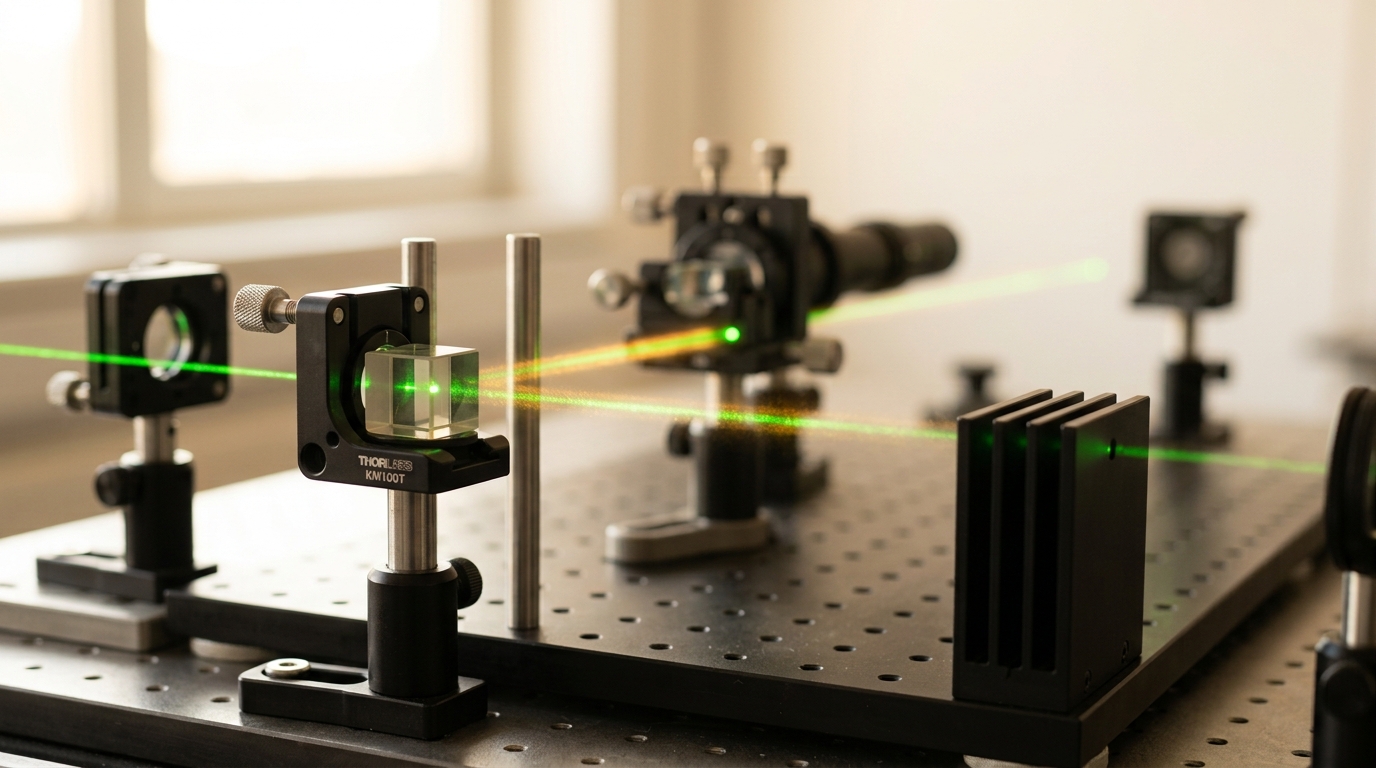
This one cube decides whether the idler photon's path becomes knowable or erasable. Nothing about the signal photon's own detection changes — only what a later comparison of records can prove about it. — Image prompt and art direction by Brecht Corbeel; image generated to that direction.
Abstract
In 2000, Kim, Yu, Kulik, Shih and Scully ran an experiment in which a choice made roughly eight nanoseconds after a photon's detection appeared to decide, retroactively, whether that photon had behaved as a wave or a particle. The result is real, twice independently strengthened since — once with a single photon and a space-like-separated switch in 2007, once across a 144-kilometre free-space link in 2013 — and it demonstrates something precise and checkable: Bohr's complementarity, not Zurek's decoherence, and nothing that sends information backward through time. This article works the arithmetic behind the eight nanoseconds, states exactly what "erase" and "preserve" mean at four physical detectors, and draws the line this series will not blur again between a choice that changes what a record shows and a choice that changes what happened.
A Headline Claims the Future Reached Back and Changed a Photon’s Past
Science writers reach for the same sentence often enough that it has become its own small genre: a measurement made today decided what a particle did yesterday. The delayed-choice quantum eraser is the experiment that genre points to most often, and the reporting is not inventing the strangeness from nothing — the physicists who ran it use the same unsettling language themselves. Jacques, Wu, Grosshans, Treussart, Grangier, Aspect and Roch, describing their own 2007 realization of the effect, quote John Archibald Wheeler’s original framing approvingly: “we have a strange inversion of the normal order of time. We, now, by moving the mirror in or out have an unavoidable effect on what we have a right to say about the already past history of that photon” [3]. Read quickly, that sentence says a choice made later changed an event that already happened. Read exactly, it says something narrower, stranger in a different way, and considerably more interesting: the choice changes which description of the already-fixed event an observer is entitled to give, and it does so without sending anything — a particle, a field, a bit of information — backward through time to make the change.
The experiment this essay works through in full, Kim, Yu, Kulik, Shih and Scully’s 2000 “A Delayed ‘Choice’ Quantum Eraser,” is not a metaphor and not a thought experiment. It is a bench of beamsplitters, mirrors, and photon counters, and its headline result is a specific number: a choice made about one photon can be delayed by at least eight nanoseconds after its entangled twin has already been detected and recorded, and the twin’s already-recorded data will, on inspection, show either a wave pattern or no wave pattern depending on that later choice [2]. That is a real, checkable, and — as of this writing, independently re-verified — accurately reported result. What it demonstrates is Bohr’s complementarity, the ninety-eight-year-old principle that a quantum system shows wave behavior or particle behavior depending on what is measured, never both in the same run [6]. What it does not demonstrate, and what a careful reading of the same paper rules out on its own terms, is retrocausation, and it does not demonstrate the redundant-record proliferation this series’ companion articles call quantum Darwinism. Getting those three claims sorted — complementarity confirmed, retrocausation excluded, quantum Darwinism not even addressed — is this article’s entire job, and every later entry in this series will use the sorting rather than redo it.
One Crystal, Two Photons, Four Detectors Deciding After the Fact
The idea of erasing which-path information rather than merely hiding it is older than the 2000 experiment by eighteen years, and naming the lineage precisely matters more than treating “quantum eraser” as a single, undifferentiated piece of jargon. Marlan Scully and Kai Drühl proposed the concept itself in 1982, in a scheme built around two fixed atoms rather than a photon pair: a resonant light pulse excites one of two atoms sitting at separate sites into emitting a marker photon, and because the atom that did the emitting is left in a distinguishable internal state, that difference tags which atom produced the photon and destroys the photon’s own interference pattern — a mark Scully and Drühl showed could be erased after the fact by a second light pulse that drives both atoms to an identical final state, emitting a further photon whose detection erases the which-atom record and restores interference in the first photon’s pattern [1]. Wheeler’s delayed-choice proposal, four years earlier, asked a related but separate question: whether the choice of what to measure could be postponed until after a photon had already committed to a path through an interferometer, without changing the outcome [5]. Kim, Yu, Kulik, Shih and Scully’s 2000 paper is the experiment that welds these two proposals into one buildable apparatus, replacing Scully and Drühl’s two marker atoms with a spontaneous-parametric-down-conversion source’s entangled photon pair and a beamsplitter network, and it is the specific combination — genuine erasure, genuinely delayed — that makes the 2000 result the direct ancestor of everything this article discusses below rather than a mere restaging of either 1978 or 1982 alone.
The apparatus starts with an ordinary nonlinear-optics trick. A 351.1-nanometre argon-ion laser beam passes through a double slit and strikes a beta-barium-borate crystal cut for type-II phase matching, and spontaneous parametric down-conversion occasionally splits one pump photon into two lower-energy photons — signal and idler, both at 702.2 nanometres, born together, correlated in polarization, and emitted from one of two possible crystal regions separated by about 0.7 millimetres depending on which slit the pump photon effectively passed through [2]. The signal photon, call it photon 1, travels to a lens and then to a single detector, D0, mounted on a track that can be scanned to build up an interference pattern one position at a time, the way a photographic plate behind Young’s original double slit would. Nothing unusual so far — this is a spontaneous-parametric-down-conversion analog of the double-slit experiment, and by itself it behaves exactly as a century of quantum optics predicts.
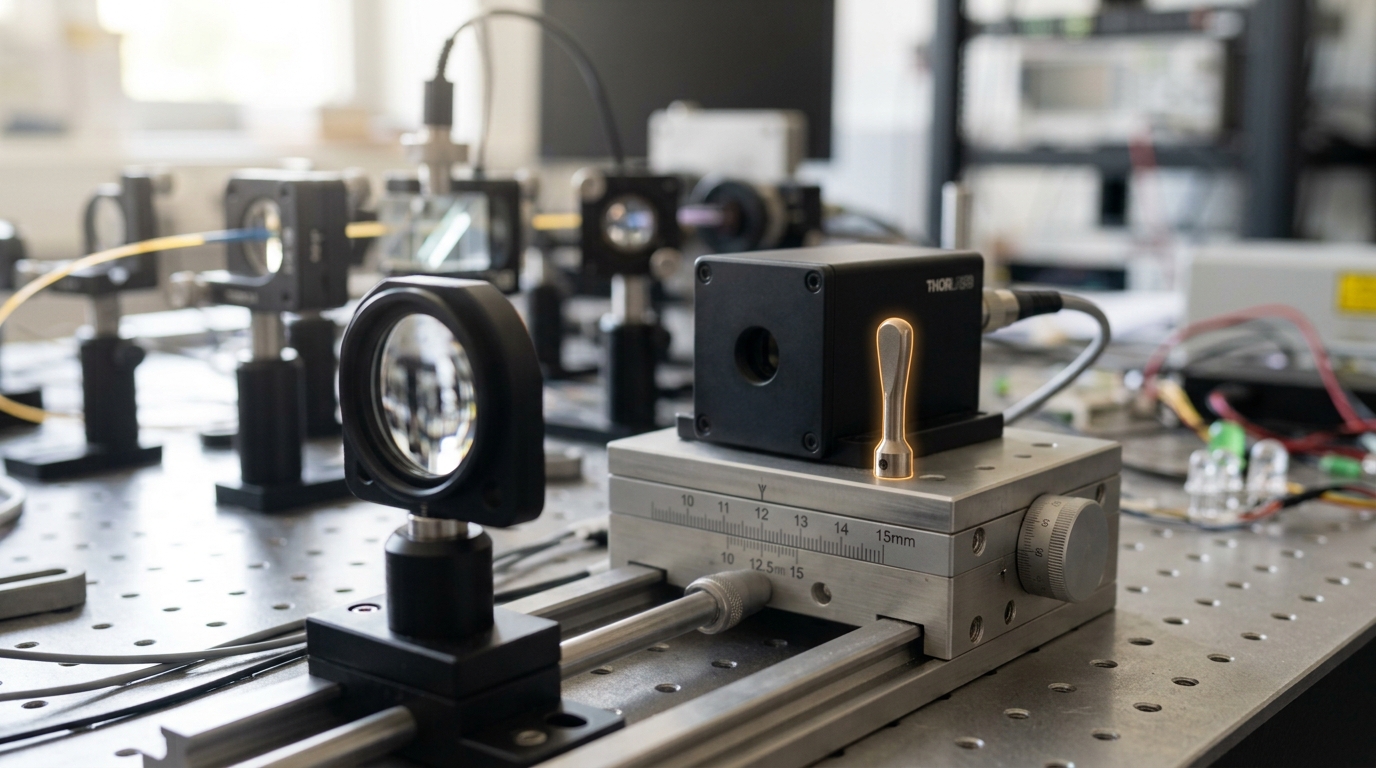
Figure 1. This detector alone never shows a fringe pattern, no matter where it sits on the track. Whatever it will turn out to reveal depends on a record that, at this exact moment, has not been made yet. — Image prompt and art direction by Brecht Corbeel; image generated to that direction.
The idler photon, photon 2, is where the experiment earns its name. It travels a longer path through a prism and into a second beamsplitter arrangement built specifically to give an experimenter, after the fact, two different things they could learn about photon 2 — and, because the two photons are entangled, two different things that learning implies about photon 1’s already-completed journey through the double slit. If photon 2 reaches beamsplitter BSA or BSB and is transmitted through, it proceeds to detector D3 or D4, and a click at either one tells an experimenter unambiguously which of the two crystal regions photon 1’s twin came from — which slit, in the double-slit language. If instead photon 2 is reflected at BSA or BSB, it travels on to mirrors and a further beamsplitter, BS, arriving at D1 or D2, and a click at either of those has erased that same information: a photon reaching D1 or D2 could have come from either region, with no way even in principle to tell which [2]. D3 and D4 mark the path. D1 and D2 erase it. Which pair fires is not decided in advance by the experimenter dialing a setting before the photons are emitted; it is decided by which port of a fifty-fifty beamsplitter the idler photon happens to take, a genuinely probabilistic quantum event that only resolves once photon 2 arrives at the beamsplitter — which, because of the path length involved, happens after photon 1 has already been counted at D0.
Coincidence circuits compare the timestamp of every D0 click against the timestamps of D1 through D4, sorting D0’s clicks into four separate joint-detection records: R01, R02, R03, and R04, one for each idler detector a given signal photon’s twin eventually triggered [2]. Scan D0 along its track while this sorting runs, and R01 and R02 — the erased-path records — trace out a clean interference pattern, alternating bright and dark fringes, exactly as if photon 1 had gone through both slits as a wave. R03 and R04 — the marked-path records — trace out two overlapping single-slit humps with no fringes at all, exactly as if photon 1 had gone through one slit or the other as a particle. Same photon 1, same D0, same scan; two different pictures, sorted apart by an event that has not yet happened when D0 does its own detecting.
The Arithmetic Behind “At Least Eight Nanoseconds”
Here is the number that makes the paper’s title literal rather than rhetorical. The path from the BBO crystal to the idler beamsplitters and on to D1 through D4 is built about 2.5 metres longer than the path from the crystal to D0 [2]. Divide that extra length by the speed of light — 2.5 metres over roughly 3×10⁸ metres per second — and the arithmetic gives about 8.3 nanoseconds. That is a derived number, not a quoted one: it is what falls out of treating the stated path-length difference as a straightforward light-travel-time calculation, and it lines up with, rather than merely repeats, the paper’s own stated floor: “any information one can learn from photon 2 must be at least 8ns later than what one has learned from the registration of photon 1” [2]. The paper says “at least” because the true delay depends on exact optical path lengths through lenses and mounts that add a little more than bare geometry would suggest; the simple 2.5-metre estimate is a lower bound on the same quantity, which is exactly why the two numbers agree instead of colliding.
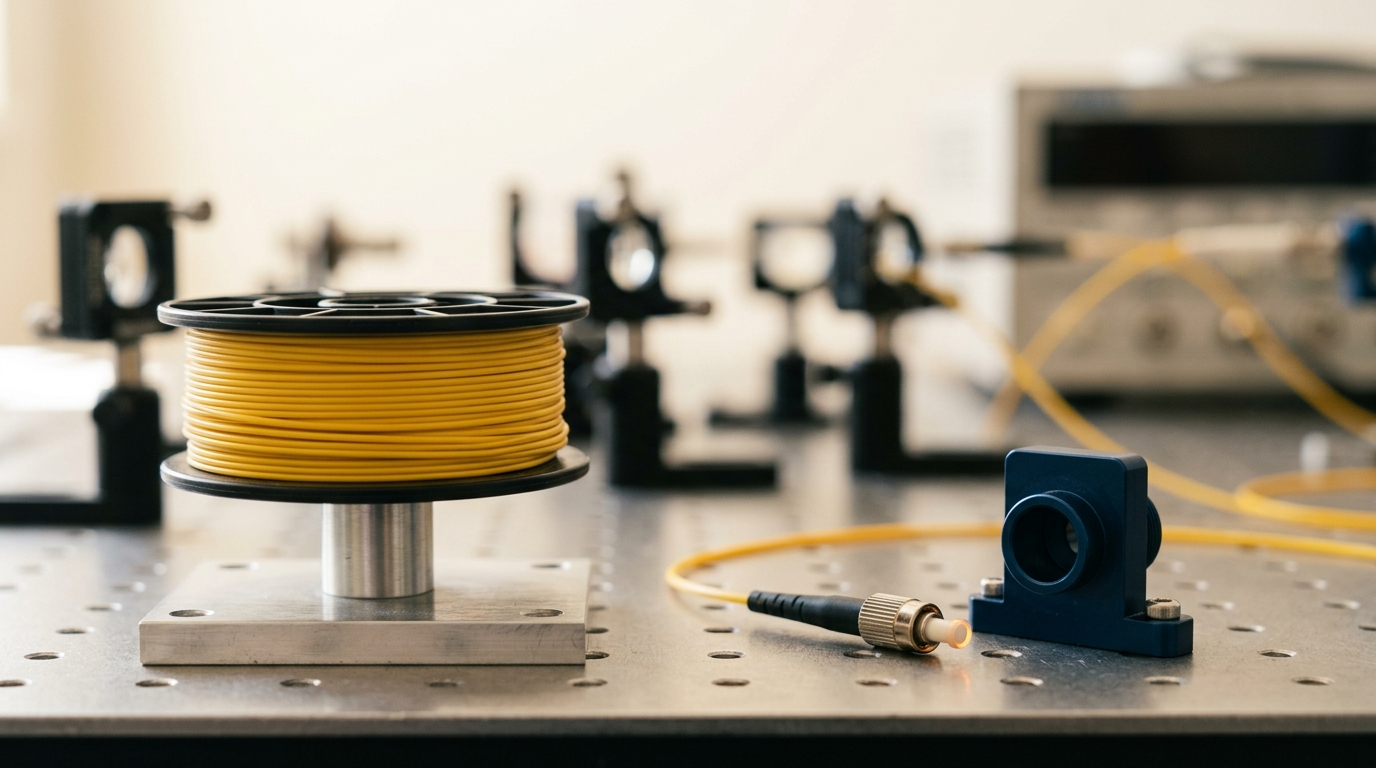
Figure 2. Two and a half metres of extra path, wound small enough to fit on a bench. Divided by the speed of light, that length is the entire argument: about eight nanoseconds, no more mysterious than that. — Image prompt and art direction by Brecht Corbeel; image generated to that direction.
Eight nanoseconds is not a long time by any human measure, and that is precisely the point worth sitting with rather than rushing past. The interval is short enough that no journalist would notice it and long enough that it is, in this specific engineered geometry, unambiguous: D0 fires, is timestamped, and its result exists as a fact in some detector’s electronics before anyone anywhere has learned whether that particular run belongs to an erased-path record or a marked-path one. The eight nanoseconds is not a philosophical flourish added to make the result sound more dramatic. It is a load-bearing piece of the experimental design, the thing that lets the paper claim its result is genuinely about a choice made after registration rather than a choice that merely looks that way once the bookkeeping catches up.
Why Nothing Crosses Backward, Even Though the English Makes It Sound Like Something Does
Here is the derived claim this article is built to defend, stated as plainly as the physics allows: no signal, no influence, and no information travels from the later idler measurement back to the earlier signal detection. What travels, and only after both detections have already happened, is a comparison — an ordinary, speed-of-light-or-slower act of bringing two separately kept lists of timestamps into the same room and sorting one against the other. The paper itself never publishes a single, unsorted count rate at D0 as its headline result; every reported pattern is a joint-detection rate, R01 through R04, built by correlating two records after the fact [2]. Sean Carroll makes the same point without reference to this specific paper, working through a structurally identical thought experiment with a recording spin standing in for the idler photon: sorting the data by how the recording spin was measured lets an observer “pick out different parts of that entangled wave function, some of which exhibit interference and others do not,” and, in Carroll’s own summary of the result, “nothing really went backwards in time” [9]. Physics World’s Maria Violaris, writing about the same family of experiments and quoting the physicist Jonte Hance, frames the lesson the same way from a different angle: what looks like the present editing the past is better read as “the rich, counterintuitive structure of quantum correlations from entanglement,” not a rewritten history — an eraser that “rewrites observers,” in her phrase, rather than rewriting events [10].
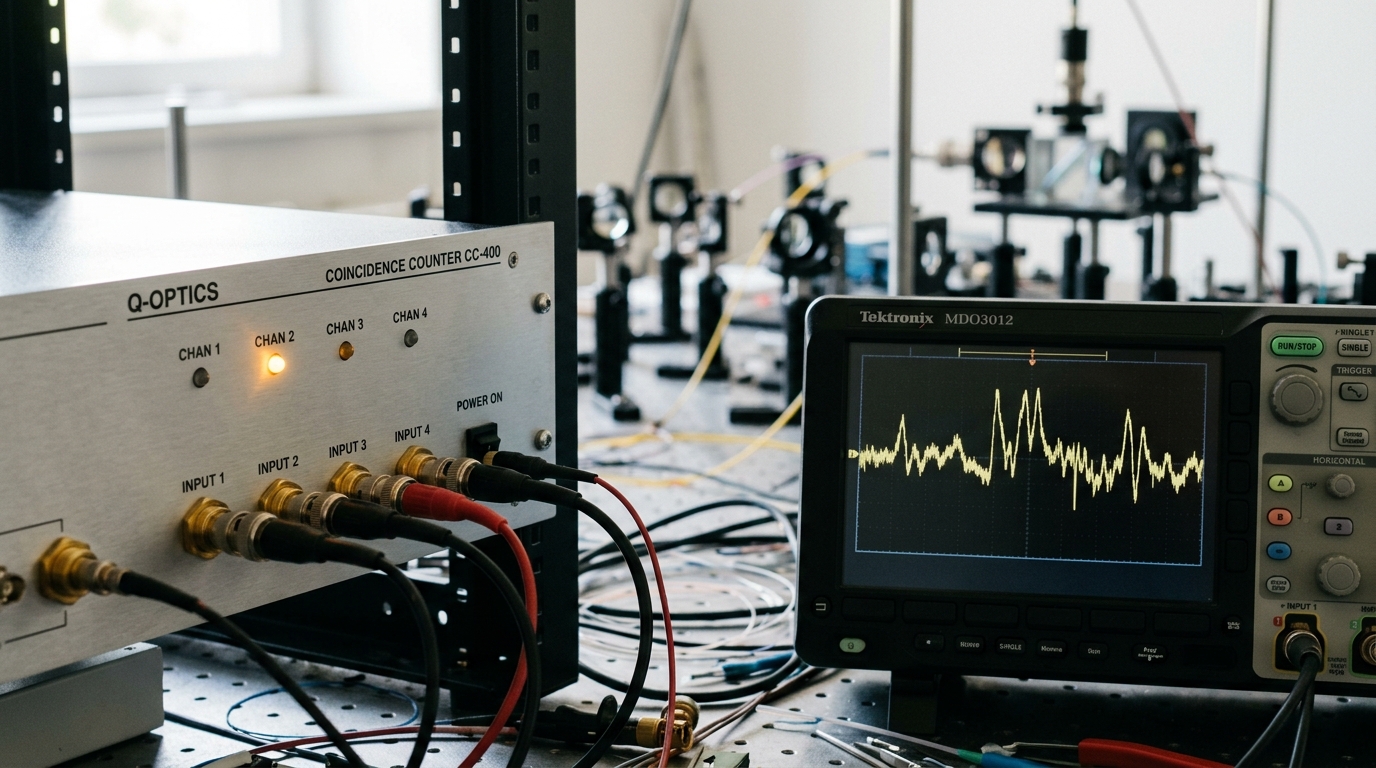
Figure 3. Four counting channels correspond to four different questions asked of the same one photon's twin. Only combining two separately kept records, after both exist, tells you which question this run answered. — Image prompt and art direction by Brecht Corbeel; image generated to that direction.
This is where Wheeler’s own “strange inversion of the normal order of time” needs its careful reading rather than its dramatic one. Wheeler is not claiming that moving a mirror alters a photon’s actual, physical trajectory after that trajectory has already unfolded — nothing in the mathematics or the measured data supports that. He is claiming that the description an experimenter is entitled to attach to that trajectory — “it went through the left slit,” “it behaved as a wave” — depends on a choice made later, and that this dependency inverts the usual assumption that a system’s properties are fixed once and for all at the moment something happens to it, whether or not anyone later asks about it. That is a real and legitimately strange feature of quantum mechanics. It is not time travel, and it is not a signal, because nobody at D0 can extract that later-determined description without also possessing the D1-through-D4 record — the very record that, by the paper’s own timing, does not exist until at least eight nanoseconds after D0 has already fired. A skeptic could still ask: what would it take to overturn this reading? A direct answer is available and unforgiving to sloppiness — if either paper’s own reported joint-detection data showed a pattern at D0 correlating with the later choice in a way that survived without ever comparing the two records, that would be a bona fide faster-than-light signal, a result that would rewrite textbooks rather than merely unsettle headline writers. Neither paper reports anything of the kind, and no replication in the twenty-six years since has either.
Two Escalating Experiments Closed the Loopholes a Skeptic Could Still Raise
Kim et al.'s original result leaves one door open to a determined skeptic: the two photons in each pair are close together, correlated, and one might wonder whether some unmodeled, ordinary physical influence — not a mysterious backward signal, just an overlooked local one — could pass between them before either measurement completes. Two later experiments, cited by name because each closes a specific version of that door rather than gesturing at closing it in general, answer that concern directly.
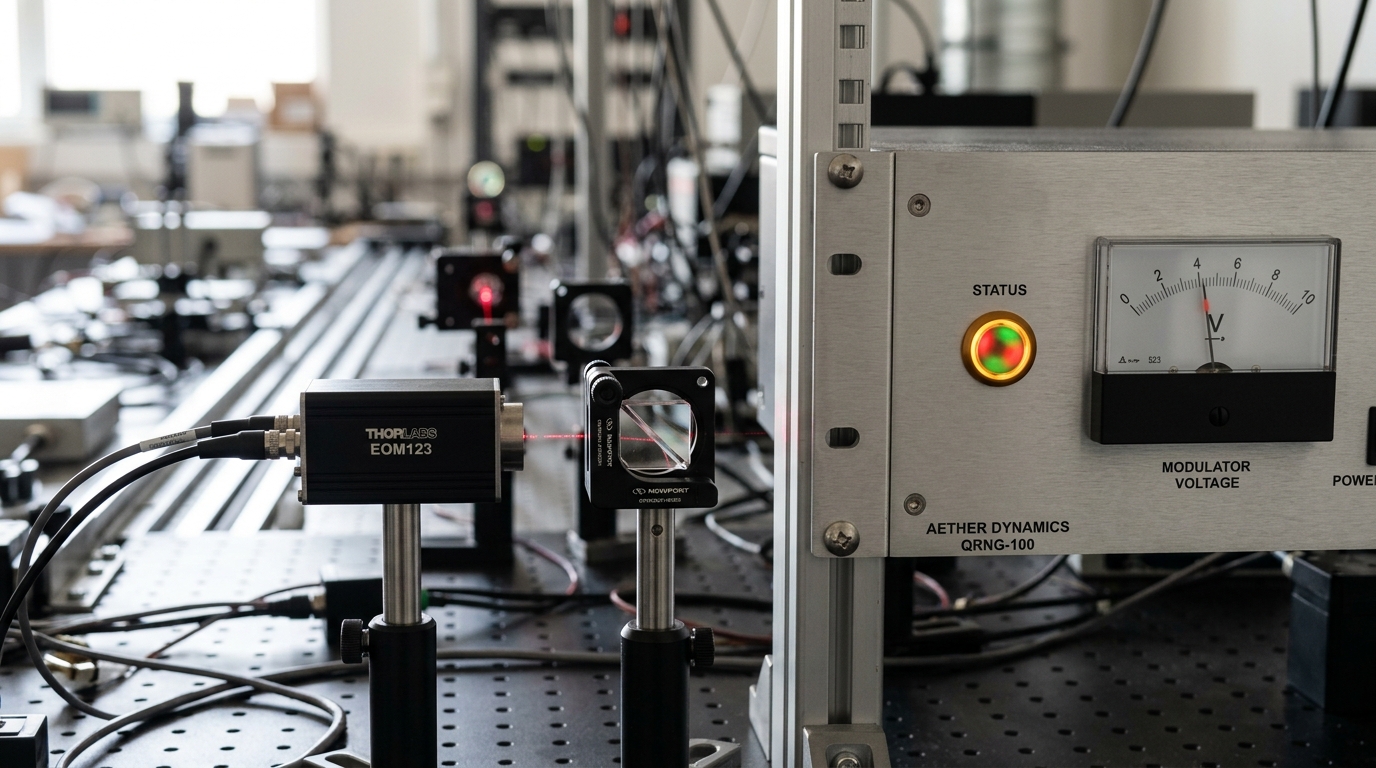
Figure 4. Amplified shot noise from ordinary light, sampled fresh on every cycle, decides open or closed here — a choice made space-like separated from the photon already travelling toward it. — Image prompt and art direction by Brecht Corbeel; image generated to that direction.
Jacques, Wu, Grosshans, Treussart, Grangier, Aspect and Roch’s 2007 realization replaces the entangled photon pair with a single photon and forces the choice itself to be made too far away, too fast, for any signal traveling at light speed to connect it to the photon’s entry into the apparatus. Their source is a single nitrogen-vacancy color center in a diamond nanocrystal, pumped by 532-nanometre laser pulses at 4.2 megahertz, producing true single photons rather than correlated pairs [3]. Each photon enters a 48-metre polarization Mach-Zehnder interferometer and takes about 160 nanoseconds to cross it. A quantum random number generator — sampling amplified shot noise from an ordinary white-light beam, not a pseudorandom algorithm — decides, independently on each run, whether a fast electro-optic modulator recombines the two paths for interference or leaves them separate for path identification, and that decision is made space-like separated, in the relativistic sense, from the photon’s entry into the interferometer: no signal moving at or below the speed of light could carry the outcome of the random choice to the photon before the photon has already committed to entering [3]. The results: 94 percent interference visibility when the interferometer is closed, and which-path identification with an error rate below 1 percent when it is left open — both configurations decided after the single photon is already inside, on hardware built specifically so that no local influence could bridge the gap [3].
Ma, Kofler, Zeilinger and colleagues pushed the same closure further in 2013, returning to entangled photon pairs — using both a 55-metre fibre link and a 144-kilometre free-space link between two measurement stations — with each station’s choice of measurement generated locally and independently, again space-like separated from the interference measurement at the other end [4]. Their own stated conclusion is exactly as narrow as the evidence allows: “no naive realistic picture is compatible with our results because whether a quantum could be seen as showing particle- or wave-like behavior would depend on a causally disconnected choice” [4]. Three experiments, three different ways of ruling out three different mundane explanations — bench-scale timing in 2000, single-photon space-like separation in 2007, kilometre-scale causal disconnection in 2013 — and all three report the identical qualitative structure Kim et al. first measured. That convergence, not any single paper’s authority, is the actual evidentiary weight behind this article’s opening claim.
It is worth naming the specific gap each later experiment closes, because “closing a loophole” is a phrase borrowed loosely from Bell-inequality testing and deserves the same precision here that it demands there. Kim et al.'s 2000 geometry closes what a Bell tester would call the timing gap for this particular claim — the eight-nanosecond figure — but leaves the two photons close enough in space and time at their point of origin that a skeptic could, in principle, posit some unmodeled local mechanism linking them before either detector fires. Jacques et al.'s 2007 single-photon version removes the second photon from the picture entirely, replacing “a hidden channel between two particles” with “a hidden channel between a random-number generator and a single particle already in flight,” and closes that specific gap by making the choice’s generation space-like separated from the photon’s entry into the interferometer — the same geometric logic Bell testers use to rule out a hidden local signal, applied here to a single-particle wave-particle claim rather than a two-particle correlation claim. Ma et al.'s 2013 return to entangled pairs, now separated by up to 144 kilometres, closes the version of the gap that is specific to entanglement: two correlated particles, far enough apart that no signal below light speed can connect one measurement station’s choice to the other’s result before both are already recorded. No single experiment closes every conceivable gap at once — that is normal, incremental experimental physics, not a weakness peculiar to this result — but the three together, run by different groups on different hardware over thirteen years, close three different, independently motivated versions of the same objection.
Complementarity Is Not Decoherence, and This Series Draws the Line Once
Here is this article’s own contribution, proposed plainly rather than left implicit: a three-way distinction the rest of this series will point back to instead of re-deriving. Bohr’s complementarity, the principle these three experiments actually confirm, says a quantum system exhibits wave behavior or particle behavior depending on which measurement is performed, never both in the same run, and — as these experiments specifically add — that this holds regardless of when the choice of measurement is made relative to the earlier, correlated detection event [6]. Decoherence, the mechanism this series’ companion article on quantum Darwinism takes as its starting point, is a different physical process entirely: an open system’s coherence is destroyed by uncontrolled entanglement with a large environment, described by Zurek as the environment moving from “a passive role of reservoir selectively destroying quantum coherence” [8]. Quantum Darwinism goes a step further still, arguing that same environment simultaneously does something constructive — proliferating many redundant copies of the surviving information so that independent observers sampling different fragments of it agree without comparing notes, the environment recast as “an active role of amplifier selectively proliferating information about the system” [7].
The delayed-choice quantum eraser has exactly one entangled pair per run, no environment, no redundant copies, and no independent observers converging on an agreed answer by sampling different fragments of anything. It is complementarity, cleanly, and it is not a small-scale demonstration of decoherence or quantum Darwinism dressed up in different hardware — a mistake this series’ own companion pieces, Quantum Darwinism: How the Classical World Wins the Election and Decoherence: The Quiet Selection That Makes the World Look Solid, are careful never to invite and this article is equally careful not to blur from the other direction. I am proposing this three-way split — complementarity, decoherence, quantum Darwinism, kept as three separate objects with three separate primary-literature anchors — as the fixed vocabulary the rest of this series returns to rather than restates every time a later entry reaches for the word “collapse” or the word “selection.”
What Would Still Have to Be True for This Reading to Fail
Intellectual honesty about a result this clean requires naming its actual, non-rhetorical failure conditions rather than declaring the matter closed. First, everything above describes the operational content of these experiments — what the data show and what any working physicist, regardless of interpretive taste, would compute from them. A separate and genuinely unresolved question, one this series’ own tenth entry takes up directly rather than settling here, is whether some interpretations of quantum mechanics treat the “choice” and the “outcome” as more than an experimenter’s evolving state of knowledge. Under Everett’s many-worlds picture, for instance, every outcome occurs in some branch and nothing is pruned at all, which changes what “the choice determines the outcome” even means; under a Bohmian, hidden-variable picture, the idler photon’s path was in some sense determinate the entire time, and what changes with the later choice is only which pre-existing fact becomes available to the experimenter, not whether a fact existed. Both readings are held by working physicists in good standing, both are consistent with everything measured in these three experiments, and neither can be adjudicated by adding a fourth delayed-choice experiment — the disagreement is about what the shared mathematics means, not about what any further data run would show. That is a live, contested, and explicitly philosophical question about interpretation, not a second empirical claim these three experiments could confirm or refute, and this article flags it rather than resolves it.
Second, the “nothing travels backward” reading is falsifiable in a specific, stated way, not merely asserted as safe. If a future, carefully controlled replication reported a joint-detection pattern at the earlier detector that correlated with the later choice without requiring the later record to be compared against the earlier one — a pattern extractable from D0’s data alone, before D1 through D4 have fired — that would be a direct empirical refutation of everything argued here, not a reinterpretation of it. No paper cited in this article reports anything resembling that, across three independent experimental lineages and twenty-six years, and the burden any future claim to the contrary would have to clear is exactly that specific and exactly that high.
Why This Series Will Use the Word “Collapse” Carefully From Here
None of this makes the delayed-choice quantum eraser a smaller or less interesting result than the headlines suggest — it makes it a more precisely interesting one. A choice made eight nanoseconds after a photon has already been counted determines, unambiguously and repeatably, which of two mutually exclusive descriptions that already-completed detection event gets to carry, and it does this without violating a single principle of relativity or sending a single bit of information anywhere it should not be able to go. That is complementarity working exactly as Bohr described it in 1928, confirmed on real hardware at three escalating standards of rigor, and it is the whole of what these three experiments are entitled to claim.
It is also, deliberately, a narrower claim than “collapse is selection” or “measurement chooses a classical reality out of many candidates” — language this series will need more than once as it moves from wave-particle duality into tunneling, enzyme catalysis, and the coherence budgets of a living cell’s own sensors. From here forward, this series draws on the distinction argued above rather than reopening it: complementarity is Bohr’s object, decoherence and quantum Darwinism are Zurek’s, and conflating any of the three with careless language about “collapse” costs a reader the one thing eight nanoseconds and three independent experiments actually bought back — a precise account of what a later choice can and cannot do to an earlier, already-recorded fact.
Sources
- Marlan O. Scully and Kai Drühl. Quantum Eraser: A Proposed Photon Correlation Experiment Concerning Observation and "Delayed Choice" in Quantum Mechanics. Physical Review A (1982). DOI: 10.1103/PhysRevA.25.2208.
- Yoon-Ho Kim, R. Yu, S. P. Kulik, Y. H. Shih, and Marlan O. Scully. A Delayed "Choice" Quantum Eraser. Physical Review Letters (2000). DOI: 10.1103/PhysRevLett.84.1.
- Vincent Jacques, E. Wu, Frédéric Grosshans, François Treussart, Philippe Grangier, Alain Aspect, and Jean-François Roch. Experimental Realization of Wheeler's Delayed-Choice Gedanken Experiment. Science (2007). DOI: 10.1126/science.1136303.
- Xiao-Song Ma, Johannes Kofler, Angie Qarry, Nuray Tetik, Thomas Scheidl, Rupert Ursin, Sven Ramelow, Thomas Herbst, Lothar Ratschbacher, Alessandro Fedrizzi, Thomas Jennewein, and Anton Zeilinger. Quantum Erasure With Causally Disconnected Choice. Proceedings of the National Academy of Sciences (2013). DOI: 10.1073/pnas.1213201110.
- John Archibald Wheeler. The "Past" and the "Delayed-Choice" Double-Slit Experiment. Mathematical Foundations of Quantum Theory, ed. A. R. Marlow (Academic Press) (1978).
- Niels Bohr. The Quantum Postulate and the Recent Development of Atomic Theory. Nature (1928).
- Harold Ollivier, David Poulin, and Wojciech H. Zurek. Objective Properties from Subjective Quantum States: Environment as a Witness. Physical Review Letters (2004). DOI: 10.1103/PhysRevLett.93.220401.
- Wojciech H. Zurek. Decoherence, Einselection, and the Quantum Origins of the Classical. Reviews of Modern Physics (2003). DOI: 10.1103/RevModPhys.75.715.
- Sean Carroll. The Notorious Delayed-Choice Quantum Eraser. Preposterous Universe (2019).
- Maria Violaris. The Quantum Eraser Doesn't Rewrite the Past — It Rewrites Observers. Physics World (2025).
Originally published at https://absolutedigitalpublishers.com/articles/eight-nanoseconds-separate-a-photons-detection-from-the-choice-that-retroactively-labels-it.