Decoherence: The Quiet Selection That Makes the World Look Solid
Superpositions do not collapse; they lose an election. Environments monitor certain observables, and only the pointer states that survive it get counted — at rates now confirmed in the lab, though which winner turns up in any one run is still an open question.
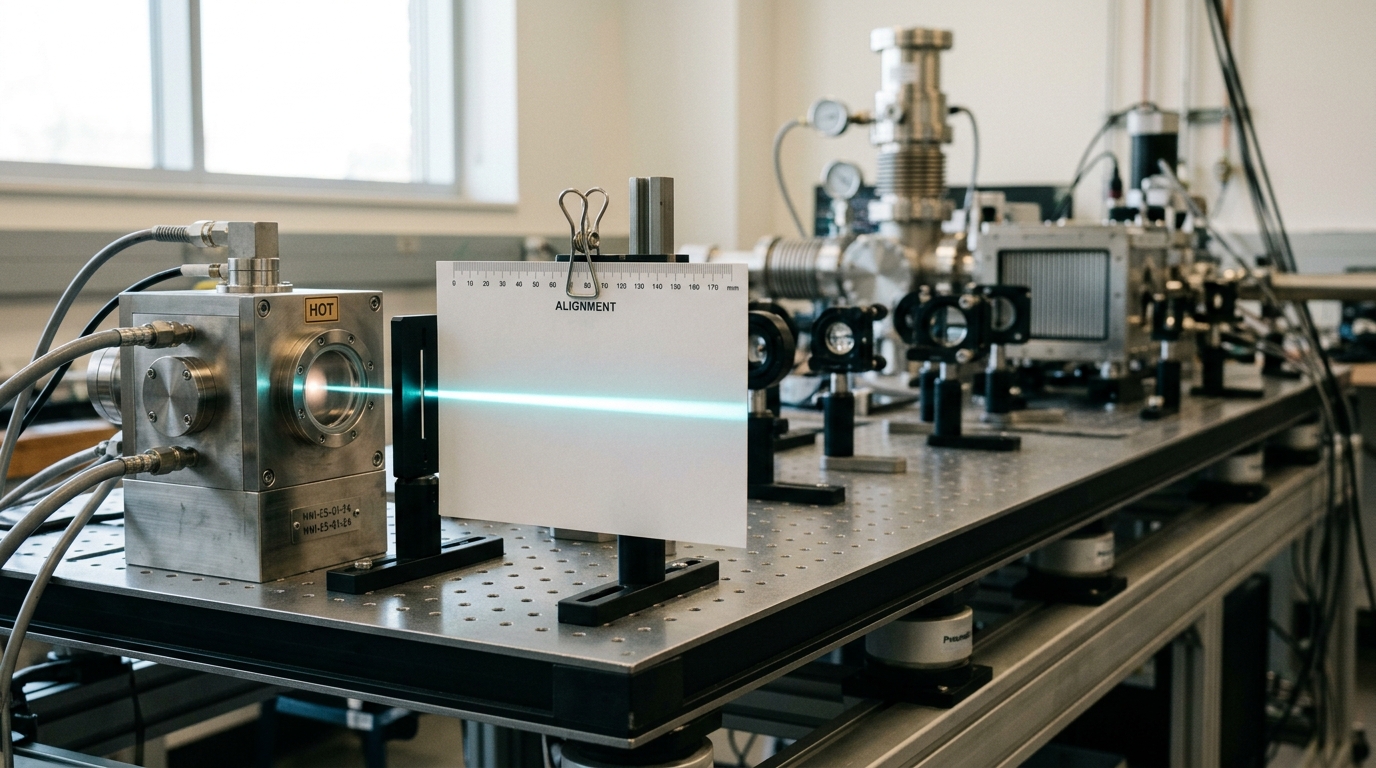
Before any interference pattern can be measured, a beam of molecules has to be built narrow and isolated enough to stay coherent — the unglamorous work no interference figure ever shows. — Image prompt and art direction by Brecht Corbeel; generation pending.
Abstract
Quantum superposition is matter's default condition, not a fragile microscopic curiosity — verified for molecules of tens of thousands of atomic mass units. What destroys it in everyday objects is not size but exposure: environments continuously monitor certain observables, and only the "pointer states" that survive that monitoring persist to leave stable, redundant records. This article follows decoherence theory from H. Dieter Zeh's isolated 1970 paper through Wojciech Zurek's 1981-82 formalization and Erich Joos's quantitative scattering calculations, to its confirmation in cavity-QED and molecular-interferometry experiments, and states plainly what the theory has and has not solved.
Superposition Is the Default State of Matter; Isolation Is the Exception
A carbon-60 molecule is not a small object by the standards of atomic physics: sixty carbon atoms bonded into a hollow cage, roughly 720 atomic mass units, big enough to see the outline of on a good electron micrograph. In 1999 a Vienna group sent a beam of them through a silicon-nitride grating with a period of 100 nanometres and slits 50 nanometres wide, at a most probable speed of 220 metres per second, and watched an interference pattern build up on a detector downstream [9]. The molecules’ de Broglie wavelength at that speed is 2.5 picometres — some four hundred times smaller than the diameter of the molecule doing the interfering [9]. Nothing about C60 is quantum-mechanically special. It behaved like a wave for the same reason an electron does: because for the several milliseconds of its flight, nothing measured which slit it used.
Twenty years later the same Vienna group, by then working with a two-metre Talbot-Lau interferometer built specifically to reach higher masses, pushed the demonstration to a library of tailor-made oligoporphyrins — organic molecules with as many as 2,000 atoms and masses above 25,000 daltons — and still recorded interference fringes, with de Broglie wavelengths down around 53 femtometres, five orders of magnitude smaller than the molecules themselves [10]. A molecule with a mass comparable to a small protein or a short strand of DNA behaved, for the purposes of that experiment, exactly like an electron in a double-slit apparatus. Superposition did not become harder to arrange as the object got heavier. It became harder to protect.
That is the fact this article is built on, and it inverts the question most people bring to quantum mechanics. The puzzle was never why microscopic things are “weird.” The puzzle is why a chair, a coin, or a cat is never seen in a superposition of two positions, given that nothing in the Schrödinger equation forbids it and given that molecules forty thousand times heavier than a hydrogen atom demonstrably do it under the right conditions. The received textbook answer — that superposition somehow “fades out” above some mass or size threshold — is not what either the theory or the two experiments above actually say. What the C60 and oligoporphyrin results demonstrate, together, is that mass is not the variable that matters. Isolation is. A fullerene interferometer works because, for the flight time in question, the molecule’s position is not being continuously recorded by anything else in the universe. A chair fails to show interference not because it is heavy but because its position is being recorded, redundantly and continuously, by every photon that bounces off it, every air molecule that collides with it, and every phonon that couples it to the floor it rests on.

Figure 1. Fullerenes far more massive than any atom still cross a diffraction grating as a wave — mass alone does not defeat quantum behavior; only an environment that reads out position does. — Image prompt and art direction by Brecht Corbeel; generation pending.
The formal name for that continuous recording is decoherence, and its clearest one-sentence statement comes from Wojciech Zurek’s own later synthesis of the field he helped found: “Decoherence is caused by the interaction with the environment. Environment monitors certain observables of the system, destroying interference between the pointer states corresponding to their eigenvalues” [13]. Read literally, that sentence contains the entire argument of this piece. An environment is not a passive backdrop; it is a monitor, continuously extracting information about specific observables of anything it touches. The observables it happens to monitor survive as sharp, classical-looking properties. Superpositions of them do not survive at all — not because a law forbids them, but because they lose, and lose almost immediately, to states that the environment can track. What follows is the history of how that idea was discovered, resisted, formalized, and eventually measured directly in a laboratory — and an honest account of the sizable part of the original quantum measurement puzzle it still leaves untouched.
Zeh Named the Environment as the Missing Term in 1970 and Was Told It Would End His Career
The physicist who first wrote the environment into the measurement problem as a dynamical actor, rather than an external nuisance to be idealized away, was H. Dieter Zeh, in a six-page paper in the first volume of Foundations of Physics in 1970 [1]. Zeh’s claim was structural rather than experimental: quantum theory, applied honestly and without a special collapse postulate, already implies that a macroscopic object cannot remain isolated from its surroundings, and that the resulting entanglement — not any new physics — is what prevents macroscopically distinct superpositions from behaving like superpositions in practice. It is, in retrospect, the founding argument of decoherence theory. At the time, it was close to career-ending.
Zeh described the reception himself, decades later, in an essay written for a 2005 seminar at the Institut Henri Poincaré. Recalling the period just before the 1970 paper, when he had been circulating a related and even more radical idea — that reduction of the wave packet might be explained dynamically rather than postulated — he wrote plainly: “It was absolutely impossible at that time to discuss these ideas with colleagues, or even to publish them. An influential Heidelberg Nobel prize winner frankly informed me that any further activities on this subject would end my academic career!” [2]. Zeh published anyway, in a venue outside the physics mainstream, and the paper was, by his own account and by later historical reconstruction, largely ignored.
It was not ignored by accident. The historian of physics Olival Freire Jr. situates Zeh within a small cohort of what he calls “quantum dissidents” — Zeh, John Bell, John Clauser, Abner Shimony, Eugene Wigner, and others, including Bryce DeWitt, alongside whom Freire builds a collective biographical profile spanning training, early career, motivations, and professional obstacles — physicists who, around 1970, worked against the dominant view among their peers that the foundations of quantum mechanics had already been settled by Bohr, Heisenberg, and von Neumann, and who each paid a professional cost, of varying size, for continuing to ask the question anyway [4]. Freire’s scientometric reading of the period even locates 1970 itself as a hinge point, the year publication rates on quantum foundations begin visibly climbing after two decades of near-total neglect — Zeh’s paper landing, in other words, at the very start of a rise it would take the better part of that rise’s own length of time to feel the benefit of [4]. Kristian Camilleri’s history of the period adds a second, more specific reason Zeh’s argument in particular sat unclaimed for a decade: Zeh had tied the physical mechanism of environmental entanglement inseparably to a specific, and at the time deeply unfashionable, interpretive commitment — an Everett-style relative-state reading in which no collapse ever occurs anywhere, for anyone [3]. Readers who might have been persuaded by the physics were asked to buy the interpretation as a package deal, and very few were willing to.
What changed the field’s mind was not a refutation of Zeh but a repackaging of the same physical mechanism in interpretation-neutral, directly calculable form. Wojciech Zurek, working independently in the early 1980s, published two papers in Physical Review D that asked a narrower and more answerable question: given a specific interaction Hamiltonian coupling a measuring apparatus to its environment, which basis of apparatus states does that interaction pick out as stable? The first paper showed that the “pointer basis” — the set of apparatus states that can be considered recorded — consists of the eigenstates of whatever operator commutes with the apparatus-environment interaction [5]. The second generalized the result into environment-induced superselection: correlations with the environment impose an effective superselection rule that prevents an apparatus from ever being observed in a superposition of distinct pointer-basis outcomes, without requiring any modification to the Schrödinger equation at all [6]. Camilleri’s account credits exactly this move — divorcing the dynamics of environmental monitoring from any single interpretation of what it means — with the field’s eventual willingness to engage seriously with an argument that, in substance, Zeh had already made a decade earlier [3]. Three years later, Erich Joos and Zeh together supplied what neither of Zurek’s papers had: an explicit master equation and, from it, actual numbers.
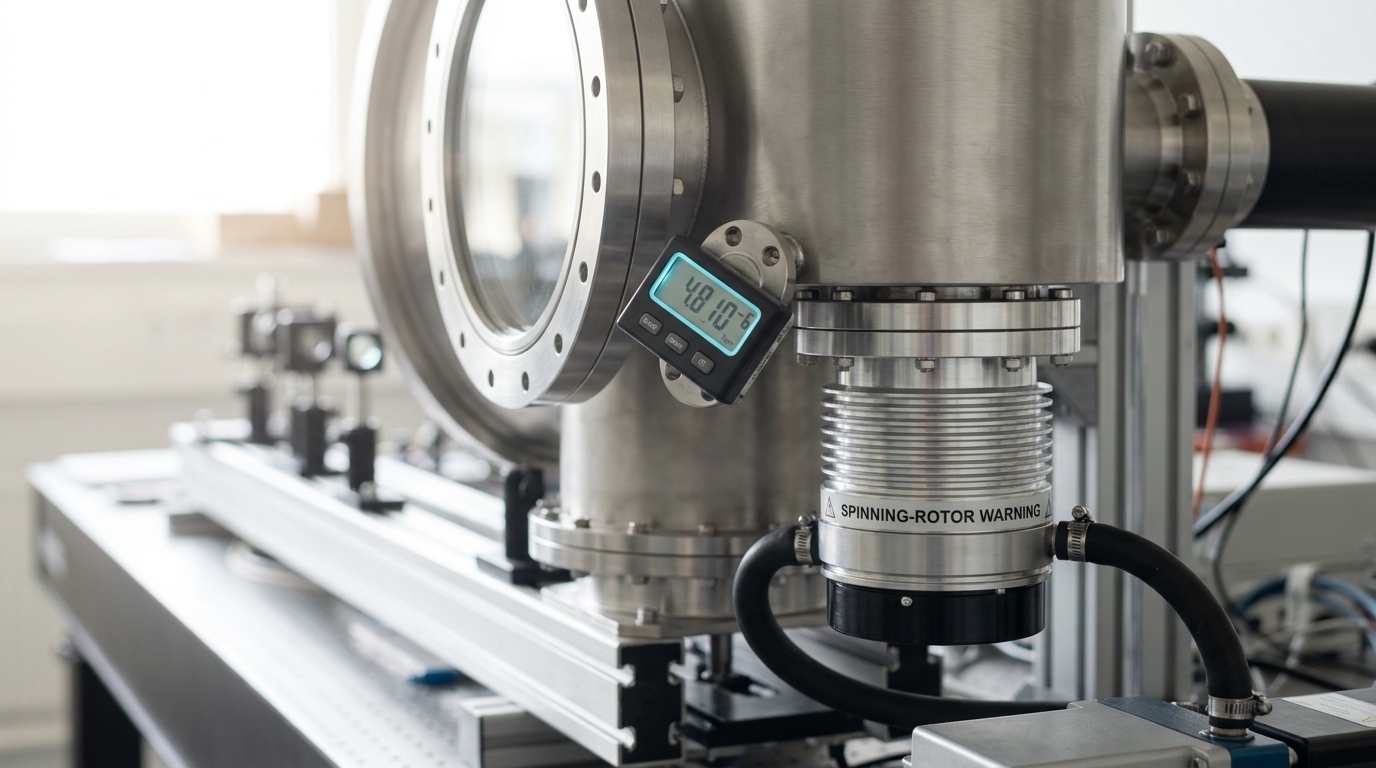
Figure 2. The instruments needed to test a 1970 argument about environments took decades to reach the vacuum and detection standards the argument itself demanded. — Image prompt and art direction by Brecht Corbeel; generation pending.
One further historical wrinkle is worth stating plainly because it is easy to get backward: the word “decoherence” itself is younger than the physics it names. Zeh recounts that the term only came into use in talks by Murray Gell-Mann and James Hartle at the end of the 1980s, almost twenty years after his own 1970 paper had already derived the phenomenon those talks would go on to name [2]. The mechanism, the mathematics, and the recognition of its importance did not arrive together. They arrived roughly fifteen years apart, in that order.
The Environment Behaves as a Continuous Monitor, and Only Pointer States Survive It
Strip the history away and the mechanism is this: an environment — air, ambient light, the cosmic microwave background, phonons in a solid — continuously scatters off any system it is coupled to, and each scattering event carries away a small amount of information about that system’s state with respect to one particular observable, typically position. States that are eigenstates, or near-eigenstates, of that monitored observable are left almost undisturbed by the scattering; a photon that reflects off an object localized at x still tells you, afterward, that the object was at x, and nothing about the interaction has to change for that to remain true on the next scattering event. A superposition of two well-separated positions, by contrast, is not an eigenstate of position, and the environment cannot scatter off it without the scattered photon or molecule becoming entangled with which branch of the superposition it scattered from. Trace out the environment — which is the only thing an observer confined to the system can ever do — and the interference term between the two branches is gone, not suppressed slightly but multiplied by a factor that falls toward zero after a single scattering event and keeps falling with every event after that.
Joos and Zeh made this quantitative in 1985 by deriving a genuine, non-phenomenological master equation for the reduced density matrix of an object’s centre-of-mass position under repeated recoil-free scattering [7]. For the off-diagonal elements of that density matrix — the very quantity whose survival or destruction is the entire question of macroscopic superposition — their result, in the short-time, many-collisions regime, takes the form of a simple exponential decay in the separation between the two positions being superposed:
\rho(x, x', t) = \rho(x, x', 0)\, \exp\!\left[-\Lambda (x - x')^2 t\right]
Here \Lambda is what Joos and Zeh call the localization rate: a single number, with units of inverse length squared per unit time, built from the scattering cross-section of the object, the flux and momentum of whatever is doing the scattering, and nothing else [7]. Everything about how fast a given superposition dies is contained in \Lambda, and \Lambda is a number you can actually compute for a real object in a real environment — which is exactly what Joos and Zeh went on to do, in the paper’s Table 2, for three sizes of hypothetical “dust particle”: a large grain of radius 10^{-3} centimetres, a small grain of 10^{-5} centimetres, and a body of 10^{-6} centimetres that the paper itself labels a “large molecule” [7]:
- Environment — Λ, a = 10⁻³ cm (cm⁻² s⁻¹) — Λ, a = 10⁻⁵ cm (cm⁻² s⁻¹) — Λ, a = 10⁻⁶ cm, “large molecule” (cm⁻² s⁻¹)
- Cosmic background radiation — 10⁶ — 10⁻⁶ — 10⁻¹²
- Ambient 300 K thermal radiation — 10¹⁹ — 10¹² — 10⁶
- Sunlight at Earth’s surface — 10²¹ — 10¹⁷ — 10¹³
- Air at standard pressure — 10³⁶ — 10³² — 10³⁰
- Laboratory vacuum (10⁶ particles/cm³) — 10²³ — 10¹⁹ — 10¹⁷
Reading a decoherence time off this table only requires the exponent above: a superposition separated by \Delta x decays with a characteristic time t \sim 1/(\Lambda\, \Delta x^2). Take the largest grain delocalized over roughly its own diameter, \Delta x \approx 10^{-3} centimetres, and the numbers in the first column turn into times measured in seconds only in the single, almost pathologically clean case of the cosmic background radiation acting alone — about one second. Every other row is not a slower version of the same story; it is a different order of magnitude of story entirely. Ordinary air brings that same superposition down to roughly 10^{-30} seconds, and a superposition delocalized over a full centimetre — genuinely macroscopically distinct positions — decoheres in air in roughly 10^{-36} seconds, a span of time with no operational meaning at all next to any timescale on which a physicist, or a chair, does anything. Even Joos and Zeh’s own “large molecule” column, sized for something in the mass range of a C60 cage rather than a visible speck of dust, still shows scattering off ordinary air overwhelming scattering off the cosmic background by thirty orders of magnitude — which is exactly why the 1999 and 2019 interferometry results opening this article had to be run in high vacuum, on a molecular beam, and nowhere near open air [7] [9] [10]. Joos and Zeh’s own language for this asymmetry is understated: an equilibrated environment such as thermal radiation “is able to destroy (or dislocalize) interference terms,” and the mechanism at work is “the sensitivity of macroscopic systems upon their environment” [7]. The arithmetic is what makes that sentence load-bearing rather than merely qualitative.
The same paper also tracks what happens to the coherence length itself, not just the decay rate: solving the full master equation for a free particle gives a coherence width l(t) = (8\Lambda t)^{-1/2}, meaning it shrinks as the inverse square root of time for as long as scattering dominates, and does so from whatever width the particle’s wave packet started with [7]. Joos and Zeh flag the counterintuitive consequence themselves: the everyday expectation that a free wave packet spreads out over time is not what this equation describes at all. “The much-discussed dispersion hardly ever shows up even for small dust particles or large molecules,” they write; instead “the coherence length decreases towards the thermal de Broglie wave length of the object, whereas the incoherent spread increases” [7]. Scattering does not let a macroscopic object’s superposition grow lazily wider with time, the way an isolated wave packet’s would; it clamps the coherent part down to a wavelength set by the temperature of whatever is doing the scattering, almost as fast as the two effects can compete.

Figure 3. A skimmer keeps only the narrow, well-collimated core of a molecular beam and discards the rest — the nearest physical picture of what einselection does to a superposition. — Image prompt and art direction by Brecht Corbeel; generation pending.
It is worth being precise about what this calculation assumes, because the paper is precise about it and an honest article should be too: Joos and Zeh’s table treats the scattering as recoil-free, idealizes the object as infinitely more massive than each individual scatterer, and calls the entries themselves “rough estimates for the localization rate” rather than exact values [7]. None of those idealizations change the qualitative conclusion — every subsequent, more careful treatment of the same physics has kept the same enormous separation of scales — but the numbers in the table are order-of-magnitude tools, not measured constants, and this article treats them as such.
This is the sense in which “selection” is the correct word for what is happening, and it is worth being exact about where the analogy to biological selection is precise and where it stops. It is precise in this respect: there genuinely is a population of candidate ways the system’s state could be described — every basis in which its density matrix could in principle be diagonalized — and there genuinely is a differential survival criterion acting on that population, namely which basis commutes with the system-environment interaction Hamiltonian [5] [6]. States in that basis are, in Zurek’s later phrase, einselected: “Einselected pointer states are stable. They can retain correlations with the rest of the Universe in spite of the environment” [13]. Everything else loses that competition at the rates in the table above. The analogy breaks, and should be broken deliberately rather than left for a physicist reader to catch, at the point where evolutionary language implies reproduction, heredity, and cumulative change across generations. Nothing in einselection reproduces. A pointer state is not copied with variation and then re-selected next round; it simply is the one description of the system that a single, one-shot monitoring interaction leaves intact, moment by moment, for as long as the coupling persists. It is selection without a population genetics — a filter, not a ratchet. The further, genuinely cumulative step, in which pointer-state information gets imprinted redundantly across many independent fragments of the environment until it becomes objectively available to multiple observers, is what Zurek later named quantum Darwinism, and it is a distinct claim built on top of einselection rather than a restatement of it [13] [16]. It is mentioned here because it is the natural next chapter; developing it is not this article’s job.
The Predicted Decoherence Rate Is Now a Measured Number, Not Just a Model
Everything above this line was, for roughly a quarter century, a calculation rather than an observation. That changed in the 1990s and 2000s, when two experiments, in very different physical systems, watched decoherence happen rather than inferring it from before-and-after snapshots.
The first was cavity quantum electrodynamics, in the Paris laboratory of Serge Haroche. Brune and colleagues prepared a single rubidium atom in a superposition of two circular Rydberg states and sent it through a high-quality microwave cavity holding a coherent field of only a few photons; depending on which of its two internal states the atom occupied, the cavity field either passed through unchanged or acquired a phase shift, so that the atom-plus-field system was left in a superposition of two classically distinguishable field states — a genuine, laboratory-scale Schrödinger-cat state of the electromagnetic field, described in the paper’s own framing as the equivalent of a measuring “meter” pointing simultaneously in two different directions at once [8]. Rather than measuring that superposition once and reporting whether it had or had not decohered, the experiment sent a second, independent atom through the same cavity after a variable delay and used it to read out the coherence that remained, tracing out the progressive loss of the interference term as a direct function of elapsed time [8]. It was the first time anyone had watched a mesoscopic superposition decohere in real time, rather than reconstructing that it must have happened. Haroche shared the 2012 Nobel Prize in Physics with David Wineland specifically “for ground-breaking experimental methods that enable measuring and manipulation of individual quantum systems,” a body of work in which this decoherence measurement is a central result [17].

Figure 4. Fringe visibility measured as a function of background-gas pressure is what turned the decoherence rate from a calculation into a number read off an instrument. — Image prompt and art direction by Brecht Corbeel; generation pending.
The second confirmation came from the same Vienna fullerene interferometer that opened this article, turned into a controlled decoherence experiment rather than a demonstration of coherence. Hornberger and colleagues deliberately admitted background gas into the interferometer’s vacuum chamber at a series of known pressures and measured how the visibility of the C60 interference fringes fell as pressure rose [11]. The matter-wave fringe contrast decayed exponentially with increasing residual gas pressure, and the decay matched the predictions of collisional decoherence theory closely enough to let the group extract, from the fringe data alone, the vacuum quality any future interferometer working with still larger objects would need [11]. This is the strongest kind of confirmation available to a theory like this one: not a qualitative demonstration that interference eventually disappears, which nobody doubted, but a quantitative prediction — visibility as an exponential function of a dial the experimenters could turn themselves — checked against data taken with that exact dial. Between Brune’s real-time observation of decoherence unfolding and Hornberger’s quantitative match between a computed rate and a measured one, decoherence theory earned the status this article has been treating it with throughout: confirmed physics, not merely a persuasive interpretation of physics.
Decoherence Diagonalizes the Ensemble; It Does Not Choose Your Outcome
Here the article has to stop being generous to its own thesis, because the theory it has just spent four sections building genuinely does less than it is sometimes credited with doing, and saying so plainly is the entire point of an honest account. Maximilian Schlosshauer’s own comprehensive review of the field, published the same decade as the Hornberger and Brune measurements, is candid that this is not a settled matter of detail: decoherence and environment-induced superselection have been intensively studied, he writes, yet “their implications for the foundational problems of quantum mechanics, most notably the quantum measurement problem, have remained a matter of great controversy” even among physicists who accept every technical result in the preceding sections without reservation [12].
What decoherence demonstrably explains is why a macroscopic superposition of pointer-basis states is never observed to persist: the off-diagonal terms of the reduced density matrix collapse toward zero, at the rates computed above, so fast that no measurement performed on the system alone could ever catch the interference in progress. That is a real and, as of the 1996 and 2003 experiments, a measured result. What it does not explain is why, on any given run of an experiment, one particular pointer-state outcome is realized rather than another. A density matrix that has been diagonalized by decoherence looks, to any observer with access only to the system, exactly like a classical statistical mixture — a genuine uncertainty over which outcome is “really” the case, weighted by the diagonal probabilities. But it is not a classical statistical mixture in the underlying formalism; it is still, in the theory’s own bookkeeping, one enormous entangled pure state of system-plus-environment, and nothing in the unitary Schrödinger evolution that produced it singles out a single branch as the one that happened. This is sometimes called the “and-then-what” problem, and it is a different and harder problem than the one decoherence solves.
The Stanford Encyclopedia of Philosophy’s entry on the subject states the boundary without hedging: “decoherence does not explain why we do observe measurement results in the first place,” and more pointedly, that taken as a complete, self-contained account, “decoherence as such does not provide a solution to the measurement problem… unless it is combined with an appropriate foundational approach” [15]. Stephen Adler made the same point in a direct, published reply to a claim by Philip Anderson that decoherence had already closed the case: decoherence, in Adler’s account, explains the practical unobservability of interference but does not by itself derive why any one outcome, and not a superposition of all of them, is what an observer ends up recording [14]. Neither Adler nor the Stanford entry is a fringe position; this is the position of people who work on decoherence theory for a living, stated about their own field’s limits.

Figure 5. The accumulating pattern is a statement about the ensemble; nothing on this screen says where the next single molecule will land. — Image prompt and art direction by Brecht Corbeel; generation pending.
What decoherence does instead — and this is not a consolation prize, it is a genuinely useful division of labour — is hand each interpretation of quantum mechanics a smaller, better-defined problem than the one it started with, and each interpretation spends that inheritance differently. The many-worlds or Everettian program uses decoherence to do real definitional work: the “worlds” of the interpretation are identified with the stable, mutually non-interfering branches that decoherence itself produces, and since roughly the 1990s decoherence has become, in the Stanford Encyclopedia’s phrase, “a defining notion” of that program precisely because it lets Everettians pick out worlds without separately postulating which states are preferred [15]. Bohmian mechanics, which already has a definite particle trajectory at every moment by construction, uses decoherence for a narrower purpose: explaining why that trajectory becomes effectively trapped inside one localized wave-packet branch and stops being influenced by the others, recovering classical-looking motion without needing decoherence to select an outcome at all, because Bohmian theory never had that problem in the first place [15]. Spontaneous-collapse theories such as GRW keep decoherence and physical collapse as two separate mechanisms in competition, and since decoherence is generally the faster of the two, a GRW collapse typically arrives to find branches decoherence has already separated, rather than doing independent work of its own [15]. Copenhagen-style accounts, finally, use decoherence to explain a narrower technical puzzle inside von Neumann’s measurement chain — why the “cut” between quantum system and classical apparatus can be moved freely along the chain without changing any prediction, since decoherence guarantees the absence of interference at every intermediate stage — while leaving Bohr’s own insistence that classical concepts are conceptually prior to, rather than derived from, quantum mechanics in open tension with a theory that tries to derive classicality from inside the quantum formalism [15].
None of these is “the answer decoherence gives.” Decoherence gives the same diagonalized density matrix to all four programs and lets each one argue, on separate grounds that decoherence itself does not adjudicate, about what that diagonalization means. That disagreement is not a sign that decoherence theory is unfinished business; the theory’s own quantitative content — the einselection criterion, the localization rates, the exponential fringe decay — is settled and repeatedly confirmed. The disagreement is evidence that decoherence answered a real question completely and left a different, older question, about the nature of outcomes and probability in a fundamentally unitary theory, exactly where it found it.
Classicality Is the Census of a Selection That Never Stops Running
Put the pieces back together and the picture is this. Superposition is not a special, fragile state that quantum systems occasionally achieve under laboratory conditions; a 25-kilodalton molecule sails through two metres of interferometer in one, and would not stop being a superposition of paths if nobody had gone to the trouble of isolating it [10]. What ends the superposition, for that molecule as for a dust grain as for a chair, is a continuous, physically real monitoring process, and the mathematics of that process — a specific interaction Hamiltonian picking out a specific pointer basis, a specific localization rate computed from real scattering cross-sections, a specific exponential in a specific separation squared — was worked out, defended in professional obscurity, reframed, and eventually measured, in exactly the historical order this article has followed [1] [5] [6] [7] [8] [11].
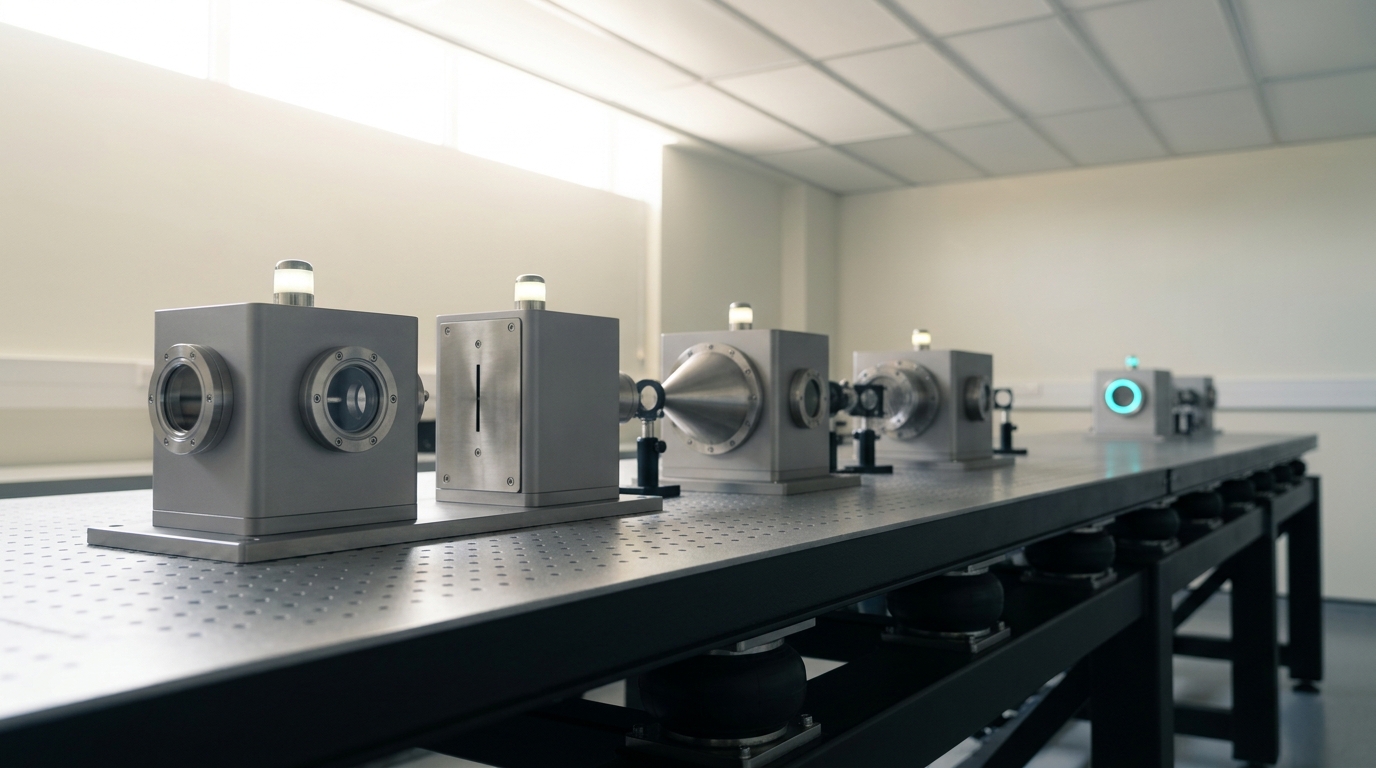
Figure 6. Every molecule that reaches the far detector has survived a lateral run of collimation, isolation, and diffraction — the classical count is a census, not a decision. — Image prompt and art direction by Brecht Corbeel; generation pending.
“Selection” earns its place in that sentence for a specific, limited reason: at every instant, a real physical interaction is filtering a real space of possible descriptions down to the one description — the pointer basis — that survives contact with everything else in the universe without losing its coherence. What we call the classical, solid world is not the whole of what quantum mechanics allows; it is the surviving census of states that happened to be robust under a filter running, in the table above, at rates as extreme as 10^{36} per square centimetre per second for an ordinary object sitting in ordinary air. Nothing macroscopic escapes that filter for longer than a fraction of the briefest time anyone has ever measured. But a census is not a verdict on any single ballot. Recent commentary on the state of the field puts the honest residue of the problem plainly: even Zurek’s own further development of these ideas “doesn’t fully answer why specific outcomes occur rather than others, at what point quantum commitment becomes irreversible, or how to rigorously test these predictions,” and serious skeptics still ask what the undecohered “quantum substrate” was actually like before the filtering began [16]. Decoherence explains, with a precision now checked against real instruments, why the world looks solid. It does not yet explain, and does not claim to explain, why any one solid outcome is the one you get. The election runs everywhere, always, at rates nothing escapes — but nobody has yet shown the physics that calls the specific winner of any single race.
Sources
- H. Dieter Zeh. On the Interpretation of Measurement in Quantum Theory. Foundations of Physics (1970). DOI: 10.1007/BF00708656.
- H. Dieter Zeh. Roots and Fruits of Decoherence. Séminaire Poincaré (arXiv:quant-ph/0512078) (2005).
- Kristian Camilleri. A History of Entanglement: Decoherence and the Interpretation Problem. Studies in History and Philosophy of Modern Physics (2009). DOI: 10.1016/j.shpsb.2009.09.003.
- Olival Freire Jr.. Quantum Dissidents: Research on the Foundations of Quantum Theory circa 1970. Studies in History and Philosophy of Modern Physics (2009).
- Wojciech H. Zurek. Pointer Basis of Quantum Apparatus: Into What Mixture Does the Wave Packet Collapse?. Physical Review D (1981). DOI: 10.1103/PhysRevD.24.1516.
- Wojciech H. Zurek. Environment-Induced Superselection Rules. Physical Review D (1982). DOI: 10.1103/PhysRevD.26.1862.
- E. Joos and H. D. Zeh. The Emergence of Classical Properties Through Interaction with the Environment. Zeitschrift für Physik B — Condensed Matter (1985). DOI: 10.1007/BF01725541.
- M. Brune, E. Hagley, J. Dreyer, X. Maître, A. Maali, C. Wunderlich, J. M. Raimond, and S. Haroche. Observing the Progressive Decoherence of the 'Meter' in a Quantum Measurement. Physical Review Letters (1996). DOI: 10.1103/PhysRevLett.77.4887.
- Physics World staff. Wave-Particle Duality Seen in Carbon-60 Molecules. Physics World (1999).
- Yaakov Y. Fein, Philipp Geyer, Patrick Zwick, Filip Kiałka, Sebastian Pedalino, Marcel Mayor, Stefan Gerlich, and Markus Arndt. Quantum Superposition of Molecules Beyond 25 kDa. University of Vienna U:cris research portal (Nature Physics) (2019). DOI: 10.1038/s41567-019-0663-9.
- K. Hornberger, S. Uttenthaler, B. Brezger, L. Hackermüller, M. Arndt, and A. Zeilinger. Collisional Decoherence Observed in Matter Wave Interferometry. University of Vienna Quantum Nanophysics Group (Physical Review Letters) (2003). DOI: 10.1103/PhysRevLett.90.160401.
- Maximilian Schlosshauer. Decoherence, the Measurement Problem, and Interpretations of Quantum Mechanics. Reviews of Modern Physics (2004). DOI: 10.1103/RevModPhys.76.1267.
- Wojciech H. Zurek. Decoherence, Einselection, and the Quantum Origins of the Classical. Reviews of Modern Physics (2003). DOI: 10.1103/RevModPhys.75.715.
- Stephen L. Adler. Why Decoherence Has Not Solved the Measurement Problem: A Response to P. W. Anderson. Studies in History and Philosophy of Modern Physics (2003).
- Guido Bacciagaluppi. The Role of Decoherence in Quantum Mechanics. Stanford Encyclopedia of Philosophy (2025).
- Philip Ball. Are the Mysteries of Quantum Mechanics Beginning to Dissolve?. Quanta Magazine (2026).
- The Royal Swedish Academy of Sciences. The Nobel Prize in Physics 2012 — Press Release. NobelPrize.org (2012).
Originally published at https://absolutedigitalpublishers.com/articles/decoherence-the-quiet-selection-that-makes-the-world-look-solid.