Cosmological Natural Selection: A Theory That Named Its Own Killer
Lee Smolin gave cosmology real Darwinian structure and then volunteered the exact neutron-star mass that would refute it. Pulsar timing has spent fifteen years closing in on that number.

The entire empirical case against a cosmological theory comes down to what a dish drive train and its encoders can resolve about the mass of a neutron star. — Image prompt and art direction by Brecht Corbeel; generation pending.
Abstract
In 1992 Lee Smolin proposed that black holes are reproductive events for universes: each bounce spawns a new expanding region with slightly mutated physical constants, and an ensemble built this way concentrates around parameters that maximize black hole production. Unlike anthropic fine-tuning arguments, cosmological natural selection named a specific, checkable consequence — a low upper mass limit for neutron stars — and said plainly what observation would kill it. This article follows that prediction from Smolin's 1992 paper through the kaon-condensate argument that grounded it, the run of pulsar-mass measurements since 2010 that have pushed hard against it, Smolin's own hedges and revisions, the rival falsification attempts from nuclear physicists and gravitational theorists, and the methodological contrast with anthropic reasoning that the whole episode was built to sharpen.
A bounce cosmology gives universes heredity, variation, and differential reproduction
In 1992, Lee Smolin published a short paper in Classical and Quantum Gravity asking whether the universe evolved [1]. The question was not rhetorical. Smolin proposed a specific mechanism, built from a specific piece of physics that was already under discussion in quantum gravity circles: the idea that the singularity inside a black hole does not end in nothing, but bounces, producing a new, causally disconnected expanding region on the other side. If that is right, every black hole in every universe is the seed of a new universe. Each bounce is a birth event, and Smolin proposed that the daughter’s dimensionless physical constants — particle masses, coupling strengths, the cosmological constant — differ from the parent’s by a small random change, the way a copied genome differs from its template. He developed the picture at length five years later in The Life of the Cosmos [2], which remains the fullest statement of the argument and the source most readers meet it through.
Run that mechanism forward across many generations and something falls out of it that has nothing to do with metaphor. Define a fitness function on the space of possible physical parameters, equal to the average number of black holes a universe with those parameters goes on to produce in its lifetime. Each bounce is a reproduction event with heritable variation. After enough generations from enough random starting points, standard results from population dynamics say the ensemble of universes will not be spread evenly across parameter space; it will pile up around the local peaks of that fitness function, the way a population under selection piles up around a fitness optimum rather than staying uniformly distributed. Smolin is explicit that this is not an analogy borrowed for color: cosmological natural selection has heredity (parameters pass from parent universe to offspring universe), variation (each transmission includes a small random change), and differential reproduction (universes whose parameters yield more black holes produce more offspring universes) — the three ingredients Darwin needed and no others. If the mechanism is real, our universe’s constants should look tuned for something, and that something should be black hole production rather than life, with life along for the ride only insofar as the conditions for copious massive-star formation happen to overlap with the conditions for carbon chemistry.
That overlap is the whole reason Smolin built the theory. Fine-tuning arguments — why is the cosmological constant so small, why does the strong force sit in the narrow window that lets carbon and oxygen exist — are usually answered, if answered at all, by anthropic reasoning: we observe these values because we could not exist to observe any others. Smolin regarded that move as an explanation that explains nothing, because it never says what a wrong observation would even look like. His stated goal, laid out most fully in a 2004 paper reviewing the whole debate, was to find a multiverse mechanism that could account for the same fine-tuning without leaning on the fact of our own existence at any point in the argument [3]. The neutron-star argument he built to make that case, discussed below, works, in his words, independently of any issue of selection effects associated with anthropic reasoning — the strange quark mass can be dialed up and down across a wide range without significant consequences for chemistry or for whether observers could exist, so a test built on it carries no anthropic contamination at all. That is the specific, checkable thing cosmological natural selection was supposed to be that the anthropic principle structurally cannot be.
It is worth being honest about where the Darwinian mapping is exact and where it quietly stops being biology. Heredity-with-mutation and differential reproduction are not loose talk here; they are the literal content of the bounce hypothesis plus the assumption of small parameter drift, and the population-genetics mathematics that predicts hill-climbing toward a fitness peak applies to this system in the same form it applies to a real population under selection. What does not carry over is almost everything else that makes biological evolution the process it is. There is no shared environment in which universes compete for a finite resource; a universe’s black holes do not out-compete another universe’s black holes for anything, because they never interact, share a history, or draw from a common pool. There is no death in the sense that matters to natural selection — a low-fitness universe does not get out-reproduced by a neighbor within any observable arena, it simply exists somewhere in an ensemble we cannot survey. And there is exactly one universe we can ever measure, so the “population” the theory is a statement about is entirely unobservable except through the single, possibly atypical, sample of parameters we happen to sit inside. Smolin’s mechanism is real Darwinian structure operating on a formal fitness landscape; it is not evolution by natural selection operating on a population in any sense a biologist would recognize as ecological. The theory’s discipline comes from taking the first half seriously enough to extract a number, not from pretending the second half is also true.

Figure 1. Cosmological natural selection is tested by an instrument no more exotic than this: a horn that has to be pointed at exactly the right patch of sky for years. — Image prompt and art direction by Brecht Corbeel; generation pending.
The theory volunteered the exact number that would kill it
A fitness function is only useful if you can say what raises it. Smolin worked through the astrophysics of massive-star formation and supernova remnants and arrived at five conditions that maximize black hole yield: light nuclei stable enough for long-lived stars to form at all; carbon and oxygen stable enough to cool giant molecular clouds efficiently, since CO’s vibrational modes are the dominant coolant that lets clouds collapse into stars massive enough to leave black holes rather than white dwarfs; a regime of self-propagated star formation, in which one generation of massive stars catalyzes the next; supernovae energetic enough to disperse the elements that make that catalysis work, but not so energetic that they blow apart every remnant above the neutron-star mass ceiling; and, last, nuclear parameters tuned so that ceiling itself — the maximum mass a stable neutron star can carry before it must collapse to a black hole — sits as low as possible [3]. The first four conditions explain the values of parameters we could not observe values for anyway, since a universe without them would have no observers in it to compare notes with. The fifth does not have that problem. The maximum mass of a neutron star is a number nature has already fixed, and a device can measure it without asking whether anyone lives in the universe being measured.
The physics behind that fifth condition comes from a specific and, at the time, actively disputed proposal by Gerald Brown and Hans Bethe: that above a critical value of the strange quark mass, the cores of neutron stars host a condensate of negatively charged kaons, which softens the equation of state at high density and caps the maximum stable mass at roughly one and a half solar masses. Below that critical value, neutron-star cores keep the conventional, stiffer equation of state, and the ceiling sits much higher, almost certainly above two solar masses. Smolin’s argument was that cosmological natural selection predicts we should live on the soft, kaon-condensed branch, because a lower neutron-star ceiling converts more of the supernova remnants that would otherwise cool into neutron stars into extra black holes instead. In the summary of properties that make his theory falsifiable, he states the resulting prediction plainly: the upper mass limit of neutron stars is less than 1.6 solar masses [3]. In the paper’s more careful technical discussion of the same argument, the number moves: he treats the Brown-Bethe estimate of roughly 1.5 solar masses as the value implied if the kaon-condensate hypothesis holds, calls a measured mass above that “troubling” for anyone fully confident in the nuclear-physics input, and sets the threshold for a clean, unambiguous refutation at a neutron star “certainly” above 2.5 solar masses. Three numbers — 1.5, 1.6, and 2.5 — appear in the same nine-page argument, and that is not sloppiness so much as an honest accounting of where the theory’s actual risk was concentrated: in an uncertain nuclear-physics assumption about a particle no one had ever put a neutron star’s core through, rather than in the Darwinian mechanism itself.
Two years later, reviewing the theory’s status before any of the decisive measurements existed, Smolin restated the operative number as an upper mass limit of approximately 1.6 solar masses, noted that every well-measured neutron star known at the time weighed between 1.3 and 1.45 solar masses, and flagged one imprecisely measured binary whose error bars reached above the prediction at just under one standard deviation [4]. The prediction, in other words, was doing exactly what a falsifiable prediction is supposed to do: standing exposed, close to the data, waiting on better instruments. An independent nuclear-physics collaboration reached the same conclusion from the opposite direction. In 2008, Brown, Chang-Hwan Lee, and Mannque Rho reviewed the whole chain — a nearly vanishing vector-meson mass at chiral restoration, kaon condensation at a few times nuclear saturation density, the Brown-Bethe maximum mass near 1.5 solar masses, and Smolin’s cosmology riding on top of it — and stated their own falsification condition without reference to Smolin’s stakes in the matter at all: a well-measured double neutron-star binary with components differing by more than four percent in mass, or a single neutron star above two solar masses, would put the entire chain in serious doubt [5]. That two-solar-mass line, arrived at independently by physicists whose interest was the nuclear equation of state rather than cosmology, is the bright line the coming decade of pulsar timing would have to clear or not.

Figure 2. The gap between a falsified prediction and a surviving one is a few hundredths of a solar mass, which only a timing base this stable can resolve. — Image prompt and art direction by Brecht Corbeel; generation pending.
Every neutron star weighed since 2010 sits above the number
The way you weigh a neutron star from a radio telescope, with no direct access to the star at all, is to time its pulses with enough precision to catch general relativity bending them. In a binary system seen close to edge-on, radio pulses from the neutron star are delayed by a few extra microseconds each orbit as they pass close to the companion star, because the companion’s gravity curves the spacetime the pulse crosses. The delay as a function of orbital phase \phi is standardly written
\Delta_S(\phi) = -2r\,\ln\!\left[1 - s\sin\phi\right]
where the “range” parameter r is set directly by the companion’s mass and the “shape” parameter s by the orbit’s inclination. Because r and s are measured independently of the pulsar’s own mass, and Kepler’s laws already fix the total system mass from the orbital period and velocity, a sufficiently edge-on, sufficiently precisely timed binary hands over both masses at once — no assumptions about the neutron star’s interior required. The catch is precision: resolving a mass difference of a few hundredths of a solar mass means resolving a timing residual measured in tens of nanoseconds across years of observation, which is why the equipment built for this work is built around atomic-clock frequency standards and years of accumulated data rather than any single observation.
That equipment delivered a run of results that moved steadily and, for the theory, unhelpfully upward. In 2010, Paul Demorest and colleagues used exactly this method on the millisecond pulsar J1614-2230, catching an unusually favorable, nearly edge-on orbit with a white dwarf companion, and measured the pulsar’s mass at 1.97 ± 0.04 solar masses against a companion mass of about 0.50 solar masses [10]. That single measurement, the paper noted, effectively ruled out the presence of hyperons, bosons, or free quarks softening the equation of state at densities near nuclear saturation — the broader family of exotic-matter hypotheses that the kaon-condensate argument belongs to. Three years later, John Antoniadis and a large collaboration measured a second, independent system, the pulsar J0348+0432, combining radio timing of the pulsar with optical spectroscopy of its white-dwarf companion in a tight 2.46-hour orbit, and found a mass of 2.01 ± 0.04 solar masses, with the system’s measured orbital decay matching general relativity’s prediction to good precision [11]. In 2019, Thankful Cromartie and the NANOGrav collaboration combined a 12.5-year pulsar-timing dataset with dedicated Green Bank Telescope observations to catch the Shapiro delay of PSR J0740+6620, then the most massive well-measured neutron star known, at 2.14 (+0.10/−0.09) solar masses [12]. Two years after that, Emmanuel Fonseca and a larger collaboration folded in further Green Bank and CHIME data and refined that same pulsar’s mass downward slightly, to 2.08 (+0.07/−0.07) solar masses at 68.3 percent credibility [13] — a genuine refinement, not a retraction, and the kind of successive tightening the table below traces.
- Object — Mass (solar masses) — Method — Year
- PSR J1614-2230 — 1.97 ± 0.04 — Shapiro delay, radio timing — 2010 [10]
- PSR J0348+0432 — 2.01 ± 0.04 — Radio timing + white-dwarf spectroscopy — 2013 [11]
- PSR J0740+6620 (initial) — 2.14 (+0.10/−0.09) — Shapiro delay, radio timing — 2019 [12]
- PSR J0740+6620 (refined) — 2.08 (+0.07/−0.07) — Shapiro delay, expanded dataset — 2021 [13]
- PSR J0952-0607 — 2.35 ± 0.17 — Optical spectroscopy of irradiated companion — 2022 [15]
- GW190814 secondary — 2.50–2.67 (90% credible) — Gravitational-wave inspiral — 2020 [14]
Every clean neutron-star mass in that table sits above Smolin’s original 1.6-solar-mass prediction, and even the lower edge of Fonseca’s 68 percent credible interval for J0740+6620 — 2.01 solar masses — sits above the 2.0-solar-mass ceiling Smolin had by then adopted. In a March 2014 Physics Today piece, written after Demorest’s and Antoniadis’s results were both already published, Smolin restated cosmological natural selection’s neutron-star claim as “the upper mass limit of neutron stars is at most two solar masses,” describing it as “a prediction that has so far been confirmed in all accurate determinations of neutron-star masses” [16]. That claim was already resting on a 2.01 ± 0.04 solar-mass measurement whose central value technically exceeded the stated ceiling, and it would come under considerably more strain from Fonseca’s 2021 refinement and from Roger Romani’s 2022 measurement of the black-widow pulsar PSR J0952-0607 at 2.35 ± 0.17 solar masses via optical spectroscopy of its irradiated companion [15] — a result whose one-sigma floor, 2.18 solar masses, has no comfortable reading under any version of the prediction stated so far.
The genuinely ambiguous case sits outside that clean run of pulsar timing altogether. In 2020, the LIGO and Virgo collaborations reported GW190814, a gravitational-wave signal from the merger of a roughly 23-solar-mass black hole with a companion of 2.50 to 2.67 solar masses at 90 percent credibility — a mass that sits squarely inside what astronomers call the lower mass gap, above every confidently identified neutron star and below every confidently identified black hole [14]. The discovery paper does not resolve the object’s nature: no tidal deformation signature and no electromagnetic counterpart broke the tie, and the paper frames the question exactly as it stands — the lightest black hole or the heaviest neutron star ever found in a compact-object binary. That ambiguity cuts in a genuinely two-sided way for the argument at hand. If the secondary is a neutron star, it obliterates any surviving version of the mass-limit prediction outright, by a wide margin. If it is a low-mass black hole — the reading favored by most subsequent equation-of-state work, since supporting 2.6 solar masses of neutron matter against collapse is difficult under nearly every nuclear model on the market — it says nothing about the prediction at all, because black holes are exactly the outcome cosmological natural selection wants more of. GW190814 is real evidence of pressure on the boundary the theory cares about, and it is simultaneously not a clean test of it, and both halves of that sentence need to stay in the record.
As far as the public record shows, Smolin has never conceded in print that these results falsify cosmological natural selection. His consistent position since 2004 has been that only the specific kaon-condensate mechanism is exposed by a heavy neutron star, not the underlying Darwinian architecture — a decreased neutron-star ceiling was always just one of several routes he listed to increasing black hole yield, and a different low-energy mechanism could in principle produce the same qualitative prediction if the kaon-condensate story turns out to be wrong. Accounts of his 2013 book Time Reborn describe him initially treating the 2010 measurement as a live threat to the theory before settling on the reading that the prediction always tolerated masses up to two solar masses and not beyond — a reading his own 2004 paper supports, since 2.0 solar masses is close to where he placed the conventional, non-condensed branch of the equation of state. Critics, including the reading implicit in Brown, Lee, and Rho’s own two-solar-mass falsification line, treat the same revision as the goalposts having moved: a theory whose headline number went from 1.6 to 2.0 solar masses only after the data came in has, on this reading, already spent its most falsifiable version. Both readings are defensible from the primary sources, and nothing in the record settles which one a neutral referee should prefer — which is itself a useful data point about how a falsifiable theory actually behaves when its prediction starts to fail: not with a clean death, but with a genuine, unresolved argument about how much interpretive latitude its own founding papers already built in.

Figure 3. Each refinement of a pulsar's mass, from 2.14 to 2.08 solar masses, is a hardware and analysis upgrade like this one, not a change of mind. — Image prompt and art direction by Brecht Corbeel; generation pending.
A theory that risks something beats one that risks nothing
Smolin’s 2004 paper is, at bottom, a piece of philosophy of science wearing an astrophysics paper’s clothes, and its argument is worth stating in his own terms because the neutron-star case is only an illustration of it. His central claim is that no theory earns a place as a candidate physical theory unless it makes falsifiable predictions, and that “to violate this maxim is to risk the development of a situation in which the scientific community splits into groups divided by different unverifiable faiths, because there is no possibility of killing popular theories by rational argument from shared evidence” [3]. His target was the anthropic multiverse: the family of arguments that explains our universe’s apparently fine-tuned constants by positing an ensemble of universes with varying constants and noting that only the fine-tuned ones could contain anyone to notice. Smolin’s objection is not that such ensembles are impossible; it is that the “principle of mediocrity” underlying most anthropic reasoning — we should expect to be a typical observer in whatever reference class the argument specifies — is dangerously ambiguous, because a reasonable change to the definition of that reference class can turn a correct-looking conclusion into an incorrect one, and there is no independent fact of the matter about which reference class is the right one to use. An argument that can always be rescued by re-specifying its own ensemble is not, on this view, taking any real risk.
The strongest counterexample the anthropic camp has is Steven Weinberg’s 1987 argument bounding the cosmological constant [9]. Weinberg’s actual paper is more careful than its later reputation suggests. He derives an upper bound on the vacuum energy density from the simple requirement that galaxies and the heavy elements inside them be able to form at all — a bound independent of any specific multiverse-generating mechanism — and then argues that if the underlying distribution of possible vacuum energies is smooth and featureless, we should expect to find ourselves within a couple of orders of magnitude of that upper bound. His own conclusion is explicitly conditional: if galaxy-count data of the kind then available held up, he wrote, “we will be able to conclude that the cosmological constant is so small that even the anthropic principle could not explain its smallness” — a sentence that reads as a test the argument could have failed, not a triumphant prediction of a discovery to come. It happened, in the event, that the 1998 discovery of the universe’s accelerating expansion turned up a nonzero cosmological constant sitting inside the anthropically plausible range Weinberg had described, and physicists have cited the coincidence ever since as the clearest example the anthropic program has of a number correctly anticipated before it was measured. That reputation is a real, defensible reading of how the numbers landed; it is not quite the same claim as the one the 1987 paper itself commits to, and the distinction matters for weighing how much genuine predictive risk anthropic reasoning has actually taken on this one celebrated occasion.
Smolin made the contrast explicit against Leonard Susskind directly, in a 2004 exchange hosted by Edge.org that both physicists treated as a serious methodological dispute rather than a public-relations exercise [8]. Smolin’s position there was that cosmological natural selection risks something concrete — a single sufficiently massive pulsar — in a way the anthropic landscape structurally cannot, because no possible astronomical observation can refute the bare claim that we live in a universe compatible with our own existence. Susskind’s response raised three separate technical objections rather than disputing the falsifiability point in the abstract: that eternal inflation, not black-hole bouncing, should dominate universe reproduction if both mechanisms operate, and inflation’s logic would favor the largest possible cosmological constant rather than the smallest; that recent results on black-hole information conservation implied an offspring universe’s quantum state could carry no memory of its parent’s parameters at all, which would break the heredity Smolin’s mechanism depends on entirely; and that even the basic act of counting black holes to compute a fitness value is ambiguous once mergers, evaporation, and the equivalence of black holes with highly excited string states are taken seriously [7]. These are not restatements of the anthropic principle; they are attempts, on Susskind’s own turf, to find a concrete technical reason the mechanism cannot work, which is precisely the kind of engagement Smolin’s framework was designed to invite.
A second, independent falsification attempt came from a direction that has nothing to do with neutron stars at all. In 2006, Alexander Vilenkin pointed out that semiclassical quantum gravity predicts a nonzero rate of black hole nucleation directly out of empty de Sitter space, driven by the Gibbons-Hawking temperature associated with a positive cosmological constant, and that this nucleation rate rises, not falls, as the cosmological constant increases [6]. If black hole production genuinely climbs with a larger constant, then our observed, extremely small cosmological constant is exactly the wrong value for a theory claiming every constant is tuned to maximize black hole yield — a direct, calculation-based attack on the theory’s core claim rather than on any of its subsidiary nuclear-physics assumptions. Smolin’s response, as characterized in subsequent discussion of the exchange, was that Vilenkin’s argument depends on trusting semiclassical gravity’s infrared and ultraviolet behavior in a regime — the birth of a black hole out of vacuum fluctuations — where that trust is itself far from secure. Neither side’s position is settled science; what matters for the point being made here is that three physicists with three different specialties — nuclear equation-of-state theory, string-landscape cosmology, and semiclassical quantum gravity — each found a concrete, checkable reason to try to kill cosmological natural selection, and each attempt is itself real, arguable physics rather than a restatement of taste. That is what a theory buys when it commits to a specific mechanism instead of a selection effect: not safety, but targets.

Figure 4. Independent attacks on the same claim, from nuclear physics to semiclassical gravity to string theory, are meant to converge on one verdict the way these two channels are converging here. — Image prompt and art direction by Brecht Corbeel; generation pending.
The same falsifiability opened two more doors, and both are still ajar
The neutron-star argument was never the theory’s only exposed nerve. Smolin derived two further falsifiable consequences from the same fitness-maximization logic, both concerning the very early universe rather than stellar remnants. The first concerns inflation: in the simplest single-field inflationary models, the same coupling constant that sets the amplitude of primordial density fluctuations also sets the number of e-foldings of expansion, so that raising that coupling to seed more primordial black holes simultaneously shrinks the total inflated volume, and the two effects roughly cancel in their net effect on total black hole count. Cosmological natural selection therefore predicts that inflation, if it occurred, should turn out to be governed by exactly this kind of single, shared parameter rather than by a more general multi-field model in which the fluctuation amplitude and the number of e-foldings could be tuned independently to boost primordial black hole production without penalty [3]. The second concerns star formation before the universe was chemically enriched: since carbon and oxygen cooling is what the theory leans on to explain efficient massive-star formation today, a universe with a very different early history of star formation — one running efficiently on molecular hydrogen alone, before any carbon or oxygen existed — would need to be reconciled with the observed absence of large numbers of very early supernovae. As of Smolin’s own 2006 review, both predictions were reported as holding up: standard single-field inflation remained observationally preferred, and no excess of early, metal-free supernovae had been detected [4].
Neither channel has been pursued with anything close to the intensity brought to the neutron-star mass ceiling, and it is worth being honest about why, rather than treating the asymmetry as evidence about the theory’s merits. Pulsar timing arrays exist, get built, and get upgraded for reasons that have nothing to do with cosmological natural selection — gravitational-wave detection, tests of general relativity, and the nuclear equation of state all independently motivate weighing neutron stars as precisely as possible, so every improvement in that instrumentation doubles as a test of Smolin’s number whether or not anyone involved is thinking about his theory at all. No comparable observational program exists whose primary motivation is testing whether primordial black hole production or the fine details of inflation are tuned the way cosmological natural selection requires; those predictions wait on Planck-successor cosmic microwave background surveys and dedicated primordial-black-hole searches that have their own, unrelated reasons for existing, and a search of the current literature turns up no dedicated 2020s test of either prediction specifically framed as a check on cosmological natural selection. What does exist is theoretical rather than observational follow-up. In 2013, Lee Altenberg applied the “reduction principle” from population-genetics theory — the general result that selection favors mechanisms of higher-fidelity replication — to Smolin’s branching-process formalism, showing mathematically that an ensemble of universes with competing rules for how faithfully parameters are inherited across a bounce should come to be dominated by whichever inheritance rule is most conservative, a genuine extension of the theory’s own mathematics rather than a new observational test [17]. More recently, a 2025 paper by Ward Blondé generalized the theory’s variation-and-inheritance mechanism using a formalism borrowed more explicitly from biological genetics, proposing that spacetime itself functions as a continuous, higher-dimensional “gene” that reproduces via black-hole propagules, an approach framed partly as a way to avoid some of the original theory’s more exotic assumptions, including the reliance on singularities and cosmic bounces [18]. Both papers extend the theory’s formal architecture; neither engages the specific, checkable claim a radio telescope can already test.

Figure 5. The same drive train that weighs neutron stars also points the dish at the other two channels this theory opened, and follow-up there has moved far more slowly. — Image prompt and art direction by Brecht Corbeel; generation pending.
A theory that told you where to shoot it did more work than one that didn’t
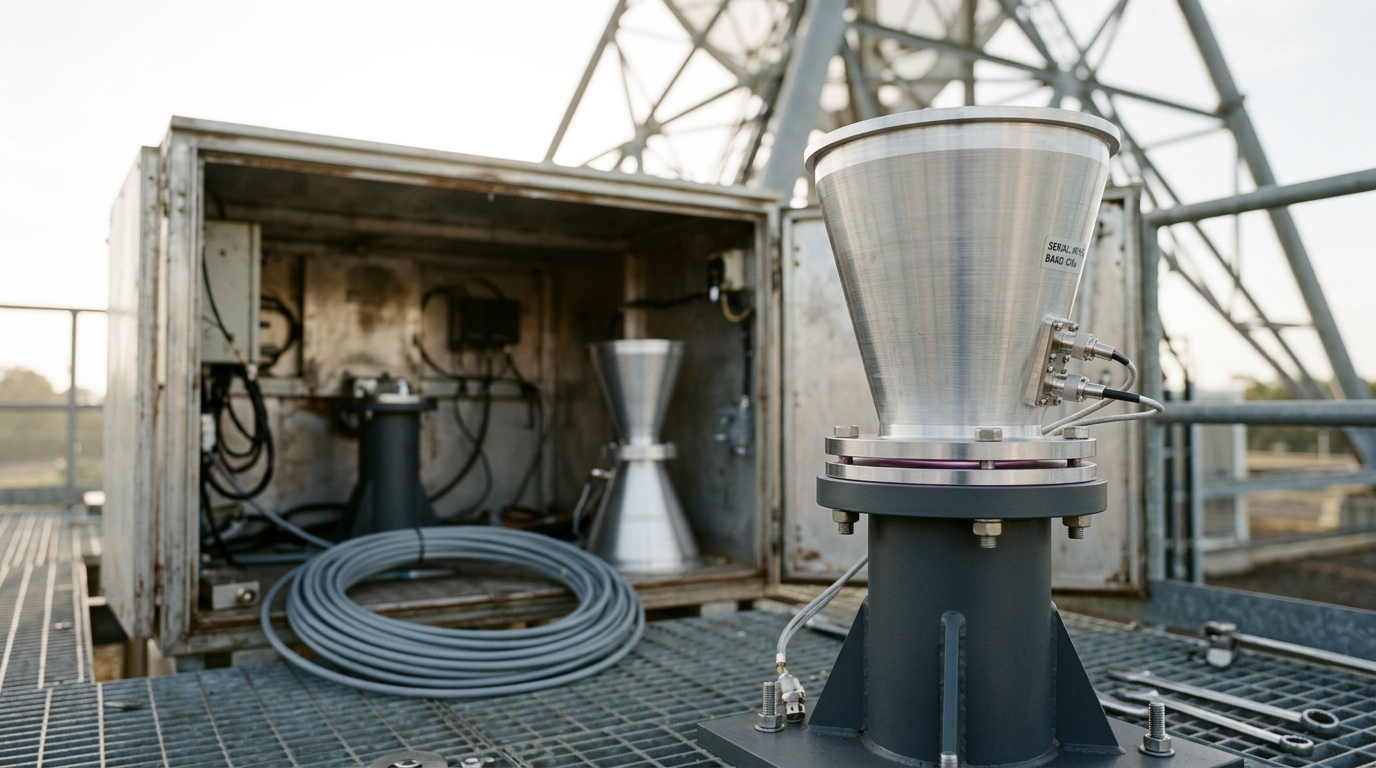
Figure 6. A theory that names its own killer keeps equipment like this pointed at the sky long after the argument that motivated it has moved on. — Image prompt and art direction by Brecht Corbeel; generation pending.
Cosmological natural selection’s most specific, most checkable form is in serious and, on the pulsar-timing evidence assembled here, worsening tension with the data, and its author has never conceded that in print. Both of those things are true at once, and the second does not undo the first. What the episode demonstrates is not that Smolin was right about neutron stars — on the numbers in front of us, the plain reading is that he was not — but that building a theory around a number a telescope could check was worth more, epistemically, than building one that no telescope ever could. A prediction that says “less than 1.6 solar masses” and then has to be defended, qualified, and eventually revised as real measurements come in is a prediction doing exactly the job Popper assigned it: standing in the open, taking hits, forcing its author to say in advance and in public what would count against him. An argument that can always be repaired by redefining the reference class it reasons about, which is Smolin’s fair charge against unqualified anthropic reasoning, never has to stand in the open at all.
None of this requires deciding that anthropic reasoning is worthless; Weinberg’s 1987 bound on the cosmological constant remains a real, if more conditionally stated than its reputation suggests, example of a number the multiverse camp got approximately right before the measurement came in. What the neutron-star case shows is the asymmetry Smolin diagnosed actually operating in the field, not just in his own rhetoric about it: a probably-wrong theory that named its own graveyard in advance drew three independent, technically serious attempts to bury it — from nuclear equation-of-state physics, from string-theory cosmology, from semiclassical gravity — each of which is itself real, arguable, checkable physics rather than a dispute about which selection effect to prefer. Fifteen years of pulsar timing later, the equipment built to answer entirely different questions about gravity and dense matter has, as a side effect nobody had to arrange, kept delivering a verdict on a cosmology. That a Darwinian mechanism built for the largest canvas physics has — an entire population of universes no one will ever see — was made to answer to a maser-locked timing residual measured in a drive room is not a failure of the method. It is the method, doing in cosmology what it has always done in biology: making claims specific enough to be wrong, and then finding out.
Sources
- Lee Smolin. Did the Universe Evolve?. Classical and Quantum Gravity (1992). DOI: 10.1088/0264-9381/9/1/016.
- Lee Smolin. The Life of the Cosmos. Oxford University Press (1997).
- Lee Smolin. Scientific Alternatives to the Anthropic Principle. arXiv (hep-th/0407213) (2004).
- Lee Smolin. The Status of Cosmological Natural Selection. arXiv (hep-th/0612185) (2006).
- G. E. Brown, C.-H. Lee, and M. Rho. Kaon Condensation, Black Holes, and Cosmological Natural Selection. Physical Review Letters (2008). DOI: 10.1103/PhysRevLett.101.091101.
- Alexander Vilenkin. On Cosmic Natural Selection. arXiv (hep-th/0610051) (2006).
- Leonard Susskind. Cosmic Natural Selection. arXiv (hep-th/0407266) (2004).
- Lee Smolin and Leonard Susskind. Smolin vs. Susskind: The Anthropic Principle. Edge.org (2004).
- Steven Weinberg. Anthropic Bound on the Cosmological Constant. Physical Review Letters (1987). DOI: 10.1103/PhysRevLett.59.2607.
- P. B. Demorest, T. Pennucci, S. M. Ransom, M. S. E. Roberts, and J. W. T. Hessels. A Two-Solar-Mass Neutron Star Measured Using Shapiro Delay. Nature (2010). DOI: 10.1038/nature09466.
- John Antoniadis, Paulo C. C. Freire, Norbert Wex, and colleagues. A Massive Pulsar in a Compact Relativistic Binary. Science (2013). DOI: 10.1126/science.1233232.
- H. T. Cromartie, E. Fonseca, S. M. Ransom, and colleagues. Relativistic Shapiro Delay Measurements of an Extremely Massive Millisecond Pulsar. Nature Astronomy (2020). DOI: 10.1038/s41550-019-0880-2.
- E. Fonseca, H. T. Cromartie, T. T. Pennucci, and colleagues. Refined Mass and Geometric Measurements of the High-Mass PSR J0740+6620. The Astrophysical Journal Letters (2021). DOI: 10.3847/2041-8213/ac03b8.
- LIGO Scientific Collaboration and Virgo Collaboration. GW190814: Gravitational Waves from the Coalescence of a 23 Solar Mass Black Hole with a 2.6 Solar Mass Compact Object. The Astrophysical Journal Letters (2020). DOI: 10.3847/2041-8213/ab960f.
- Roger W. Romani, D. Kandel, Alexei V. Filippenko, Thomas G. Brink, and WeiKang Zheng. PSR J0952-0607: The Fastest and Heaviest Known Galactic Neutron Star. The Astrophysical Journal Letters (2022). DOI: 10.3847/2041-8213/ac8007.
- Lee Smolin. Time, Laws, and the Future of Cosmology. Physics Today (2014). DOI: 10.1063/PT.3.2310.
- Lee Altenberg. Implications of the Reduction Principle for Cosmological Natural Selection. arXiv (gr-qc/1302.1293) (2013).
- Ward Blondé. Adding Genes and Interaction to Smolin's Cosmological Natural Selection. Synthese (2025). DOI: 10.1007/s11229-025-05189-y.
Originally published at https://absolutedigitalpublishers.com/articles/cosmological-natural-selection-the-theory-that-said-kill-me-here.