Comparing the Main Approaches to Writing, Archives, and Information Revolutions
Philology, book-history bibliometrics, and computational text analysis ask different questions of the same five-thousand-year record — and each pays for its view with a different blind spot.
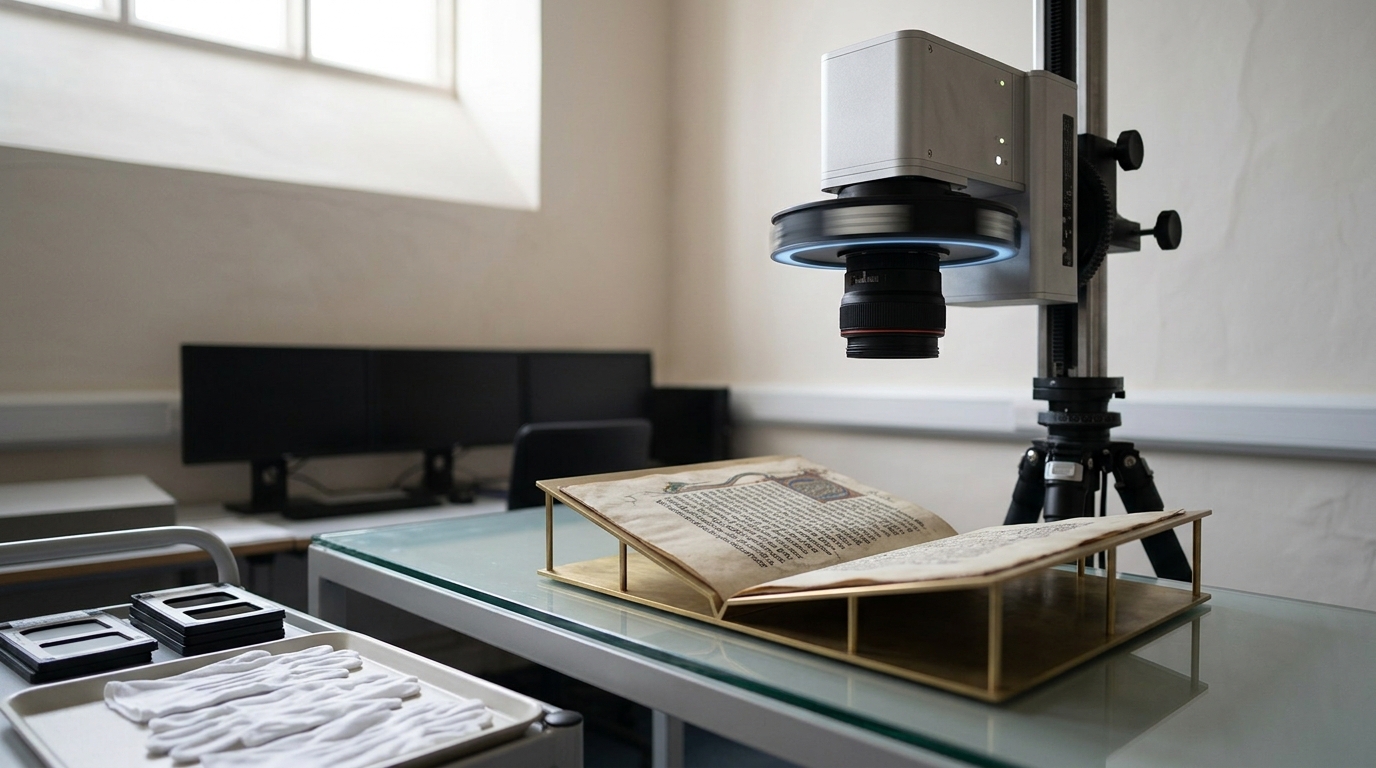
Recovering an erased or damaged page under multiple light bands is close reading's own information revolution: the same document read again, differently, decades after it was catalogued. — Image prompt and art direction by Brecht Corbeel; generation pending.
Abstract
From Uruk's ration tablets to the queryable digital archive, the history of writing has been studied by three approaches that rarely agree on method: close philological reading of individual primary documents, quantitative book-history and bibliometric analysis of publication records at scale, and computational digital-humanities analysis of machine-readable corpora. This article compares them on three concrete dimensions — how much of the record each can cover, how much interpretive depth each preserves per document, and how each is distorted by what survived to be studied at all — using the invention of cuneiform bureaucracy, the print revolution, the telegraph and mass media, and the digital search and provenance problem as through-lines. It separates documented fact from vendor and platform claims, marks interpretive analysis as such, and treats forward-looking claims about digital provenance as scenario, not settled outcome. No approach is ranked above the others; each answers a question the others cannot.
Three rooms, one record
Down one corridor of a modern archival-science building you can pass three working rooms in a hundred metres. The first is a conservation lab where a single manuscript leaf sits under a raking-light lamp while someone checks whether a quire’s stitching matches its original collation. The second is a digitization line where a card-catalog drawer feeds into a scanner, turning tens of thousands of acquisition records into dated, priced, geolocated spreadsheet rows. The third is a server alcove where a corpus of five million digitized books sits ready for a script to count word frequencies across three centuries in the time it takes to make coffee.
All three rooms study the same underlying fact: humans have spent five thousand years inventing ways to fix information outside a living memory and move it somewhere else. But the three rooms answer different questions, at different scales, with different blind spots, and a comparison of the rooms is more informative than a ranking of them. This article sets three broad approaches to the history of writing, archives, and information revolutions side by side — close philological reading of primary documents, quantitative book-history and bibliometric analysis, and computational digital-humanities text analysis — and asks what each buys and what each cannot see, using cuneiform bureaucracy, the print revolution, the telegraph, and digital provenance as four historical anchors that all three approaches have tried to explain.
Anchor one: writing invented as an administrative tool
The earliest writing was not literature. Proto-cuneiform emerged in the southern Mesopotamian city of Uruk in the late fourth millennium BCE, and for centuries afterward it served an exclusively administrative function: counts of grain, beer rations, labor, and livestock pressed with a reed stylus into wet clay [1]. The wedge-shaped marks that gave cuneiform its name were a bureaucratic technology before they were ever a literary one; the script that would eventually carry the Epic of Gilgamesh began as an inventory system for a temple economy that needed to remember who owed what.
This fact is not in dispute among the three approaches — it is one of the rare cases where philology, book history, and computational analysis would each independently confirm it from their own evidence. A philologist reads individual tablets and identifies administrative formulae repeated tablet after tablet. A quantitative historian would count the proportion of surviving early tablets that are administrative versus literary and find the ratio overwhelmingly administrative [1]. A computational analysis of a transcribed cuneiform corpus would find the same skew in the frequency of sign combinations associated with quantities and commodities versus narrative verbs. The three methods converge here because the signal is strong enough to survive any of the three lenses. Later in this article, the harder cases are the ones where the three methods disagree — not because one is wrong, but because each is built to see something the others cannot.
The first approach: philological and textual analysis
Philology is the oldest of the three approaches and the one closest to how writing has always been studied: a scholar reads one document, or a small closely related set of documents, with total attention to its material form — the ink, the hand, the collation of its leaves, the erasures beneath its visible layer — and its language. Its unit of analysis is the individual artifact.
Its interpretive depth is the highest of the three approaches by a wide margin. A trained codicologist examining a disbound manuscript quire under raking light can determine whether a leaf is an original bifolium or a later replacement, whether a gathering has lost a leaf (a “stub” left in the binding is the tell), and roughly when a repair was made, from evidence no automated process currently reads reliably. Multispectral and ultraviolet imaging extends this further: manuscripts that were scraped clean and reused — palimpsests — can sometimes be read again under bands of light invisible to the naked eye, recovering an erased layer decades or centuries after a cataloguer recorded only the visible, later text. {{figure:multispectral-manuscript-scan}}
Its cost is scale. A philologist can give exhaustive attention to one leaf, one quire, one letter collection, or one scribal hand — but not simultaneously to the tens of thousands of comparable documents that might exist in an archive, let alone the millions across a linguistic tradition.
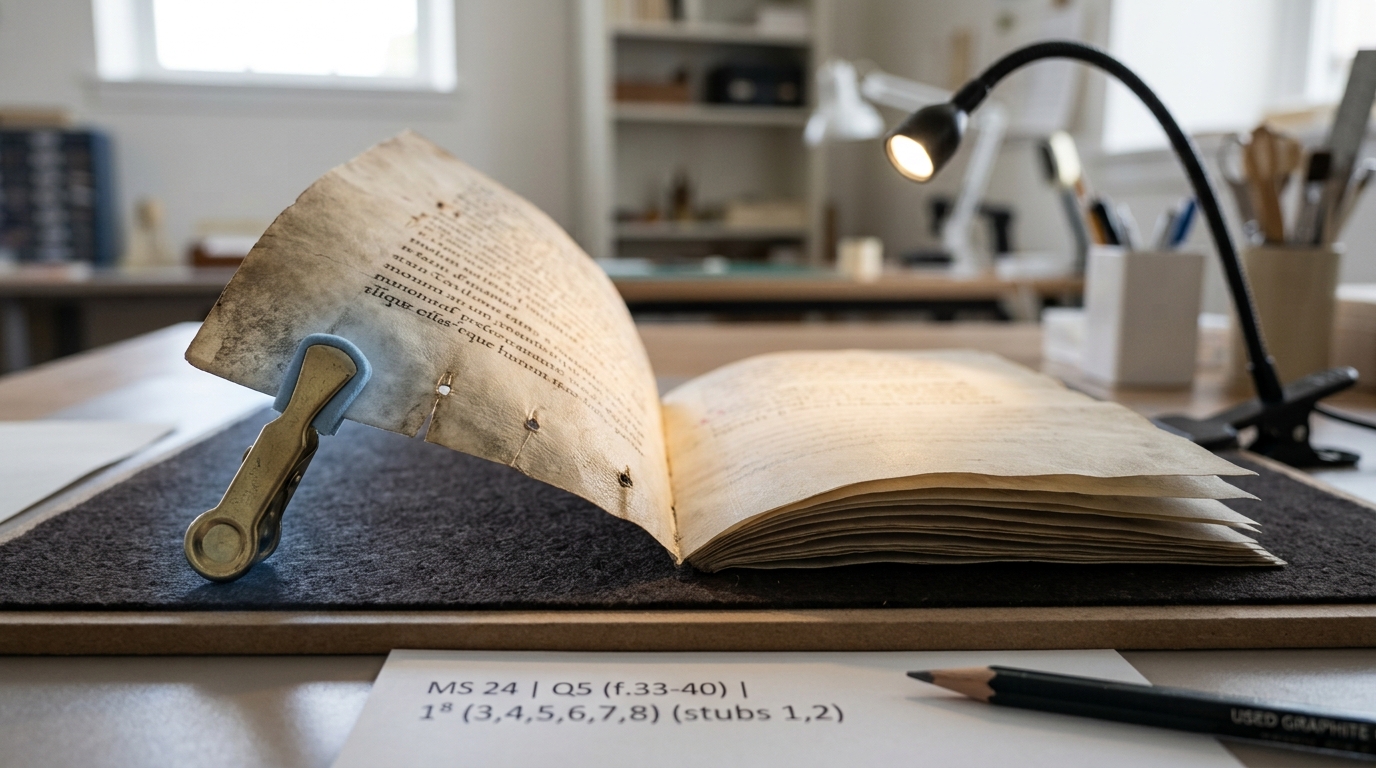
Figure 1. Philological method reads one object exhaustively: collation checks whether a quire's leaves are original, replaced, or reordered, one gap or stub at a time. — Image prompt and art direction by Brecht Corbeel; generation pending.
This is not a failure of the method; it is what the method trades for depth. A claim philology is well positioned to make — “this specific letter was altered after the fact, and here is the physical evidence” — is a claim the other two approaches cannot make at all, because they do not look at any single document closely enough to notice.
The second approach: quantitative book history and bibliometrics
Where philology reads one document deeply, quantitative book history counts many documents shallowly, and treats the count itself as the finding. Its raw material is exactly the kind of record a library keeps about its holdings rather than what a manuscript itself contains: publisher, date, place of publication, format, price, edition size, and — where surviving records permit — sales figures [3].
This approach’s productive move is to convert an archive’s own paperwork — accession ledgers, printers’ account books, library catalog cards — into structured rows that can be aggregated, compared across regions, and plotted over time.
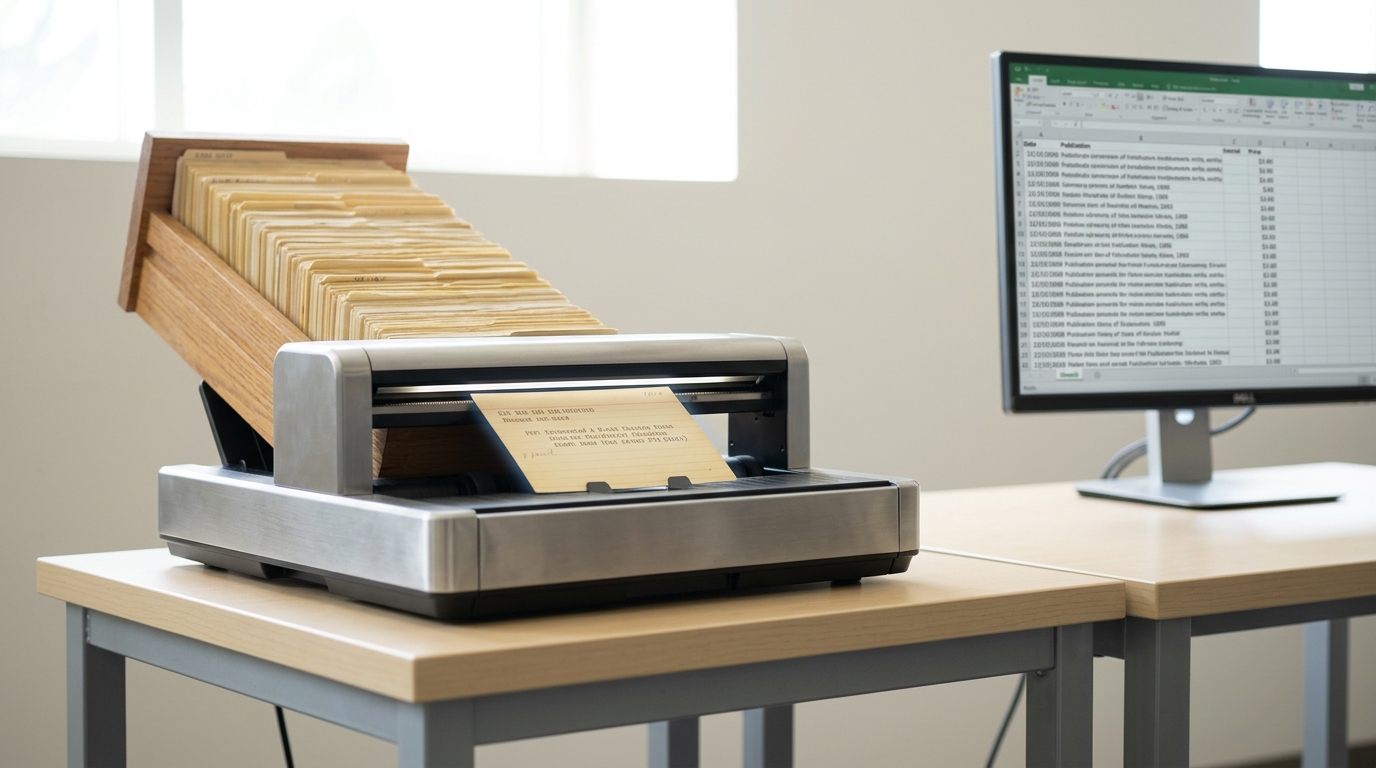
Figure 2. Quantitative book history trades depth for reach: a scanning line can convert tens of thousands of catalog cards into dated, priced, geolocated publication records no single reader could hold in mind. — Image prompt and art direction by Brecht Corbeel; generation pending.
Historical bibliometrics has been used this way to trace the geography of print output, the rise and fall of genres, and shifts in the price and format of books across centuries, drawing on large harmonized bibliographies that now cover millions of catalogued print items across Europe [3].
Its interpretive depth per document is close to zero: a bibliometric row records that a book was printed, priced, and sold — not what it argued, whether it was read carefully, or whether its ideas mattered. Its scale, though, reaches an order of magnitude philology cannot: thousands to millions of catalogued items rather than one leaf. And its evidence is filtered twice before it ever reaches a spreadsheet — once by which books were catalogued at all, and again by which catalog records survived long enough to be digitized. A book that sold poorly, was never entered in a surviving ledger, or was catalogued by an institution whose own records later burned simply does not appear as a row, and a bibliometric count built from surviving catalogues will silently undercount exactly the kind of print that left the thinnest paper trail. Quantitative book history is honest about aggregate structure and correspondingly blind to any individual document’s content or significance.
Print, fixity, and the argument that a technology can standardize a text
The clearest case where all three approaches have something to say about the same event is the print revolution, and it is a useful place to see how their claims differ in kind rather than degree. Elizabeth Eisenstein’s The Printing Press as an Agent of Change argued that movable-type printing’s most consequential effect was not merely faster copying but typographical fixity: mechanical reproduction guaranteed, in a way hand copying could not, that many copies of a text were identical to one another, which let scholars in different cities cite the same page number, compare editions against each other with confidence, and build cumulative bodies of scholarship in mathematics, cartography, and natural philosophy that depended on a stable, shared reference text [2].
This is an analytical claim, not a simple fact — it is Eisenstein’s interpretation of print’s causal role in the Reformation, the Renaissance, and the Scientific Revolution, and one that other historians have contested and refined in the decades since.
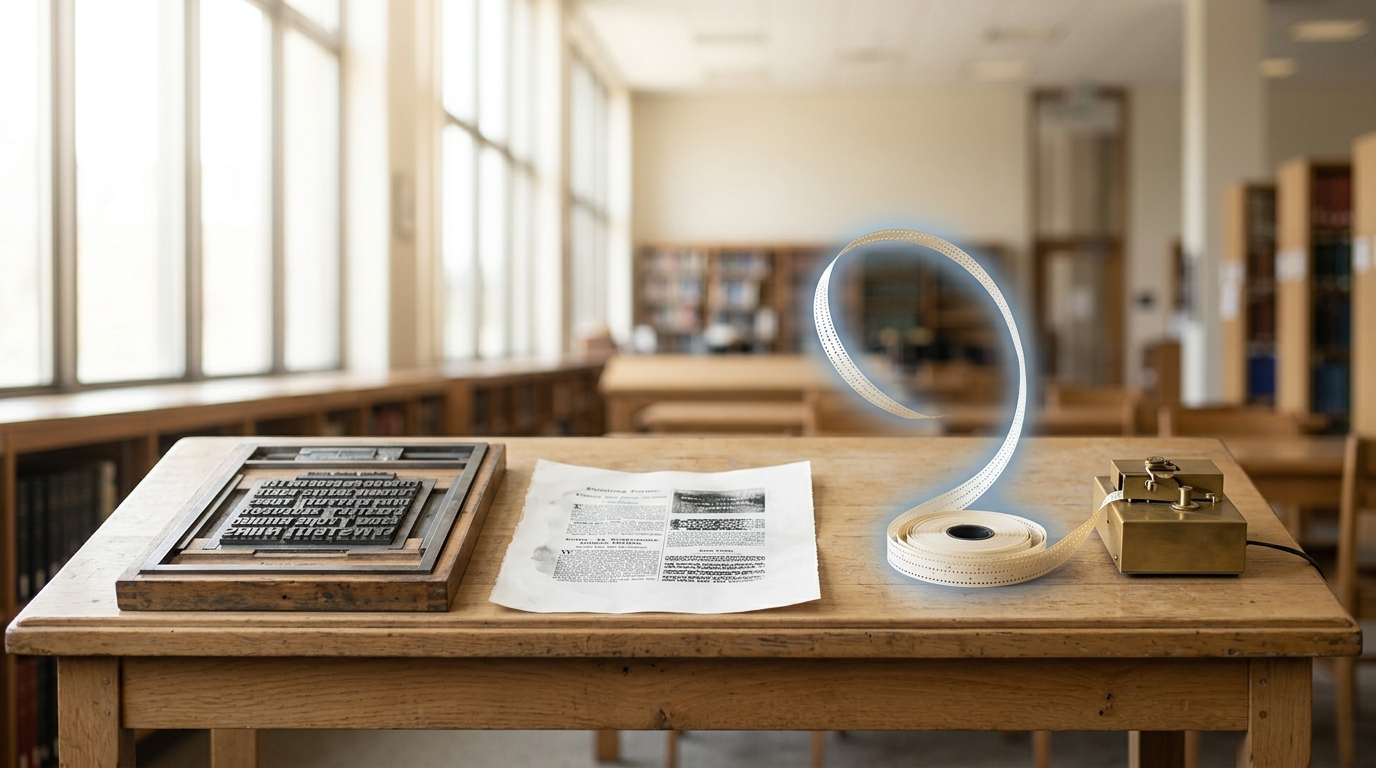
Figure 5. Print standardized the text a reader could trust to be identical everywhere; the telegraph then let that fixed text travel faster than any courier — two separate information revolutions read from the same table. — Image prompt and art direction by Brecht Corbeel; generation pending.
It is exactly the kind of claim philology is positioned to make, because it rests on close comparison of specific early printed editions against each other and against manuscript exemplars. A bibliometric count of how many books were printed in a given decade cannot, by itself, establish whether those books were textually identical to one another — that requires someone to actually collate copies. A computational analysis of a digitized corpus built after the fact inherits whatever textual variation survived into its source scans and cannot detect fixity or its absence unless the underlying editions were collated first. The claim depends on philological method even when quantitative and computational approaches are used to describe print’s broader diffusion.
The telegraph, roughly three centuries later, is a genuinely different kind of information revolution and a useful contrast: it did not standardize text, it collapsed the time required to move a fixed message across distance. Telegraph operators used Morse code to transmit messages at speeds that made an 1866 transatlantic cable able to carry news between Europe and the Americas in minutes rather than the weeks a ship crossing required, and the resulting wire services reorganized journalism, finance, and diplomacy around near-instantaneous dispatch [8]. Print and telegraphy are both “information revolutions,” but they revolutionized different variables — one fixed the content of a message, the other collapsed the time to deliver it — and treating them as instances of one undifferentiated category obscures that they solved different problems.
The third approach: computational and digital-humanities analysis
The newest of the three approaches treats a large digitized corpus as data to be queried rather than a shelf to be read. Franco Moretti’s “distant reading” is its most cited articulation: rather than close-reading individual novels, treat literary forms the way population biology treats species, tracking which forms spread, which go extinct, and which cluster, across a corpus far larger than any one scholar could read in a career [5]. The approach has drawn sustained criticism as well as adoption — reviewers have pushed back on whether frequency counts across a corpus can support the kind of literary-critical claims Moretti draws from them, and the debate over what distant reading can and cannot license remains active rather than settled [5].
The best-known large-scale instance of this approach is “culturomics”: in 2011, a team working with a Google-digitized corpus of roughly 5.2 million books — described by the authors as about four percent of all books ever printed — used year-by-year word frequency counts to study long-run shifts in language, fame, censorship, and grammatical change, publishing the result and an accompanying public query tool [4]. The scale here is not a modest improvement over bibliometric counting; it is several orders of magnitude beyond what philological reading or a bibliometric spreadsheet built from library catalogs could reach, because the corpus consists of the actual digitized text of the books rather than only their catalog metadata.
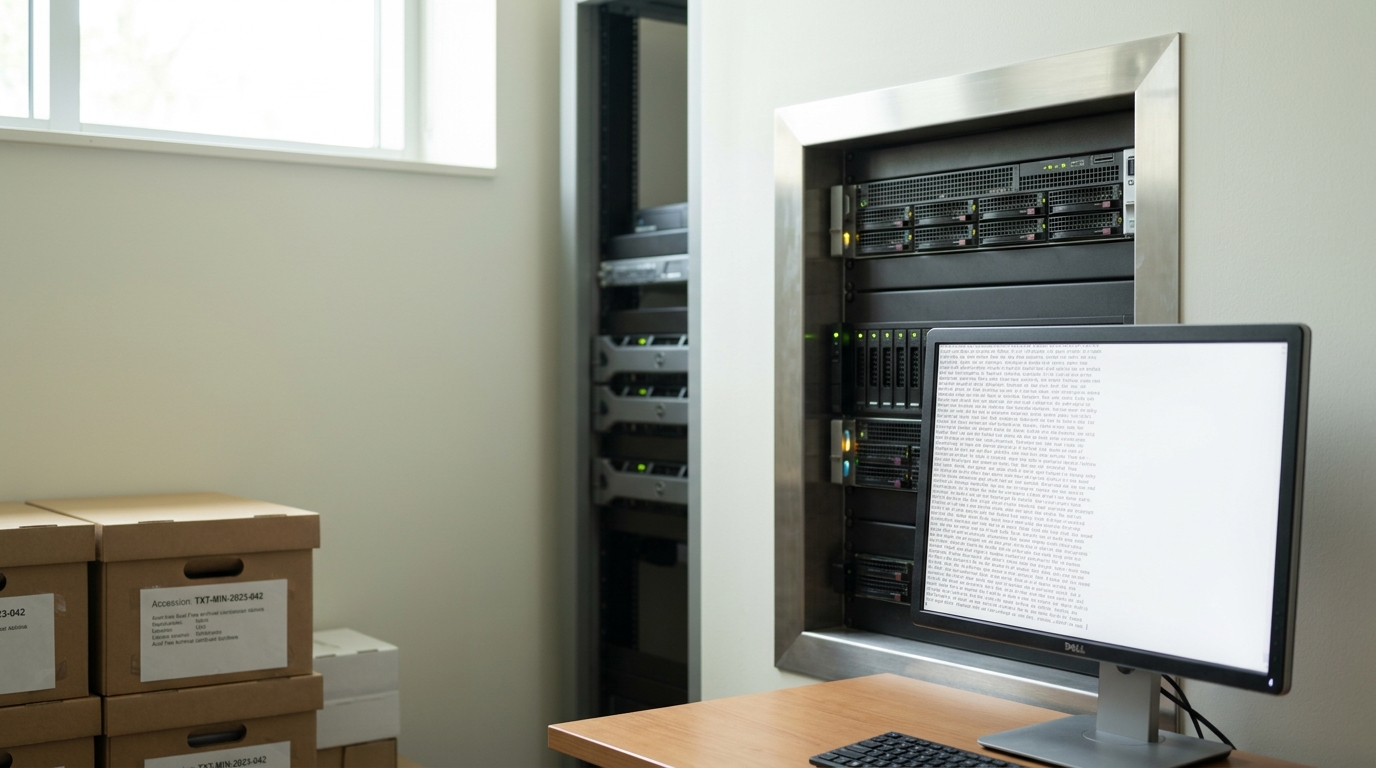
Figure 3. Computational digital humanities substitutes machine-readable scale for hands-on reading, running pattern searches across millions of pages a philologist could not read in a career. — Image prompt and art direction by Brecht Corbeel; generation pending.
The trade is depth, and it is a steep one. A frequency count of a word’s appearance across five million books cannot distinguish sincere use from quotation, satire, or negation; it treats a corpus as a bag of dated tokens and discards the argument each individual passage was making. It also inherits every bias in what was digitized in the first place — a corpus built from libraries with strong English-language, twentieth-century, commercially published holdings will systematically undercount minority-language print, ephemera, and anything that was destroyed, never catalogued, or held in collections outside the digitization program’s reach. Computational analysis can describe a signal that recurs across millions of documents; it depends on philology and bibliography to establish what any one of those documents was actually doing when it used the word.
Survivorship bias, compared directly
The clearest way to compare the three approaches is to ask how each is distorted by the same underlying fact: most of what was ever written is gone, and what remains is not a random sample of what once existed.
A 2022 study applied statistical “unseen species” models — originally developed in ecology to estimate undiscovered wildlife populations from observed sampling patterns — to a sample of 3,648 surviving medieval manuscripts containing chivalric and heroic narratives in six European languages, and extrapolated that only around 9 percent of individual manuscript copies from that genre survive, though a much higher share of the underlying literary works survive in at least one copy, with survival rates varying sharply by language and region: about 81 percent of medieval Irish romance narratives survive as works against roughly 38 percent for comparable English narratives [6]. This is analysis, not a fact philology alone could establish, because it required a statistical model applied across a large tallied sample of manuscripts rather than deep reading of any one of them — an approach closer to bibliometric method borrowed for a philological question.
Each of the three approaches inherits this loss differently. Philology at least sees its own blind spot directly: a codicologist examining a quire can usually tell when a leaf is missing, because a stub remains in the binding — the gap in a single object leaves physical evidence of itself. Bibliometric counts built from library and publisher records see a different, harder-to-detect gap: a book that was never catalogued, or whose catalogue burned, disappears from the count without leaving any equivalent stub — the record simply has one fewer row than it should, with no signal that a row is missing.
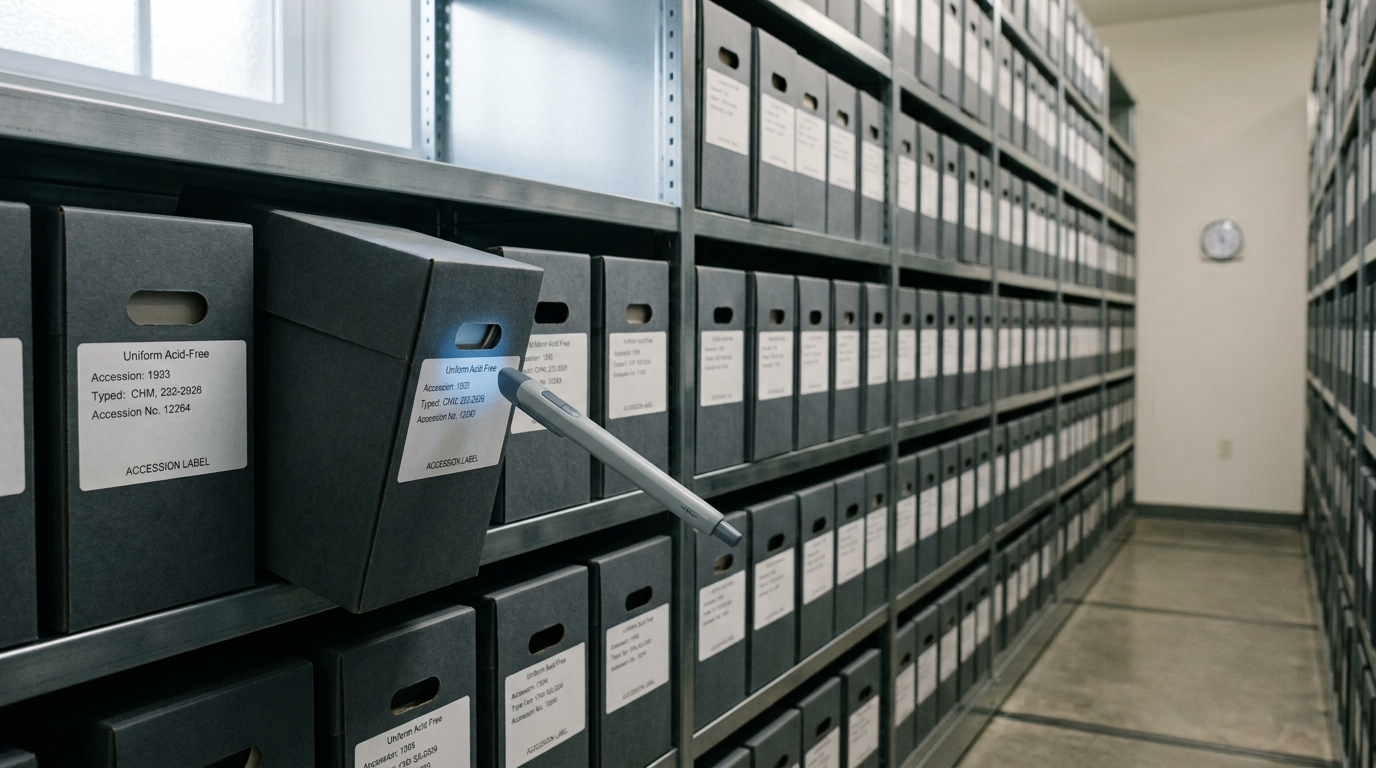
Figure 4. Digital provenance extends the same custody problem archives have always had — proving a record has not been altered since it was accessioned — into checksums and audit trails instead of wax seals. — Image prompt and art direction by Brecht Corbeel; generation pending.
Computational corpus analysis inherits both problems at once, compounded by a further filter of which surviving, catalogued items were selected for digitization in the first place, and it is the least able of the three to detect its own gap, because a word-frequency count run across an incomplete corpus produces a result that looks exactly as confident as one run across a complete one. None of the three approaches escapes survivorship bias; they differ in whether the bias leaves a visible trace in the method’s own output.
Digital provenance: fact, vendor claim, and open question
The digital era adds a new version of the custody problem archives have always faced — proving a record has not been silently altered since it entered the archive — and it is worth separating what is established from what is proposed.
As fact: the Open Archival Information System reference model, developed originally for space-agency data by the Consultative Committee for Space Data Systems and standardized as ISO 14721, defines six functional components — ingest, archival storage, data management, administration, preservation planning, and access — and has been adopted as a design framework by major libraries and repositories for long-term digital preservation [7]. This is documented institutional practice, not a prediction.
As a live technical proposal rather than settled practice: some archival and digital-preservation researchers have proposed using blockchain-style cryptographic ledgers to record hashes and provenance events for digital records, while keeping the records themselves in a conventional trusted repository rather than on the ledger — an “off-chain” design intended to make tampering detectable without requiring the ledger to store the archive’s actual content. This remains a proposed architecture under active research and pilot deployment rather than an established standard practice across the archival field, and it should be read as one candidate approach competing with, and layered on top of, the older OAIS model rather than as a proven replacement for it.
As scenario, not fact: it is plausible that cryptographic provenance chains become a standard layer of digital-archive infrastructure within the next decade, conditional on archival institutions adopting common technical standards, on the approach demonstrating cost and complexity advantages over simpler audit-log methods in practice, and on regulators or funders requiring it. A disconfirming signal would be continued reliance on conventional audit logs and checksums by major national libraries and archives five to ten years from now, with cryptographic-ledger provenance remaining confined to pilot projects — which would indicate the added complexity was judged not to be worth its cost relative to simpler existing methods.
What the comparison is for
None of the three approaches described here supersedes the others, and the history of writing gives no case where one alone was sufficient. Philology establishes what a specific artifact is and what happened to it physically, at a cost of scale that keeps it from ever covering more than a fraction of any large archive. Quantitative book history converts an archive’s own paperwork into structured counts that reveal aggregate patterns invisible to any single reader, at the cost of discarding what any counted item actually said. Computational analysis extends counting to the content of millions of documents at once, at the cost of collapsing each document’s argument into undifferentiated tokens and inheriting every earlier filter on what got digitized in the first place.
The productive move, visible in the debate over Moretti’s distant reading and in serious book-history scholarship alike, is not choosing a winner but knowing which question is being asked. A claim about whether one particular letter was forged calls for philology. A claim about how the price of a printed book changed across a century calls for bibliometrics. A claim about how a word’s usage shifted across a national literature over two hundred years calls for computational corpus analysis. Mistaking one method’s answer for another method’s question — treating a frequency count as though it settled an authorship dispute, or treating a single manuscript’s marginalia as though it represented print culture at large — is the actual methodological error the comparison is meant to guard against, not any ranking among the three approaches themselves.
Sources
- Joshua J. Mark. Cuneiform. World History Encyclopedia (2023).
- Elizabeth L. Eisenstein. The Printing Press as an Agent of Change: Communications and Cultural Transformations in Early-Modern Europe. Cambridge University Press (1980).
- Alexis Weedon. The Uses of Quantification. A Companion to the History of the Book (Wiley-Blackwell) (2019). DOI: 10.1002/9781119018193.ch3.
- Jean-Baptiste Michel, Yuan Kui Shen, Aviva P. Aiden, et al.. Quantitative Analysis of Culture Using Millions of Digitized Books. Science (2011). DOI: 10.1126/science.1199644.
- Michael Widner. In Praise of Overstating the Case: A Review of Franco Moretti, Distant Reading. Digital Humanities Quarterly (2014).
- Ella Feldman. How Much Medieval Literature Has Been Lost Over the Centuries?. Smithsonian Magazine (2022).
- CCSDS (Consultative Committee for Space Data Systems); Wikipedia contributors. Open Archival Information System. Wikipedia / ISO 14721 (2025).
- Computer History Museum. The Victorian "Internet". Computer History Museum (2020).
Originally published at https://absolutedigitalpublishers.com/articles/comparing-the-main-approaches-to-writing-archives-and-information-revolutions.