Comparing the Main Approaches to Quantum and Condensed-Matter Systems
BCS theory, resonating-valence-bond proposals, and numerical methods such as DMRG and quantum Monte Carlo are not competing brands of the same product. Each explains a different slice of strongly correlated matter, and each fails in its own characteristic way.
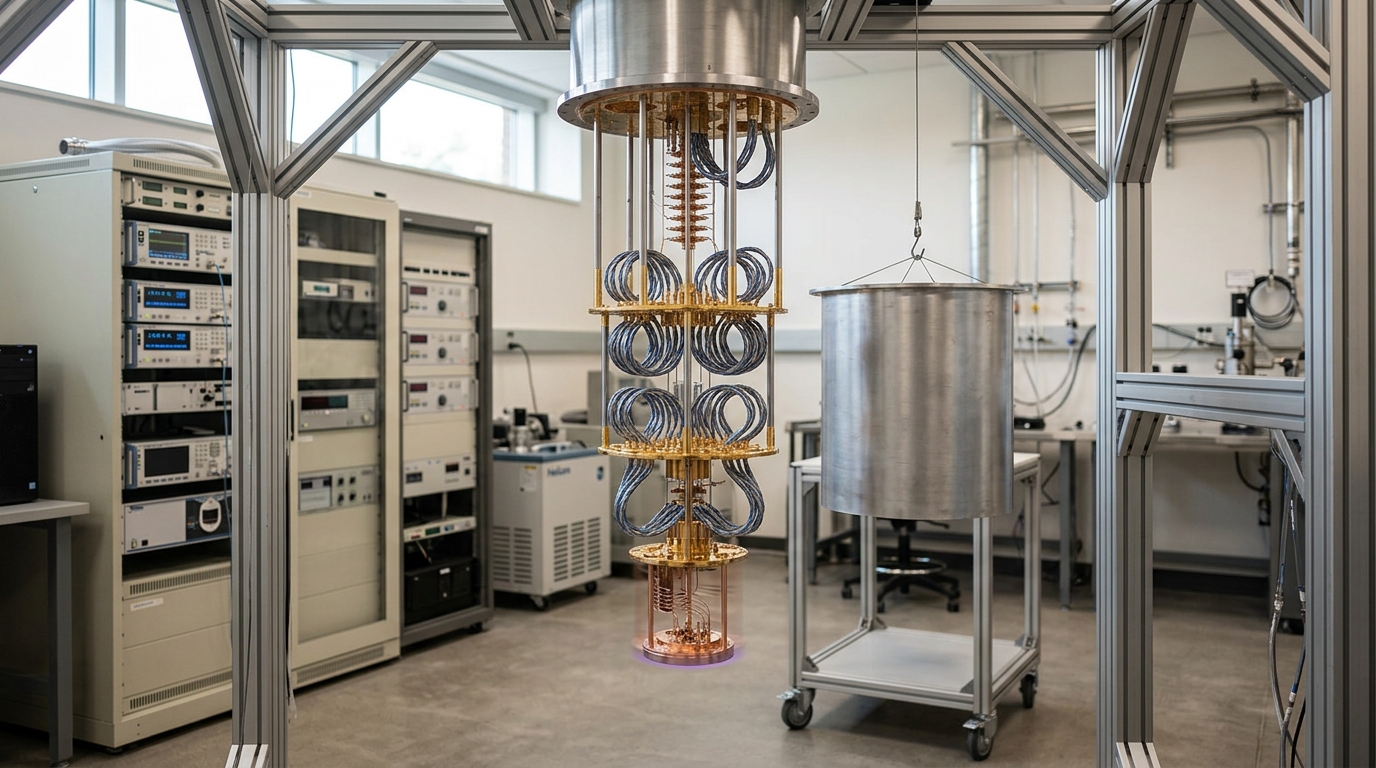
A dilution refrigerator under construction: several theories and several numerical methods will all be tested against whatever this rig eventually measures. — Image prompt and art direction by Brecht Corbeel; generation pending.
Abstract
Strongly correlated electron systems are studied through frameworks that do not compete on the same terms. BCS theory gives conventional superconductivity a mechanism and a sharp domain of validity; the cuprates and other unconventional superconductors sit outside that domain, and the resonating-valence-bond proposal and its rivals remain open theoretical programs rather than settled replacements. Numerical methods including the density-matrix renormalization group and quantum Monte Carlo do not propose mechanisms at all; they compute, and each carries a specific computational wall — entanglement growth for DMRG, the fermionic sign problem for quantum Monte Carlo. This article lays out what each approach actually explains, on what dimensions they can be compared, and where the field's real disagreements sit, without adjudicating among proposals that remain contested in the literature.
One phenomenon, several incompatible vocabularies
Strongly correlated electron systems resist a single unifying framework, and that resistance is not a temporary embarrassment awaiting a cleverer theorist. It reflects a real split in what different approaches are built to do. Some, like BCS theory, propose a mechanism: a specific physical process that produces a specific observed behavior, with parameters that can be measured and predictions that can fail. Others, like the resonating-valence-bond proposal for the cuprates, are still open theoretical programs competing with several rivals to explain a phenomenon that BCS mechanics does not obviously cover. And others still, like the density-matrix renormalization group (DMRG) and quantum Monte Carlo (QMC), are not mechanisms at all. They are numerical methods for extracting exact or controlled-approximate answers from a Hamiltonian that is, in most interesting cases, otherwise intractable.
Comparing these on one axis — “which theory is right” — is a category error that this article deliberately avoids. A transport puck lowered into a dilution refrigerator to test a candidate mechanism, a scanning tunneling microscope closing in on a freshly cleaved crystal to map a gap structure, and a rack of processors running a tensor-network contraction are three different kinds of activity answering three different kinds of question. The useful comparison is not who wins, but what each approach explains, what it assumes, and where it runs out.
That last clause matters more than it first appears. A mechanism like BCS pairing can be wrong in a locatable way: a specific assumption (weak coupling, a Fermi-liquid normal state, phonon-mediated attraction) fails, and the failure is often visible in a specific measurement before anyone has a replacement theory in hand. A numerical method like DMRG or quantum Monte Carlo fails in an even more precisely characterizable way, because computational complexity results can sometimes prove, rather than merely observe, that a method cannot be extended efficiently into some regime. A still-competing theoretical program like RVB fails, when it fails, in the least tidy way of the three: by not yet producing the kind of sharp, quantitatively matched prediction that would let the field rule competitors out. Holding these three different failure grammars apart is most of what a fair comparison requires.
BCS theory: a mechanism with a sharp domain
Bardeen, Cooper, and Schrieffer’s 1957 theory remains the reference point for understanding conventional superconductivity because it supplies an actual physical story rather than a fit [1]. Electrons near the Fermi surface experience a weak, phonon-mediated attraction: one electron slightly distorts the lattice, and a second electron is drawn toward that distortion before it relaxes away. Below a critical temperature, this attraction is enough to bind electrons into Cooper pairs, and the many-body ground state built from these pairs is separated from excited states by an energy gap. That gap is why resistance vanishes discontinuously rather than fading gradually: there is no low-energy channel for a pair to scatter into once the temperature drops far enough below the transition.
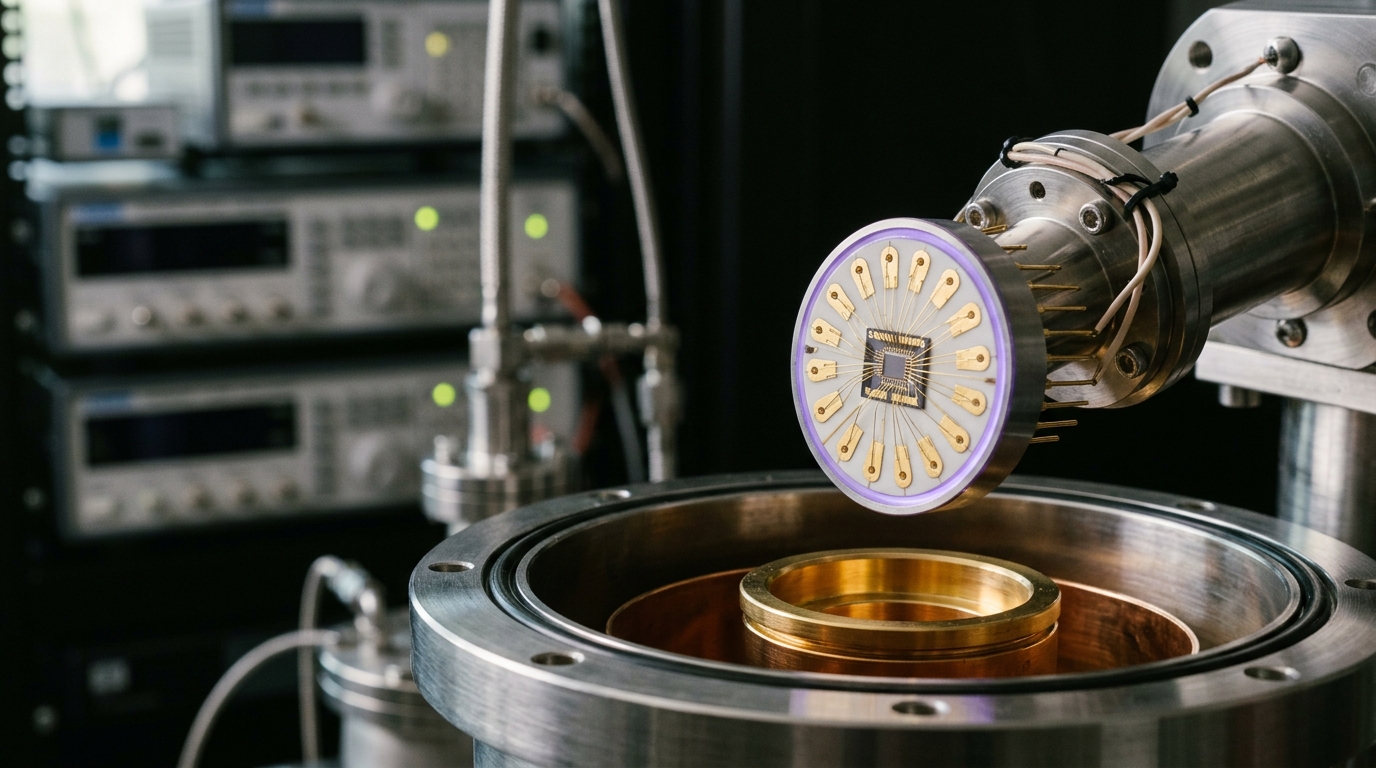
Figure 1. BCS theory explains why resistance in a conventional metal collapses to zero below a sharp temperature: electrons pair through lattice-mediated attraction into a condensate with an energy gap. — Image prompt and art direction by Brecht Corbeel; generation pending.
BCS theory earns its central place for a specific reason: its predictions are quantitative and falsifiable, not merely qualitative. The ratio of the gap to the critical temperature, the isotope effect linking the transition temperature to the mass of the lattice ions, and the specific-heat discontinuity at the transition are all measurable, and for the elemental and many alloy superconductors known before 1986, they matched. That agreement is a fact, not a vendor claim, and it is why BCS-type pairing remains the default assumption for a newly discovered superconductor until evidence forces reconsideration.
The theory’s limitation is equally sharp, not vague. It assumes a weak, retarded, phonon-mediated attraction acting on a good Fermi liquid — a metal whose low-energy excitations behave, to a controlled approximation, like weakly interacting electrons. When that assumption holds, BCS theory is not one competing option among several; it is the mechanism. The theory does not, by construction, address materials where the normal state above the transition is not a conventional Fermi liquid at all, where the pairing glue is not obviously phononic, or where the transition temperature is far higher than the phonon-mediated mechanism’s own parameter space comfortably supports. Bednorz and Müller’s 1986 discovery of superconductivity above 30 kelvin in a layered copper-oxide compound put a large and important class of materials squarely into that excluded territory [2].
The cuprates: a phenomenon several frameworks are still racing to explain
It is tempting to describe the cuprates as “materials where BCS theory fails,” but that framing understates what actually happened after 1986. The discovery did not falsify BCS theory in its own domain — it identified a new domain the theory was never built to cover, and a family of competing theoretical proposals arose to fill it, none of which has become the settled successor.
Anderson’s 1987 resonating-valence-bond (RVB) proposal is the most-cited of these programs. It starts from the observation that the undoped parent compound is an antiferromagnetic Mott insulator, not a metal, and proposes that its ground state is close to a quantum spin liquid — a superposition of singlet electron pairs, “resonating” among many possible pairings rather than settling into a single ordered pattern [3]. Doping this spin liquid with mobile charge carriers, in Anderson’s account, allows the preexisting singlet pairs to become charge-carrying Cooper pairs without invoking a phonon-mediated attraction at all. It is an elegant unification of magnetism and pairing, and it has motivated three decades of theoretical and experimental work on spin liquids, gauge theories of doped Mott insulators, and related constructions.
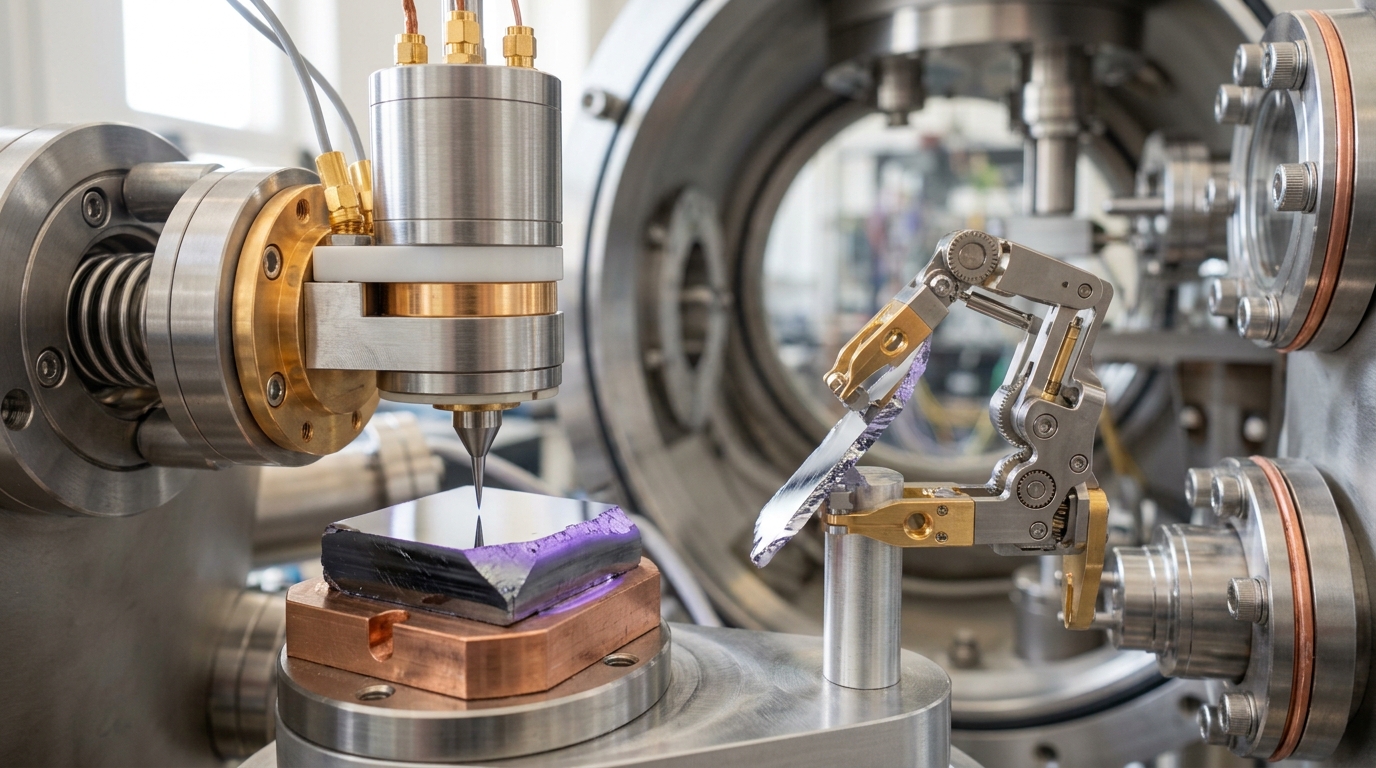
Figure 2. Where a mechanism as clean as BCS pairing does not obviously apply, the resonating-valence-bond proposal and its rivals remain competing, unresolved accounts of what pairs the electrons. — Image prompt and art direction by Brecht Corbeel; generation pending.
It is also, on its own, incomplete as an account of cuprate superconductivity, and saying so is not disparaging the proposal — it is the honest state of the field. A comprehensive 2015 review of cuprate physics catalogs the phenomenology that any candidate theory must eventually explain: a pseudogap phase above the superconducting dome whose origin is disputed, competing charge-density-wave and stripe orders that appear and disappear with doping, a normal-state resistivity that scales linearly with temperature in a way conventional Fermi-liquid theory does not predict, and a superconducting gap whose momentum-space structure (d-wave, with sign-changing lobes) is well established experimentally even though the pairing glue that produces it is not [4]. RVB theory, gauge-theoretic approaches to doped Mott insulators, spin-fluctuation-mediated pairing pictures, and quantum-critical-point scenarios all claim pieces of this phenomenology. None has produced the kind of sharp, quantitatively matched prediction — comparable to the isotope effect for BCS superconductors — that would let the field declare the mechanism settled. This is a live disagreement among serious researchers, not a case where one camp is simply behind on the evidence, and this article does not adjudicate it.
Numerical methods: not mechanisms, but instruments for reading a Hamiltonian
DMRG and quantum Monte Carlo occupy a different category entirely. Neither proposes a physical story about pairing or magnetism. Each takes a specified microscopic Hamiltonian — a particular lattice, a particular set of hopping and interaction terms — and attempts to extract its ground state, its low-lying excitations, or its finite-temperature behavior essentially exactly, subject to a controlled and quantifiable error. They are best understood as instruments, not theories, and like any instrument they have a specific range in which they perform well and a specific failure mode outside it.
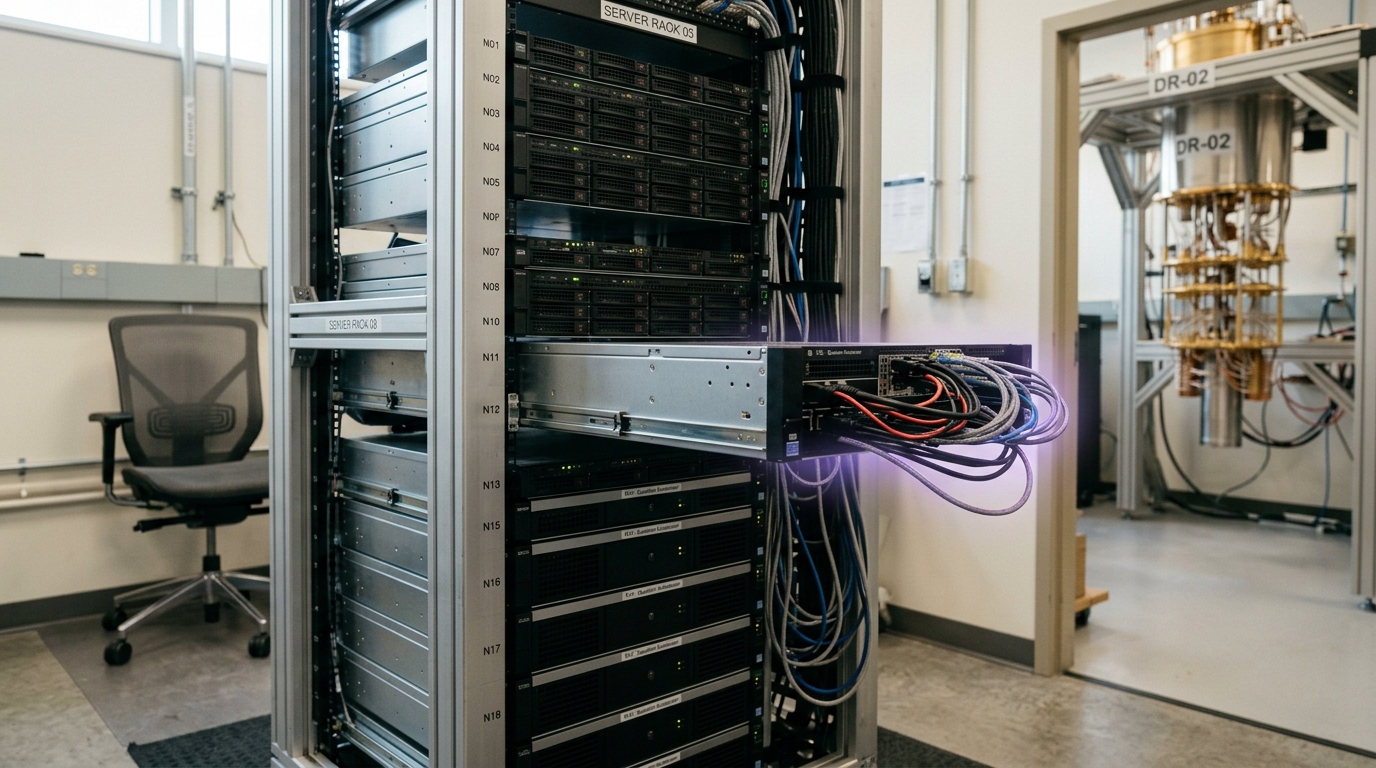
Figure 3. The density-matrix renormalization group compresses a one-dimensional chain's relevant quantum states with remarkable efficiency, then loses that advantage as the geometry gets wider or the entanglement grows. — Image prompt and art direction by Brecht Corbeel; generation pending.
White’s 1992 density-matrix renormalization group recast an earlier real-space renormalization approach by choosing which quantum states to keep based on the reduced density matrix of a block, rather than on the block’s own low-lying energy eigenstates [5]. This turns out to be close to optimal for one-dimensional and quasi-one-dimensional systems: DMRG can compute ground-state properties of long spin chains and narrow ladders to a precision that rivals or exceeds any other available method, because the entanglement entropy of a low-energy state in one dimension typically obeys an area law — it grows with the boundary between two regions, and in one dimension a boundary is just a point, so the entanglement stays bounded and easy to compress. The same efficiency does not carry over to two and three dimensions, where a boundary is a line or a surface and the relevant entanglement grows accordingly; DMRG can still be applied to modestly sized two-dimensional strips, but the computational cost grows quickly enough that the method’s comparative advantage narrows or disappears as the system widens.
Quantum Monte Carlo methods take a different route: they sample configurations of a many-body system stochastically, weighted by their contribution to a path integral or partition function, and in doing so they can reach much larger system sizes than exact diagonalization or, in favorable cases, DMRG. For bosonic systems and many unfrustrated spin models, this sampling converges efficiently and QMC is often the most powerful available tool. For fermionic systems on frustrated or geometrically non-bipartite lattices — precisely the kind of lattice relevant to many correlated-electron models proposed for the cuprates — the configurations being summed carry both positive and negative statistical weights that nearly cancel, and the variance of the resulting estimate grows exponentially with system size and inverse temperature. This is the fermionic sign problem, and Troyer and Wiese’s 2005 analysis showed it is not merely a stubborn technical inconvenience: they proved that a generic, efficient solution to the sign problem would imply an efficient solution to an entire class of computationally hard problems believed to have no efficient solution at all [6]. That is a computational-complexity result, not an engineering limitation awaiting a faster processor, and it is why quantum Monte Carlo cannot simply be scaled up to settle open questions about frustrated or strongly doped fermionic models the way it can for many bosonic ones.

Figure 4. Quantum Monte Carlo samples configurations directly and scales well for bosons; for fermions on frustrated lattices, cancelling positive and negative contributions turn the same sampling into an exponentially hard problem. — Image prompt and art direction by Brecht Corbeel; generation pending.
The comparison worth making explicit here is not DMRG versus quantum Monte Carlo as competing champions. It is that each method has a specific, provable domain of efficient applicability and a specific, often provable, domain of failure, and those domains do not overlap with the domains where BCS theory or RVB-style proposals succeed or struggle. A numerical method returning an essentially exact ground state for a small frustrated cluster does not by itself decide whether RVB physics or an alternative mechanism is closer to correct in the thermodynamic limit relevant to a real crystal; it constrains candidate theories by testing whether their predicted phase diagrams match what direct computation finds in the regime the computation can actually reach.
Quasiparticles and topological order: when the excitation is not a particle
A further axis on which these frameworks differ is what they treat as the fundamental object being described. BCS theory and RVB-style proposals both, in different ways, describe collective excitations that behave like particles without being any single constituent electron — quasiparticles. Laughlin’s 1983 theory of the fractional quantum Hall effect made this concrete in a different but related setting: a two-dimensional electron gas in a strong magnetic field condenses into an incompressible quantum fluid whose excitations carry a fraction of the electron’s charge, a result derived from a specific many-body wavefunction rather than asserted by analogy [7]. These fractionally charged excitations satisfy every operational test physicists use to identify a particle — they can be created, moved, and counted — without being pieces of any single electron.
Topological order takes this a step further and breaks with the older organizing principle of symmetry breaking altogether. Kitaev’s 2003 construction of a lattice model whose excitations are anyons — particles whose exchange statistics interpolate between the bosonic and fermionic cases, or generalize to non-abelian braiding — showed that some ordered phases of matter are distinguished not by any local order parameter or broken symmetry but by a global, topological property of the ground-state wavefunction [8]. This is directly relevant to why quasiparticles and topological order sit awkwardly next to BCS and RVB in any single comparison: the former describes a class of possible excitations and ground states, largely independent of which microscopic mechanism produces them, while BCS and RVB are specific proposed mechanisms that, if correct, would produce (among other things) particular kinds of quasiparticles. Comparing “topological order” to “BCS theory” as if they were rival explanations of the same material is a mismatch of category, similar to comparing a symmetry classification to a chemical reaction mechanism.
Nonequilibrium phases: the newest axis, and the least settled
Everything above concerns systems at or near thermal equilibrium. A newer and less mature research direction asks what happens when a strongly correlated system is driven far from equilibrium — by an ultrafast optical pulse, a sudden change in a control parameter, or continuous periodic driving — and whether genuinely new phases exist only in that driven, nonequilibrium regime. Eisert, Friesdorf, and Gogolin’s 2015 review lays out both the promise and the immaturity of this direction: quench dynamics, the eigenstate thermalization hypothesis, many-body localization, and periodically driven (“Floquet”) phases are all active areas where basic questions — which systems thermalize, on what timescale, and which driven phases are stable against realistic coupling to an environment — remain open [9].
This matters for the comparison in this article because none of BCS theory, RVB-style proposals, DMRG, or equilibrium quantum Monte Carlo were built with nonequilibrium dynamics as their primary target, and extending any of them into that regime is itself a nontrivial and partly unresolved research program. A scenario worth stating explicitly, with its horizon and its disconfirmation condition: if pump-probe experiments over the next decade can reliably drive a cuprate-like material into a transient state with a higher effective pairing gap than its equilibrium superconducting phase, and if that transient state can be shown to result from a genuinely new nonequilibrium mechanism rather than a heating artifact or a known equilibrium phase reached faster than expected, it would constitute real evidence for light-induced or nonequilibrium superconductivity as a distinct phenomenon. The observable indicator is a gap or coherence signature measured via time-resolved spectroscopy that exceeds what the equilibrium phase diagram allows; the disconfirmation condition is a demonstration that the same signature appears from ordinary heating and relaxation without any pulse-specific coherent driving. As of this writing that question remains open and contested rather than settled in either direction.
Devices: where the theoretical disagreement becomes an engineering constraint
Superconducting qubits make the practical stakes of this comparison concrete, because they are devices built directly from BCS-type pairing physics, and their central engineering limitation is a quasiparticle problem. Kjaergaard and coauthors’ 2020 review of the field describes how coherence times in transmon-type qubits are limited in part by nonequilibrium quasiparticles — unpaired electrons that should, at operating temperatures far below the superconducting gap, be exponentially rare but are instead present at much higher densities than simple BCS thermal equilibrium predicts, likely due to stray infrared radiation and cosmic-ray-induced phonon bursts breaking Cooper pairs [10]. This is a case where a mechanism understood in outline since 1957 still generates open engineering and physics questions in 2020, because a working superconducting qubit is exquisitely sensitive to exactly the excitation BCS theory was built to suppress.
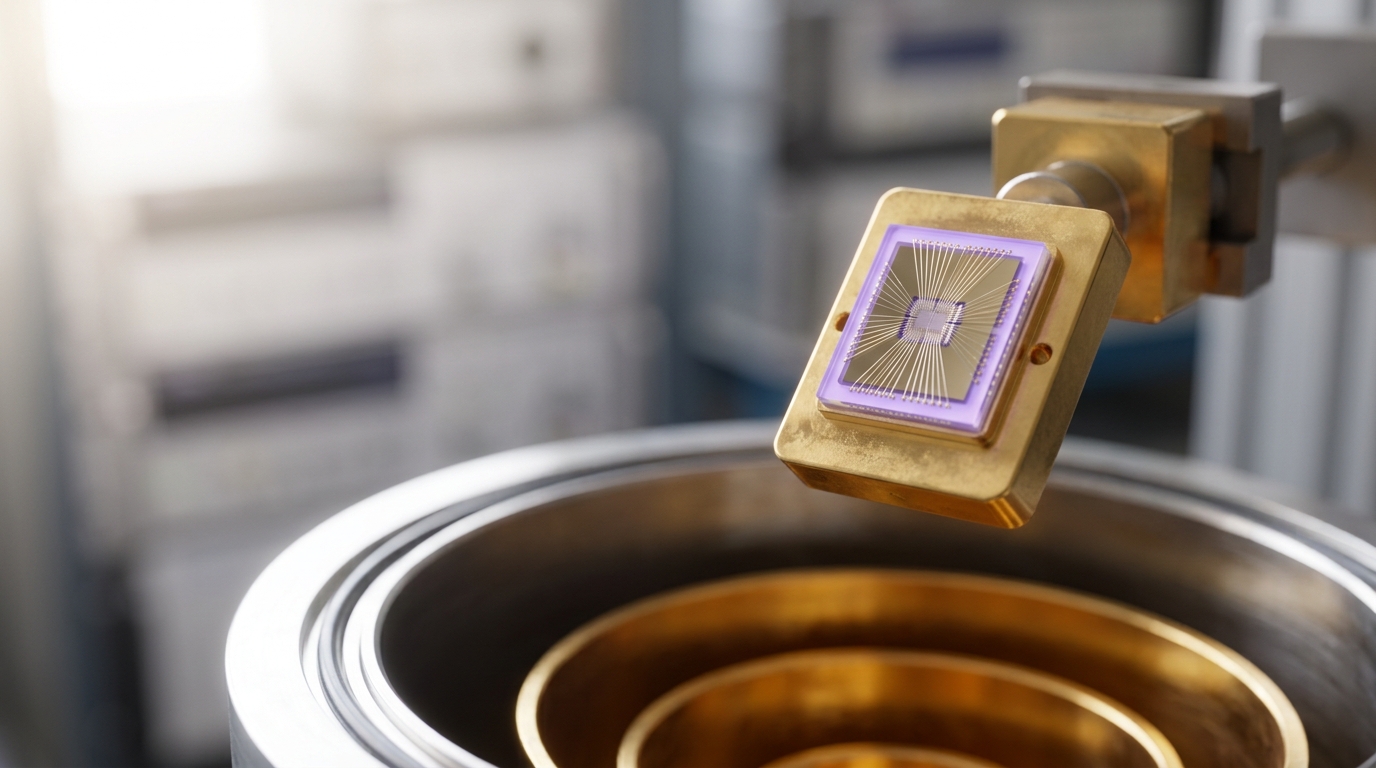
Figure 5. Devices built from these same correlated states turn theory into engineering constraint: a superconducting qubit's coherence is bounded by the very quasiparticles the underlying theory is used to describe. — Image prompt and art direction by Brecht Corbeel; generation pending.
It is worth being explicit, in vendor-claim terms, about what this does and does not establish. A qubit manufacturer’s claim of a particular coherence time is a measured device specification, not a direct confirmation or refutation of any theory of correlated matter; it is downstream of materials quality, fabrication, packaging, and shielding as much as of the underlying pairing mechanism. Attributing a specific coherence-time improvement to “better understanding of BCS physics” without naming the specific engineering change (better shielding, cleaner substrates, gap engineering) overstates what the theory alone explains.
What the comparison actually shows
Laid side by side, the dimensions on which these approaches can be fairly compared are: what each one is (a mechanism, a competing theoretical program, or a numerical instrument); what phenomenology each is built to explain; what its own domain of validity is, stated in the field’s own terms rather than as a vague hedge; and what specific, checkable failure mode marks the edge of that domain. BCS theory explains conventional superconductivity with a phonon-mediated mechanism whose domain is bounded by the Fermi-liquid and weak-coupling assumptions it depends on. RVB and its rival cuprate proposals compete to explain a phenomenology BCS does not reach, and remain genuinely unresolved rather than merely under-tested. DMRG and quantum Monte Carlo do not propose mechanisms at all; they test candidate mechanisms against exact or controlled numerics, each bounded by a distinct and partly provable computational wall — entanglement growth in higher dimensions for DMRG, the sign problem for QMC. Quasiparticle and topological-order frameworks classify what excitations and ground states are possible largely independent of which specific mechanism produces them. And nonequilibrium approaches extend all of the above into a regime where even the basic questions are still being formed.
None of this yields a single winner, and the absence of one is not a shortcoming of the field. A phonon-mediated mechanism, a family of contested doped-Mott-insulator proposals, two numerical methods with complementary and non-overlapping failure modes, a topological classification scheme, and an emerging nonequilibrium research program are not five attempts at the same answer. They are five different instruments pointed at different parts of the same broad problem, and the discipline’s actual progress consists of using each for what it can specifically do, refusing to over-claim past its domain, and being explicit about which questions remain genuinely open.
A reader looking for a scoreboard will not find one here, and should be suspicious of any account of this field that offers one. The honest summary is closer to an inventory of tools and their warranties: BCS theory is warranted for weak-coupling, phonon-mediated, Fermi-liquid superconductors, and its warranty explicitly does not extend to the cuprates. RVB and its rivals are candidate mechanisms for the territory BCS does not cover, still under active adjudication rather than settled. DMRG is warranted, close to optimally, for one-dimensional and quasi-one-dimensional ground states, with a computational cost that grows as the relevant entanglement grows past that regime. Quantum Monte Carlo is warranted for bosonic and unfrustrated fermionic models, and is provably, not just practically, limited on frustrated fermionic ones by the sign problem. Quasiparticle and topological-order frameworks classify what kinds of excitations and order are possible at all, largely independent of which microscopic mechanism produces them in a given material. Nonequilibrium approaches are the newest and least warranted of the group, extending every other item on this list into a regime where the basic vocabulary is still being written. Treating any one of these as a substitute for the others, rather than as a specific instrument with a specific warranty, is the actual mistake to avoid.
Sources
- J. Bardeen, L. N. Cooper, and J. R. Schrieffer. Theory of Superconductivity. Physical Review (1957). DOI: 10.1103/PhysRev.108.1175.
- J. G. Bednorz and K. A. Müller. Possible high Tc superconductivity in the Ba-La-Cu-O system. Zeitschrift für Physik B Condensed Matter (1986). DOI: 10.1007/BF01303701.
- P. W. Anderson. The Resonating Valence Bond State in La2CuO4 and Superconductivity. Science (1987). DOI: 10.1126/science.235.4793.1196.
- Bernhard Keimer, Steven A. Kivelson, Michael R. Norman, Shin-ichi Uchida, and Jan Zaanen. From quantum matter to high-temperature superconductivity in copper oxides. Nature (2015). DOI: 10.1038/nature14165.
- Steven R. White. Density matrix formulation for quantum renormalization groups. Physical Review Letters (1992). DOI: 10.1103/PhysRevLett.69.2863.
- Matthias Troyer and Uwe-Jens Wiese. Computational Complexity and Fundamental Limitations to Fermionic Quantum Monte Carlo Simulations. Physical Review Letters (2005). DOI: 10.1103/PhysRevLett.94.170201.
- R. B. Laughlin. Anomalous Quantum Hall Effect: An Incompressible Quantum Fluid with Fractionally Charged Excitations. Physical Review Letters (1983). DOI: 10.1103/PhysRevLett.50.1395.
- A. Yu. Kitaev. Fault-tolerant quantum computation by anyons. Annals of Physics (2003). DOI: 10.1016/S0003-4916(02)00018-0.
- J. Eisert, M. Friesdorf, and C. Gogolin. Quantum many-body systems out of equilibrium. Nature Physics (2015). DOI: 10.1038/nphys3215.
- Morten Kjaergaard, Mollie E. Schwartz, Jochen Braumüller, Philip Krantz, Joel I.-J. Wang, Simon Gustavsson, and William D. Oliver. Superconducting Qubits: Current State of Play. Annual Review of Condensed Matter Physics (2020). DOI: 10.1146/annurev-conmatphys-031119-050605.
Originally published at https://absolutedigitalpublishers.com/articles/comparing-the-main-approaches-to-quantum-and-condensed-matter-systems.