Comparing the Main Approaches to Precision Cosmology
Three families of explanation compete for the same handful of anomalies — changing the model, distrusting the measurement, and adding new early-universe physics. None of them yet explains everything the others explain.
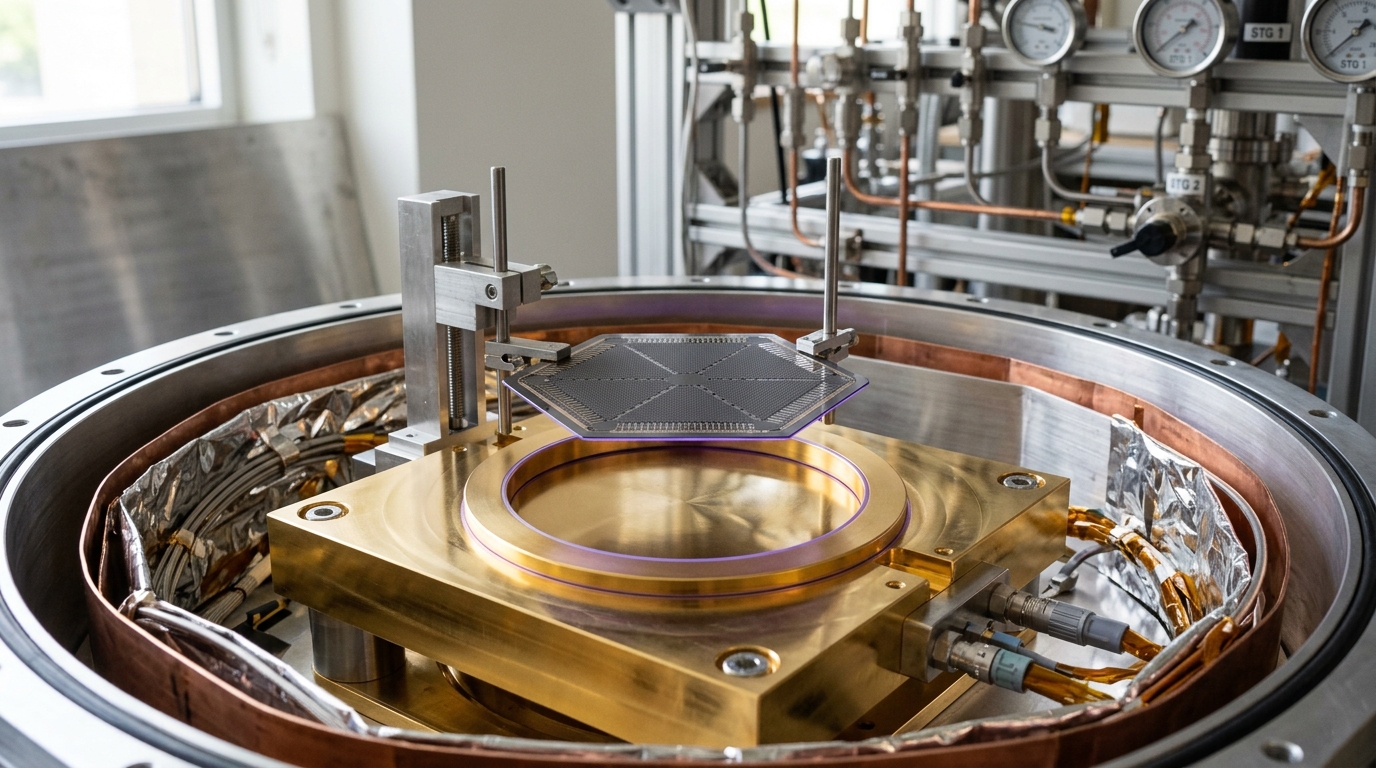
A transition-edge-sensor detector wafer, seconds from seating on the cold stage of a millimeter-wave receiver. — Image prompt and art direction by Brecht Corbeel; generation pending.
Abstract
Precision cosmology now runs two independent measurement programs — the early universe read through the cosmic microwave background, and the late universe read through distance ladders, weak lensing, and galaxy surveys — that disagree with each other at a level too large to be chance and too small to be settled. This article lays out the three live families of response next to one another on the same dimensions: modifying the LambdaCDM model (early dark energy, evolving dark energy), attributing the mismatch to systematic error in one or more of the measurement chains, and adding new early-universe physics beyond the standard recombination history. For each, it states what data the approach explains, what it fails to explain, and what a null result would look like. No approach is declared the winner; several remain live at the time of writing.
Two independent measurement programs now report the expansion history and structure content of the universe, and they do not fully agree. One reads the early universe: the cosmic microwave background, imprinted about 380,000 years after the Big Bang and mapped in its most complete form by the Planck satellite [1]. The other reads the late universe: distance ladders built from Cepheid variables and supernovae, weak gravitational lensing surveys, and galaxy redshift catalogs spanning billions of years of cosmic history [2, 3]. Both programs are precise. Run each through the same six-parameter LambdaCDM model — cold dark matter, a cosmological constant, ordinary baryonic matter, and a handful of initial-condition parameters — and they should predict the same present-day expansion rate and the same present-day clustering of matter. Increasingly, they predict numbers that differ by more than their stated uncertainties allow.
This article is not about which side is right. It is about the shape of the disagreement, and about the three broad families of response competing to resolve it. Framing it as a horse race between named theories obscures the more useful comparison, which is dimensional: what does each family of explanation actually account for, what does it leave dangling, and what observation would rule it out. None of the three families is settled. Treat this as a map of live positions, not a verdict.
The two tensions, stated plainly
The first and best-known disagreement is the Hubble tension. Planck’s CMB analysis, extrapolated forward through LambdaCDM, predicts a present-day expansion rate (the Hubble constant, H0) of roughly 67.4 kilometers per second per megaparsec [1]. The SH0ES collaboration’s local distance-ladder measurement, built from HST observations of Cepheid variables calibrating Type Ia supernovae, instead reports H0 = 73.04 ± 1.04 km/s/Mpc [2]. The two results differ at roughly 5 sigma — a level the SH0ES team states does not appear to arise from measurement error or analysis choices considered so far [2].
The second, quieter disagreement is the S8 tension. S8 is a combination of the amplitude of matter density fluctuations (sigma8) and the matter density parameter (Omega_m), defined as
S_8 \equiv \sigma_8 \sqrt{\Omega_m / 0.3}
Weak gravitational lensing surveys — which measure the distortion of background galaxy shapes by intervening matter, and therefore probe how clustered matter actually is in the late universe — have historically reported S8 values a few percent below what Planck’s early-universe fit predicts [7]. This tension has been smaller and less consistent across surveys than the Hubble tension; the 2025 KiDS Legacy reanalysis, notably, shifted upward into consistency with Planck, while DES’s Y6 release remains on the low side [7]. That instability is itself informative: it is closer to what a systematic-error story predicts than what a new-physics story predicts, a point the comparison below returns to.
A third, more recent data point complicates both: the DESI collaboration’s second data release of baryon acoustic oscillation measurements, drawn from more than 14 million galaxies and quasars, finds its own baseline BAO fit in mild (2.3 sigma) tension with Planck-derived parameters under flat LambdaCDM, and — more strikingly — finds that a time-evolving dark energy equation of state fits the combined DESI, CMB, and supernova data better than a cosmological constant, at a significance ranging from 2.8 to 4.2 sigma depending on which supernova compilation is used [3, 10]. This did not exist as a public data point before 2024, and it reframes the whole field: the anomaly is no longer only “H0 measured two ways disagrees.” It is now “the equation of state of dark energy itself may not be constant.”
Approach one: modify the LambdaCDM model
The most direct response is to add a new ingredient to the model rather than treat either measurement as flawed. Two variants dominate the literature.
Early dark energy (EDE) proposes a scalar field that behaves like a cosmological constant for a brief window around matter-radiation equality (redshift z ≳ 3000) and then dilutes away faster than matter, contributing negligibly today [5]. Its appeal is specific: the Hubble tension is, at bottom, a disagreement about the sound horizon — the comoving distance sound waves traveled in the pre-recombination plasma, denoted r_s. The CMB measures the angular size of that ruler on the sky with exquisite precision; a smaller physical ruler, for the same measured angle, implies a larger inferred H0. EDE works by briefly increasing the expansion rate before recombination, shrinking r_s, and pulling the CMB-inferred H0 up toward the SH0ES value — without touching anything about the late universe, where the SH0ES measurement lives.
What EDE explains: it can close a substantial fraction of the Hubble tension while leaving the well-tested late-universe physics (structure growth, BAO peak positions relative to r_s, supernova magnitudes) essentially alone, because its effect turns off well before those epochs matter [5].
What EDE fails to explain, or complicates: pushing more energy density into the early universe to shrink r_s also tends to increase the fitted amplitude of matter fluctuations, sigma8 — worsening the S8 tension rather than helping it, a well-documented tradeoff in the 2023 review of EDE models [6]. It also requires new large-scale-structure and CMB polarization data to distinguish it from LambdaCDM at high significance; as of the 2023 review, no EDE model fits current data decisively better than LambdaCDM once the full parameter space and its priors are accounted for, and viable models occupy a narrower slice of parameter space than early announcements suggested [6].
Evolving dark energy, in the w0-wa parametrization, keeps the sound horizon alone and instead lets dark energy’s equation of state change with cosmic time:
w(a) = w_0 + w_a (1 - a)
where a is the cosmic scale factor (a = 1 today) and w = -1 recovers a plain cosmological constant. This is the family DESI’s DR2 BAO release put back on the table: fit jointly to DESI BAO, Planck CMB, and supernovae, a w0-wa model is preferred over flat LambdaCDM at up to several sigma, with the preferred trajectory suggesting dark energy was somewhat more negative than -1 in the past and is evolving toward less negative values now [3, 4].
What w0-wa explains: it directly addresses the specific measurement that motivated it — a genuine, reproduced shift in the BAO distance-redshift relation relative to LambdaCDM’s prediction, present in an independent successor analysis using extended datasets and multiple supernova compilations [4]. It does not, by itself, close the Hubble tension; it is a separate anomaly that happens to appear in the same generation of data.
What w0-wa fails to explain: the preferred trajectory has no settled physical model behind it yet — it is presently a fit to a functional form, not a derivation from a specific field theory, and the significance depends on which supernova sample is included, which is exactly the kind of dataset-dependence that invites a systematics explanation rather than a new-physics one [3].
Approach two: attribute the mismatch to systematic error
The second family does not add anything to LambdaCDM. It argues that one or more of the measurement chains carries an uncorrected systematic bias — in calibration, in selection, or in an assumed physical relationship used to convert a raw observable into a distance or a shear.
For the Hubble tension, the candidate systematics live in the distance ladder: Cepheid period-luminosity calibration, potential contamination of Cepheid photometry by crowding in the host galaxy, the photometric zero-point tying HST filters together across rungs, and the calibration anchor itself (the geometric distance to the Large Magellanic Cloud or NGC 4258). The SH0ES collaboration has directly addressed several of these by construction — using the same instrument and filters across rungs specifically to cancel zero-point discontinuities, and cross-checking against multiple anchors [2]. That does not make a systematic explanation impossible; it means any remaining systematic-error account now has to identify a specific mechanism that survives those cross-checks, which is a narrower and more falsifiable claim than a general appeal to “the ladder is probably wrong somewhere.”
For the S8 tension, the systematics-first case is comparatively stronger, precisely because the tension itself has moved. The 2025 KiDS Legacy reanalysis — using an updated pipeline and larger galaxy-shear catalog — shifted the measured S8 upward into agreement with Planck, while DES’s independently processed Y6 catalog remains low [7]. A single physical parameter in nature does not become “less discrepant” because one survey re-ran its pipeline; a shared calibration or intrinsic-alignment systematic moving between analysis versions is a more economical explanation than new physics that must also somehow track pipeline choices.
What systematic-error accounts explain: they require no new field, no new energy component, and no revision to a well-tested standard model; when a specific systematic is identified and corrected, and the tension narrows, this is direct, strong evidence for that account, as arguably happened with KiDS.
What systematic-error accounts fail to explain: they do not yet identify a single mechanism, checked and confirmed, that accounts for the full Hubble-tension gap — the SH0ES team’s own stress-testing found no such mechanism as of their 2022 analysis [2] — and a systematic account for one tension does nothing by default to explain the other; it is two separate arguments that happen to be filed under the same heading.
Approach three: new physics in the early universe, beyond a single scalar field
A third family sits adjacent to early dark energy but is broader: any modification to the pre-recombination universe that changes r_s or the expansion history at z ≳ 1000 without being the specific EDE scalar-field construction. This includes extra relativistic species (additional “dark radiation” beyond the three known neutrino species, changing the radiation-domination era), modified neutrino interactions, or primordial magnetic fields altering recombination physics. DESI’s own neutrino-mass bound is a useful anchor here: combining DESI with CMB data under flat LambdaCDM gives an upper limit on the summed neutrino mass of 0.064 eV, loosening to 0.16 eV once a w0-wa dark energy sector is allowed [3] — a reminder that early-universe model choices and the neutrino sector are coupled, and that loosening one loosens the other.
What this family explains: like EDE, it targets the sound horizon and can in principle be tuned to relieve the Hubble tension without disturbing late-time observables, since the new physics operates and then stops mattering before structure formation proceeds.
What this family fails to explain: it faces the same generic problem as EDE — degeneracy with sigma8 and matter clustering — and it is currently the least constrained of the three families precisely because it is the broadest category, covering many candidate mechanisms rather than one falsifiable model. A broad family that is hard to falsify is not evidence in its own favor; it is evidence that this family needs a specific, testable member before it can be evaluated on the same footing as the other two.
What would resolve this, and what would not
None of the three families produces the observation that would end the disagreement outright; each proposes something more modest.
Early dark energy and new early-universe physics predict a specific signature in CMB polarization on intermediate angular scales, distinct from a pure LambdaCDM spectrum, that next-generation ground-based CMB surveys are built to detect. The Simons Observatory, now under construction in Chile’s Atacama Plateau, and the planned CMB-S4 program are both designed explicitly to improve constraints on exactly this kind of early-universe physics, alongside the search for primordial gravitational waves and light relic particles [9, 8]. A clean detection of the specific EDE polarization signature, at the amplitude needed to resolve the Hubble tension, would be strong positive evidence; its absence at the relevant sensitivity would substantially disfavor EDE as the resolution, though it would not by itself disfavor the entire new-early-universe-physics family, since other mechanisms make different predictions.
Evolving dark energy predicts that the preference for w0-wa over a cosmological constant should sharpen, not average away, as DESI accumulates more years of BAO data and as independent supernova samples converge, since dataset-dependence is currently one of its weaker points [3, 4]. If a future DESI data release with a larger galaxy sample and a supernova-independent check finds the preference for w0-wa evaporating, that would be evidence for a transient systematic in the current sample rather than a real evolving equation of state. This is testable within the current decade, since DESI’s survey program continues to accumulate BAO tracers each year [10].
Systematic-error accounts predict that identifying and correcting the specific bias should make the tension shrink measurably in that one channel without requiring any new physics elsewhere — the pattern arguably already observed once, in the KiDS Legacy S8 shift [7]. The account is falsified, in any given channel, if independent groups re-derive the same measurement with materially different pipelines, calibration choices, and anchors, and the discrepancy persists rather than narrowing — which is closer to the present status of the Hubble tension than of the S8 tension.
Why the dimensions matter more than the labels
It is tempting to compress this into a single scoreboard — which family currently “wins.” Resist that compression, for two reasons specific to this field.
First, the three families are not mutually exclusive. A universe could plausibly contain a modest, uncorrected calibration offset in one distance-ladder rung and a genuine early-universe modification and a dark energy sector that departs mildly from a constant — each contributing a fraction of an observed gap rather than one contributing all of it. Cosmological parameter fits are joint fits across many parameters at once; a partial resolution from one family changes the preferred region of parameter space for the others, which is part of why the DESI collaboration reports its neutrino-mass bound separately under flat LambdaCDM and under an evolving-dark-energy model rather than as one universal number [3]. Treating the tensions as a single yes/no question invites exactly the kind of false precision the underlying data does not support.
Second, the three families differ in how directly they are testable, and that difference is itself information. A systematic-error claim about a specific calibration step is falsifiable within a single survey’s own reanalysis, on a timescale of months to a few years — which is why the KiDS Legacy shift is such a clean data point either way it had gone. A claim about the dark energy equation of state needs an independent tracer and several more years of accumulated survey volume before the current 3-to-4-sigma preference can be called a discovery rather than a fluctuation worth watching. A claim about new early-universe physics needs an entirely new instrument generation, because the relevant signal sits in a part of the CMB polarization spectrum current instruments were not built to resolve at the necessary sensitivity. Readers should weight confidence accordingly: the shorter the observational path to falsification, the more the current status should be read as “provisional and about to be checked,” and the longer that path, the more today’s fit should be read as “consistent with, but not yet distinguishing between, several live possibilities.”
That asymmetry also explains why popular coverage of these results often overstates certainty in both directions — announcing a new dark energy discovery on a single data release, or declaring the standard model refuted, when the underlying papers themselves report significance levels that depend on which secondary dataset is included and explicitly frame the result as a preference, not a detection [3, 4]. The responsible read sits between those two headlines.
Reading the comparison honestly
Laid side by side, the three families are not actually competing for the same job. Evolving dark energy targets a genuinely new BAO-scale anomaly that did not exist as public data before DESI DR2. Early dark energy and broader new-early-universe-physics proposals target the sound horizon specifically, and both carry an unresolved cost in the matter-clustering sector that has not been fully paid down. Systematic-error accounts target the measurement chains directly and have already scored one clear success — but that success was in the S8 channel, which was the smaller and less stable of the two tensions to begin with, not the Hubble tension, where the distance-ladder team’s own stress tests have so far failed to locate the systematic a purely-error account requires [2, 7].
None of this licenses a headline claiming cosmology is “broken,” and none of it licenses the opposite headline that the standard model has been vindicated. The honest summary is procedural: multiple independent surveys — DESI’s spectroscopic program, the Simons Observatory and CMB-S4’s polarization measurements, and the next generation of weak-lensing catalogs — are converging on exactly the observations that would discriminate between these families over the next several years [10, 9, 8]. Until that data lands, treating any one of the three families as the explanation is premature, and treating the disagreement as evidence for a specific favored alternative to LambdaCDM, chosen in advance of that data, is not analysis — it is priors doing the work that measurement has not yet done.
Figure 1. Two independent measurement chains, built on the same bench, calibrated against different standards. — Image prompt and art direction by Brecht Corbeel; generation pending.
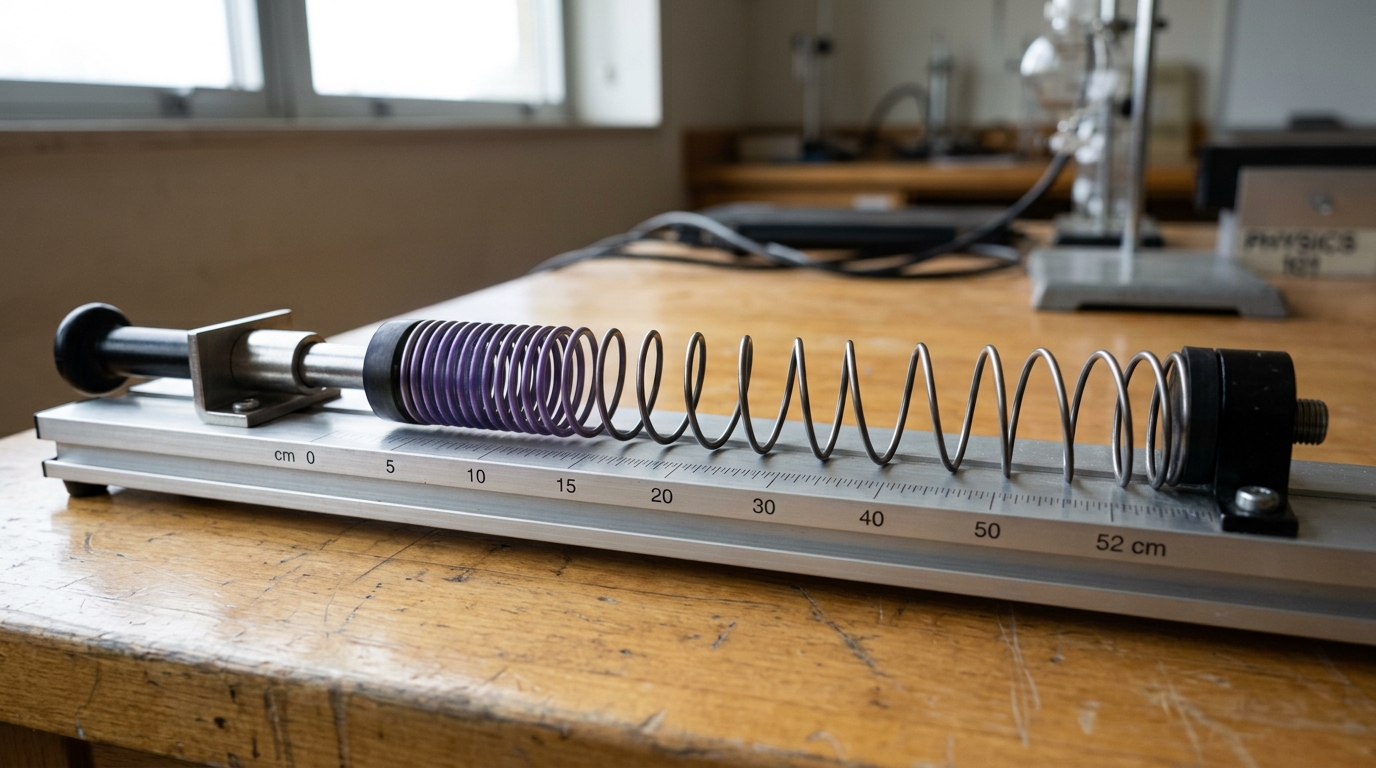
Figure 2. A bench analogy for a field that briefly stiffens then relaxes — the mechanical intuition behind early dark energy. — Image prompt and art direction by Brecht Corbeel; generation pending.
Figure 3. A fiber-positioner focal plane mid-reconfiguration between exposures — the mechanical heart of a spectroscopic survey. — Image prompt and art direction by Brecht Corbeel; generation pending.
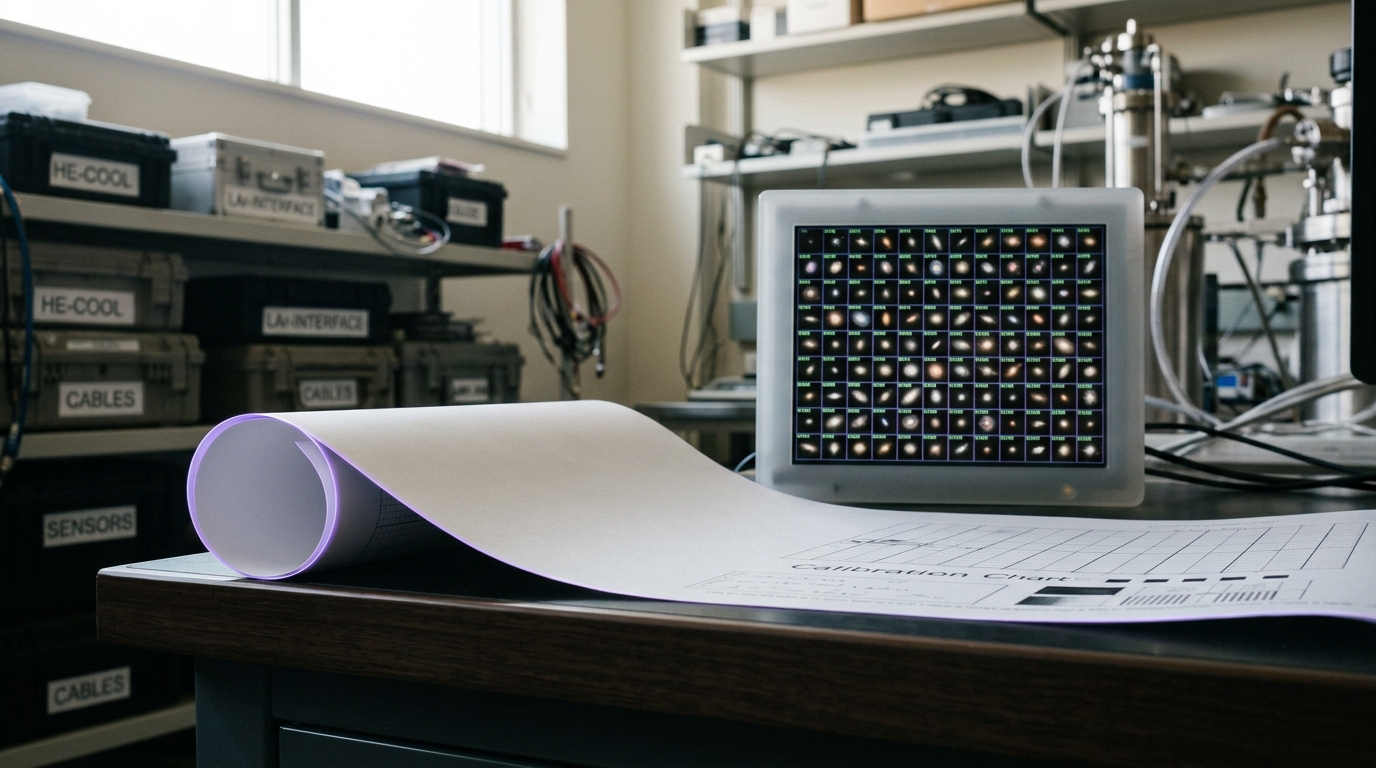
Figure 4. A weak-lensing shear-calibration desk, where systematic-error explanations for the tensions are tested one correction at a time. — Image prompt and art direction by Brecht Corbeel; generation pending.
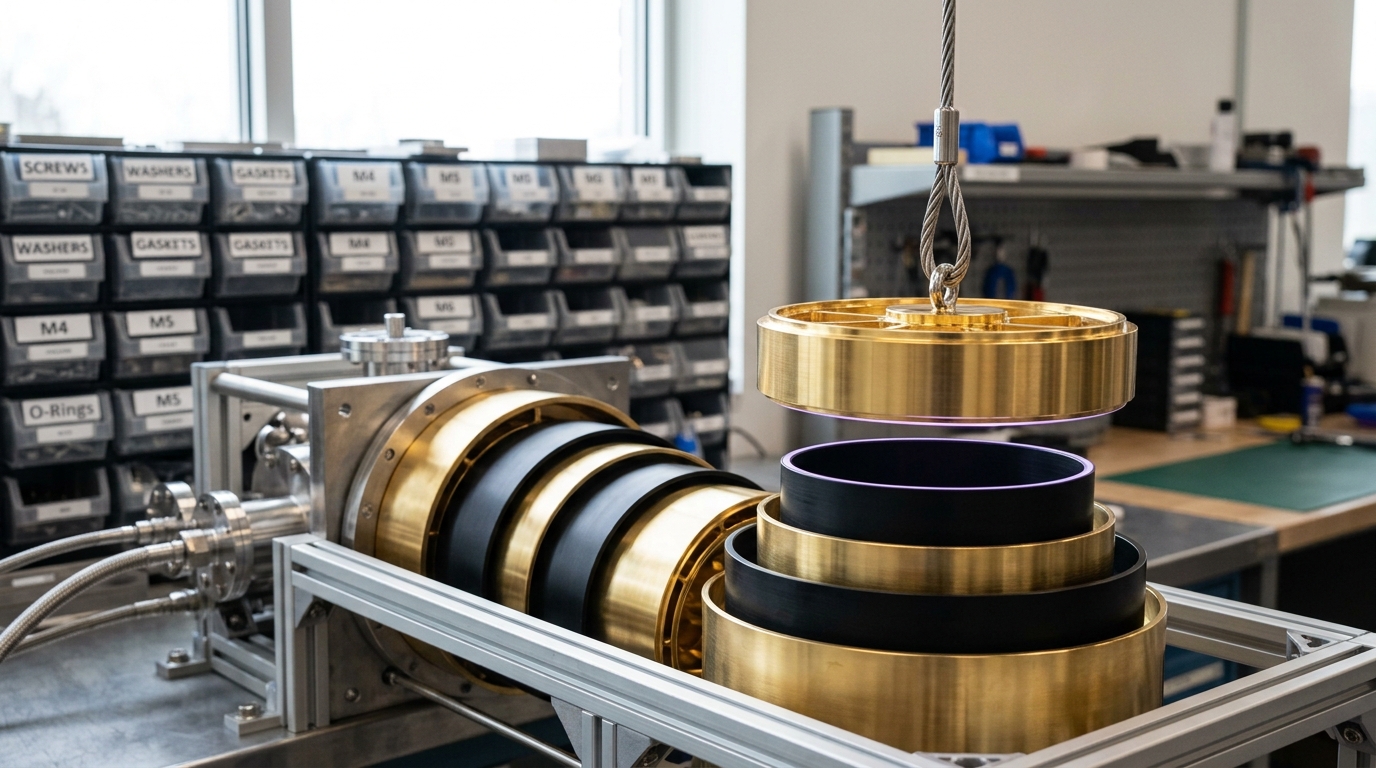
Figure 5. Nested radiation shields for a next-generation receiver, one still being lowered into place — new early-universe physics adds a shield, not a repaint. — Image prompt and art direction by Brecht Corbeel; generation pending.
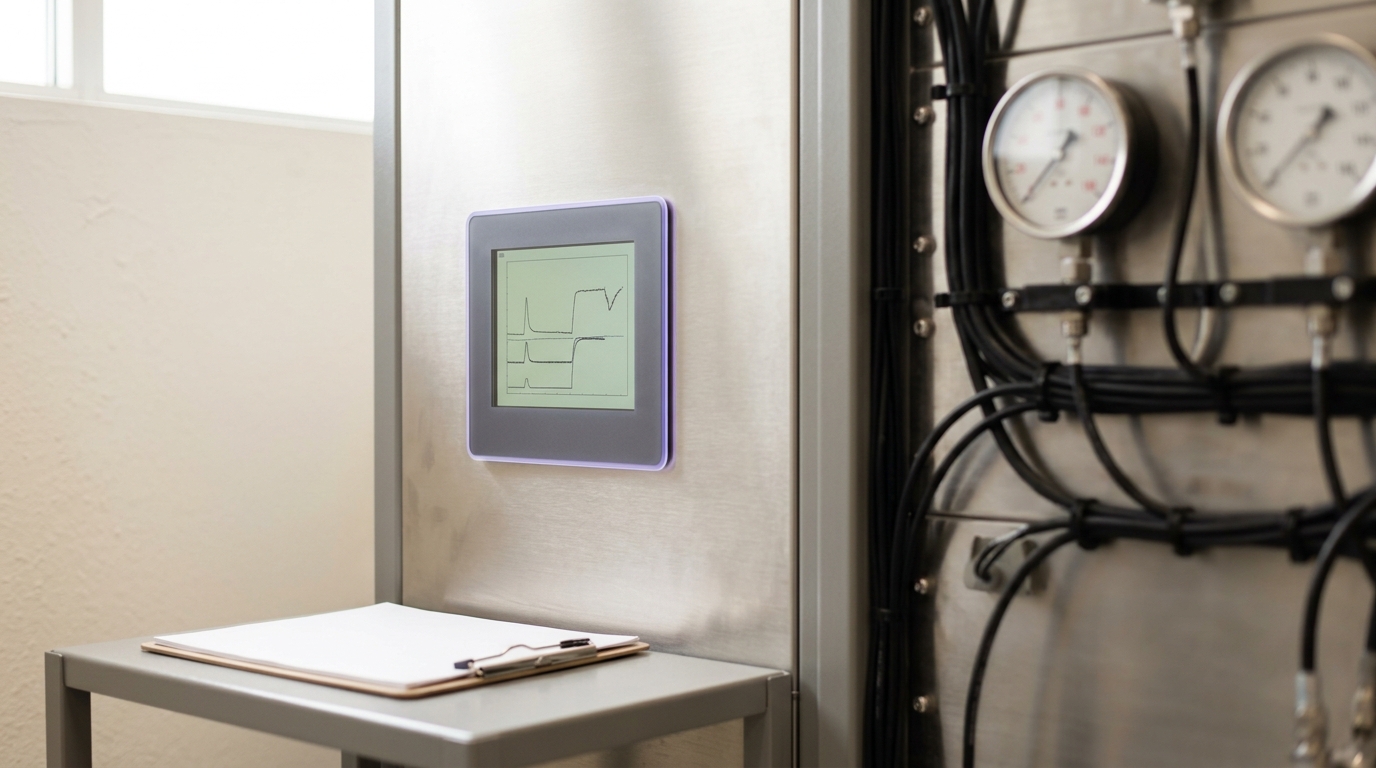
Figure 6. Housekeeping traces from a live cooldown — the ordinary instrument work underneath every reported cosmological number. — Image prompt and art direction by Brecht Corbeel; generation pending.
Sources
- Planck Collaboration. Planck 2018 results. VI. Cosmological parameters. Astronomy & Astrophysics (2020). DOI: 10.1051/0004-6361/201833910.
- Adam G. Riess, Wenlong Yuan, Lucas M. Macri, et al.. A Comprehensive Measurement of the Local Value of the Hubble Constant with 1 km/s/Mpc Uncertainty from the Hubble Space Telescope and the SH0ES Team. The Astrophysical Journal Letters (2022). DOI: 10.3847/2041-8213/ac5c5b.
- DESI Collaboration. DESI DR2 Results II: Measurements of Baryon Acoustic Oscillations and Cosmological Constraints. Physical Review D (2025). DOI: 10.1103/PhysRevD.112.083515.
- DESI Collaboration. Extended Dark Energy analysis using DESI DR2 BAO measurements. Physical Review D (2025). DOI: 10.1103/w4c6-1r5j.
- Vivian Poulin, Tristan L. Smith, Tanvi Karwal, Marc Kamionkowski. Early Dark Energy Can Resolve The Hubble Tension. Physical Review Letters (2019). DOI: 10.1103/PhysRevLett.122.221301.
- Vivian Poulin, Tristan L. Smith, Tanvi Karwal. The Ups and Downs of Early Dark Energy solutions to the Hubble tension: a review of models, hints and constraints circa 2023. Physics of the Dark Universe / arXiv (2023). DOI: 10.1016/j.dark.2023.101348.
- Astrobites (summarizing KiDS Legacy collaboration). Is the sigma-8 tension being sheared away? Cosmology with weak lensing from KiDS. astrobites.org (2025).
- CMB-S4 Collaboration. Snowmass 2021 CMB-S4 White Paper. arXiv (2022).
- Simons Observatory Collaboration. The Simons Observatory: Astro2020 Decadal Project Whitepaper. arXiv (2019).
- DESI Collaboration. DESI DR2 Results: March 19 Guide. desi.lbl.gov (2025).
Originally published at https://absolutedigitalpublishers.com/articles/comparing-the-main-approaches-to-precision-cosmology.