Comparing the Main Approaches to Particle Physics Beyond the Standard Model
Supersymmetry, extra dimensions, hidden sectors, and effective field theory all predict a layer beneath the Standard Model. Null collider results have not eliminated any of them, but they have changed what each can still say.
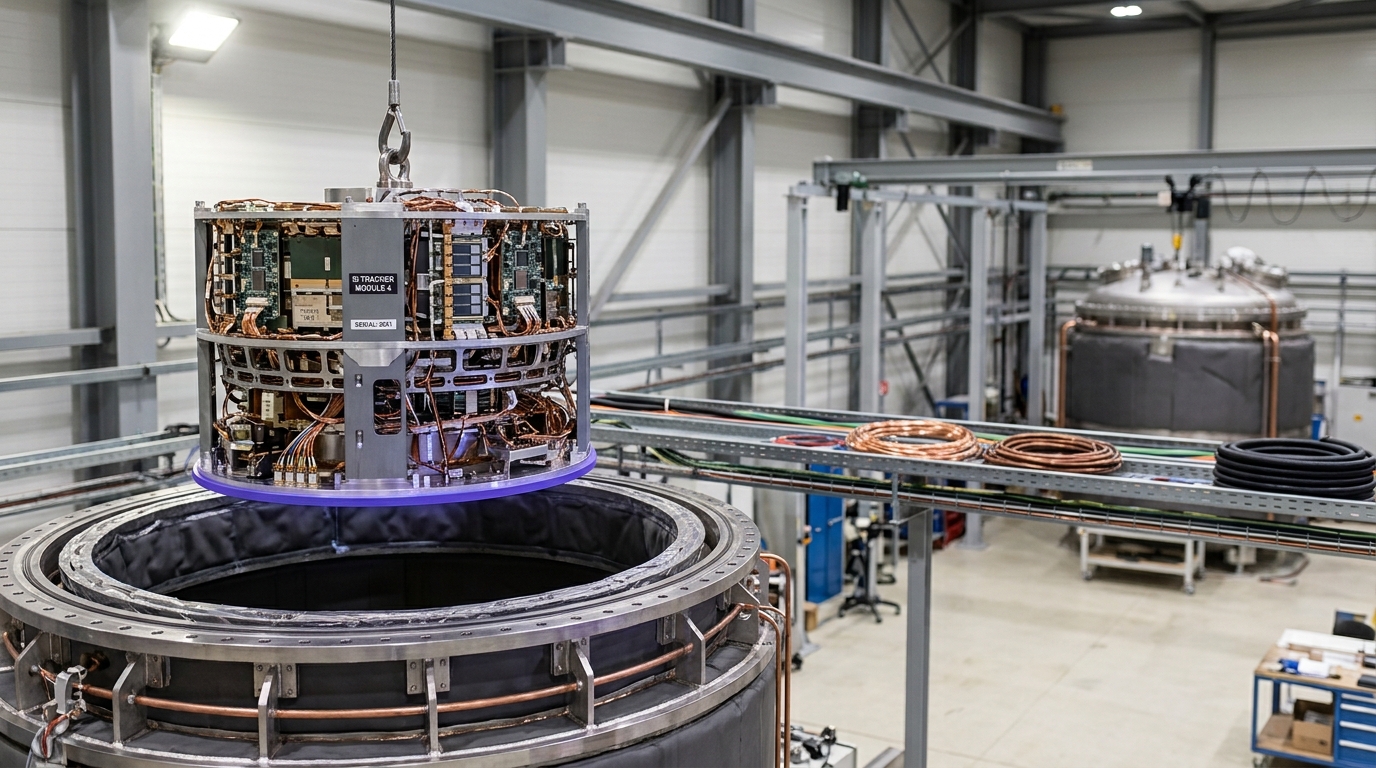
Exclusion, not discovery: each new run narrows where a partner particle, an extra dimension, or a hidden-sector boson could still be hiding — it does not say one exists. — Image prompt and art direction by Brecht Corbeel; generation pending.
Abstract
The Standard Model is complete as an equation but visibly incomplete as a description of nature — it has no dark matter candidate, no mechanism for neutrino mass, and no explanation for why the weak scale sits sixteen orders of magnitude below the Planck scale. Four broad research programs answer that incompleteness differently: supersymmetry posits a partner particle for every known one; extra-dimensional models let gravity dilute into unseen geometry; dark-sector models add a parallel, weakly-coupled particle content; and effective field theory refuses to guess the underlying model at all, instead cataloguing every deviation the Standard Model's own field content could produce. This article sets the four side by side on the same axes — what each predicts, what the LHC, neutrino, and flavor experiments have already excluded, and what continuing to find nothing would still mean for the field.
The Standard Model of particle physics has now survived roughly fifty years of increasingly precise experimental attack without a single confirmed internal contradiction. That is, on its own terms, an extraordinary result. It is also not the same thing as completeness. The Standard Model has no particle that behaves like the dark matter astronomers infer from galaxy rotation curves and gravitational lensing. It has no built-in mechanism for the tiny but nonzero masses neutrinos are now known to carry. It offers no reason why the weak scale, around 100 GeV, sits some sixteen orders of magnitude below the Planck scale where gravity becomes strong — the “hierarchy problem.” And it treats dozens of parameters, from quark masses to mixing angles, as measured inputs rather than derived consequences. Something beyond the Standard Model has to give an account of at least some of this. The question this article compares is not whether new physics exists — most working physicists assume some form of it must — but which of the major research programs aimed at finding it has fared better against two decades of collider, neutrino, and flavor data, and what “fared better” can honestly be claimed to mean at this point [1].
Four programs, one incompleteness
It is worth being precise about what distinguishes the four approaches compared here, because they are not four guesses at the same theory — they are four different strategies for locating new physics at all.
Supersymmetry (SUSY) proposes a symmetry relating fermions and bosons, requiring every known Standard Model particle to have a superpartner differing in spin by one-half unit. In its most studied, weak-scale form, SUSY was motivated by three problems at once: it stabilizes the Higgs mass against runaway quantum corrections (the hierarchy problem), it provides a natural dark matter candidate in the lightest, stable superpartner, and — in its minimal supersymmetric form — it makes the three Standard Model gauge couplings converge cleanly at a single high-energy scale, suggestive of grand unification.
Extra-dimensional models keep four-dimensional particle content largely as is but add extra spatial dimensions, compactified or warped, in which gravity — and, in some versions, other fields — can propagate. The appeal is again the hierarchy problem: if gravity’s true strength is diluted across large or warped extra dimensions, the scale at which quantum gravity becomes strong could be far lower than the apparent four-dimensional Planck mass, potentially within reach of collider energies.
Dark-sector and hidden-photon models are more modest in scope. Rather than fixing the hierarchy problem, they add a separate, weakly coupled sector of particles — often including a “dark photon” that mixes kinetically with the ordinary photon — motivated directly by the astrophysical evidence for dark matter rather than by naturalness arguments.
Effective field theory (EFT), in the specific form called SMEFT (the Standard Model Effective Field Theory), makes the fewest assumptions of all. Rather than proposing new particles, it adds every allowed higher-dimension operator built from Standard Model fields to the Standard Model Lagrangian, each suppressed by inverse powers of an unknown high energy scale. It does not predict what the new physics is — it predicts, model-independently, what any new physics heavy enough to have not yet been produced directly would look like as a small distortion of processes we can already measure [7].
These four are not mutually exclusive, and this article does not rank them. A version of SUSY could exist inside an extra-dimensional framework; dark-sector particles could show up as specific SMEFT operators at low energy before their full particle content is resolved. What follows compares them on shared, checkable ground: what each would look like if seen, what has already been excluded, and what a continued absence would and would not tell us.
What collider data has actually excluded
The clearest, least ambiguous results in this comparison come from direct production searches at the Large Hadron Collider, because a direct search either sees an excess over Standard Model background or it does not, and after a decade of running at the LHC, it mostly has not.
For weak-scale supersymmetry, ATLAS and CMS have searched extensively for gluinos, squarks, charginos, and neutralinos in a wide range of final states, including compressed-spectrum and long-lived-particle scenarios designed to catch versions of SUSY that evade the simplest searches. As of the most recent joint summary presented at the 2025 Rencontres de Moriond conference, electroweak production searches exclude higgsino and wino masses up to roughly 800 GeV in simplified models, gluino masses up to several TeV in R-parity-violating scenarios, and slepton masses up to around 400 GeV, depending on the assumed decay channel and mass splitting [2]. No convincing excess consistent with supersymmetric particle production has appeared in any of these channels. This is a fact, not an interpretation: the simplest, most “natural” versions of weak-scale SUSY, in which superpartner masses sit close enough to the weak scale to solve the hierarchy problem without reintroducing fine-tuning, are now under real strain. It is not correct, however, to say SUSY as a theoretical framework has been excluded. Heavier, more finely tuned, or more exotic-signature (long-lived, compressed, R-parity-violating) versions of supersymmetry remain viable; what has narrowed is the space in which SUSY solves the hierarchy problem without reintroducing a milder version of the same fine-tuning it was invented to remove.

Figure 1. Supersymmetry predicts a partner for every Standard Model particle; the LHC's tracker modules are what would have caught the lightest one — instead they have caught only tighter mass limits. — Image prompt and art direction by Brecht Corbeel; generation pending.
Extra-dimensional models have fared similarly. Searches for microscopic black holes, string balls, and Kaluza-Klein graviton resonances — the collider-scale signatures of large or warped extra dimensions — have found nothing beyond Standard Model expectation at energies now reaching several TeV, pushing the effective Planck scale in these models well above what early large-extra-dimension proposals originally hoped would be accessible at the LHC [9]. As with SUSY, this does not exclude extra dimensions as a category — it excludes the specific parameter regions in which the fundamental gravity scale would be low enough to produce microscopic black holes or resonant gravitons at LHC energies, which was precisely the regime that made those models attractive as a low-energy solution to the hierarchy problem in the first place.

Figure 2. Extra-dimensional models trade a hidden partner particle for hidden geometry — a fix for the hierarchy problem that so far shows up only as an absence at the energies gravity would need to strengthen. — Image prompt and art direction by Brecht Corbeel; generation pending.
The dark sector: a different kind of search
Dark-sector and hidden-photon searches are methodologically distinct from SUSY and extra-dimension searches, because the signal they are looking for is not a heavy new particle produced at high energy but a light, extremely weakly coupled one that could have been missed precisely because it barely interacts. ATLAS’s long-lived-particle program, for example, searches for displaced leptons and displaced vertices — decay signatures that occur measurably far from the original collision point, as would happen if a light hidden-sector particle traveled some distance before decaying. The most recent such search, combining the full LHC Run 2 dataset with early Run 3 data, sets new limits on models with pair-produced long-lived sleptons and on dark-sector models with pair-produced chargino-like states, again without observing a significant excess [6].
What makes the dark sector program distinct is that a null result here is weaker evidence against the underlying motivation than a null SUSY or extra-dimensions result is against naturalness. Dark matter’s existence is established by gravitational evidence independent of any particle model; dark-sector searches are testing specific candidate mediators for a particle we already have strong indirect evidence must exist in some form. Excluding a hidden photon in some mass-coupling range narrows the map of viable dark-sector candidates without touching the underlying motivation the way a null SUSY search erodes the naturalness argument for SUSY.

Figure 3. Hidden-sector and dark-photon searches look for a much fainter signal than a new heavy particle — a light, weakly coupled force sitting almost, but not quite, out of reach of existing photomultiplier arrays. — Image prompt and art direction by Brecht Corbeel; generation pending.
Neutrinos, flavor, and the anomalies that did and did not survive
Two other experimental fronts bear on this comparison, and they illustrate the discipline of not overclaiming in opposite directions.
The KATRIN experiment, which measures the endpoint of tritium beta decay to directly bound the neutrino mass without relying on cosmological assumptions, reported in 2024 an upper limit of 0.45 eV at 90% confidence, based on 259 days of data — tightening its own previous limit by roughly a factor of two [3]. This result constrains, but does not by itself favor, any one beyond-Standard-Model framework: neutrino mass requires new physics of some kind (the Standard Model as originally formulated has exactly massless neutrinos), and mechanisms compatible with it exist within SUSY, EFT-style seesaw operators, and other frameworks alike. KATRIN narrows a shared constraint rather than adjudicating between programs.
Flavor physics has produced the field’s clearest recent lesson in not overclaiming an anomaly. For several years, LHCb measurements of the ratios R(K) and R(K*) — which test whether the Standard Model’s prediction that electrons and muons behave identically in certain B-meson decays actually holds — showed a persistent tension with Standard Model predictions, and those tensions were widely discussed as a possible sign of new physics coupling differently to different lepton flavors. In 2022, LHCb’s improved analysis of the complete Run 1 and Run 2 dataset brought both R(K) and R(K*) into agreement with the Standard Model at the one-sigma level, superseding the earlier results that had shown tension [5]. The lesson generalizes: some flavor observables in the same family of b→sℓℓ decays continue to show milder tensions, and the field’s honest position is that the R(K)/R(K*) anomaly specifically has receded with more data, while the broader question of lepton-flavor-universality violation in B decays is not closed. Treating an early-data anomaly as a discovery, and then treating its resolution as proof no new physics exists anywhere in flavor, are both overclaims the data does not support.
The muon’s anomalous magnetic moment, g−2, tells a related but separate story on the theory side rather than the experimental side. Fermilab’s Muon g−2 experiment released its final, most precise measurement in June 2025, reaching 127 parts-per-billion precision and confirming its own earlier results [4]. What has moved is not the measurement but the Standard Model prediction against which it is compared: newer lattice-QCD calculations of the hadronic vacuum polarization contribution have shifted the theoretical prediction closer to the measured value, substantially narrowing what had briefly looked like a multi-sigma discrepancy. This is a case where the “anomaly” was never a clean discovery signal — it was, and largely remains, a disagreement between two theoretical calculation methods that has not yet been settled, layered under an experimental result that is not itself in question.

Figure 4. Effective field theory does not propose a new particle at all — it re-patches the Standard Model's own couplings, asking only how far each one could be nudged before an experiment would already have noticed. — Image prompt and art direction by Brecht Corbeel; generation pending.
Effective field theory: comparing without guessing
SMEFT occupies a different position in this comparison because it is not competing to be the correct underlying theory — it is a bookkeeping framework for any underlying theory heavy enough to not yet have been produced directly. Concretely, SMEFT adds effective operators to the Standard Model Lagrangian, each suppressed by powers of an energy scale \Lambda representing the mass of whatever new particles generate it:
\mathcal{L}_{\text{SMEFT}} = \mathcal{L}_{\text{SM}} + \sum_i \frac{c_i}{\Lambda^{2}} \mathcal{O}_i^{(6)} + \mathcal{O}\!\left(\frac{1}{\Lambda^{4}}\right)
where each \mathcal{O}_i^{(6)} is a dimension-six operator built from Standard Model fields and c_i is a dimensionless Wilson coefficient set by the details of the underlying theory. This notation is worth showing because it makes the comparison’s real structure explicit: SUSY, extra dimensions, and dark-sector models are each, in this language, a specific choice of which \mathcal{O}_i operators get generated and with what coefficients. A null search in a global SMEFT fit constrains c_i/\Lambda^2 combinations directly from precision electroweak, Higgs, and flavor data, without committing to which particle content produced them [7]. The tradeoff is exactly the one implied by that generality: an EFT fit can tell you that new physics coupling to a particular operator must lie above some energy scale, but it cannot, by itself, tell you whether that new physics looks like a superpartner, a Kaluza-Klein mode, or a dark-sector mediator. It is the most model-independent of the four approaches and, for that reason, the hardest to describe as “confirmed” or “excluded” in the way a direct search can be.
What continuing to find nothing would and would not mean
It is tempting, after a decade of null direct searches, to declare the naturalness-motivated programs — weak-scale SUSY and low-scale extra dimensions — dead and the model-independent EFT approach the presumptive winner by default. That conclusion overstates what has actually happened. What the LHC has excluded is specific, calculable mass ranges within specific, calculable models; it has not excluded supersymmetry or extra dimensions as categories, because both admit versions (heavier superpartners, more compressed spectra, higher-scale extra dimensions) that remain untested and, in some cases, will remain untested by any currently operating facility. What has changed is the naturalness argument that made the weak-scale versions of these theories especially attractive in the first place: the more the “natural” parameter space shrinks, the more any surviving version of these theories requires the same kind of fine-tuning its proponents originally hoped to avoid. That is a real theoretical cost, and serious voices within each community have said so publicly. It is not the same claim as “SUSY is falsified,” and treating it as equivalent to falsification would be an overclaim in the other direction.
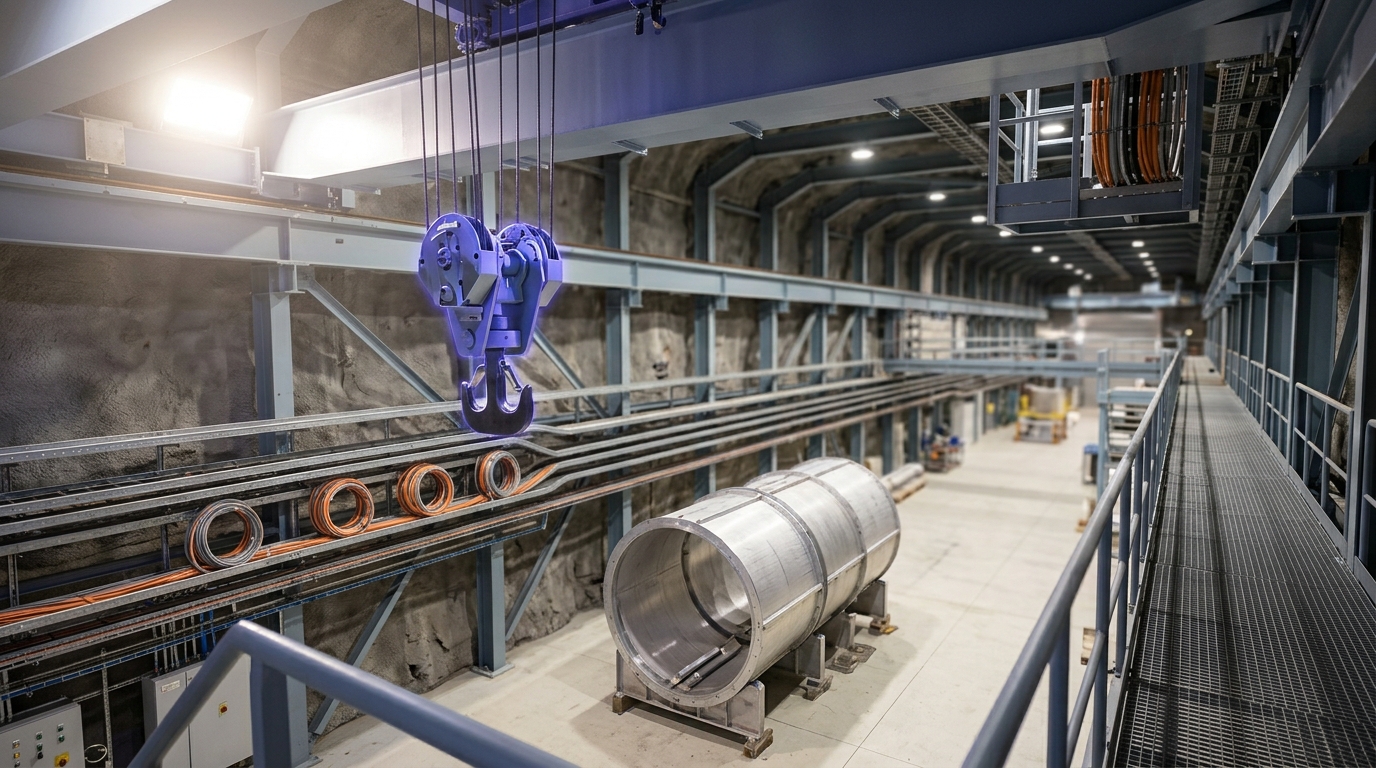
Figure 5. A future collider is itself a bet on which of these approaches is worth another decade of hardware — the current feasibility review commits money to the tunnel, not to any one theory. — Image prompt and art direction by Brecht Corbeel; generation pending.
The next scheduled step in the search is not a new theory but a new machine. In November 2025, the CERN Council reviewed the completed Feasibility Study for a Future Circular Collider and concluded that the project remains technically viable with no identified showstoppers, while flagging substantial remaining work on siting, cost, and financing; a further recommendation is expected in May 2026 as part of the European Strategy for Particle Physics update, with a construction decision anticipated around 2028 [8]. It is worth being explicit about what a machine like the FCC would and would not resolve. A higher-energy, higher-luminosity collider would extend direct search reach for all four approaches compared here — heavier superpartners, higher extra-dimensional Planck scales, and rarer dark-sector production would all become newly testable, and Higgs self-coupling and precision electroweak measurements would tighten SMEFT bounds across the board. It would not, on its own, adjudicate between the approaches; a null result at a future collider would narrow the same parameter spaces further without resolving the underlying theoretical question any more than the LHC’s null results have.
Scenario: three ways the next decade could read
Held to the article’s own discipline about labeling scenarios as scenarios rather than predictions: if a future high-luminosity run or a next-generation collider found a genuine excess consistent with a new particle below several TeV, that would favor a direct-production framework (SUSY, extra dimensions, or a dark-sector mediator) over pure EFT, because EFT by construction only describes physics too heavy to produce directly — the observable indicator would be a resonance or missing- energy excess inconsistent with any Standard Model background, and the condition that would disconfirm this scenario is simply continued absence of such an excess through the collider’s full design luminosity. Alternatively, if global SMEFT fits to Higgs, electroweak, and flavor data continued tightening without any accompanying direct-production excess, that would favor a heavy, possibly inaccessible new-physics scale over any weak-scale realization of SUSY or extra dimensions — the observable indicator being ever-smaller allowed regions in Wilson-coefficient space with no corresponding resonance, and the disconfirming condition being a direct discovery at accessible energy that a pure EFT description would not have anticipated in that form. A third, and currently live, possibility is that no qualitatively new signal appears at all through the 2030s, in which case the field’s working strategy would likely continue shifting further toward the dark sector and neutrino programs, where evidence for new physics (dark matter, neutrino mass) is least disputed even as the mediating particle content remains unknown. None of these three outcomes is preferred by the data available today; they are laid out as branching possibilities conditioned on results that have not yet occurred, not as house predictions.
What comparing them fairly requires
The discipline this comparison depends on is separating four distinct kinds of statement that are easy to blur together in less careful treatments. There is fact: specific mass ranges have been excluded in specific simplified models, specific measurements have specific numerical values with specific uncertainties. There is vendor-style overclaim, most often seen in early single-experiment announcements of an “anomaly,” which deserves attribution as a claim under active testing rather than a settled finding — the R(K)/R(K*) history is the clearest recent example of this pattern resolving in the Standard Model’s favor after more data, and it is a caution against treating any current single tension as more than that. There is analysis: the naturalness argument for weak-scale SUSY and low-scale extra dimensions has been weakened by null direct searches, which is a real and defensible inference, distinct from the false analysis that either framework has been excluded outright. And there is scenario and prediction, which this article has tried to keep explicitly labeled, with horizons, assumptions, and disconfirmation conditions attached, rather than presented as forecasts of what is coming. None of the four approaches compared here has “won.” What has happened, concretely, is that a decade of increasingly sensitive null results has moved all of them from where they stood in the years before the LHC turned on to a narrower, more constrained, and in some respects more theoretically costly position — a genuine scientific result, even though it is not the one any of these programs originally set out looking for.
Sources
- S. Navas et al. (Particle Data Group). Review of Particle Physics. Particle Data Group / Progress of Theoretical and Experimental Physics (2024). DOI: 10.1093/ptep/ptad097.
- Hyejin Kwon, on behalf of the ATLAS and CMS Collaborations. Supersymmetry searches at ATLAS and CMS. arXiv (Rencontres de Moriond 2025 proceedings) (2025).
- KATRIN Collaboration. Direct neutrino-mass measurement based on 259 days of KATRIN data. Science (2024).
- Muon g-2 Collaboration. Muon g-2 announces most precise measurement of the magnetic anomaly of the muon. Fermi National Accelerator Laboratory (news.fnal.gov) (2025).
- CERN Courier staff, reporting the LHCb Collaboration result. LHCb brings leptons into line. CERN Courier (2022).
- ATLAS Collaboration. Search for displaced leptons in $\sqrt{s}=13$ TeV and $13.6$ TeV pp collisions with the ATLAS detector. arXiv (2024).
- Gino Isidori, Felix Wilsch, Daniel Wyler. The Standard Model effective field theory at work. Reviews of Modern Physics (2024). DOI: 10.1103/RevModPhys.96.015006.
- CERN. CERN Council reviews feasibility study for a next-generation collider. home.cern (2025).
- ATLAS Collaboration. Continuing the search for extra dimensions. ATLAS Experiment at CERN (2024).
Originally published at https://absolutedigitalpublishers.com/articles/comparing-the-main-approaches-to-particle-physics-beyond-the-standard-model.