AI Datacenter Power and Cooling in 2035: Scenarios, Signals, and Falsifiable Predictions
Grid queues, on-site turbines, immersion tanks, and waste-heat pipes are each mid-curve. This article extends five of those curves to 2035 and states in advance what would prove each extension wrong.
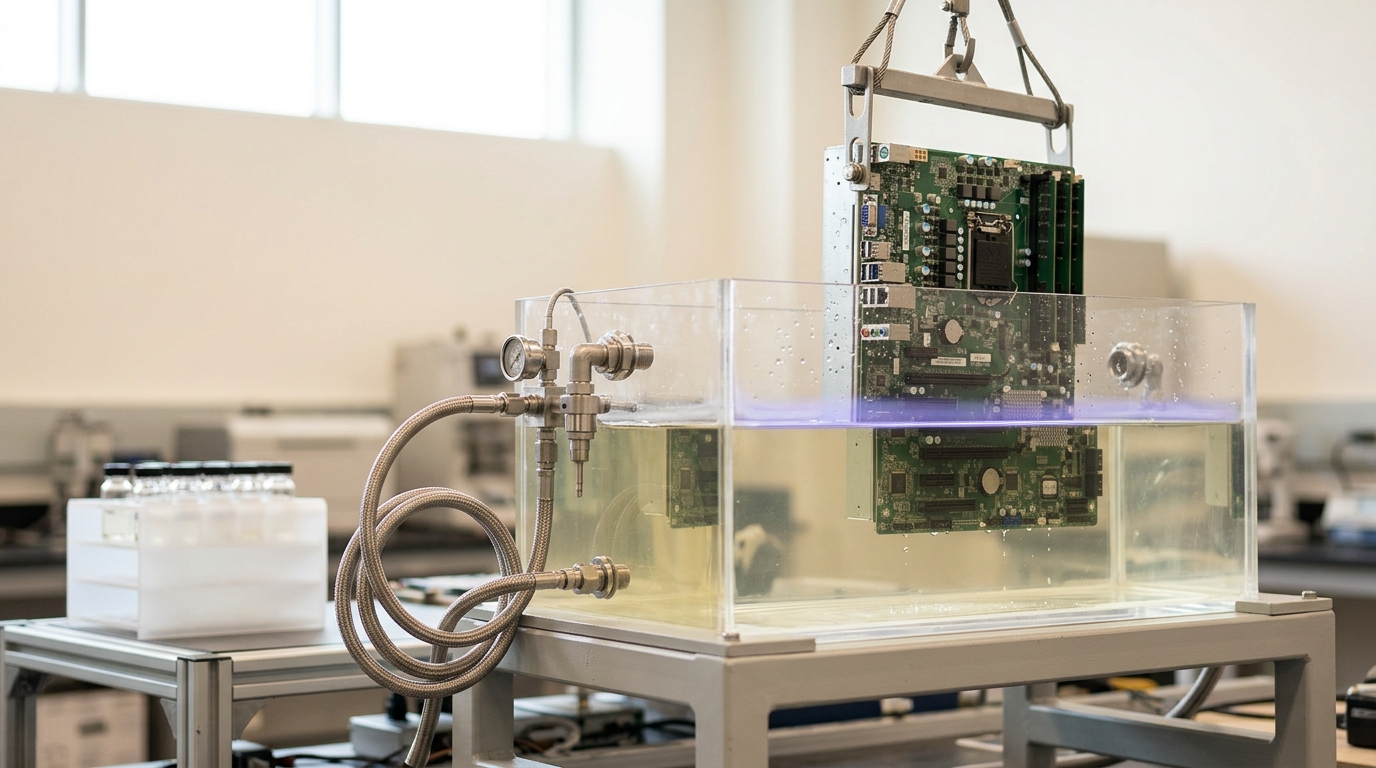
Every trajectory about liquid cooling in this article is still a bench bet; the industry's own surveys still describe most of it as a tank a tray has not yet fully entered. — Image prompt and art direction by Brecht Corbeel; image generated to that direction.
Abstract
This article builds dated, falsifiable scenarios for where AI datacenter power and cooling go by 2035, organised around five trajectories: whether grid interconnection reform actually shortens the multi-year queue that gates new sites; whether behind-the-meter generation becomes a standard fixture or a stopgap retired once the grid catches up; whether immersion cooling graduates from bench niche to mainstream, and which of its two variants wins; whether heat-reuse economics mature into routine practice or stay a handful of flagship projects; and what would force a genuine discontinuity. Each trajectory carries a horizon, assumptions, indicators, and a disconfirmation condition, grounded in FERC's interconnection orders, Lawrence Berkeley National Laboratory's queue data, IEA datacenter-energy assessments, ASHRAE's liquid-cooling guidance, a peer-reviewed life-cycle assessment of cooling technologies, a peer-reviewed review of datacenter-to-district-heating projects, and demonstrations of datacenters as flexible grid assets. Fact, vendor claim, analysis, scenario, and prediction are kept separate throughout.
Five bets, and what would prove each one wrong
This series’ pilot article showed that an AI datacenter is, underneath the accelerators, a power-and-heat plant with a computing load bolted on: bounded by what can be delivered at the fence and what can be carried away as heat, not by what sits in the racks. This article takes five specific, load-bearing pieces of that plant and asks what happens to each between now and 2035, committing in advance to the observations that would show each answer wrong.
The five are: whether grid interconnection reform actually shortens the queue that currently gates every new site; whether behind-the-meter generation becomes a standard part of the plant or a stopgap retired once the grid catches up; whether immersion cooling graduates from a bench and niche-deployment technology to a mainstream one, and which of its two variants wins that race; whether heat-reuse economics mature into a routine line item or stay a handful of flagship projects; and what would have to happen for a genuine discontinuity — a change sharp enough that extending today’s curves stops being a useful way to think about 2035 at all.
Throughout, five kinds of statement are kept visibly separate, exactly as in the companion pieces in this series. A fact is something disclosed in a regulatory order, a standard, a laboratory report, or a peer-reviewed paper. A vendor claim is a company’s own statement about its own product or project, reported as a claim because the company has a stake in the answer. Analysis works out a consequence of stated facts, including one calculation below that is my own and cites no source. A scenario is one internally consistent way the future could go, presented beside its alternatives rather than as the likely one. A prediction commits to a horizon, states its assumptions, names an observable indicator, and states in advance what would disconfirm it.
The documented present
Grid interconnection is the constraint every other trajectory in this article sits downstream of. The most recent comprehensive accounting, Lawrence Berkeley National Laboratory’s Queued Up series, reported roughly 10,300 generation and storage projects actively seeking transmission interconnection in the United States as of the end of 2024, representing about 1,400 GW of generation and 890 GW of storage — and found that the median time from interconnection request to commercial operation had doubled, from under two years for projects built 2000–2007 to more than four years for those built 2018–2024, with only 13% of the capacity that entered the queue between 2000 and 2019 having reached commercial operation by the end of 2024 [3]. The IEA separately estimates that, absent intervention, around 20% of planned data centre projects could face delays from exactly this kind of grid risk [13], and its 2026 update reports data centre electricity demand rising 17% in 2025 against roughly 3% growth in electricity demand generally, with supply chains for gas turbines and transformers having “tightened over the past year” and the project pipeline itself “straining planning and regulatory systems, holding up grid connections” [14].
Two regulatory moves sit inside that pressure. FERC’s Order No. 2023, issued 28 July 2023, replaced the historic serial, first-come-first-served interconnection study process with a mandatory annual “first-ready, first-served” cluster study — a 45-day customer request window, a 60-day customer engagement window, and a 150-day cluster study, applied to every US transmission provider [1]. That reform targeted generation. On 18 June 2026, FERC opened a second and more directly relevant front: six simultaneous Section 206 show-cause proceedings against PJM, MISO, SPP, CAISO, ISO-NE and NYISO, ordering each to justify or reform its tariff provisions specifically for large and co-located loads — covering application processes, cost transparency, co-location arrangements, flexible load service, and the terms for loads sited electrically close to existing generation — with the Commission stating that “how the transmission system is studied, planned, expanded and operated is critical to the United States winning the AI race and onshoring manufacturing” [2].
On cooling, ASHRAE’s technical committee on liquid cooling in mainstream datacenters organises facility water design around named temperature classes — W17, W27, W32, W40, W45 and W+, each named for the maximum entering-water temperature the design tolerates [9]. On heat reuse, the peer-reviewed literature has moved from isolated case studies to systematic review: a 2025 review in Renewable and Sustainable Energy Reviews surveys global datacenter-to-district-heating projects and identifies “complex technical issues, economic constraints, policy limitations, and gaps in infrastructure” as the standing barriers, even as it catalogues a growing number of operating examples [8]. One of those examples is documented directly by an equipment supplier on the project: Meta’s Odense, Denmark campus recovers heat via industrial ammonia heat pumps supplied in part by Alfa Laval, recovering “100,000 MWh of energy per year… enough to warm some 7,000 homes” [15]. That is a real, operating installation, not a pilot on paper — and, as the next four sections argue, still the exception rather than the rule.
Trajectory one: does interconnection reform actually shorten the queue
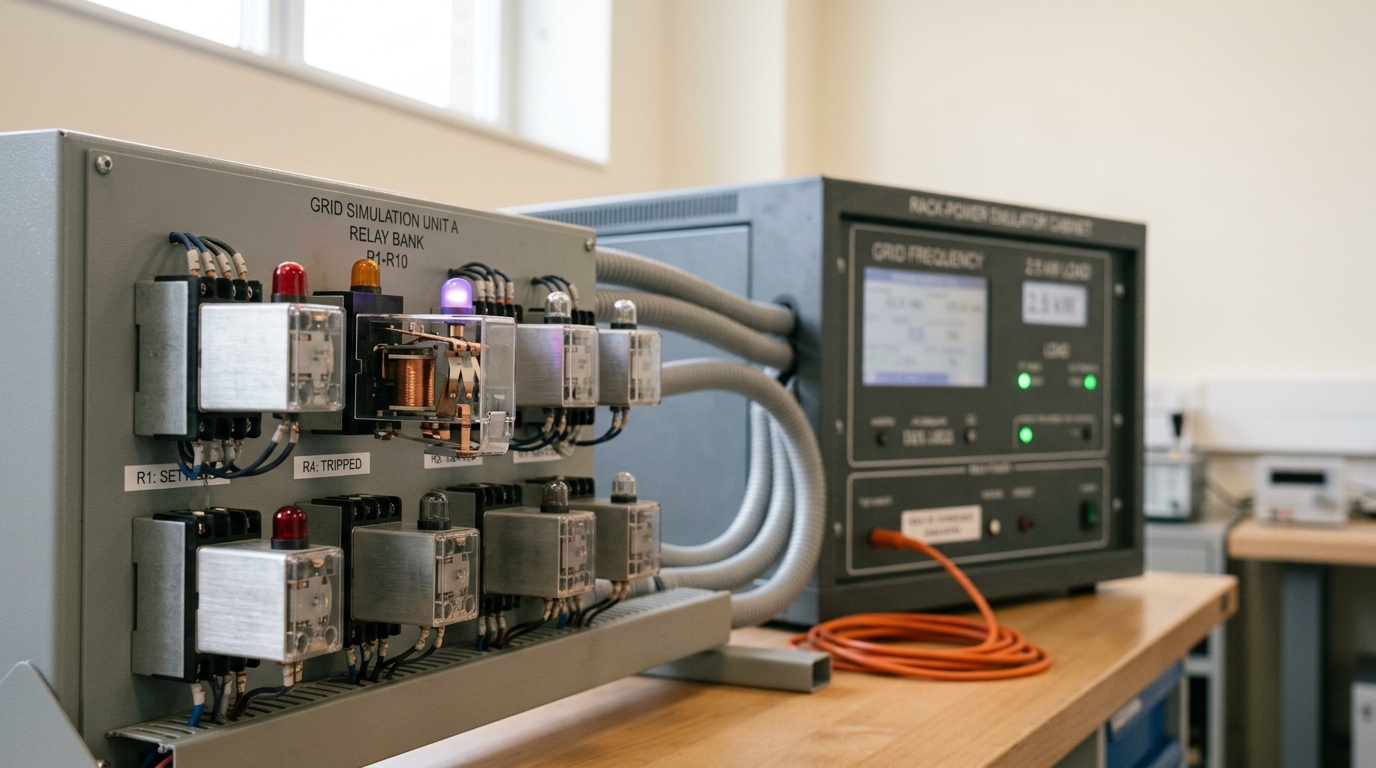
Figure 1. Flexible interconnection service treats a datacenter's load as something that can be told to shrink; the rig that proves this out is still a bench relay, not a grid-scale default. — Image prompt and art direction by Brecht Corbeel; image generated to that direction.
Fact. Order No. 2023’s cluster-study reform is mandatory and already in force at every US transmission provider, and FERC’s 2026 show-cause orders extend the same reforming pressure specifically to large-load and co-located interconnection — the exact category a new AI campus falls into [1, 2]. Separately, and outside the interconnection-queue process entirely, two research groups have published quantitative evidence that a datacenter’s own load flexibility can substitute for some of what a faster queue would otherwise have to deliver. A 2026 modelling study finds that letting an AI datacenter defer or geographically shift its computing load can reduce grid investment and operating costs by 3% to 21%, depending on siting and how much flexibility is offered, with diminishing returns as the allowed deferral window lengthens [6]. A field demonstration goes further: a software-only control platform tested on a 256-GPU commercial cluster in Phoenix, Arizona held AI service-level guarantees while cutting cluster power draw by 25% during three-hour simulated peak-grid events, with no hardware modification and no battery storage required [5]. A parallel laboratory validation, NREL’s Vulcan test platform, demonstrated a 70 MW emulated datacenter responding to a utility request within ten seconds and riding through a simulated grid disturbance in islanded mode without compute workloads being affected [4].
Analysis. These two lines of evidence attack the same problem from opposite directions. Order 2023 and the 2026 show-cause orders attack queue length — how long it takes a full firm interconnection to be studied and granted. The flexibility research attacks queue necessity — how much firm capacity a given datacenter actually needs if it can shed or shift load on demand. FERC’s own reform categories name this explicitly: “flexible load service” is one of the five things the June 2026 orders direct grid operators to define, alongside “electrically proximate load interconnection terms” for large loads that co-locate near existing generation rather than waiting for a new interconnection at all [2]. If flexible or curtailable interconnection service becomes a standard tariff product, a datacenter could plausibly connect years earlier by accepting a service level that lets the grid operator curtail it during system stress — precisely the capability the Phoenix field trial and the Vulcan platform were built to prove out. That is a genuinely different mechanism from “the queue got faster,” even though both would show up in the same headline interconnection-timeline statistic.
Prediction. Horizon: end of 2031. At least three of the six RTOs/ISOs named in FERC’s June 2026 show-cause orders will have an approved tariff offering some form of flexible or curtailable large-load interconnection service, distinct from standard firm service, and at least one large AI datacenter campus will be operating under such a tariff. Assumption: the economic case demonstrated at 256-GPU and 70 MW test scale — meaningful power reduction with no hardware changes and no loss of service-level guarantees [5, 4] — continues to hold as it is scaled to gigawatt campuses, where correlated, synchronous training-job power swings are a documented complication rather than the smoothly averaged demand the test platforms modelled. Indicator: approved RTO/ISO tariff filings creating a named flexible or curtailable large-load interconnection product, and any grid operator’s public disclosure of megawatts interconnected under it. Disconfirmed if, by the horizon, no RTO/ISO has approved such a tariff, or approved tariffs exist on paper but no campus-scale load has actually interconnected under one.
Trajectory two: behind-the-meter generation, standard fixture or stopgap
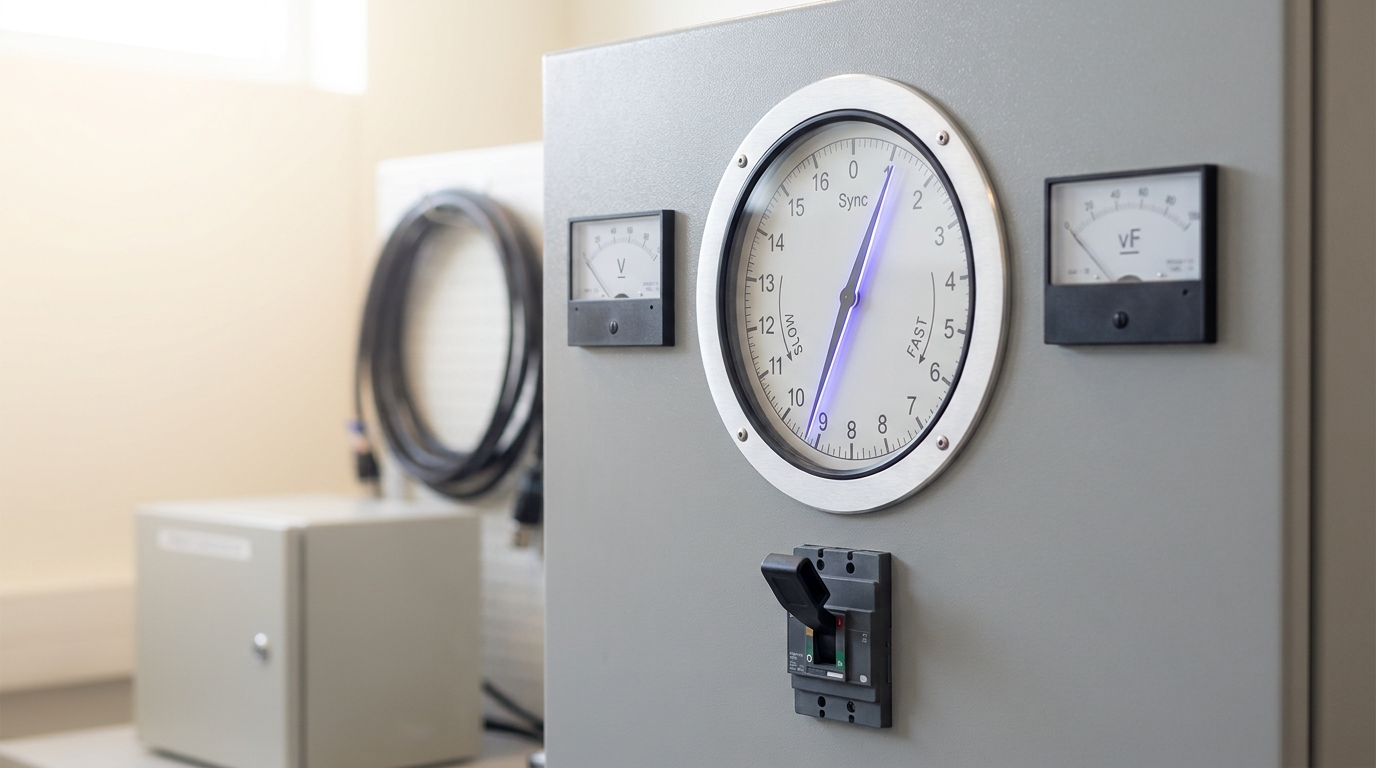
Figure 2. On-site generation only helps a datacenter once it can be paralleled safely with the rest of the supply; that moment of closing the breaker is the whole engineering problem compressed into one instant. — Image prompt and art direction by Brecht Corbeel; image generated to that direction.
Vendor claim / fact. The clearest evidence of demand is the equipment order book, disclosed by the manufacturer rather than by any datacenter operator: GE Vernova’s gas turbine backlog reached 116 GW by the end of Q2 2026, up from 100 GW a quarter earlier, with company guidance targeting at least 125 GW under contract by year-end 2026 and roughly a fifth of the backlog now tied to data centers rather than the company’s traditional utility customers [10]. That is real, measurable capital commitment. It is also, on the company’s own account, capacity that cannot be delivered quickly: GE Vernova is already booking reservations for 2031 delivery and, as of mid-2026, expects to be “more than halfway contracted for 2031 by the end of the year” [10] — a lead time of four to five years that is not obviously shorter than an interconnection queue reformed under Order 2023.
Fact. The IEA’s own 2026 assessment is notably unenthusiastic about how far along this trend actually is: it describes onsite natural-gas power projects for data centers as concentrated largely in the United States and still “predominantly in early stages,” facing “significant technical and financial challenges, particularly regarding the variable power demands of AI data centres” [14]. That clause connects directly to a physical fact documented elsewhere in this series: training clusters draw power in large, synchronised swings tied to iteration boundaries, and a reciprocating or turbine generator has its own ramp-rate and governor-response limits that a hard grid tie, backed by the inertia of an entire regional system, does not have to contend with in the same way. Behind-the-meter generation therefore solves the interconnection-queue problem and simultaneously reintroduces, in miniature, exactly the power-quality problem a firm grid connection was absorbing for free.
Analysis. This is the structural tension that decides whether behind-the-meter generation becomes a standard fixture or stays a stopgap, and it does not resolve in one direction for every site. Where firm interconnection is genuinely unavailable for the medium term — the four-plus-year median documented in the interconnection-queue data [3] — a turbine ordered today, arriving in four to five years [10], is not actually faster than waiting for the grid; it functions as a hedge against the grid connection slipping further, and as an asset that can be paralleled onto the eventual grid connection once it arrives rather than stranded. Where flexible interconnection service of the kind discussed in trajectory one becomes available on a comparable timeline, behind-the-meter generation loses its main advantage — speed — while keeping its main disadvantage, which is that the operator now owns and maintains a power plant rather than buying a service from one.
Prediction. Horizon: end of 2032. The majority of behind-the-meter gas generation capacity ordered for AI data centers between 2025 and 2027 will be interconnected to the grid, in a hybrid or paralleled configuration, rather than operated as a permanently islanded standalone plant. Assumption: owners of these assets prefer to sell surplus capacity and participate in wholesale markets once a grid connection exists, rather than absorb the cost of a second, redundant firm tie once one plant already serves the load — an assumption about asset-owner incentive rather than a physical constraint, and the more doubtable half of this prediction. Indicator: interconnection applications and generator-owner disclosures identifying a facility’s original purpose as datacenter behind-the-meter supply, cross-referenced against whether it later sought grid interconnection. Disconfirmed if, by the horizon, a majority of surveyed behind-the-meter gas assets serving data centers remain permanently islanded with no grid interconnection filed or completed.
Trajectory three: immersion cooling, from bench niche to mainstream

Figure 3. Two-phase immersion's biggest obstacle by 2035 may not be a thermal one; a fluid now has to clear a chemical regulator as well as a cooling engineer. — Image prompt and art direction by Brecht Corbeel; image generated to that direction.
Fact. The most direct, apples-to-apples comparison available is a peer-reviewed life-cycle assessment from Microsoft’s own sustainability and hardware engineering teams, published in Nature in 2025. Comparing cold-plate, one-phase immersion and two-phase immersion cooling against an air-cooled baseline across a full cloud-infrastructure life cycle, the study reports greenhouse-gas emissions reductions of roughly 15%, 16% and 21% respectively, energy-demand reductions of roughly 15%, 15% and 20%, and blue-water-consumption reductions of roughly 31%, 45% and 48% [7]. That ordering is consistent and unambiguous: two-phase immersion is the best-performing technology on every axis the study measured. It is also, on the same paper’s account, the technology facing the sharpest regulatory headwind, because its dielectric fluids are built from the same carbon-fluorine chemistry as the broader class of PFAS compounds now under restriction review in the European Union and multiple US states [7].
Fact. That regulatory review is not hypothetical or distant. The European Chemicals Agency’s Committee for Socio-Economic Analysis published a draft opinion in March 2026 recommending that many of the time-limited and time-unlimited exemptions in the original 2023 universal PFAS restriction proposal be narrowed or removed; a European Commission decision on the restriction is not expected before the third quarter of 2027, with any resulting restrictions unlikely to take effect before 2029 [12]. Industrial cooling fluids are not the headline target of that proposal — cosmetics, food-contact packaging and textiles feature more prominently in current reporting — but a universal PFAS restriction is, by construction, chemistry-based rather than sector-based, and a fluorinated two-phase dielectric fluid is not automatically exempt from it merely because its use case is industrial.
Analysis. Uptime Institute’s own analyst view, published April 2026, is more sceptical about mainstream adoption than the thermal case alone would suggest, and for reasons that have nothing to do with PFAS: it argues direct liquid cooling “will not deploy at scale for mission-critical applications” over the following three years, because most business-critical IT lacks the density pressure to justify the resiliency re-engineering liquid cooling requires — unclear ownership between facility and IT teams, insufficient ride-through time without redesigned UPS architecture, and a lack of settled operational standards [11]. A separate industry survey reported by Network World found 90% of datacenter leaders “considering switching to immersion cooling by 2030,” with leak risk, implementation time and maintenance complexity cited as the leading concerns among that same group [16] — a vendor-adjacent survey finding, reported here as a claim about industry sentiment rather than a measured adoption rate.
Prediction. Horizon: end of 2030. Single-phase immersion and direct-to-chip cold-plate cooling — not two-phase immersion — will account for the large majority of newly deployed liquid-cooling capacity at AI-dedicated facilities, even as two-phase immersion continues shipping in a minority of high-density deployments. Assumption: the regulatory uncertainty around PFAS-based two-phase fluids [12] weighs more heavily on new-build procurement decisions with a ten-to-fifteen-year asset life than the performance advantage documented in the life-cycle study [7] weighs in the other direction. Indicator: vendor and hyperscaler disclosures of which cooling technology is specified in new-build AI facilities, and any operator statement citing regulatory risk as a reason to avoid two-phase fluids. Disconfirmed if, by the horizon, two-phase immersion has become the majority liquid-cooling technology specified in new AI-facility construction, or PFAS restriction efforts have collapsed entirely with no restriction adopted anywhere two-phase fluids are manufactured or used.
Trajectory four: heat-reuse economics, maturing or staying a showcase
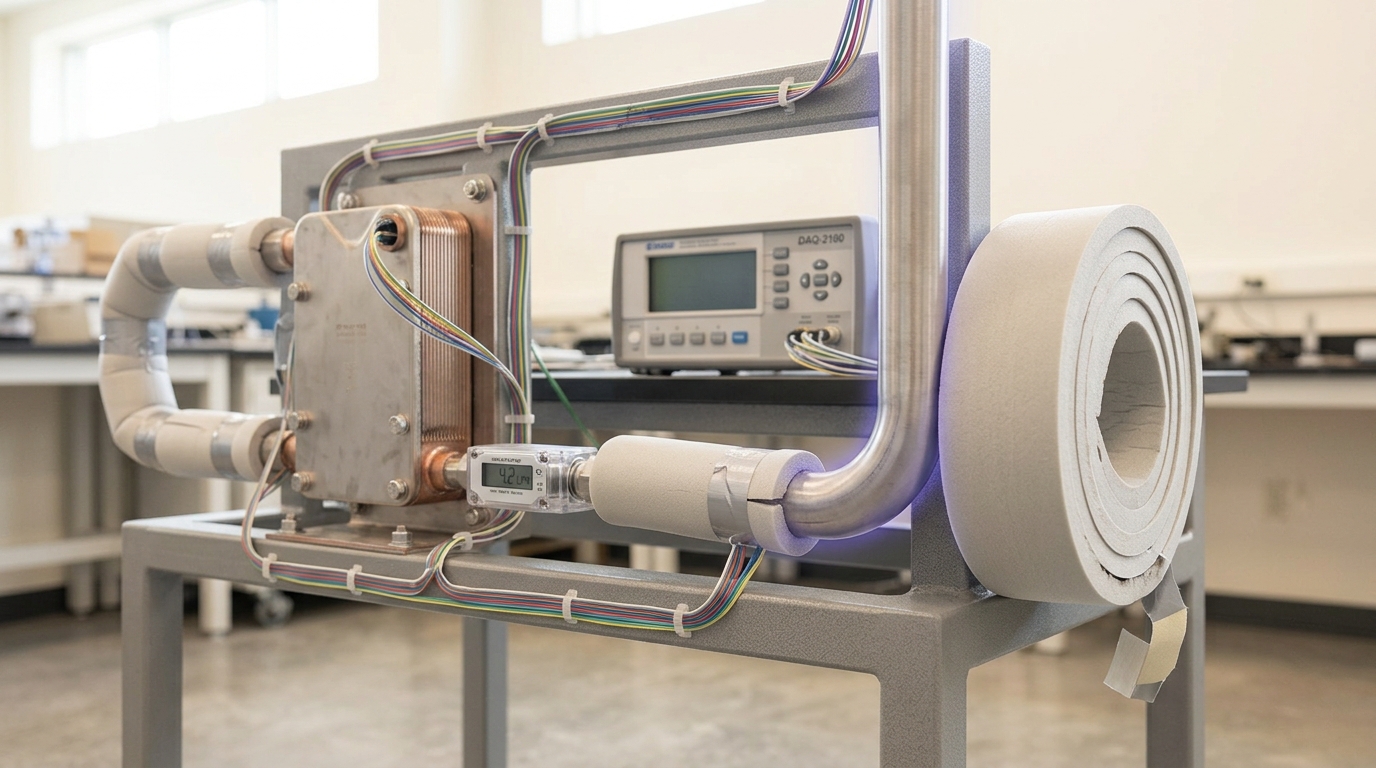
Figure 4. Waste heat is only worth reusing once its temperature clears a threshold a heat pump can afford; this module exists to find out where that threshold actually sits. — Image prompt and art direction by Brecht Corbeel; image generated to that direction.
Fact. The 2025 systematic review in Renewable and Sustainable Energy Reviews is unambiguous that the barriers to datacenter heat reuse are not primarily technical: it names economic constraints, policy limitations, and infrastructure gaps alongside technical issues as the standing obstacles to wider deployment, even while cataloguing a growing set of real projects [8]. Odense is the clearest of those: Meta’s campus there, using ammonia heat pumps with equipment supplied by Alfa Laval, recovers 100,000 MWh of heat a year, enough to warm roughly 7,000 homes through the city’s existing district heating network [15]. That is a real, sustained operating result, not a pilot.
Analysis. What Odense does not settle is why heat reuse is common in Denmark and rare almost everywhere else, and thermodynamics supplies at least part of the answer independent of policy. A heat pump’s maximum possible efficiency at converting electrical work into delivered heat is set by the Carnot limit,
\mathrm{COP}_{\mathrm{Carnot}} = \frac{T_{\mathrm{hot}}}{T_{\mathrm{hot}} - T_{\mathrm{cold}}},
with both temperatures in kelvin. The following is my own illustrative calculation, using representative round numbers rather than any specific project’s measured temperatures, to show how sharply this ratio depends on the lift between the waste-heat source and the district-heating supply it must reach — commonly on the order of 70–80 °C in an established European district-heating network. Lifting a relatively cool waste stream at 30 °C (303 K) to a 75 °C (348 K) supply gives \mathrm{COP}_{\mathrm{Carnot}} = 348/(348-303) \approx 7.7; lifting a warmer waste stream at 45 °C (318 K) to the same 75 °C supply gives \mathrm{COP}_{\mathrm{Carnot}} \approx 348/(348-318) = 11.6. Real ammonia heat pumps of the kind used at Odense achieve only a fraction of the Carnot figure once irreversibilities are accounted for, but the ratio between the two cases survives that discount: a waste stream that leaves the datacenter fifteen degrees warmer needs meaningfully less electricity per unit of district heat delivered. Because ASHRAE’s own facility water classes are organised explicitly by the maximum temperature a design tolerates, W17 through W45 and W+ [9], the choice of cooling architecture and the choice of facility water class are not separable from heat-reuse economics — they are decided upstream of it, years before any district-heating operator gets a phone call.
Scenario. Two futures diverge here and are worth naming separately rather than blending into one trend line. In one, new liquid-cooled campuses are specified with heat reuse as a design requirement from day one, coordinated with a local heat-network operator during siting rather than retrofitted afterward, and the Odense pattern becomes routine wherever a district-heating network already exists nearby. In the other, cooling architecture keeps being chosen purely on thermal and reliability grounds, heat-reuse retrofits stay economically marginal for all but the largest campuses next to willing heat networks, and Odense-style projects remain a European, district-heating-market phenomenon that does not generalise to markets — including most of the United States — that lack the underlying district-heating infrastructure to receive the heat at all, regardless of how cheaply a datacenter could supply it.
Prediction. Horizon: end of 2033. The number of operating datacenter-to-district-heating projects will grow substantially in absolute terms, but the share of global datacenter heat that is captured and reused will remain in the low single digits of a percent, because the binding constraint is the availability of a district-heating network to receive the heat, not the cost of capturing it. Assumption: district-heating network buildout, which is capital-intensive municipal infrastructure with its own multi-decade replacement cycle, does not accelerate materially faster than it has historically merely because data centers now offer a new heat source. Indicator: counts of operating datacenter-heat-reuse projects reported in the peer-reviewed and trade literature, set against estimated total datacenter heat rejection over the same period. Disconfirmed if a jurisdiction without pre-existing district-heating infrastructure builds a new district-heating network primarily justified by datacenter waste heat, at a pace that visibly outruns historical district-heating buildout rates.
Trajectory five: what could force a discontinuity
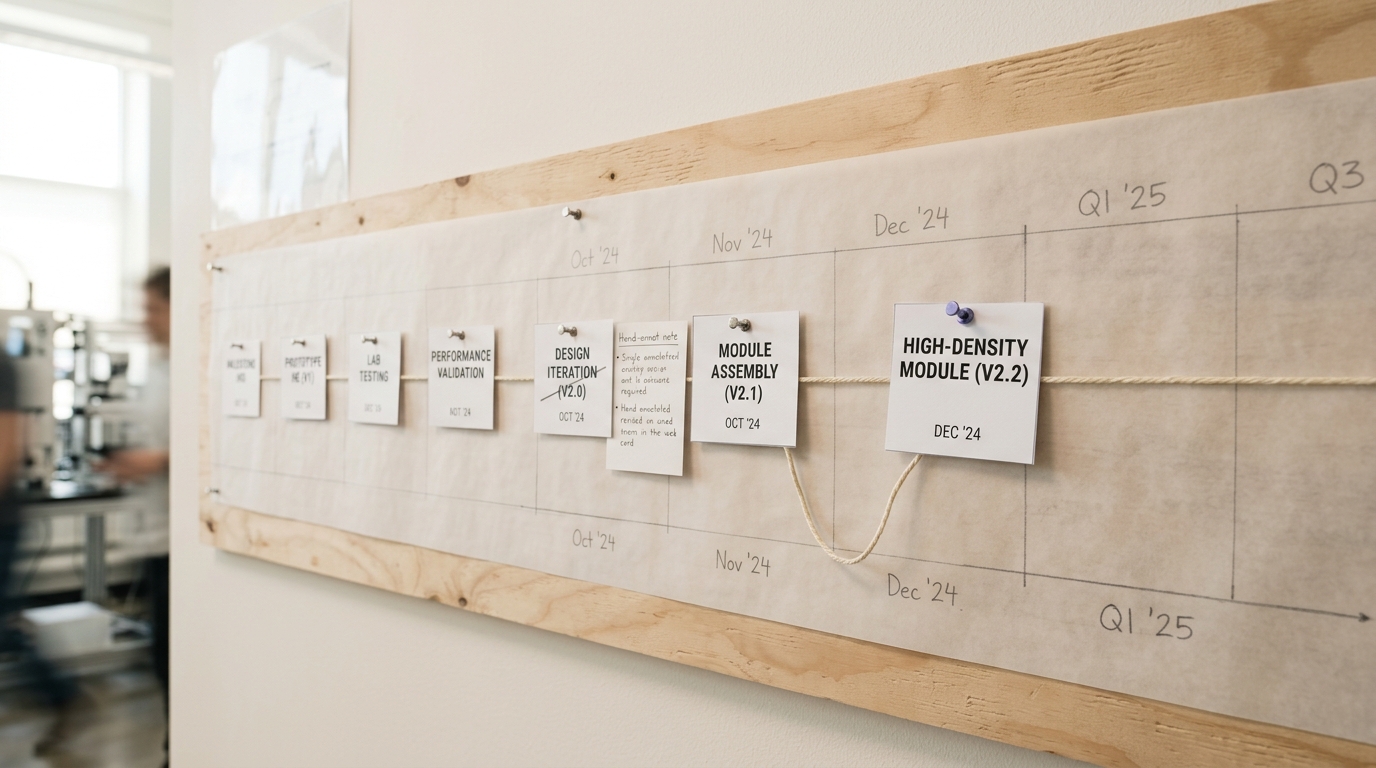
Figure 5. A 2035 roadmap for power and cooling is a claim pinned up years before the date it names arrives; this article treats every one of its own claims the same way. — Image prompt and art direction by Brecht Corbeel; image generated to that direction.
Scenario. The sharper candidate for a genuine discontinuity is not a single new technology but the point where trajectories one and two collapse into each other: flexible interconnection service, proven at the 256-GPU and 70 MW scale already demonstrated [5, 4], becomes so cheap and so standard a tariff product that behind-the-meter generation stops being ordered as a hedge against queue delay at all, because the queue itself has effectively been replaced by a curtailment contract. That would not be a breakthrough in any single piece of hardware; it would be a change in what “interconnected” means for a large load, and it is the kind of discontinuity that would make trajectory two’s prediction above wrong for a reason unrelated to gas-turbine economics.
Scenario. A second, lower-probability candidate sits inside trajectory three: a non-fluorinated two-phase dielectric fluid, thermally competitive with today’s PFAS-based fluids but outside the scope of the EU’s pending restriction, would remove the single biggest disconfirming force behind this article’s prediction that two-phase immersion stays a minority technology. Nothing in the sources behind this article establishes that such a fluid exists at the reliability and cost the industry would need; it is named here as a scenario precisely because a genuine discontinuity, almost by definition, is not yet visible as a mature product in 2026.
Fact. One thing already visible is not a discontinuity but a demonstrated capability that several of this article’s other trajectories quietly assume will keep working: both the Phoenix field trial and NREL’s Vulcan platform validated flexible datacenter operation without hardware modification and without loss of AI service-level guarantees [5, 4], and a separate grid-planning model finds the value of that flexibility varies by 3% to 21% depending on siting and how much deferral is allowed, with real but bounded, diminishing returns as more flexibility is offered [6]. That bound matters for how large a discontinuity flexibility alone could produce: it is a real lever, evidenced at real if modest scale, not an unlimited one.
Prediction. Horizon: end of 2032. No jurisdiction will have adopted a grid interconnection regime in which flexible or curtailable service has become the default offering for new large loads rather than an optional alternative to firm service, and no dielectric fluid outside current PFAS-restriction scope will have reached commercial volume deployment in two-phase immersion cooling. This is stated as the conservative baseline precisely so either discontinuity scenario above has a clean, checkable test. Assumption: regulatory and engineering change of this magnitude — rewriting the default interconnection contract, or replacing an entire fluid chemistry class — typically takes longer than a single reform cycle or product generation, based on the multi-year timelines already visible in trajectories one through three of this article. Indicator: RTO/ISO tariff structures (default versus optional flexible service) and dielectric-fluid product disclosures naming their chemistry class. Disconfirmed if, before the horizon, any major grid operator makes flexible service the default rather than optional interconnection product for new large loads, or a non-PFAS two-phase dielectric fluid ships at commercial volume.
Two axes, four scenarios toward 2035
Crossing trajectory one’s queue-relief-or-not question against trajectories three and four’s cooling-and-reuse-maturation question gives four scenarios. None is presented as the likely one.
Scenario A: Fast Grid, Slow Plant. Interconnection reform and flexible-service tariffs genuinely shorten the effective wait for power, behind-the-meter generation recedes to a niche hedge, but cooling architecture and heat-reuse practice keep being decided on thermal and reliability grounds alone, so liquid cooling matures without becoming reuse-aware and Odense-style projects stay rare outside Europe. Horizon: a majority of new large-load interconnections completed in under three years by 2031; datacenter heat-reuse project counts growing only in line with historical rates. Assumptions: flexible-service tariffs scale from the 70 MW and 256-GPU demonstrations to gigawatt campuses without new correlated-load complications emerging. Indicators: RTO/ISO median interconnection timelines trending down for large loads specifically; heat-reuse project counts flat relative to total new liquid-cooled capacity. Disconfirmation: falsified if median large-load interconnection timelines do not improve, or heat-reuse project counts grow visibly faster than the historical baseline.
Scenario B: Slow Grid, Fast Plant. Interconnection reform stalls or only partially succeeds, so behind-the-meter generation becomes a durable, permanent fixture of large campuses rather than a stopgap, while operators facing that capital cost also invest more deliberately in cooling and heat-reuse design to extract every efficiency available from a plant they now expect to own outright for longer. Horizon: behind-the-meter gas capacity still growing past 2030 with no corresponding acceleration in interconnection timelines; heat-reuse specification becoming standard practice at the largest campuses specifically. Assumptions: capital ownership of on-site generation changes an operator’s efficiency incentives even where cooling and reuse decisions are formally separate line items. Indicators: continued turbine-order backlog growth alongside flat interconnection statistics; heat-reuse specification appearing in the largest campuses’ public disclosures at a disproportionate rate relative to their size. Disconfirmation: falsified if behind-the-meter orders decline as interconnection improves, or the largest campuses show no disproportionate heat-reuse adoption.
Scenario C: Fast Everywhere. Both axes improve together — flexible interconnection service becomes routine and cooling architecture becomes reuse-aware by design, because the same siting conversations that now negotiate a grid connection increasingly also negotiate a heat off-taker, treating both as one integrated plant decision rather than two separate ones. Horizon: by 2033, a majority of new gigawatt-scale campuses disclose both an interconnection timeline under three years and an active or planned heat-reuse arrangement. Assumptions: siting decisions increasingly bundle grid and heat-network negotiation because the same regulatory and community-relations pressure pushes on both at once. Indicators: joint grid-and-heat-network disclosures in campus announcements becoming common rather than exceptional. Disconfirmation: falsified if the two remain negotiated and disclosed entirely separately, or either axis fails to improve on its own terms.
Scenario D: Slow Everywhere. Interconnection reform produces tariffs with little actual uptake, behind-the-meter generation persists as a genuine long-term fixture rather than a hedge, and cooling and heat-reuse decisions stay driven by thermal performance alone, with reuse remaining a European, district-heating-market curiosity. Horizon: by 2033, no material change in either axis from the 2026 baseline described in this article’s documented-present section. Assumptions: the barriers named throughout this article — resource adequacy constraints, four-to-five-year turbine lead times, unresolved liquid-cooling operational standards, and district-heating infrastructure scarcity outside Europe — are each individually harder to resolve than optimistic industry commentary currently suggests. Indicators: stagnant interconnection timelines, stagnant or declining heat-reuse project counts relative to total datacenter build. Disconfirmation: falsified if either axis shows the improvement described in scenarios A through C.
What survives across all four cells, and the wildcard none of them names
One fact holds regardless of which cell the industry lands in by 2035: every trajectory in this article is gated by an off-site actor a datacenter operator does not control — a grid operator’s tariff, a chemical regulator’s restriction schedule, a district-heating utility’s willingness to build a pipe, a turbine manufacturer’s production slots already booked into 2031. None of the five trajectories resolves through better engineering inside the fence alone. That is a genuinely different shape of constraint from the compute-side trajectories elsewhere in this series, where the limiting factor is more often a vendor’s own roadmap.
The wildcard none of the four scenarios names is a change in who bears the risk of the queue itself — a market mechanism, not yet proposed in the sources behind this article, in which a grid operator or a third party sells firm interconnection capacity years in advance as a tradable, insurable instrument, the way generation-queue capacity is already informally traded through project acquisitions today. Nothing in the current FERC dockets or the literature surveyed here describes such an instrument existing at large-load scale; it is named here only because the show-cause orders already treat cost transparency and co-location arrangements as open questions [2], and a tradable interconnection-capacity market is one coherent way those open questions could eventually be answered.
What to take away
Four things are documented fact about AI datacenter power and cooling at the point this article was written, and none of them is a prediction: the interconnection queue is genuinely years long and getting longer on average, even as two separate regulatory processes are actively trying to shorten it; on-site generation is being ordered at real scale but with lead times not obviously shorter than the queue it is meant to bypass; liquid cooling’s best-performing variant, two-phase immersion, is also the variant facing the most direct chemical-regulatory threat; and heat reuse works, demonstrably, at specific sites with specific infrastructure already in place, without yet being economic or physically possible almost anywhere else. Everything beyond those four facts in this article is either a company’s own claim about its own project, an analysis of what a stated assumption implies, or a scenario and prediction carrying an explicit horizon and an explicit way to be proven wrong.
The discipline this article asks of a reader returning to it in 2035 is the same one asked by the rest of this series: check each prediction’s stated indicator against what actually happened, and notice which of the assumptions behind it turned out to be the load-bearing one.
Sources
- K&L Gates LLP. Order No. 2023: Interconnection Reform is Finally Here. K&L Gates (2023).
- McGuireWoods LLP. FERC Issues Section 206 Show Cause Orders Directing All Six RTOs/ISOs to Justify or Reform Large Load Integration Rules. McGuireWoods (2026).
- Joseph Rand, Nick Manderlink, Steven Zhang, Chris Talley, Will Gorman, Ryan H. Wiser, Joachim Seel, Julie Mulvaney Kemp, Seongeun Jeong, and Fredrich Kahrl. Queued Up: 2025 Edition, Characteristics of Power Plants Seeking Transmission Interconnection As of the End of 2024. Lawrence Berkeley National Laboratory (2025).
- Deepthi Vaidhynathan et al.. Vulcan Test Platform: Demonstrating the Data Center as a Flexible Grid Asset. National Renewable Energy Laboratory (2025). DOI: 10.2172/2583521.
- Philip Colangelo et al.. Turning AI Data Centers into Grid-Interactive Assets: Results from a Field Demonstration in Phoenix, Arizona. arXiv (2025). DOI: 10.48550/arXiv.2507.00909.
- Yize Chen and Xiaogui Zheng. To Defer or To Shift? The Role of AI Data Center Flexibility on Grid Interconnection. arXiv (2026). DOI: 10.48550/arXiv.2604.05376.
- Husam Alissa et al.. Using Life Cycle Assessment to Drive Innovation for Sustainable Cool Clouds. Nature (2025). DOI: 10.1038/s41586-025-08832-3.
- Xiaolei Yuan, Jiayi Liu, Sijia Sun, Xiaojie Lin, Xiaojun Fan, Weixin Zhao, and Risto Kosonen. Data Center Waste Heat for District Heating Networks: A Review. Renewable and Sustainable Energy Reviews (2025). DOI: 10.1016/j.rser.2025.115863.
- ASHRAE Technical Committee 9.9. Emergence and Expansion of Liquid Cooling in Mainstream Data Centers. ASHRAE (2021).
- Utility Dive staff. GE Vernova gas turbine backlog climbs to 116 GW. Utility Dive (2026).
- Jacqueline Davis. Liquid Cooling Will Not Outgrow Its High-Density Niche. Uptime Institute (2026).
- Covington & Burling LLP. ECHA Launches a New Public Consultation on a Proposed Universal Ban on PFAS in the EU. Covington & Burling (2026).
- International Energy Agency. Energy and AI: Executive Summary. International Energy Agency (2025).
- International Energy Agency. Data centre electricity use surged in 2025, even with tightening bottlenecks driving a scramble for solutions. International Energy Agency (2026).
- Alfa Laval. Waste Heat from Odense Data Center to Warm Local Community. Alfa Laval (2026).
- Network World staff. Liquid cooling becoming essential as AI servers proliferate. Network World (2025).
Originally published at https://absolutedigitalpublishers.com/articles/ai-datacenter-power-and-cooling-in-2035-scenarios-signals-and-falsifiable-predictions.