1859 and 1905: Two Papers That Ended Two Absolutes
The Origin dissolved the fixity of species; special relativity dissolved the fixity of space and time. Both replaced an essence with a relation and won by re-explaining old anomalies — and resistance to both is now a pattern bibliometrics can measure.

One collation table, two print objects behind two ended absolutes: an 1859 octavo and a 1905 bound journal, undergoing the same joint condition assessment this piece runs on their arguments. — Image prompt and art direction by Brecht Corbeel; generation pending.
Abstract
Charles Darwin's On the Origin of Species and Albert Einstein's 1905 relativity paper are usually paired as a rhetorical flourish. This piece tests the pairing against the verified record instead: both replaced a fixed essence — a species type, an absolute frame of space and time — with a relation defined only between members of a population or between an observer and an event; both won their first credibility by re-explaining anomalies already on file rather than by a novel prediction; and resistance to both concentrated among an older generation closely enough that a 1978 study could test the pattern against Victorian Britain's own demography and a 2019 economics paper could test its modern analogue against the death records of hundreds of scientists. The piece also states plainly where the parallel breaks — Darwin's decades of withheld publication against Einstein's undelayed one, religious opposition against a physics establishment's own opposition, and a theory missing its mechanism against one that arrived structurally whole.
Two Publication Records, Read Precisely Rather Than Remembered
On 24 November 1859, John Murray published On the Origin of Species in a first printing of 1,250 copies, of which 1,192 were actually available for sale — twelve reserved for the author, forty-one sent out for review, five deposited at Stationers’ Hall for copyright [1]. The popular claim that the whole run sold out in a single day rests on one letter Darwin sent Huxley; the bibliographic record complicates it, since the trade’s actual stock that autumn was closer to 1,170 copies moving through booksellers over days, which makes same-day sell-through unconfirmed rather than disproved [1]. What is confirmed is what followed: demand was real enough that Murray committed to a second printing of 3,000 copies dated 7 January 1860, six weeks after the first appeared [5]. Among the readers responding that fast was the botanist Asa Gray, whose review in the American Journal of Science and Arts that March called Darwin’s argument compact and fair while predicting, correctly, “a spirited conflict among opinions” [4].
Just over forty-five years later, on 30 June 1905, the Annalen der Physik received a manuscript from a Bern patent examiner titled “Zur Elektrodynamik bewegter Körper” — “On the Electrodynamics of Moving Bodies.” It named five other physicists and cited no other publication [9]. It ran that September in the journal’s seventeenth volume, one of four papers that year — on the photoelectric effect, on Brownian motion, on this new electrodynamics, and, three months later, mass-energy equivalence [9]. Its first serious reader was Max Planck, the Annalen’s theoretical-physics editor; Einstein later credited Planck’s early, public backing with getting the paper noticed at all — “the attention that this theory so quickly received from colleagues is surely to be ascribed in large part to the resoluteness and warmth with which he intervened,” Einstein wrote in 1913 [9, 11].
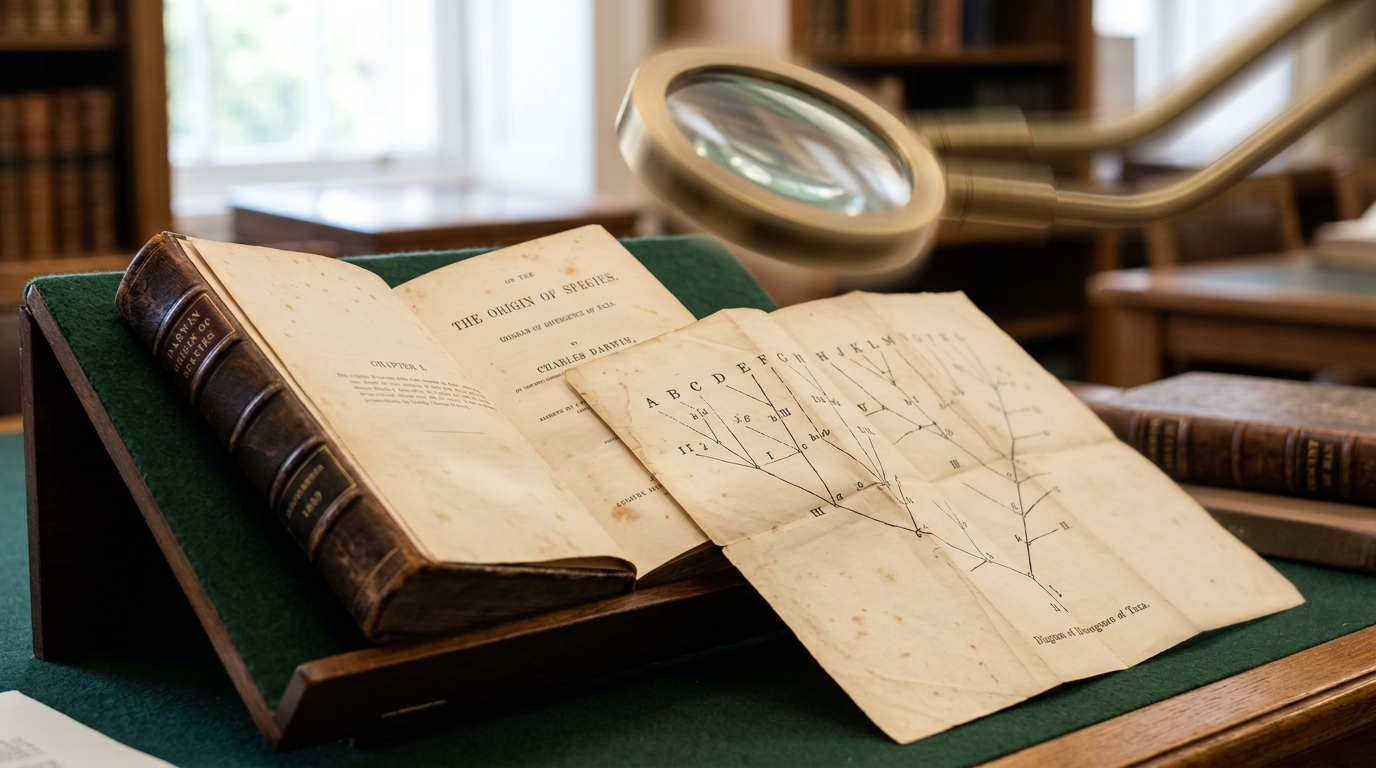
Figure 1. The Origin's only illustration, a branching diagram of divergence, held open on a conservation cradle — the one page the whole argument against a fixed species-type ran through. — Image prompt and art direction by Brecht Corbeel; generation pending.
Both documents made the same order of claim before either had confirming data behind it. Darwin’s book argued that a species has no essence — that everything called a species is a population of variants connected by descent, its boundary drawn for convenience rather than found in nature. Einstein’s paper argued that space and time have no shared, absolute frame — that simultaneity, length and duration are relations between an observer and what is measured, not properties an object carries on its own.

Figure 2. The volume that carried Einstein's four 1905 papers, opened here against a second bound copy for comparison — an ordinary academic annual, unremarkable to anyone in the room that September. — Image prompt and art direction by Brecht Corbeel; generation pending.
Both Replaced a Fixed Essence With a Population of Relations
The evolutionary biologist Ernst Mayr gave Darwin’s move a name: population thinking, set against the essentialist, or typological, view that a species is a fixed type from which individuals are imperfect variations [8]. On Mayr’s account — developed in his 1959 centennial essay on Darwin and elaborated in his 1982 The Growth of Biological Thought — Darwin’s contribution was not natural selection alone but the ontological move underneath it: there is no fixed type behind actual organisms, only a population whose variation is the raw material selection works on, not noise around a truer form [8]. That is a stronger claim than “species change”: the category biology had organized itself around since Linnaeus — a fixed species essence — was the wrong unit from the start.
Historians of biology have since pushed back on how cleanly this maps onto real pre-Darwinian naturalists: Joeri Witteveen argues Mayr’s split was assembled for programmatic reasons within twentieth-century evolutionary biology more than it describes what earlier morphologists actually believed [8]. The dispute is worth naming rather than smoothing over — Mayr’s frame remains the standard shorthand for 1859 because it usefully compresses a real shift in strategy, and historians who think it flattens the record still reach for it for that reason.
Special relativity performs the identical move in physics. Newtonian mechanics had treated space and time as a fixed backdrop — an essence every observer shared, against which motion and simultaneity were absolute facts. Einstein’s paper replaced that backdrop with relations: how long a rod measures, how much time a clock records, which events count as simultaneous, all become functions of the relative motion between observer and observed, with no privileged frame left to arbitrate. Species had no essence apart from a population’s variation; the universe, on this reading, had no absolute space or time apart from relations between events. Both moves discard what philosophers call an intrinsic property for one that exists only relative to something else — the precise sense in which the parallel is exact, not merely poetic.
Both Won by Re-Explaining Facts Already on File
Neither theory earned its first credibility from a novel prediction confirmed after the fact. Darwin’s middle chapters — on geographical distribution, on the affinities among organisms, on the succession of fossil forms, on vestigial organs — re-describe patterns naturalists had already catalogued under special creation: why island faunas resemble the nearest mainland’s more than climatically similar but distant places, why unrelated organisms in similar environments diverge rather than converge on one ideal form, why the fossil record shows a rough nested succession rather than isolated types. None of this was new data. What was new was one mechanism, descent with modification, explaining all of it at once instead of a separate argument for each pattern.
General relativity’s own strongest early evidence worked the same way. Mercury’s orbit precesses slightly with each pass around the sun, and by 1859 the astronomer Urbain Le Verrier had already found a discrepancy between the observed precession and what Newtonian gravity, accounting for every other planet’s pull, predicted [10]. Le Verrier’s estimate was refined by Simon Newcomb in 1882 to roughly 43 arcseconds per century [10]. That anomaly sat unresolved for fifty-six years — the same fifty-six years, as it happens, that separate 1859 from 1915. In November 1915, working through his finished field equations, Einstein calculated that gravity’s own effect on spacetime’s geometry accounted for the entire 43 arcseconds, not as a new observation but an old one, finally closed [14]. This mattered because it was old: Einstein’s earlier 1913 “Entwurf” equations, worked out with his friend Michele Besso, had recovered only about 18 of the 43 arcseconds; it took the switch to a fully general-covariant theory to close the gap [14]. A theory that reproduces a fact everyone already knew, with no free parameter tuned to match it, earns credibility a genuinely novel prediction cannot claim until it, too, has been checked — and both 1859 and 1915 collected that credibility before either collected the other kind.
Resistance Concentrated by Generation — a Pattern the Record Now Measures Directly
Darwin anticipated this and said so in the Origin’s own closing pages: “I by no means expect to convince experienced naturalists whose minds are stocked with a multitude of facts all viewed, during a long course of years, from a point of view directly opposite to mine,” warning that “any one whose disposition leads him to attach more weight to unexplained difficulties than to the explanation of a certain number of facts will certainly reject my theory” [6]. Max Planck generalized the same observation decades later into what is now called Planck’s principle, writing that “a new scientific truth does not triumph by convincing its opponents and making them see the light, but rather because its opponents eventually die, and a new generation grows up that is familiar with it” [6]. Thomas Henry Huxley, Darwin’s most combative defender, made the same point with characteristic bluntness, declaring that men ought to be strangled on their sixtieth birthday “lest age should hinder them against the reception of new truths, and make them clog its progress” — ribbing Huxley took in turn once he reached sixty himself [6].
David Hull, with Peter Tessner and Arthur Diamond, tested the claim against the historical record rather than treating it as self-evident. Tracking 67 British scientists who were adults in 1859, they found the mean age of those who had accepted evolution by 1869 was 39.6, against 48.1 for those who still rejected it, a statistically significant gap [6]. Extending the sample to scientists who died during that decade widened the gap to 41.7 versus 53.0, significant again [6]. More surprising: the effect was small. Age explained under ten percent of the variation in who accepted evolution, and barely three-quarters of the sample — not “nearly all,” as the folklore around a ten-year triumph held — had accepted it at all by 1869 [6]. Generation correlated with conversion. It did not determine it.

Figure 3. A heavily read later copy of the Origin, under repair — the wear itself is physical evidence of years spent being returned to and argued with, one owner at a time. — Image prompt and art direction by Brecht Corbeel; generation pending.
A newer, sharper test comes from economics. Pierre Azoulay, Christian Fons-Rosen and Joshua Graff Zivin tracked what happened to a subfield after the sudden, premature death of one of its most eminent members, using 452 such deaths among academic life scientists as a natural experiment isolating a star’s departure from any change in the underlying ideas [7]. Publications by the dead scientist’s own collaborators fell, unsurprisingly. Publications by outsiders who had not previously worked in that subfield rose by 8.6 percent on average, and those new entrants’ papers were disproportionately likely to be highly cited [7]. The authors’ interpretation is not that death changes anyone’s mind; living eminence suppresses competing approaches outsiders were capable of pursuing all along, and removing it removes the suppression. That is a different mechanism from Hull’s — Hull measured whether individuals updated their beliefs with age; Azoulay and coauthors measured whether a field’s allowable approaches loosen when a gatekeeper leaves — and the two results should not be read as one finding confirmed twice. What they share is that generational turnover, not argument alone, does real work in how a science changes direction.
The Parallel Breaks on Delay, on Who Objected, and on What Was Missing
The comparison is most useful exactly where it stops holding. Darwin had assembled the core of natural selection in his private notebooks by around 1838 and sat on a complete, unpublished theory for two decades, sharing it only with a small circle, until Alfred Russel Wallace’s 1858 letter outlining an almost identical mechanism forced a joint announcement at the Linnean Society that July and pushed Darwin to finish an “abstract” of his larger, unfinished work within eight months [3]. Einstein held no comparable theory in reserve. By his own later account he had circled the problem of a moving observer and a light beam for roughly a decade, but once the argument reached final form in spring 1905 he sent it to the Annalen that June, the same season, with no rival’s letter forcing the timing [9]. One theory was withheld out of a documented fear of the reaction it would provoke; the other was not withheld at all.
The opposition each theory drew also differed in kind, not only intensity. Darwin’s most public antagonists spoke for religious and natural-theological authority — Bishop Samuel Wilberforce called the idea “absolutely incompatible … with the word of God,” and the naturalist Louis Agassiz dismissed it from within his own museum as “a scientific mistake, untrue in its facts, unscientific in its method” [2]. Relativity drew essentially no religious opposition; its organized detractors were credentialed physicists and engineers, most visibly the 121 contributors to the 1931 pamphlet Hundert Autoren gegen Einstein, a document whose hostility was entangled with the antisemitic politics of the period as much as with physics [13]. Einstein is widely quoted replying that it would not have taken a hundred authors to prove him wrong, one would have been enough — a line Calaprice’s collection preserves, though it traces only through secondary retellings, not a verified transcript [15, 13]. Even Einstein’s staunchest ally complicates any clean story of old resisters and young converts: Planck championed special relativity within months, but as late as 1913 warned Einstein off general relativity entirely — “as an older friend, I must advise against it … you won’t succeed” — before reversing himself after the 1919 eclipse measurements, calling the finished theory “an intimate union between the beautiful, the true and the real” [11]. Eddington’s and Dyson’s expeditions to Príncipe and Sobral that May measured a deflection of 1.6 and 1.98 arcseconds against Einstein’s predicted 1.75, and the Royal Society’s 6 November announcement made Einstein a global celebrity within days [12]. No comparable single afternoon exists anywhere in the reception of Darwinism.
The last disanalogy is the most consequential. Special relativity arrived structurally whole: its kinematics needed no undiscovered physical entity to function, and within a few years Hermann Minkowski recast it in a four-dimensional geometric form that removed any remaining doubt about its consistency [9]. Natural selection did not arrive whole. Darwin had a mechanism for selection but no theory of heredity explaining how favorable variations survived rather than blended away each generation — a gap that did not close until Mendel’s 1866 work on pea-plant inheritance was rediscovered around 1900, and closed fully only once population geneticists fused Mendelian inheritance with selection into the modern synthesis of the 1930s and 1940s. For the better part of two generations, Darwinians defended a conclusion whose engine they could not yet specify. Relativity asked its critics to accept a conclusion; evolutionary theory asked them to accept one and wait for the mechanism to be filled in by people unborn when the argument appeared.
What the Parallel Actually Teaches
None of this makes Darwin and Einstein interchangeable case studies, and the disanalogies above are the reason a disciplined comparison has to state them rather than let the tidy parts stand alone. But the parts that hold up are not decorative. Both theories dissolved a category earlier science had treated as a brute given — a fixed species essence, an absolute frame of space and time — and replaced it with a relation defined only between members of a population or between an observer and an event. Both won their first real credibility by re-explaining facts already sitting unresolved in the record, not by predicting something new and later being proven right. And in both cases a body of contemporaries who had built careers on the older framework resisted longer than the evidence alone would justify — a pattern real enough that a philosopher of science tested it against Victorian Britain’s demography in 1978, and an economist tested its modern analogue against the death records of hundreds of scientists in 2019, finding in both cases that generational turnover does measurable work argument alone does not. A science rarely changes because an opponent is out-argued in real time. It changes because a minority converts immediately, on the evidence, while the field around them retires into a settled premise rather than an active dispute. That is not a cynical story about science. It is a mechanical one, and it is now, unlike in 1859 or 1905, a mechanism with numbers attached to it.
Sources
- Richard Freeman; John van Wyhe (ed.). On the Origin of Species (Editorial Introduction). Darwin Online (2026).
- John van Wyhe. The Reviews of Charles Darwin. Darwin Online (2026).
- Darwin Correspondence Project. Darwin in letters, 1858-1859: Origin. Darwin Correspondence Project, University of Cambridge (2026).
- Darwin Correspondence Project. Review: The Origin of Species. Darwin Correspondence Project, University of Cambridge (2026).
- Darwin Correspondence Project. Darwin in letters, 1860: Answering critics. Darwin Correspondence Project, University of Cambridge (2026).
- David L. Hull, Peter D. Tessner, and Arthur M. Diamond. Planck's Principle: Do Younger Scientists Accept New Scientific Ideas with Greater Alacrity than Older Scientists?. Science (1978). DOI: 10.1126/science.202.4369.717.
- Pierre Azoulay, Christian Fons-Rosen, and Joshua S. Graff Zivin. Does Science Advance One Funeral at a Time?. American Economic Review (2019). DOI: 10.1257/aer.20161574.
- Joeri Witteveen. Typological thinking: Then and now. Journal of Experimental Zoology Part B: Molecular and Developmental Evolution (2018). DOI: 10.1002/jez.b.22796.
- Wikipedia contributors. Annus mirabilis papers. Wikipedia (2026).
- Wikipedia contributors. Tests of general relativity. Wikipedia (2026).
- Brandon R. Brown. Planck's support of Einstein's general relativity. OUP Blog (Oxford University Press) (2015).
- Smithsonian Magazine. A Total Solar Eclipse 100 Years Ago Proved Einstein's General Relativity. Smithsonian Magazine (2019).
- Skeptical Inquirer. 100 Authors against Einstein: A Look in the Rearview Mirror. Skeptical Inquirer (2020).
- Galina Weinstein. Einstein and the Perihelion Motion of Mercury. arXiv (2021).
- Albert Einstein; Alice Calaprice (ed.). The Ultimate Quotable Einstein. Princeton University Press (2013).
Originally published at https://absolutedigitalpublishers.com/articles/1859-and-1905-two-papers-that-ended-two-absolutes.